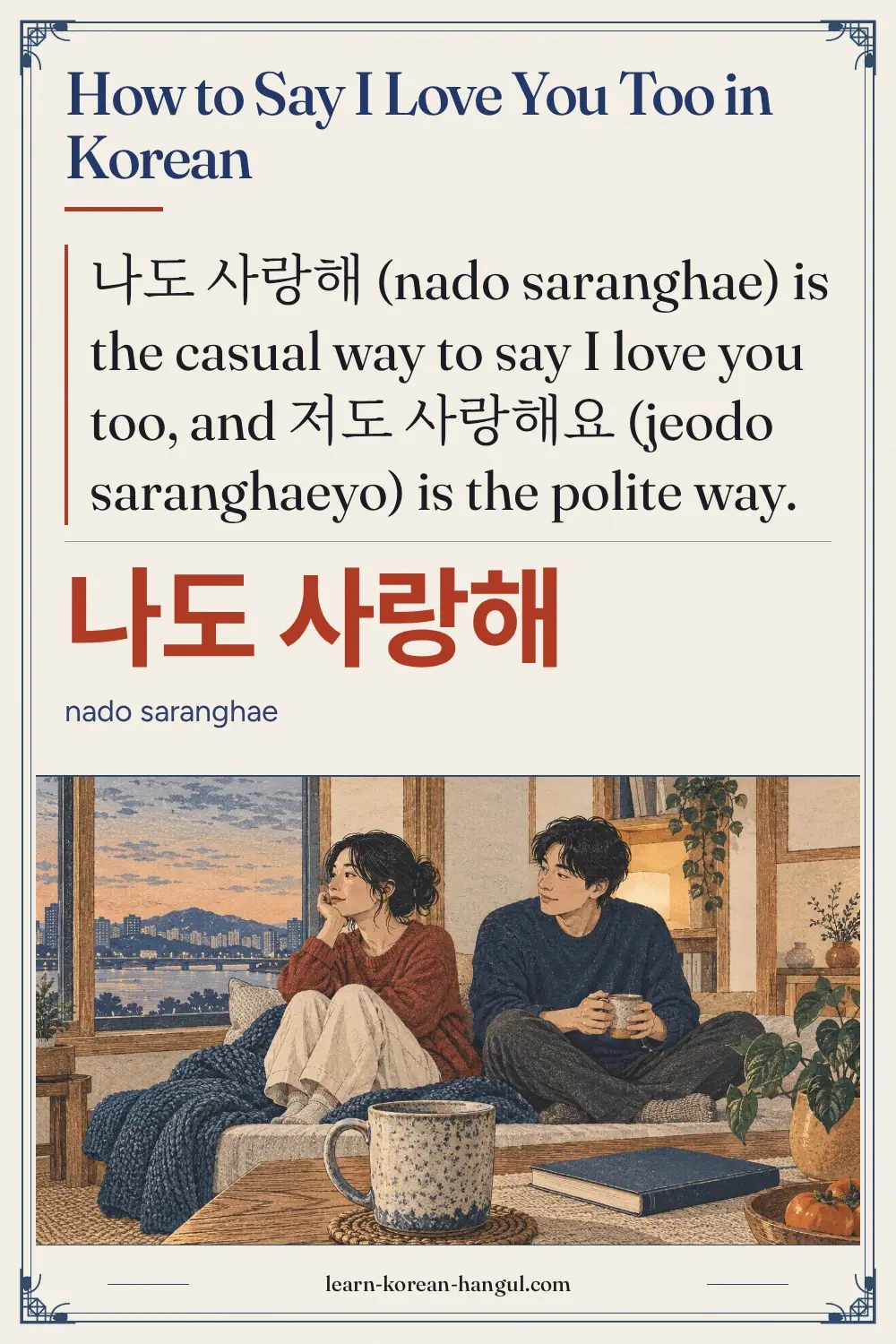
나도 사랑해
나도 사랑해
What you'll learn
- Reply to 사랑해 with 나도 사랑해, 저도 사랑해요 or 저도 사랑합니다.
- Understand what the particle 도 does.
- Choose 나 or 저 for the listener.
- Use the same pattern for other replies, such as me too.
Before you start: first learn I love you in Korean, because this page is the answer to it. Time: about 8 minutes. Audio plays only when you press a button.
How Do You Say I Love You Too in Korean?
The standard way to say I love you too in Korean is 나도 사랑해. It has three words: 나 (I), 도 (too) and 사랑해 (love). You answer the same verb, and the 도 shows you agree.
| Situation | Best form | Romanization | Why |
|---|---|---|---|
| A partner says 사랑해 | 나도 사랑해 | nado saranghae | Casual, warm |
| A parent says 사랑해 | 저도 사랑해요 | jeodo saranghaeyo | Polite |
| A formal speech or letter | 저도 사랑합니다 | jeodo saranghamnida | Formal |
| A quick reply by text | 나도 | nado | Short, casual |
| A quick polite reply | 저도요 | jeodoyo | Short, polite |
Now the small particle that does the work.
What Does 도 Do in 나도 사랑해?
The particle 도 means "too" or "also". It attaches directly after a noun or pronoun, and it replaces the topic marker 은/는 or the subject marker 이/가. So 나는 (as for me) becomes 나도 (me too).
- 나는 학생이에요. (I am a student.)
- 나도 학생이에요. (I am a student too.)
Because the verb is already in the question, a listener hears 나도 and adds 사랑해 in their mind. That is why 나도 alone, or 저도요 in polite speech, is a complete reply.
저도 학생이에요.
jeodo haksaengieyo
I am a student too.
The same pattern works for other words: 너도 (you too), 우리도 (we too), 이것도 (this too). The next section shows how the level changes the whole phrase.
What Are the Formal, Polite and Casual Ways to Say I Love You Too?
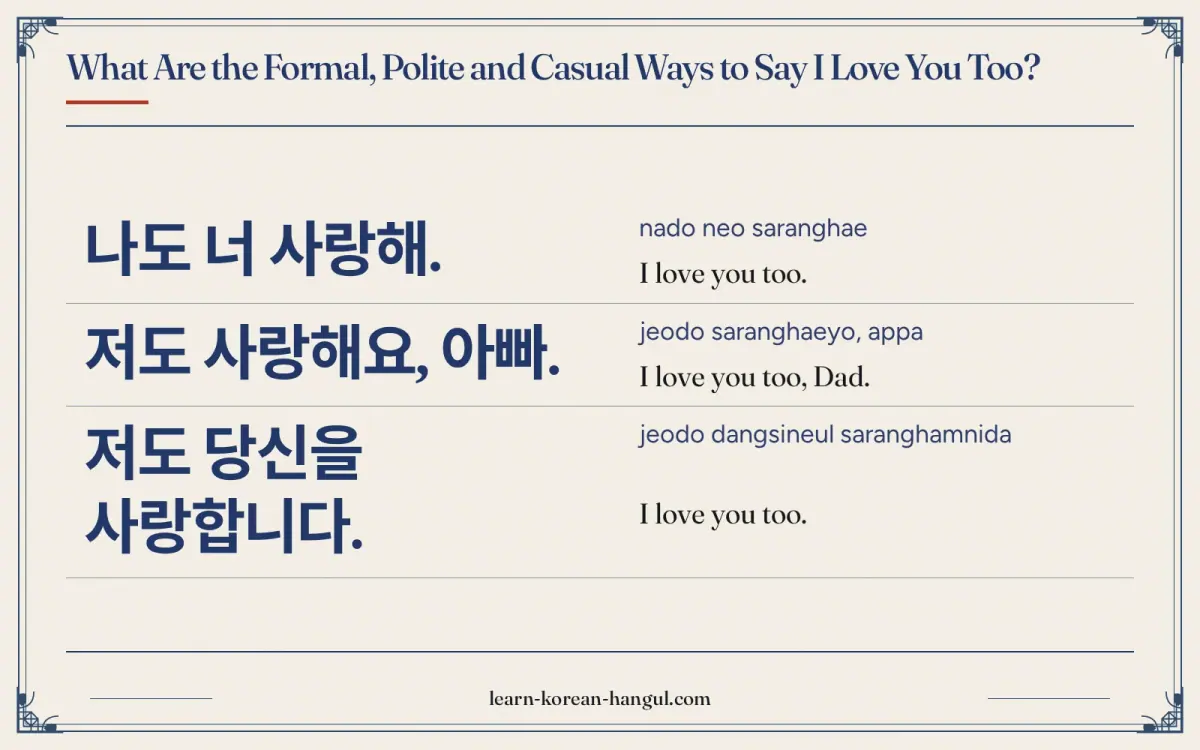
The level follows the Korean speech levels, explained in the guide to Korean speech levels. The pronoun and the ending change together.
Casual: 나도 사랑해 (nado saranghae)
Casual · 반말나도 사랑해 pairs the plain 나 with the casual ending. It fits partners, close friends and people younger than you. Add 너 for emphasis: 나도 너 사랑해 (I love you too).
나도 너 사랑해.
nado neo saranghae
I love you too.
Polite: 저도 사랑해요 (jeodo saranghaeyo)
Polite · 해요체저 is the humble form of "I", and it pairs with the polite ending -요. Use it with parents, grandparents, a partner you address politely, or a senior. It is warm and respectful.
저도 사랑해요, 아빠.
jeodo saranghaeyo, appa
I love you too, Dad.
Formal: 저도 사랑합니다 (jeodo saranghamnida)
Formal · 합쇼체저도 사랑합니다 is formal and solemn. It appears in vows, in letters to elders and in public statements. It is pronounced [저도 사랑함니다].
저도 당신을 사랑합니다.
jeodo dangsineul saranghamnida
I love you too.
Short: 저도요 (jeodoyo) and 나두 (nadu)
Polite · 해요체저도요 is a quick polite "me too". 나두 is a cute, casual way of saying and texting 나도, common between friends and couples (나두 사랑해). Both work when the verb is clear from what was just said.
Next, the pronunciation of the whole phrase.
How Do You Pronounce 나도 사랑해?
나도 사랑해 is pronounced [나도 사랑해], na-do sa-rang-hae, in five syllables. It sounds like it is spelled.
- 나 (na): "nah".
- 도 (do): a soft d and "oh".
- 사 (sa): "sah".
- 랑 (rang): a light r, "ah" and ng.
- 해 (hae): a clear h and "eh".
Sound Changes to Listen For
These changes follow the National Institute of Korean Language standard pronunciation rules (표준 발음법, Article 18):
- ㅂ before ㄴ becomes ㅁ. 사랑합니다 is [사랑함니다], so 저도 사랑합니다 is [저도 사랑함니다]. See Korean nasalization.
- No other changes. 도 stays [도]. The word boundary after 도 is a light pause.
Now, which form should you reach for?
When Should You Use 나도 사랑해, and When Should You Not?
Use 나도 사랑해 when someone says they love you and you feel the same. Do not use it as a polite "you too" to a stranger who is being friendly.
Situations Where It Fits
- A partner texts 사랑해. 나도 사랑해.
- A parent says it at the airport. 저도 사랑해요.
- A child says it at bedtime. 엄마도 사랑해.
Situations to Avoid
- A stranger says 사랑해요 in a joke. A light 감사합니다 is safer.
- A senior colleague wishes you well. Say 감사합니다, not 저도 사랑합니다.
- When you do not feel it yet. Say 고마워요 or 저도 좋아해요.
Two short conversations show the patterns.
What Does I Love You Too Sound Like in a Real Conversation?
A reply is short, and the tone does the work. Listen for the soft ending.
A Goodnight Call
Jimin
자기 전에 말하고 싶었어. 사랑해.
jagi jeone malhago sipeosseo. saranghae
I wanted to say it before bed. I love you.
Taeho
나도 사랑해. 잘 자.
nado saranghae. jal ja
I love you too. Sleep well.
What to notice: the answer repeats 사랑해 and adds 나도. A goodnight wish follows.
At the Station
Mother
잘 가. 사랑한다, 우리 딸.
jal ga. saranghanda, uri ttal
Take care. I love you, my daughter.
Daughter
저도 사랑해요, 엄마.
jeodo saranghaeyo, eomma
I love you too, Mom.
What to notice: the mother uses 사랑한다, a warm plain form, while the daughter replies politely with 저도.
What Should You Know about the Culture behind I Love You Too?
In Korean families, love is often shown by action. A parent may say 밥 먹었니? (did you eat?) instead of 사랑해. Younger Koreans say 사랑해 more openly, and replying with 나도 or 저도 is a loving sign in itself.
- Pronoun by relationship. 나 for equals and juniors, 저 for seniors and parents.
- Replying in kind. A casual message gets a casual reply.
- Shy replies. 나도 or ㅋㅋ with a heart is a common text reply when someone is shy.
An expert tip: do not copy an English habit of saying "love you too" mechanically at the end of every call. In Korean, the phrase works best when you mean it, so a warm 나도 is better than a rushed one.
What Mistakes Do Learners Make with I Love You Too in Korean?
Most mistakes mix levels or drop the particle.
| Mistake | Why it is a problem | Fix |
|---|---|---|
| 나는 사랑해 | Loses "too" | Say 나도 사랑해 |
| 나도 사랑해요 to a parent or senior | Casual 나 with polite -요 | Say 저도 사랑해요 (some couples mix them playfully) |
| 저도 사랑해 to a parent | Humble 저 with casual ending | Say 저도 사랑해요 |
| 나도는 | Particles stacked | Say 나도 |
| [사랑합니다] with a clear b | Not the standard sound | Say [사랑함니다] |
Learners often assume English "me too" needs the same word order. Actually, Korean puts 도 straight after the person, so the order is "I too love".
Is It the Same as Love You Too or Me Too?
Mostly: "love you too" is the same reply, and "me too" is its shortest form. The short answers below cover the other searches folded into this page.
- Love you too in Korean: 나도 사랑해, with 나도 first.
- I love you too casual in Korean: 나도 사랑해 or just 나도.
- Me too love in Korean: 나도 (사랑해), or 저도요 to be polite.
- I love you also in Korean: 나도 너를 사랑해 (I also love you), with 너를 for emphasis.
Now practise aloud.
Practice: Say It Aloud
Play the slow clip of 나도 사랑해 three times, then change the ending to polite. Then choose. Answers follow.
- Your partner says 사랑해 in a text.
- Your grandmother says 사랑한다.
- You want a very short polite reply.
- How do you say "I like you too"?
Answers
- 나도 사랑해.
- 저도 사랑해요, 할머니.
- 저도요.
- 나도 좋아해 or 저도 좋아해요.
The phrase flashcards drill these lines with audio.
Related Phrases to Learn Next
Replies lead to more feeling words.
- I love you in Korean: 사랑해 itself.
- I miss you in Korean: 보고 싶어 to say you miss someone.
- Me too in Korean: 저도요 in many other settings.
This guide belongs to the Korean love phrases collection. What this page does not cover: love letters, marriage vows and all uses of 도. Pick 나 or 저 for the listener, add 도, and you can say i love you too in Korean naturally.
Frequently Asked Questions
How do you say I love you too in Korean?
Say 나도 사랑해 (nado saranghae) to a partner or close friend. Use 저도 사랑해요 (jeodo saranghaeyo) in a polite setting, such as with parents or a partner you still address politely. In a formal speech, say 저도 사랑합니다. The word 도 means too, so it can follow 나 or 저.
What does 도 mean in 나도 사랑해?
도 is a particle that means too or also. It attaches to the word it adds, so 나도 means I too, and 저도 is the humble version. Like other Korean particles, it comes straight after the noun or pronoun. Unlike 은/는 or 이/가, it replaces them, so you do not write 나는도.
Can I just say 나도 or 저도요?
Yes. 나도 (casual) and 저도요 (polite) mean me too, and listeners fill in the verb from the question. They are very common as a quick answer when you do not want to repeat 사랑해. For a stronger reply, repeat the verb, because 나도 사랑해 sounds clearer and warmer.
How do I say I love you too to my parents?
The polite 저도 사랑해요 is the safe choice. Parents usually speak casually to their children, and many grown children answer politely. Others, especially with their mother, speak casually all their lives, and for them 나도 사랑해 is natural. Follow the level you already use at home, and choose the polite form when in doubt.
Is 나도 사랑해 also used for me too in other contexts?
The pattern is general. 나도 좋아해 means I like it too, and 나도 보고 싶어 means I miss you too. Replace the verb to answer other feelings. This is a useful template for all replies, as in 저도 보고 싶어요 for a polite me too.
What is the most common mistake with I love you too in Korean?
Learners say 나는 사랑해 or 나도 사랑해요 to a parent. The first drops the meaning of too, and the second mixes casual 나 with a polite ending. Match the pronoun to the ending, as in 나도 사랑해 or 저도 사랑해요. Another slip is pronouncing 사랑합니다 with a clear b instead of [사랑함니다].