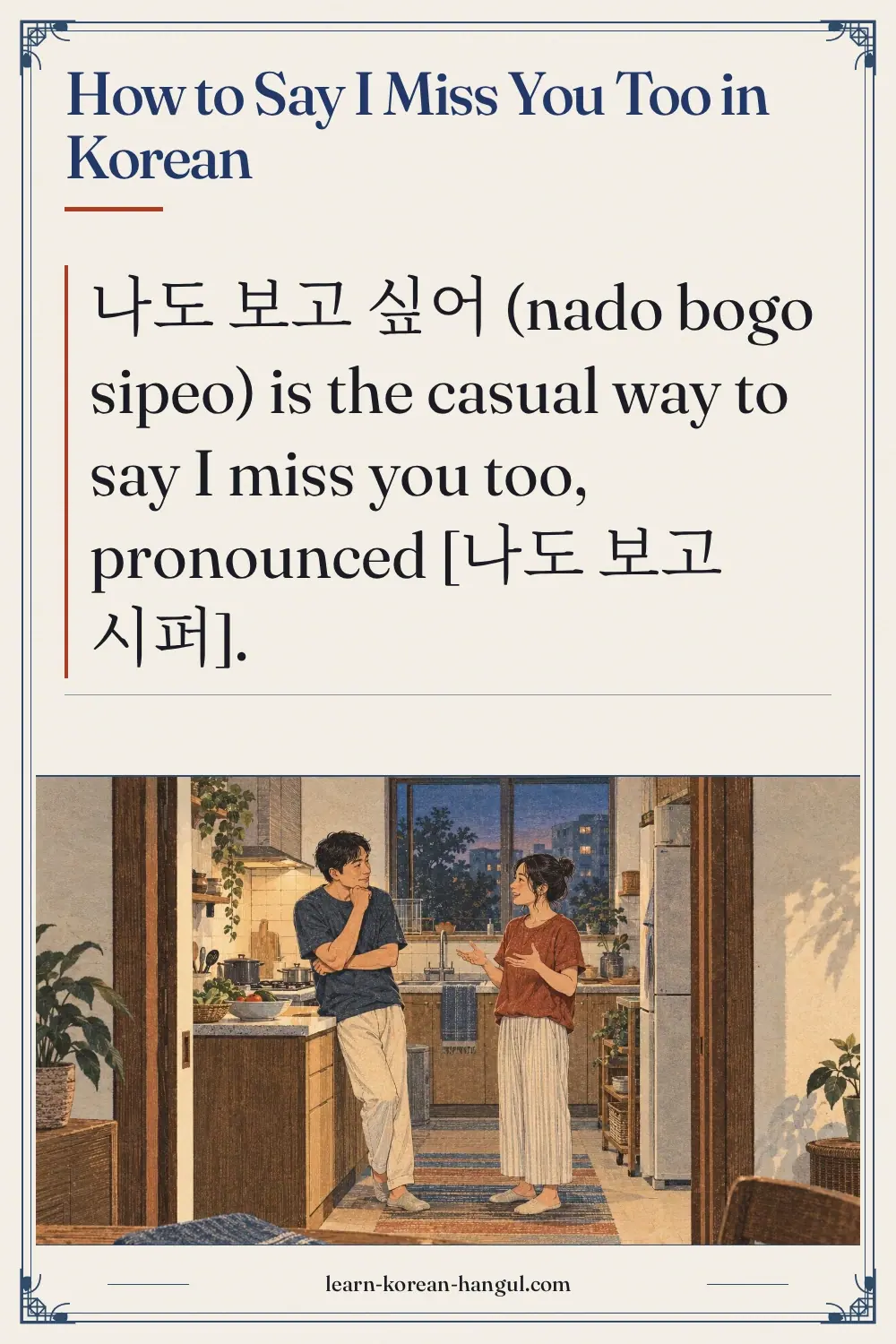
나도 보고 싶어
나도 보고 싶어
What you'll learn
- Say I miss you too with 나도 보고 싶어, 저도 보고 싶어요 or 저도 보고 싶습니다.
- Use the particle 도 to mean "too".
- Choose 나도 or 저도 to match the speech level.
- Answer with a short reply, 저도요.
Before you start: first learn the phrase you are answering, I miss you in Korean. Time: about 10 minutes. Audio plays only when you press a button.
Key facts
- 나도 보고 싶어 (nado bogo sipeo) is the casual way to say I miss you too.
- 도 means "too" and takes the place of the subject marker: 나도, 저도.
- 저도 보고 싶어요 (jeodo bogo sipeoyo) is polite, and 저도 보고 싶습니다 is formal.
- 저도요 (jeodoyo) is a short polite reply: "me too".
- 보고 싶었어 (bogo sipeosseo) means "I missed you", said when you meet again.
How Do You Say I Miss You Too in Korean?
The standard way to say I miss you too in Korean is 나도 보고 싶어. It is built from 나 (na, I), the particle 도 (do, too), the verb 보다 (boda, to see) and the ending -고 싶어 (-go sipeo, want to). Together they say "I also want to see you".
| Situation | Best form | Romanization | Why |
|---|---|---|---|
| Answering a partner or a close friend | 나도 보고 싶어 | nado bogo sipeo | Casual |
| Answering a teacher, an elder or a colleague | 저도 보고 싶어요 | jeodo bogo sipeoyo | Polite |
| A formal letter or speech | 저도 보고 싶습니다 | jeodo bogo sipseumnida | Formal |
| A very short reply | 저도요 | jeodoyo | Polite and brief |
| Saying you missed them while apart | 나도 보고 싶었어 | nado bogo sipeosseo | Past |
Korean often drops "you", so nothing in the sentence names the other person. The next section sorts the forms by level.
What Are the Formal, Polite and Casual Ways to Say I Miss You Too?
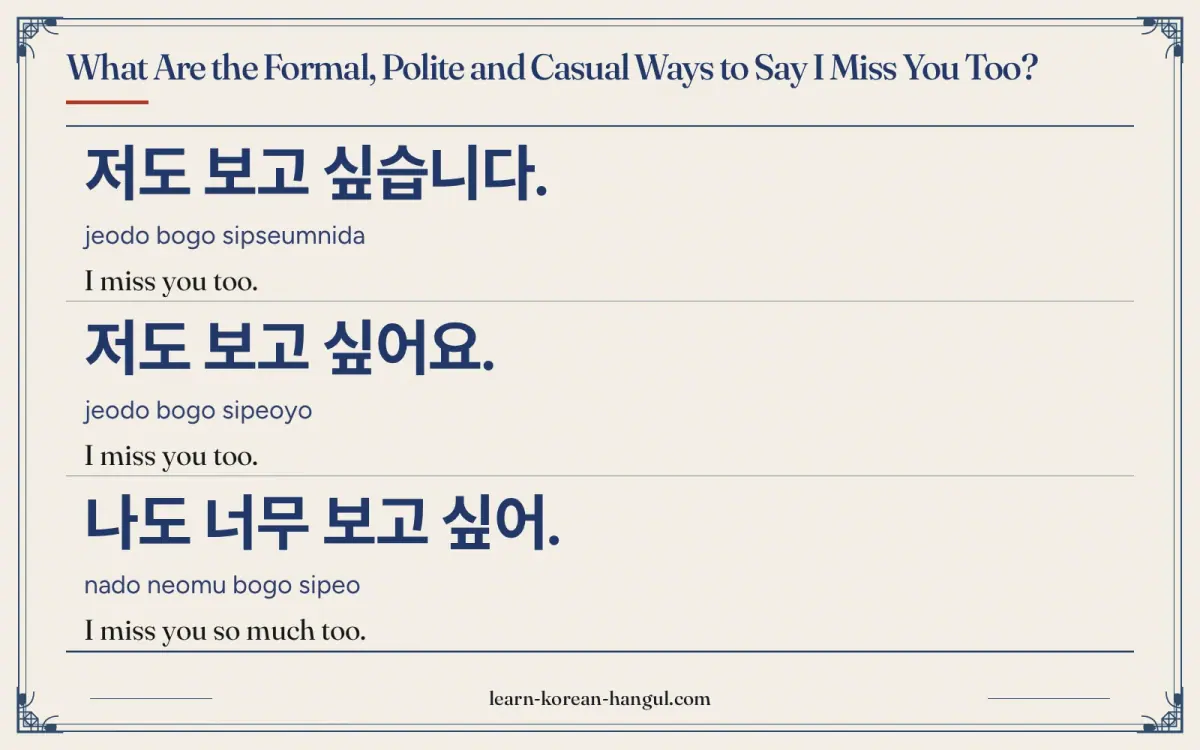
The forms follow the Korean speech levels, explained in the guide to Korean speech levels. Here we move from formal to casual.
Formal: 저도 보고 싶습니다 (jeodo bogo sipseumnida)
Formal · 합쇼체저도 보고 싶습니다 uses the formal -습니다 ending and the humble 저. It fits a letter to a teacher or a message to an older relative who expects formal speech. It is pronounced [저도 보고 십씀니다].
저도 보고 싶습니다.
jeodo bogo sipseumnida
I miss you too.
Polite: 저도 보고 싶어요 (jeodo bogo sipeoyo)
Polite · 해요체저도 보고 싶어요 is the everyday polite form. It suits parents, teachers, colleagues and friends you address politely. It is pronounced [저도 보고 시퍼요].
저도 보고 싶어요.
jeodo bogo sipeoyo
I miss you too.
Casual: 나도 보고 싶어 (nado bogo sipeo)
Casual · 반말나도 보고 싶어 drops the polite 요 and uses the plain 나. Use it with a partner, a close friend or a younger person. Add 너무 or 진짜 to make it stronger: 나도 너무 보고 싶어.
나도 너무 보고 싶어.
nado neomu bogo sipeo
I miss you so much too.
Short Reply: 저도요 (jeodoyo)
Polite · 해요체저도요 means "me too". The polite 요 attaches directly to 저도, with no verb. It is the quickest warm reply, and it works for any "me too", not only for missing someone.
Past: 나도 보고 싶었어 (nado bogo sipeosseo)
Casual · 반말나도 보고 싶었어 is pronounced [나도 보고 시퍼써]. It means "I missed you too". Say it when you meet again, or when you look back on the time apart.
나도 보고 싶었어.
nado bogo sipeosseo
I missed you too.
Same Feeling: 나도 그래 (nado geurae)
Casual · 반말그래 (geurae) means "it is so", and 나도 그래 means "me too, same here". It fits when the other person describes any feeling, not only missing. The polite form is 저도 그래요.
The Pattern behind It: the Particle 도
The particle 도 means "also" or "too". It replaces 은/는 and 이/가, and it attaches to the word it adds. 나도 is "I too", 저도 is "I too" (polite), and 친구도 is "my friend too". After 도, you do not add 가, so 나도가 is wrong. Once you know this pattern, you can say 저도 좋아요 (I like it too), 저도 가요 (I'm going too) and 저도 한국어 공부해요 (I study Korean too).
How Do You Pronounce 나도 보고 싶어?
나도 보고 싶어 is pronounced [나도 보고 시퍼], na-do bo-go si-peo, in six syllables. The only change is in 싶어, where the ㅍ moves to the next syllable.
- 나 (na) and 도 (do): a clear "na" and a soft "do".
- 보 (bo) and 고 (go): the ㄱ between vowels is soft, close to "g".
- 싶 (sip): spelled with ㅍ, but the ㅍ moves on in speech.
- 어 (eo): joins the ㅍ to sound like "puh", with an unrounded ㅓ.
Sounds to Listen For
These notes follow the National Institute of Korean Language standard pronunciation rules (표준 발음법):
- A final consonant moves to a vowel. 싶어 is [시퍼], 싶어요 is [시퍼요] and 싶었어 is [시퍼써] (Article 13).
- Formal ending. 싶습니다 is [십씀니다]: ㅍ is said as ㅂ at the end of a syllable (Article 9), ㅅ becomes tense ㅆ (Article 23) and ㅂ before ㄴ turns into ㅁ (Article 18).
- No change in the pronoun. 나도 and 저도 are said as written, so keep the ㄷ soft between vowels.
Practise the words in two parts: 나도 / 보고 싶어. Then link them. If you say 싶어 as [십어], without linking, it sounds choppy and foreign.
When Should You Use 나도 보고 싶어, and When Should You Not?
Use 나도 보고 싶어 as an echo. It answers someone else's 보고 싶어, so it works best right after they say it.
Situations Where It Fits
- A call with a partner. 보고 싶어. 나도 보고 싶어.
- A text from a friend abroad. 저도 보고 싶어요.
- A message from a parent. 저도요, 엄마.
Situations to Avoid
- Starting the conversation. If you speak first, say 보고 싶어요 with no 도. See I miss you in Korean.
- Missing a place or a time. 그리워요 fits better.
- A feeling you do not share. Do not say 나도 out of politeness if you are unsure. A warmer, honest reply is 연락해 줘서 고마워요 (thank you for contacting me).
Two short conversations show how the phrase sounds.
What Does I Miss You Too Sound Like in a Real Conversation?
In real life, the phrase comes as a reply, often with a plan to meet. Listen for the soft ending.
A Phone Call with a Partner
Jiho
보고 싶어.
bogo sipeo
I miss you.
Soyeon
나도 보고 싶어. 언제 만날 수 있어?
nado bogo sipeo. eonje mannal su isseo?
I miss you too. When can we meet?
Jiho
토요일에 갈게.
toyoire galge
I'll come on Saturday.
Soyeon
좋아. 기다릴게.
joa. gidarilge
Good. I'll wait.
What to notice: 언제 만날 수 있어? is a wh-question, so the pitch does not climb at the end. The promises 갈게 and 기다릴게 end with -ㄹ게, pronounced [갈께] and [기다릴께].
A Video Call with a Friend
Hana
잘 지내요? 보고 싶어요.
jal jinaeyo? bogo sipeoyo
Are you doing well? I miss you.
Minji
저도 보고 싶어요. 방학에 만나요.
jeodo bogo sipeoyo. banghage mannayo
I miss you too. Let's meet during the break.
Hana
네, 빨리 만나요.
ne, ppalli mannayo
Yes, let's meet soon.
What to notice: Minji answers with 저도 and a polite 요 ending, so the whole exchange stays in one level. The ending -아요 in 만나요 means "let's meet" here.
What Should You Know about the Culture behind I Miss You Too?
In Korean, a reply that echoes the other person's words is a sign of closeness. People who miss each other often say 보고 싶어 first and the other answers 나도, and the exchange can end there. Short replies also work in messages, where a single 저도요 is both polite and warm.
- Texting. In casual messages, 나도 is sometimes typed 나두 to sound cute, and ㅠㅠ (two crying eyes) is added to the end.
- Family. Children say 저도 보고 싶어요 to parents on the phone, and parents answer 엄마도 보고 싶어.
- Plans follow. Missing someone is often followed by a plan to meet, such as 이번 주말에 만나요 (let's meet this weekend).
An expert tip: when you reply, match the sender's level. If they write 보고 싶어요, answer 저도 보고 싶어요, and if they write 보고 싶어, answer 나도 보고 싶어. Matching feels natural and shows you listened.
What Mistakes Do Learners Make with I Miss You Too in Korean?
Most mistakes come from the word "too" and from the pronoun level.
| Mistake | Why it is a problem | Fix |
|---|---|---|
| 또 보고 싶어 | 또 means "again" | Use 도 on the person: 나도 |
| 나가도 보고 싶어 | 가 and 도 do not combine | Say 나도 |
| 저도 보고 싶어 | Humble pronoun, casual ending | Say 저도 보고 싶어요 |
| 나도 보고 싶어요 to an elder | Casual pronoun, polite ending | Say 저도 보고 싶어요 |
| Saying 싶어 as [십어] | Not the standard sound | Say [시퍼] |
Learners often assume that "too" is a separate word. Actually, Korean puts it on the word it adds as the small particle 도, so the sentence has no extra word.
Is It the Same as I Missed You or I Miss You so Much?
Mostly. The short answers below cover the other searches folded into this page.
- Miss you too in Korean: 나도 보고 싶어, or the short 나도.
- I missed you in Korean: 보고 싶었어요 (polite) or 보고 싶었어 (casual).
- I missed you too: 나도 보고 싶었어.
- I miss you so much in Korean: 너무 보고 싶어요, or 나도 너무 보고 싶어.
Now say them aloud.
Practice: Say It Aloud
Play the slow clip of 나도 보고 싶어 three times, then say 싶어 as [시퍼]. Choose a phrase. Answers follow.
- Your partner says 보고 싶어. You answer casually.
- Your teacher writes that she misses you. You answer politely.
- You want the shortest polite reply.
- You meet a friend at the station and say "I missed you too".
Answers
- 나도 보고 싶어.
- 저도 보고 싶어요.
- 저도요.
- 나도 보고 싶었어.
The phrase flashcards drill these lines with audio.
Related Phrases to Learn Next
An echo reply leads to the first phrase and to the next feeling.
- I miss you in Korean: 보고 싶어요 for the first move.
- I love you in Korean: 사랑해요 for deeper feelings.
- I love you too in Korean: 저도 사랑해요 for another echo reply.
- See you soon in Korean: 곧 봐요 for what comes next.
This guide belongs to the Korean love phrases collection. What this page does not cover: poetry, song lyrics and long letters. Remember that 도 means "too", match 나도 or 저도 to the speech level, and you can say i miss you too in Korean naturally.
Frequently Asked Questions
How do you say I miss you too in Korean?
Say 나도 보고 싶어 (nado bogo sipeo) to a partner or a close friend. In polite speech, say 저도 보고 싶어요 (jeodo bogo sipeoyo). In formal speech, say 저도 보고 싶습니다. The particle 도 means "too", and the verb phrase 보고 싶다 means "to want to see", which is how Korean says "miss".
How do you say I missed you in Korean?
Use the past: 보고 싶었어 (bogo sipeosseo) in casual speech and 보고 싶었어요 (bogo sipeosseoyo) in polite speech. To say "I missed you too", add 나도 or 저도 in front: 나도 보고 싶었어. The past shows that the time apart is over, so people say it when they meet again. Pronounce it [보고 시퍼써].
How do you say I miss you so much in Korean?
Add 너무 (neomu, so much) or 많이 (mani, a lot) before the verb: 너무 보고 싶어 or 많이 보고 싶어요. With 도, say 나도 너무 보고 싶어, "I miss you so much too". Friends also say 진짜 보고 싶어 (jinjja bogo sipeo), "I really miss you". The more casual the setting, the stronger the adverb can be.
What is the difference between 나도 and 저도?
Both mean "me too". 나도 (nado) is casual and is used with friends, partners and younger people. 저도 (jeodo) is the humble, polite version, used with teachers, elders, colleagues and strangers. Pair 나도 with casual endings such as 싶어 and 저도 with polite endings such as 싶어요. Mixing them, such as 저도 보고 싶어, sounds uneven.
Can I just say 저도요?
Yes. When someone says 보고 싶어요, you can answer with the short 저도요 (jeodoyo), which means "me too". It is polite, warm and very common. For a casual reply, say 나도 or 나도 그래 (nado geurae, "same here"). A single word is enough when the listener has just said the full phrase.
What is the most common mistake with I miss you too in Korean?
Learners translate "too" as 또 (again) or 너무 (too much), which are wrong. Use the particle 도 and attach it to the person: 나도, 저도. A second slip is putting 가 and 도 together, as in 나가도, which changes the meaning. A third is pronouncing 싶어 as [십어] instead of [시퍼].