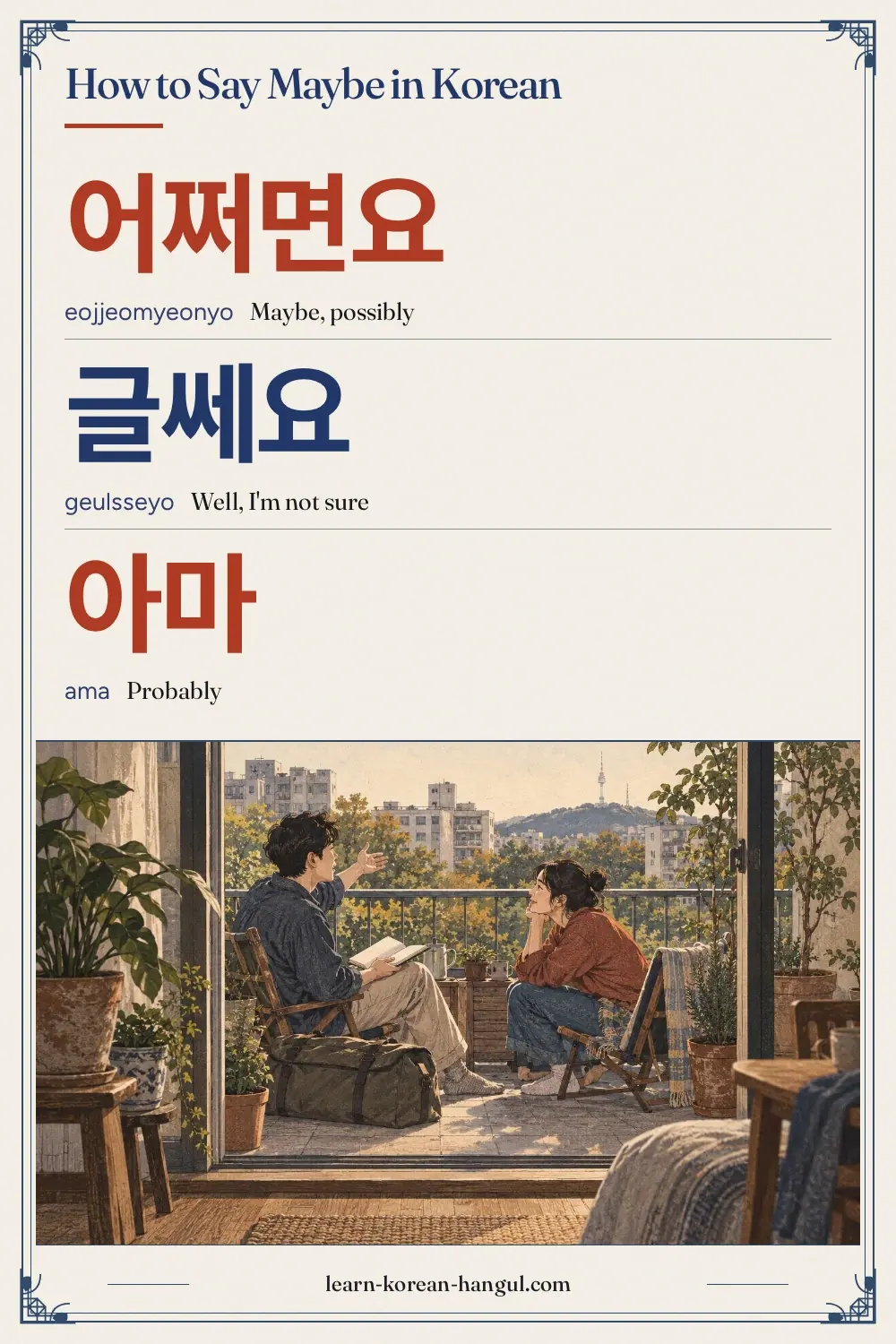
어쩌면요
어쩌면요
What you'll learn
- Say 어쩌면요, 글쎄요, 아마 and 아마도, and know what each one commits you to.
- Decide whether your "maybe" is a real possibility, a hesitation or a guess.
- Hear and say the tense ㅆ in 글쎄요 and the tense ㅉ in 어쩌면요.
- Avoid the mistake of using 글쎄요 to mean "yes, maybe".
Before you start: the forms below depend on your listener, so a quick look at Korean speech levels helps. Time: about 10 minutes. Audio plays only when you press a button.
How Do You Say Maybe in Korean?
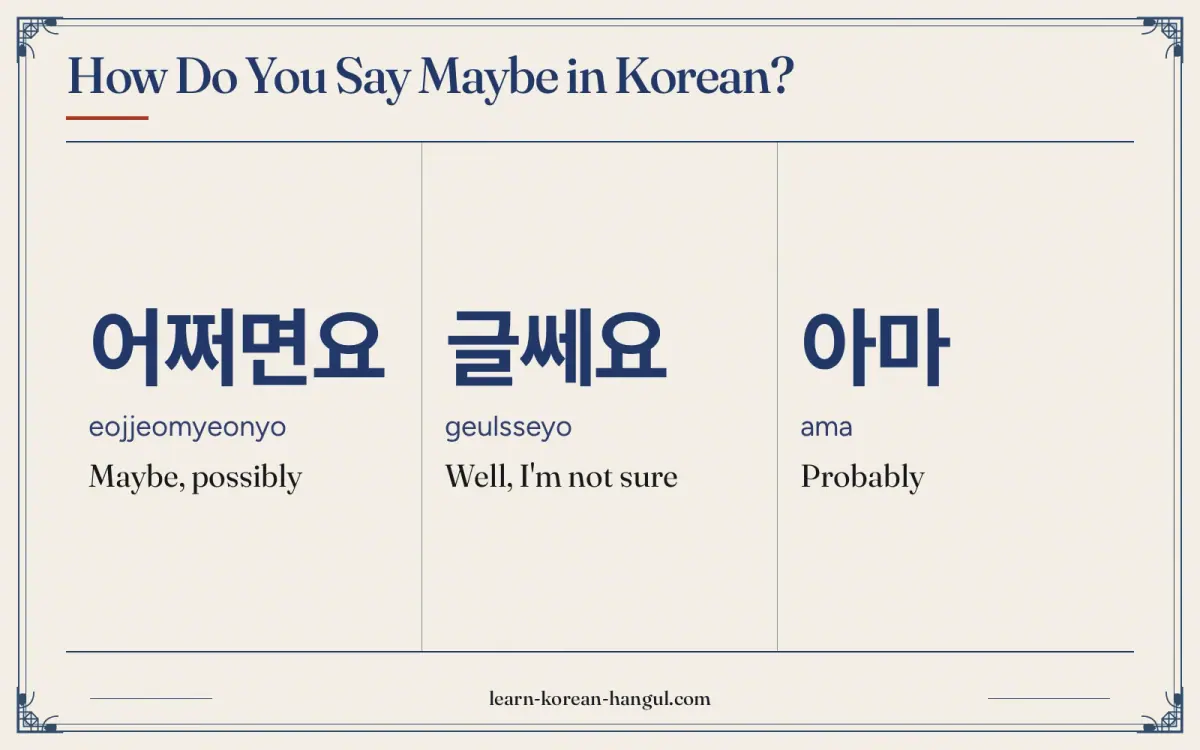
The short answer is 어쩌면요. It comes from the adverb 어쩌면 (eojjeomyeon, "perhaps, possibly") plus the polite particle 요. Because it says "there is a real chance", it works as a full reply to a question such as 내일 올 수 있어요? ("Can you come tomorrow?").
| Korean | Romanization | Meaning | Style |
|---|---|---|---|
| 어쩌면요 | eojjeomyeonyo | Maybe, possibly | Polite |
| 글쎄요 | geulsseyo | Well, I'm not sure | Polite |
| 아마 | ama | Probably | Any level, used in sentences |
| 아마도 | amado | Perhaps, probably | Any level, a little more careful |
Revised Romanization (the South Korean government standard of 2000) is a reading aid. Learn the Hangul first. The next section sorts these words by what they tell the listener.
What Are the Polite and Casual Ways to Say Maybe?
Korean splits "maybe" into a possibility word, a hesitation word and a guess word. Choose by what you want the listener to understand.
Polite: 어쩌면요 (eojjeomyeonyo)
Polite · 해요체Use 어쩌면요 when it could really go either way. It is polite because of the final 요, and it is safe with colleagues, teachers and strangers. The tone is open: "it is possible, but I cannot promise".
어쩌면요. 아직 잘 모르겠어요.
eojjeomyeonyo. ajik jal moreugesseoyo
Maybe. I am not sure yet.
Polite: 글쎄요 (geulsseyo)
Polite · 해요체글쎄요 is a hesitation: "well... I am not sure". People say it when they are asked for something they cannot commit to. Listeners often hear it as a gentle "probably not", so do not use it to mean "yes, maybe".
글쎄요. 내일은 좀 어려울 것 같아요.
geulsseyo. naeireun jom eoryeoul geot gatayo
Well... tomorrow looks a bit difficult.
Any Level: 아마 (ama)
아마 means "probably" and normally belongs inside a statement, usually with -(으)ㄹ 거예요 for the future: 아마 갈 거예요 ("I will probably go"). Because it has no ending of its own, its politeness comes from the verb ending. As a one-word reply, 아마요 is possible, but a full sentence is clearer.
아마 갈 거예요.
ama gal geoyeyo
I will probably go.
Any Level: 아마도 (amado)
아마도 adds the emphasising particle 도 ("also, even") to 아마. It sounds a little more careful or literary than 아마. In a casual sentence, such as 아마도 비가 올 거야 ("it will probably rain"), it carries the same meaning with a softer shade.
아마도 비가 올 거야.
amado biga ol geoya
It will probably rain.
The four words are easy to spell. The sounds need a little more care, and that is the next section.
How Do You Pronounce 어쩌면요?
어쩌면요 has four syllables: 어 (eo), 쩌 (jjeo), 면 (myeon) and 요 (yo). In careful speech the ㄴ simply links into 요, giving [어쩌며뇨]. In common speech many people keep the ㄴ and add another before 요, saying [어쩌면뇨]. The Revised Romanization stays eojjeomyeonyo.
- 어: the vowel ㅓ is unrounded. Keep your lips relaxed and open your jaw a little, like "uh" in "bus", not like "oh".
- 쩌: a tense ㅉ plus ㅓ. Tighten your throat and let the sound out without a puff of air.
- 면: "myeon", a quick "mye" and a clear ㄴ.
- 요: "yo", short and bright.
Sound Changes to Listen For
- Tense ㅉ in 쩌. The double letter ㅉ is pronounced tight, unlike the plain ㅈ in 저.
- Tense ㅆ in 글쎄요. In [글쎄요] the ㅆ is a tense "ss", written in the spelling, and RR shows it: geulsseyo. See Korean tensification for the wider rule.
- 요 after ㄴ. After a consonant, 요 often picks up a light ㄴ in common speech, as in [어쩌면뇨]. The spelling stays 요, and RR does not add an n: eojjeomyeonyo.
- 아마도. There is no tension here: say a-ma-do with a light stress on the first syllable.
| Korean | Type | Sound |
|---|---|---|
| 세 | plain | se, soft |
| 쎄 | tense | sse, tight |
Once you can say the words, think about when each one is safe.
When Should You Use 어쩌면요, and When Should You Not?
Use 어쩌면요 when a real possibility exists, 글쎄요 when you hesitate, and 아마 when you guess. Mixing them up changes what the listener understands.
Situations Where It Fits
- A real possibility. A friend asks if the rain will stop. 어쩌면요 says "it might".
- You cannot commit yet. A colleague asks if you can attend. 글쎄요 buys time, and the listener understands that you have doubts.
- A guess about a plan. 아마 갈 거예요 tells a friend that you will probably go.
Situations to Avoid
- A real yes. Do not answer 글쎄요 if you mean yes, because many listeners hear a refusal. Say 아마 갈 거예요 instead.
- A direct question about facts you know. 글쎄요 sounds evasive if the answer is obvious.
- A formal written reply. Prefer a full sentence, such as 아직 확실하지 않습니다 ("it is not certain yet").
- A request to a boss. 글쎄요 may sound like a flat no. Add a reason: 글쎄요, 확인해 보겠습니다 ("well, I will check").
Two short dialogues show the contrast.
What Does Maybe Sound Like in a Real Conversation?
In the first dialogue a colleague answers with 글쎄요. In the second two friends talk about the weather with 아마.
A Colleague Asks about Tomorrow
Colleague
내일 올 수 있어요?
naeil ol su isseoyo
Can you come tomorrow?
You
글쎄요. 확실하지 않아요.
geulsseyo. hwaksilhaji anayo
Well... I'm not sure.
What to notice: the question 내일 올 수 있어요? is a yes/no question and ends with a rise. The answer 글쎄요 pauses before the next sentence, and the pause is the signal of doubt. Pronounce 올 수 as [올쑤], with a tense ㅅ after the ending -(으)ㄹ.
Two Friends and the Weather
Ji-Won
내일 비 올까?
naeil bi olkka
Do you think it will rain tomorrow?
Seo-Yun
아마 올 거야. 우산 챙겨.
ama ol geoya. usan chaenggyeo
It will probably rain. Bring an umbrella.
What to notice: 올까 uses the guessing ending -(으)ㄹ까 and 올 거야 uses the future-guess ending in casual speech. 올 거야 sounds like [올꺼야]. Next, why does Korean treat 글쎄요 so carefully?
What Should You Know about the Culture behind Maybe?
Korean speech often avoids a flat "no", so "maybe" words carry more information than they do in English.
- A pause is an answer. A hesitant 글쎄요 is often a polite way to say no without saying 아니요, so listeners infer refusal from the pause and tone.
- Indirect refusals. Offers and invitations are often turned down with softeners such as 글쎄요 or 좀 어려울 것 같아요 ("it looks a bit difficult"). The word 좀 ("a little") makes the refusal gentle.
- Real possibility needs a signal. If you want to say "I might really come", say 어쩌면 갈 수도 있어요 ("I might go") or 아마 갈 거예요. Add a reason or a time to make the maybe clear.
- Check before relying. If a Korean colleague answers 글쎄요 to a request, treat it as unconfirmed, and ask again later.
An expert insight: the Korean "maybe" words are scaled by confidence. 아마 is closer to "probably yes", 어쩌면 is "genuinely 50-50", and 글쎄요 is "probably no, but I do not want to say so". Learners who treat them as synonyms will give the wrong signal. Now, the mistakes.
What Mistakes Do Learners Make with Maybe in Korean?
Most mistakes come from using one word for every kind of "maybe".
| Mistake | Why it is a problem | Fix |
|---|---|---|
| Using 글쎄요 to mean "yes, maybe" | Listeners hear a soft refusal | Say 아마 갈 거예요 for probably yes |
| Answering a manager with a bare 아마 | Without 요 or a verb it sounds casual and vague | Say a full sentence, such as 아마 그럴 거예요 |
| Using 어쩌면요 for "I don't know" | It means there is a chance, not that you lack information | Say 모르겠어요 |
| Pronouncing 쎄 like 세 | The plain sound changes the feel of the word | Tighten the throat on ㅆ |
| Treating 아마도 as the casual form | It is more careful than 아마 | Use 아마 with friends |
Many learners think a single translation of "maybe" is enough. In Korean the choice tells the listener how likely the thing is, so the choice matters more than the grammar. The English word also has relatives, as the next section shows.
Is It the Same as Perhaps?
Mostly. "Perhaps", "probably" and "not sure" all lead to the words on this page, but the best choice differs.
- Perhaps in Korean: 어쩌면 or 아마도, with 아마도 sounding more careful.
- Probably in Korean: 아마, with a future or guess ending.
- Not sure in Korean: 글쎄요 for a hesitation, or 잘 모르겠어요 ("I don't really know") for a plain statement.
- Yes or no instead of maybe: see yes in Korean and no in Korean.
Now practise choosing among them.
Practice: Say It Aloud
Play the slow clip and repeat 어쩌면요 three times, keeping the ㅉ tight and the ㅓ unrounded. Then choose a word for each situation. Answers follow.
- A friend asks if it will really rain, and you say it might.
- A boss asks you to work on Sunday, and you are not sure you can.
- You tell a friend you will probably go to the party.
- You do not have the information to answer.
Answers
- 어쩌면요.
- 글쎄요, 확인해 보겠습니다.
- 아마 갈 거예요.
- 모르겠어요.
The phrase flashcards drill common responses with audio.
Related Phrases to Learn Next
Maybe belongs to a set of short reply phrases.
- I don't know in Korean: the plain way to say you lack the answer.
- Yes in Korean: 네, 예 and the casual 응.
- No in Korean: 아니요 and a polite way to refuse.
This guide belongs to the Korean filler words collection. What this page does not cover: longer hedging phrases, written Korean for formal emails, and the full range of possibility endings in grammar. Use 어쩌면요 for a real chance and 글쎄요 for a hesitation, and you can say maybe in Korean with the meaning you intend.
Frequently Asked Questions
How do you say maybe in Korean?
Say 어쩌면요 (eojjeomyeonyo) when something is really possible. It is polite and works as a short reply. If you only want to say "probably" inside a sentence, use 아마, as in 아마 갈 거예요. If you hesitate to commit, say 글쎄요.
How do you pronounce 어쩌면요?
Say it as eo-jjeo-myeon-yo, four syllables. The ㅓ is unrounded, so keep your lips relaxed. The ㅉ in 쩌 is tense: tighten the throat and release it without a puff of air. In everyday speech the ending may sound like [어쩌면뇨], with a light ㄴ before 요.
What is the difference between 어쩌면요 and 글쎄요?
어쩌면요 says there is a real chance. 글쎄요 shows hesitation and, in many situations, signals a soft "probably not". If a friend asks "Will you come?" and you say 어쩌면요, they expect you might. If you say 글쎄요, they may assume you will not come.
Is 어쩌면요 formal or casual?
It is polite, because it ends with 요. It suits colleagues, teachers and strangers. With close friends, drop the 요 and say 어쩌면 or use 아마 in a sentence. In a very formal setting, a full sentence such as 아직 확실하지 않습니다 is clearer.
What is the most common mistake with maybe in Korean?
The most common mistake is using 글쎄요 to mean "yes, maybe". Many Koreans hear it as a soft refusal, so use 아마 갈 거예요 for "probably yes". The second is pronouncing the tense ㅆ and ㅉ as plain sounds.