알아요
알아요
What you'll learn
- Say I know with 알아요, 압니다 or 알아, depending on the listener.
- Use 알았어요 for "got it" and 아세요? for "do you know?"
- Understand the ㄹ-drop in 압니다, 아세요 and 아는.
- Tell 알아요 apart from 알고 있어요 and from 몰라요.
Before you start: you only need to read Hangul. For the opposite, see I don't know in Korean. Time: about 10 minutes. Audio plays only when you press a button.
Key facts
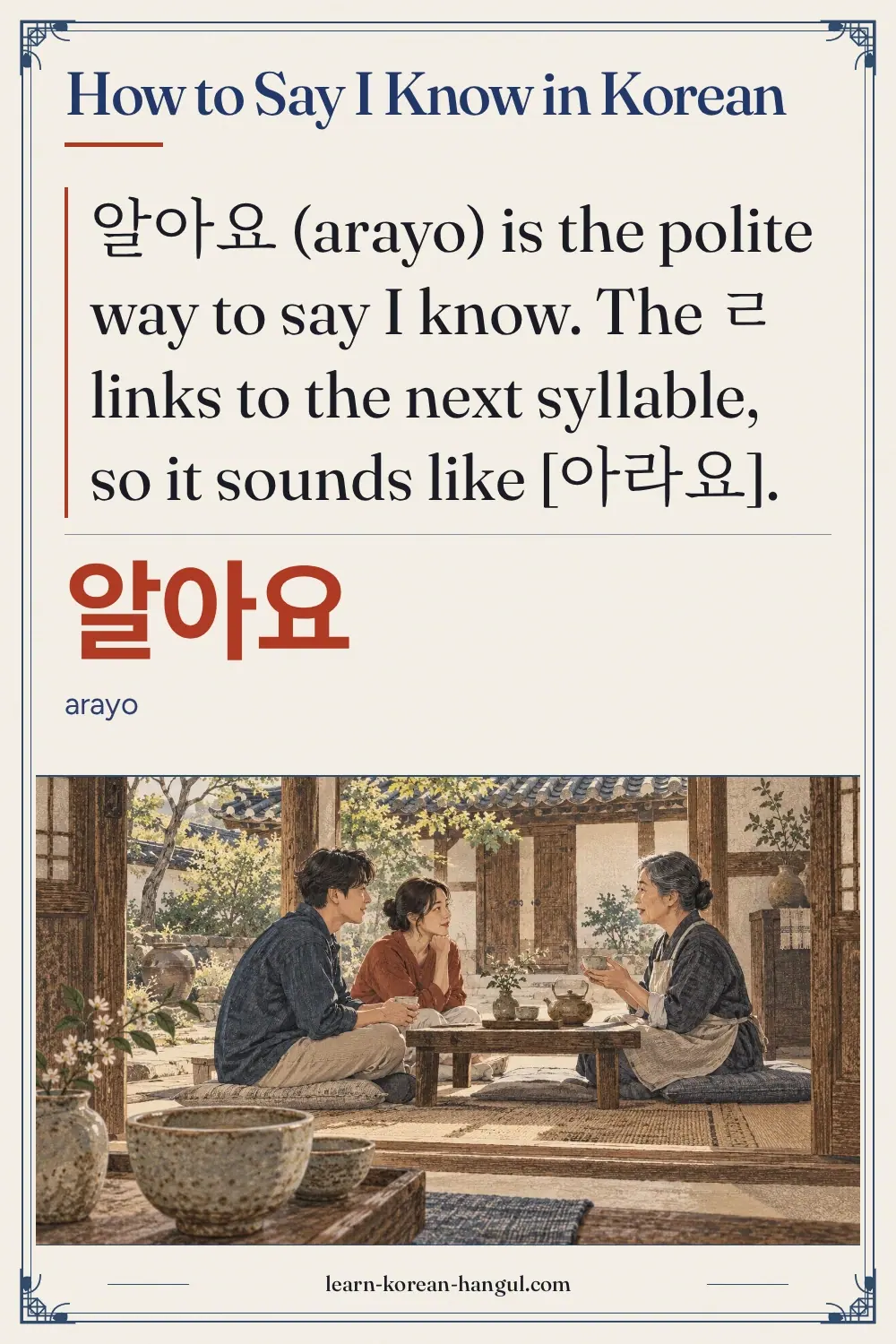
- 알아요 (arayo) is the polite way to say I know, and it sounds like [아라요].
- 알다 is a ㄹ-irregular verb: ㄹ drops before ㅂ, ㅅ and ㄴ.
How Do You Say I Know in Korean?
The standard way to say I know in Korean is 알아요. It is built from the verb 알다 (alda, to know) and the polite ending -아요. Korean drops "I" when the speaker is clear, so 알아요 can mean "I know", "you know" or "they know", and the situation decides which.
| Situation | Best form | Romanization | Why |
|---|---|---|---|
| Telling a colleague or a stranger | 알아요 | arayo | Polite, the default |
| Telling a friend | 알아 | ara | Casual |
| A formal meeting or a report | 압니다 | amnida | Formal |
| Saying you got it | 알았어요 | arasseoyo | Past, used as "okay" |
| Asking an older person | 아세요? | aseyo? | Honorific |
| Acknowledging at work | 알겠습니다 | algetseumnida | Formal "understood" |
알다 covers both facts and people: 그 사람 알아요 means "I know that person". The next section sorts the forms by level.
What Are the Formal, Polite and Casual Ways to Say I Know?
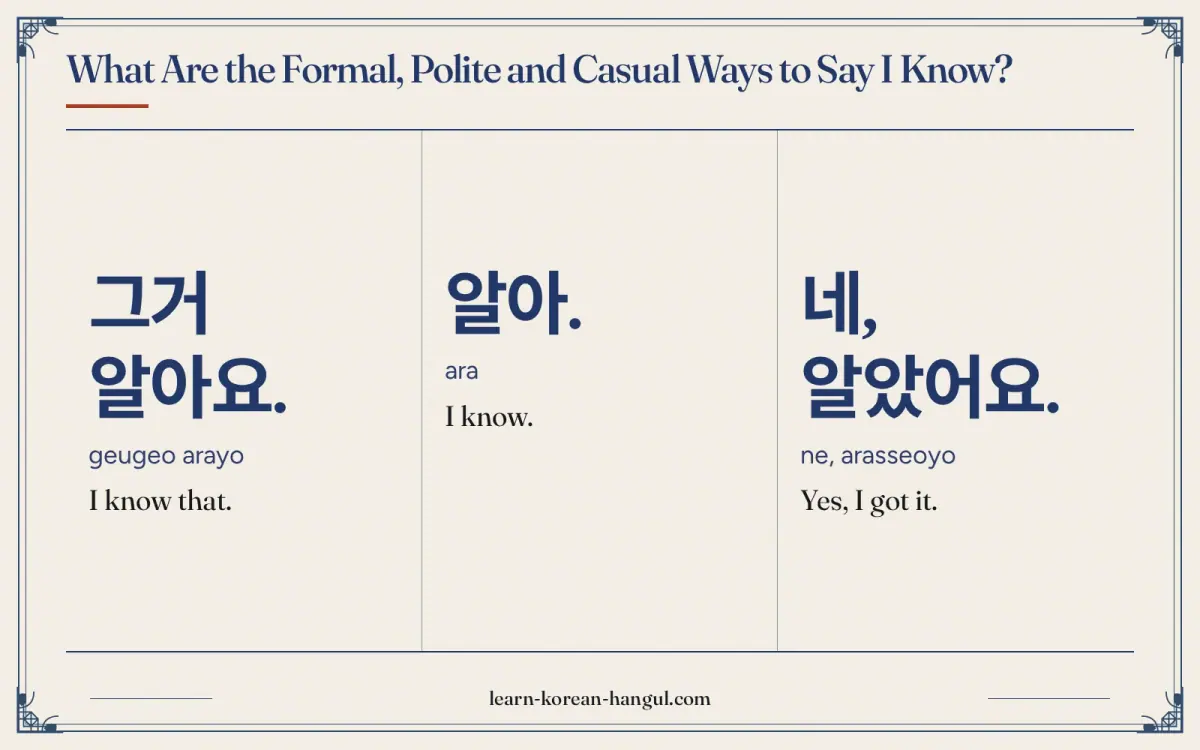
The forms follow the Korean speech levels, explained in the guide to Korean speech levels. Here we move from formal to casual.
Formal: 압니다 (amnida)
Formal · 합쇼체압니다 uses the formal -ㅂ니다 ending. The stem 알 loses its ㄹ before ㅂ, so 알 + ㅂ니다 is 압니다. It fits a speech, a news report or a formal reply. It is pronounced [암니다], because ㅂ before ㄴ turns into ㅁ.
Polite: 알아요 (arayo)
Polite · 해요체알아요 is the everyday default. It suits colleagues, teachers, shop staff and strangers.
그거 알아요.
geugeo arayo
I know that.
Casual: 알아 (ara)
Casual · 반말알아 drops the polite 요. Use it with a friend, a sibling or a younger person. Said twice, 알아, 알아 means "I know, I know", often with a hint of impatience.
알아.
ara
I know.
Got It: 알았어요 (arasseoyo)
Polite · 해요체알았어요 is the past form of 알다, but in daily talk it means "I got it" or "okay". It is pronounced [아라써요]. It is what you say after an instruction, as in 네, 알았어요.
네, 알았어요.
ne, arasseoyo
Yes, I got it.
Do You Know?: 아세요? (aseyo?)
Polite · 해요체아세요? is the honorific question "do you know?", used toward an older person or a customer. The ㄹ of 알다 drops before ㅅ. It is a yes/no question and ends with a rise. Never use 아세요 about yourself, because the honorific -(으)시- respects the subject of the sentence, and you never honour yourself.
Formal Acknowledgement: 알겠습니다 (algetseumnida)
Formal · 합쇼체알겠습니다 means "understood" at work. It is pronounced [알겓씀니다]. Use it with a manager, a customer or a teacher when you take an instruction.
Know How: 할 줄 알아요 (hal jul arayo)
Polite · 해요체With a verb and -ㄹ 줄 알다, the meaning becomes "know how to". 한국어 할 줄 알아요 means "I know how to speak Korean". It is pronounced [한구거 할쭐 아라요].
한국어 할 줄 알아요.
hangugeo hal jul arayo
I know how to speak Korean.
The Pattern behind It: the ㄹ-Drop
알다 belongs to the ㄹ-irregular verbs. Its ㄹ drops before ㅂ, ㅅ and ㄴ, and stays elsewhere:
| Ending | Result | Meaning |
|---|---|---|
| -ㅂ니다 | 압니다 | formal "know" |
| -(으)세요 | 아세요 | honorific "know" |
| -는 | 아는 | "who/what I know", as in 아는 사람 |
| -아요 | 알아요 | polite "know" |
| -면 | 알면 | "if you know" |
Once you know this one rule, you can also build 사세요 (live, honorific) from 살다 and 만드세요 (make, honorific) from 만들다.
How Do You Pronounce 알아요?
알아요 is spelled with a final ㄹ, but you say [아라요], a-ra-yo, in three syllables. The ㄹ moves to the front of the next syllable, so 알아 sounds like 아라.
- 아 (a): a clean "a".
- 라 (ra): the ㄹ from 알 joins the silent ㅇ of 아, giving "ra", a quick tap of the tongue.
- 요 (yo): "yo".
Sounds to Listen For
These notes follow the National Institute of Korean Language standard pronunciation rules (표준 발음법):
- A final consonant moves to a vowel. 알아요 is [아라요] (Article 13), and 알았어요 is [아라써요], where the ㅆ moves too.
- Formal ending. 압니다 is [암니다]: ㅂ becomes ㅁ before ㄴ (Article 18). 알겠습니다 is [알겓씀니다]: ㅆ is said as ㄷ at the end of a syllable, and the ㅅ after it becomes tense ㅆ (Articles 9 and 23).
- Tense after -ㄹ. In 할 줄 알아요, the ㅈ after 할 becomes tense, so you say [할쭐] (Article 27). See Korean tensification.
Practise by saying 아-라-요 slowly. If you pause between 알 and 아, it sounds foreign. Keep it as one flow.
When Should You Use 알아요, and When Should You Not?
Use 알아요 when you share knowledge, confirm that you are aware of something, or answer a yes/no question about it.
Situations Where It Fits
- Answering a question. 그 사람 알아요? 네, 알아요.
- Showing you are aware. 그건 알아요, "That I know".
- Taking an instruction. 알았어요 is the usual short reply.
Situations to Avoid
- Understanding a lesson. For "I understand", 이해해요 (ihaehaeyo) is clearer. See I understand in Korean.
- Not knowing. Do not say 안 알아요. Say 몰라요 instead.
- Talking to an elder in a flat tone. A bare 알아요 can sound impatient. Say 네, 알겠습니다 or 네, 알고 있어요 for a softer effect.
Two short conversations show how the phrase sounds.
What Does I Know Sound Like in a Real Conversation?
In real life, 알아요 is short, and the tone shows the feeling. A rise makes it a question, and a fall shows that you already knew.
Do You Know Him?
Hana
민수 씨 알아요?
minsu ssi arayo?
Do you know Minsu?
Jun
네, 알아요. 같은 회사에 다녀요.
ne, arayo. gateun hoesae danyeoyo
Yes, I know him. We work at the same company.
Hana
전화번호도 알아요?
jeonhwabeonhodo arayo?
Do you know his phone number too?
Jun
아니요, 몰라요.
aniyo, mollayo
No, I don't.
What to notice: Jun answers 알아요 and then 몰라요. These two are the natural pair. Both questions are yes/no questions, so they end with a rise.
Advice and a Reply
Mina
비가 와요. 우산 가져가요.
biga wayo. usan gajyeogayo
It's raining. Take an umbrella.
Jun
알아요. 벌써 챙겼어요.
arayo. beolsseo chaenggyeosseoyo
I know. I've already packed one.
Mina
늦지 마세요.
neutji maseyo
Don't be late.
Jun
알았어요.
arasseoyo
Okay, got it.
What to notice: Jun's first reply, 알아요, means "I already know", while his later 알았어요 means "I got it". The first sounds a little proud, and the second simply accepts the advice.
What Should You Know about the Culture behind I Know?
In Korean conversation, a short reply shows that you are listening. People nod and say 네, 알아요 or 아, 알아요 to show understanding. Yet 알아요 can also close a topic, so it matters how you say it.
- Tone counts. A warm, falling 알아요 means "yes, I'm aware". A quick 알아요, 알아요 can signal "stop telling me".
- Elders and bosses. Use 알겠습니다 or 알겠어요, which show that you will act on the words, rather than a plain 알아요.
- Friends. 알아, 알아 is normal, and a grin turns it into a joke.
An expert tip: answer a "do you know?" question with the same verb. If someone asks 아세요?, answering 네, 알아요 is clear and polite, and it avoids the English habit of saying "yes, I do".
What Mistakes Do Learners Make with I Know in Korean?
Most mistakes come from the negative form and from the sound.
| Mistake | Why it is a problem | Fix |
|---|---|---|
| 안 알아요 | Unnatural: Korean uses a separate verb for not knowing | Say 몰라요 |
| 알으세요 | The ㄹ must drop before ㅅ | Say 아세요 |
| 압니다 to a friend | Stiff | Say 알아 |
| Saying 알아요 with a gap | Sounds broken | Say [아라요] in one flow |
| 알아요 for "I understand" in class | Different idea | Use 이해해요 or 알겠어요 |
Learners often assume that 알아요 always means "I know a fact". Actually, it also covers people, places and skills, such as 그 식당 알아요 (I know that restaurant) and 한국어 할 줄 알아요 (I know how to speak Korean).
Is It the Same as I Know It, Know or I Know That?
Mostly. The short answers below cover the other searches folded into this page.
- I know it in Korean: 그거 알아요, or just 알아요.
- I know that in Korean: 그건 알아요, or 그거 알아요.
- Know in Korean (the verb): 알다. The dictionary form is 알다, and the polite form is 알아요.
- I already know: 이미 알아요 (imi arayo) or 벌써 알아요 (beolsseo arayo).
Now say them aloud.
Practice: Say It Aloud
Play the slow clip of 알아요 three times, then say it as one flow, [아라요]. Choose a phrase. Answers follow.
- You tell a stranger that you know the restaurant.
- You tell your friend you know.
- You ask an older person if they know.
- You tell your manager you understood the instruction.
Answers
- 그 식당 알아요.
- 알아.
- 아세요?
- 알겠습니다.
The phrase flashcards drill these lines with audio.
Related Phrases to Learn Next
Knowing leads to not knowing and to understanding.
- I don't know in Korean: 몰라요 for the opposite.
- I understand in Korean: 이해해요 for a lesson or an explanation.
- Understood in Korean: 알겠습니다 for acknowledging an instruction.
This guide belongs to the Korean conversation collection. What this page does not cover: the full set of ㄹ-irregular verbs and the endings -는지 and -ㄹ지 for indirect questions. Remember that 알다 drops its ㄹ before ㅂ, ㅅ and ㄴ, link the sounds as [아라요], and you can say i know in Korean naturally.
Frequently Asked Questions
How do you say I know in Korean?
Say 알아요 (arayo) in a polite setting and 알아 (ara) to a friend. In a formal setting, say 압니다 (amnida). The verb is 알다 (alda, to know). Korean usually leaves out "I", so 알아요 alone is a full sentence. Add an object when you need one: 그거 알아요, "I know that".
How do you say I know it in Korean?
Say 그거 알아요 (geugeo arayo), where 그거 means "that". If you mean a person, say 그 사람 알아요, "I know that person". If you mean "I know that already", say 그건 알아요 (geugeon arayo). Korean often drops the object when the listener knows it, so a bare 알아요 is also fine.
How do you say I know that in Korean?
Use 그건 알아요 (geugeon arayo) or 그거 알아요 (geugeo arayo). With 은/는, the sentence has a contrastive feel, as in "that I know (but not the rest)". Use 알아요 alone when you only want to show that you already knew, but be warm, because a flat 알아요 can sound impatient to an elder.
Why is it 아세요 and not 알으세요?
ㄹ drops before ㅅ, ㅂ and ㄴ in verbs such as 알다. So 알 + -으세요 becomes 아세요, 알 + -ㅂ니다 becomes 압니다 and 알 + -는 becomes 아는. The ㄹ stays before a vowel or other consonants: 알아요, 알고, 알면. This is the same ㄹ-drop that 살다 (사세요) and 만들다 (만드세요) follow.
What is the difference between 알아요 and 알고 있어요?
알아요 states that you know something. 알고 있어요 (algo isseoyo) says that you are in a state of knowing it, as in "I am aware of it". In daily talk, they are close and often swap. Use 알고 있어요 for facts and news, and 알아요 for people and things you simply know.
What is the most common mistake with I know in Korean?
Learners say 안 알아요 for "I don't know", but the normal word is 몰라요 (mollayo). Another slip is saying 알아요 as [알아요] with a gap, instead of the linked [아라요]. A third is using 알아요 for "I understand" in class, where 이해했어요 or 알겠어요 fits better.