집에 가고 싶어요
집에 가고 싶어요
What you'll learn
- Say 집에 가고 싶어요 aloud as [지베 가고 시퍼요], with the linked sounds.
- Choose between a wish (가고 싶어요) and an announcement (갈게요).
- Use 퇴근하고 싶어요 for the end of the workday.
- Avoid using 에서 for a destination.
Before you start: you need to read Hangul; romanization is shown as an aid and can be hidden. Time: about 9 minutes. Audio plays only when you press a button.
How Do You Say I Want to Go Home in Korean?
The direct answer is 집에 가고 싶어요. 집 (jip) means "home" or "house", 에 marks the destination, 가다 means "to go", and -고 싶어요 adds the wish. Korean has a few related phrases for leaving, staying and finishing work, and the table shows them side by side.
| Form | Romanization | Meaning | Use it for |
|---|---|---|---|
| 집에 가고 싶어요 | jibe gago sipeoyo | I want to go home | A polite wish |
| 집에 갈게요 | jibe galgeyo | I'm going home | Announcing your exit |
| 집에 가고 싶어 | jibe gago sipeo | I want to go home (casual) | Friends and family |
| 퇴근하고 싶어요 | toegeunhago sipeoyo | I want to leave work | Colleagues, in a joking tone |
| 집에 있고 싶어요 | jibe itgo sipeoyo | I want to stay home | Preferring a quiet day |
All five fit different moments, so the next section shows each in a sentence.
What Are the Polite, Casual and Formal Ways to Say I Want to Go Home?
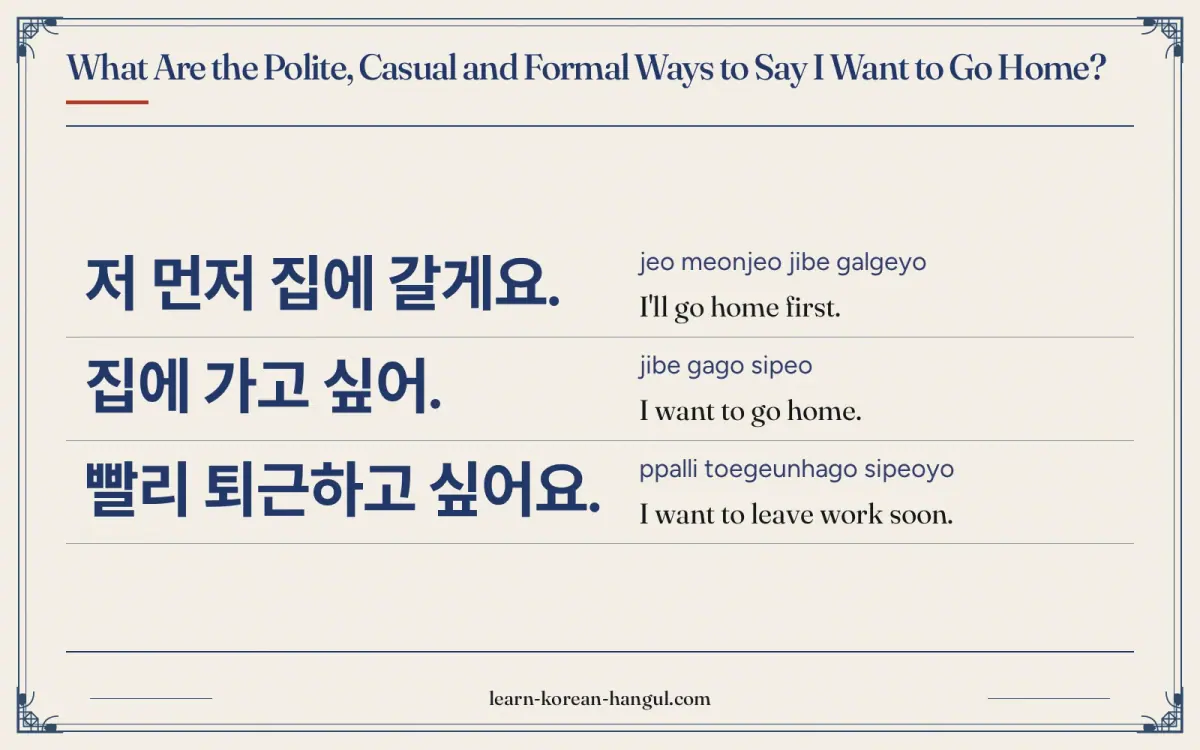
The forms follow the Korean speech levels explained in the guide to Korean speech levels. The ending changes with the listener, and the verb changes with your meaning.
Polite: 집에 가고 싶어요 (jibe gago sipeoyo)
Polite · 해요체This is the standard wish. It suits colleagues you know, teachers and hosts. Add a reason first: 너무 피곤해요 (I'm so tired).
너무 피곤해요. 집에 가고 싶어요.
neomu pigonhaeyo. jibe gago sipeoyo
I'm so tired. I want to go home.
Polite: 집에 갈게요 (jibe galgeyo)
Polite · 해요체The ending -ㄹ게요 is a promise or announcement to the listener, so 집에 갈게요 means "I'll go home now". It is the natural line when you leave a gathering. Add 먼저 (first) to be polite about leaving before others.
저 먼저 집에 갈게요.
jeo meonjeo jibe galgeyo
I'll go home first.
Casual: 집에 가고 싶어 (jibe gago sipeo)
Casual · 반말Without -요, the wish is casual. Use it with friends, siblings and people younger than you.
집에 가고 싶어.
jibe gago sipeo
I want to go home.
Polite: 퇴근하고 싶어요 (toegeunhago sipeoyo)
Polite · 해요체퇴근 (toegeun) means "leaving work at the end of the day". 퇴근하고 싶어요 is "I want to leave work", and colleagues often say it with a laugh. Add 빨리 (quickly).
빨리 퇴근하고 싶어요.
ppalli toegeunhago sipeoyo
I want to leave work soon.
Polite: 집에 있고 싶어요 (jibe itgo sipeoyo)
Polite · 해요체If you do not want to go out, swap 가다 for 있다 (to be, to stay). 집에 있다 is "to be at home", so this means "I want to stay home". It sounds like [지베 읻꼬 시퍼요].
오늘은 집에 있고 싶어요.
oneureun jibe itgo sipeoyo
I want to stay home today.
Formal: 집에 가고 싶습니다 (jibe gago sipseumnida)
Formal · 합쇼체The formal ending is rare for this wish, because it sounds odd to announce it formally. It appears in speeches or in writing.
Each form signals a different attitude, and pronunciation links the main phrase together.
How Do You Pronounce 집에 가고 싶어요?
집에 가고 싶어요 is pronounced [지베 가고 시퍼요], jibe gago sipeoyo in Revised Romanization, the official system for writing Korean in Latin letters.
- 지베 (jibe): written 집에, said "jee-beh", because ㅂ moves forward.
- 가고 (gago): "ga-go", with plain, voiced g sounds between vowels.
- 시퍼요 (sipeoyo): written 싶어요, said "shee-puh-yo", because ㅍ moves forward.
Sound Changes to Listen For
- Liaison in 집에. The final ㅂ of 집 moves onto the silent ㅇ of 에, so 집에 is [지베]. See the lesson on liaison.
- Liaison in 싶어요. The final ㅍ of 싶 moves onto the silent ㅇ of 어, so it is [시퍼요]. The ㅓ is said with unrounded lips, like "uh".
- Tense ending in 갈게요. After the ㄹ of -ㄹ게요, the ㄱ becomes tense, so 갈게요 is [갈께요]. Revised Romanization does not show tensing caused by a neighbouring sound, so it writes galgeyo. See Korean tensification.
Sounding natural helps, and so does knowing who should hear the wish, which comes next.
When Should You Use 집에 가고 싶어요, and When Should You Not?
Use 집에 가고 싶어요 with friends and close colleagues when you are tired, bored or homesick. Use 집에 갈게요 when you are really leaving.
Situations Where It Fits
- A tiring party or trip. Tell a friend how you feel.
- The end of a long day. Say it with a laugh to a colleague.
- A taxi ride. Ask for the destination with 집으로 가 주세요 (please go home).
Situations to Avoid
- Telling your boss. The wish alone can sound lazy; say 먼저 가 보겠습니다 (I'll leave first) if you must go.
- In the middle of a meeting. The wish interrupts, so wait for a break.
- When you mean "go home with me". That needs a different pattern, such as a suggestion.
Hearing the wish in context shows its tone, so here are three exchanges.
What Does I Want to Go Home Sound Like in a Real Conversation?
The wish usually follows a sign of tiredness. Listen for how each speaker reacts.
Friends at a Party
Friend
피곤해?
pigonhae
Are you tired?
You
응, 집에 가고 싶어.
eung, jibe gago sipeo
Yes, I want to go home.
What to notice: the friend's question rises, because it is a yes/no question, and the reply keeps the casual register of close friends.
Two Colleagues in the Afternoon
Colleague
오늘 너무 피곤해요.
oneul neomu pigonhaeyo
I'm so tired today.
You
저도요. 빨리 집에 가고 싶어요.
jeodoyo. ppalli jibe gago sipeoyo
Me too. I want to go home soon.
What to notice: 저도요 means "me too", and the shared wish is a bonding joke between colleagues.
Leaving a Gathering
You
저 먼저 집에 갈게요.
jeo meonjeo jibe galgeyo
I'll go home first.
Host
네, 조심히 가세요.
ne, josimhi gaseyo
Yes, go safely.
What to notice: 갈게요 announces the exit, and the host answers with 조심히 가세요, "go carefully". For a taxi, the request is different.
The sentence above is a taxi request, said [지브로 가 주세요]. These exchanges show a wider cultural habit.
What Should You Know about the Culture behind Wanting to Go Home?
Home has a warm meaning in Korean, and the wish to leave work early is a famous joke.
- 퇴근 jokes. 퇴근하고 싶다 is a common online joke about the workday. Among colleagues, it creates a smile and not a problem.
- Leaving first. Leaving before others can feel rude in a group, so people say 먼저 가 보겠습니다 or 먼저 갈게요 with a small bow.
- 집밥. 집밥 [집빱] means "home-cooked food", a comfort that people miss when they travel.
- Missing home. For homesickness, Koreans say 집이 그리워요 (jibi geuriwoyo), "I miss home".
An expert insight: learners often say 집에 가고 싶어요 in the office as if it were a neutral statement. Actually, in a Korean workplace it can sound like a complaint, so pair it with a laugh or save it for friends. The mistakes below show other traps.
What Mistakes Do Learners Make with I Want to Go Home in Korean?
Most mistakes come from the particle or from the ending.
| Mistake | Why it is a problem | Fix |
|---|---|---|
| 집에서 가고 싶어요 | 에서 means "at" or "from" | Say 집에 가고 싶어요 |
| 집을 가고 싶어요 | Heard in casual speech (어디를 가요?), but 에 is the clear, standard destination marker | Say 집에 가고 싶어요 |
| 집에 가요 for the wish | States a fact, "I go home" | Add -고 싶어요 |
| 집에 갈게요 for the wish | Announces a decision | Use 가고 싶어요 for a wish |
| Saying jip-e | Misses the liaison | Say [지베] |
Learners often assume that 집에 갈게요 is a softer version of the wish. Actually, it is the opposite: it is firmer, because you have decided to leave.
Other Ways People Search for I Want to Go Home in Korean
People search for this idea in a few shapes. The short answers below cover each one.
- Go home in Korean: 집에 가요 (jibe gayo) for a plain "I go home", or 집에 가자 for "let's go home" with friends.
- Take me home in Korean: 집으로 가 주세요 to a taxi driver; the address is often better.
- Want to go home in Korean: 집에 가고 싶어요, as above.
- Romanized: jibe gago sipeoyo, following the Revised Romanization of Korean; romanization is an aid, not the real spelling.
Reading the forms is one thing; saying them on cue is another, so practise now.
Practice: Say It Aloud
Play the slow clip of 집에 가고 싶어요 and repeat it three times, linking [지베] and [시퍼요]. Then say 저 먼저 집에 갈게요 with a firm [갈께요]. Choose a phrase for each situation, and check the answers below.
- You are tired at a friend's party.
- You are leaving a dinner with colleagues.
- You are in a taxi and want to go home.
Answers
- 집에 가고 싶어.
- 저 먼저 집에 갈게요.
- 집으로 가 주세요.
Drill these lines with the phrase flashcards, which include audio for each form.
Related Phrases to Learn Next
Wanting to leave connects to other feelings and exits.
- I'm tired in Korean: the usual reason.
- I'm bored in Korean: another reason to leave.
- I'm leaving first in Korean: the polite way to exit.
This guide belongs to the Korean feelings phrases collection. What this page does not cover: complaints about work and long goodbyes. Use 가고 싶어요 for the wish, 갈게요 for the exit, and you will say I want to go home in Korean the way Koreans do.
Frequently Asked Questions
How do you say I want to go home in Korean?
Say 집에 가고 싶어요 (jibe gago sipeoyo). 집 is home or house, 에 marks the destination, 가다 is to go, and -고 싶어요 means "want to". To announce that you are leaving, say 집에 갈게요. With friends, drop the -요 and say 집에 가고 싶어.
How do you pronounce 집에 가고 싶어요?
It sounds like [지베 가고 시퍼요]. The final ㅂ of 집 moves onto the silent ㅇ of 에, giving [지베], and the final ㅍ of 싶 moves onto 어, giving [시퍼요]. Revised Romanization writes the linked sounds as jibe gago sipeoyo.
What is the difference between 집에 가고 싶어요 and 집에 갈게요?
집에 가고 싶어요 expresses a wish: you would like to be at home, but you may not be able to leave yet. 집에 갈게요 announces a decision: you are going home now, and you tell the listener. In the office, a wish is a complaint or a joke, while an announcement is a plan.
Is 집에 가고 싶어요 formal or casual?
It is polite, in the everyday 해요 style. For a formal setting, say 집에 가고 싶습니다. For friends and family, say 집에 가고 싶어. At work, remember that the wish itself can sound unprofessional, even when the ending is polite, so be careful with your boss.
Can I use 집에 가고 싶어요 with friends, elders and strangers?
Yes, the polite -요 ending suits elders and strangers. With friends, drop the -요. The meaning is the issue at work: telling a boss that you want to go home can sound lazy. If you need to leave, say 먼저 가 보겠습니다 instead, and keep 집에 가고 싶어요 for friends and colleagues you know well.
What is the most common mistake with I want to go home in Korean?
The most common mistake is saying 집에서 가고 싶어요. The particle 에서 means "at" or "from", so it describes where an action happens. For a destination, use 에: 집에 가고 싶어요. A second mistake is saying 집으로 가요 when you mean the wish; the ending -고 싶어요 is required for "want".