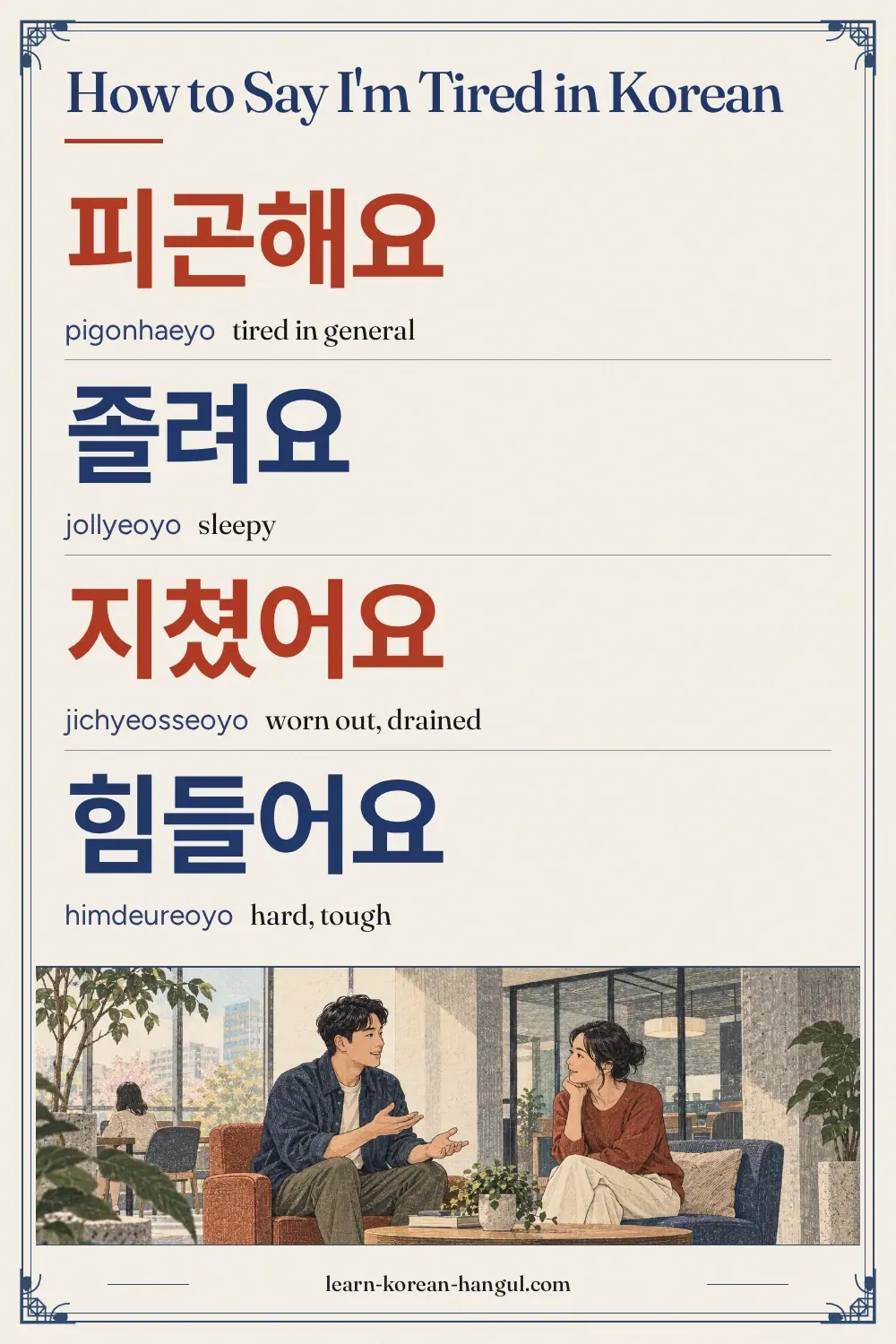
피곤해요
피곤해요
What you'll learn
- Say I'm tired with 피곤해요, 피곤합니다 or 피곤해, depending on the listener.
- Say dead tired, worn out and you look tired.
- Tell 피곤해요 apart from 졸려요 (sleepy) and 힘들어요 (hard).
- Pronounce 피곤합니다 as [피곤함니다] and 피곤했어요 as [피곤해써요].
Before you start: you only need to read Hangul. When you want to say you need sleep, learn I'm sleepy in Korean. Time: about 10 minutes. Audio plays only when you press a button.
How Do You Say I'm Tired in Korean?
The standard way to say I'm tired in Korean is 피곤해요. The word 피곤 (pigon) is a noun meaning tiredness or fatigue, and 하다 turns it into a describing word, so 피곤하다 means "to be tired". Korean usually drops "I" when the speaker is clear, which makes 피곤해요 a full sentence on its own.
| Situation | Best form | Romanization | Why |
|---|---|---|---|
| Telling a colleague or teacher | 피곤해요 | pigonhaeyo | Polite, natural |
| Telling a close friend or sibling | 피곤해 | pigonhae | Casual |
| A speech or formal report | 피곤합니다 | pigonhamnida | Formal |
| Very tired | 너무 피곤해요 | neomu pigonhaeyo | So tired |
| Dead tired | 피곤해 죽겠어요 | pigonhae jukgesseoyo | Exaggeration |
The ending changes with the listener, while the stem 피곤하- stays the same. The next section sorts the forms by level.
What Are the Formal, Polite and Casual Ways to Say I'm Tired?
The forms follow the Korean speech levels, explained in the guide to Korean speech levels. Each level is a different ending on the same stem.
Polite: 피곤해요 (pigonhaeyo)
Polite · 해요체피곤해요 is the form to learn first. It suits colleagues, teachers, shop staff and anyone you do not know well. It is warm without being stiff. It is built from 피곤하- plus 여요, which contracts to 해요, the same way 일하다 becomes 일해요.
어제 늦게 자서 피곤해요.
eoje neutge jaseo pigonhaeyo
I went to bed late yesterday, so I'm tired.
The ending 서 gives the reason. In the sentence, 늦게 is pronounced [늗께], with a final ㅈ-sound that is spoken as ㄷ and a tense ㄱ after it.
Casual: 피곤해 (pigonhae)
Casual · 반말피곤해 drops the polite 요. Use it with close friends, siblings, classmates of the same age and children. Say 나 (na, I) in front of it when you want to sound like a friend.
나 오늘 너무 피곤해, 일찍 잘래.
na oneul neomu pigonhae, iljjik jallae
I'm so tired today, I'll sleep early.
The ending ㄹ래 (llae) means "I will" or "I want to" in casual speech.
Formal: 피곤합니다 (pigonhamnida)
Formal · 합쇼체피곤합니다 is the formal form. It appears in announcements, news style and when a soldier or a presenter speaks. In daily life you will hear it less often. It is pronounced [피곤함니다].
Past: 피곤했어요 (pigonhaesseoyo)
Polite · 해요체피곤했어요 puts the tiredness in the past. It can mean "I was tired" or "I got tired" after something happened. Learners sometimes hear it as "I am tired now", because people use it when the tiredness has just been building up.
하루 종일 걸어서 피곤했어요.
haru jongil georeoseo pigonhaesseoyo
I walked all day, so I was tired.
The verb 걷다 (to walk) changes its ㄷ to ㄹ before a vowel, so 걷 + 어서 becomes 걸어서. The past marker 었 is spelled 했 here and gives [피곤해써요].
Strong: 피곤해 죽겠어요 (pigonhae jukgesseoyo)
Polite · 해요체피곤해 죽겠어요 uses 죽겠다, literally "I will die", as an exaggeration. Koreans use it for many strong feelings, such as 배고파 죽겠어요 (I'm starving). It sounds playful, so keep it for friends, family and light moods.
With the forms clear, here is the sound of each one.
How Do You Pronounce 피곤해요?
피곤해요 is pronounced [피곤해요], pi-gon-hae-yo, in four syllables. It sounds almost as it is written. In fast everyday speech the ㅎ after ㄴ often weakens, so you will also hear something close to [피고내요]; the careful form keeps a soft h.
- 피 (pi): "pee", with a light puff for ㅍ.
- 곤 (gon): "gohn", with a short vowel and ㄴ at the end.
- 해 (hae): "heh", with a soft h.
- 요 (yo): "yo".
Sound Changes to Listen For
These changes follow the National Institute of Korean Language standard pronunciation rules (표준 발음법):
- ㅂ before ㄴ becomes ㅁ. 피곤합니다 is [피곤함니다] (Article 18). See Korean nasalization.
- Tense after ㄱ. 죽겠어요 is [죽께써요]: the ㄱ in 죽 makes the next ㄱ tense (Article 23), and 겠 passes its ㅆ to the next syllable. See Korean tensification.
Revised Romanization writes the tense letters you see in the spelling, such as the ㅆ in 죽겠어요 (jukgesseoyo), but it does not show tensing that comes from a sound change. Now you can say the phrase, so let us see when it fits.
When Should You Use 피곤해요, and When Should You Not?
Use 피곤해요 to explain how you feel, to give a reason, or to ask for a break. It is a safe, honest sentence.
Situations Where It Fits
- After work or school. 오늘 너무 피곤해요. (I'm so tired today.)
- Declining an invitation. 오늘은 좀 피곤해요. 다음에 봐요. (I'm a bit tired today. Let's meet next time.)
- Travel. 비행기에서 못 자서 피곤해요. (I couldn't sleep on the plane, so I'm tired.)
Situations to Avoid
- A job interview or first meeting. Saying you are tired can sound low in energy.
- Showing it in front of a boss at a formal event. Wait for a break, or use a softer line such as 조금 힘들어요 (a little hard).
- When you mean sleepy. Say 졸려요 if you are about to fall asleep.
Two short conversations show how it sounds.
What Does I'm Tired Sound Like in a Real Conversation?
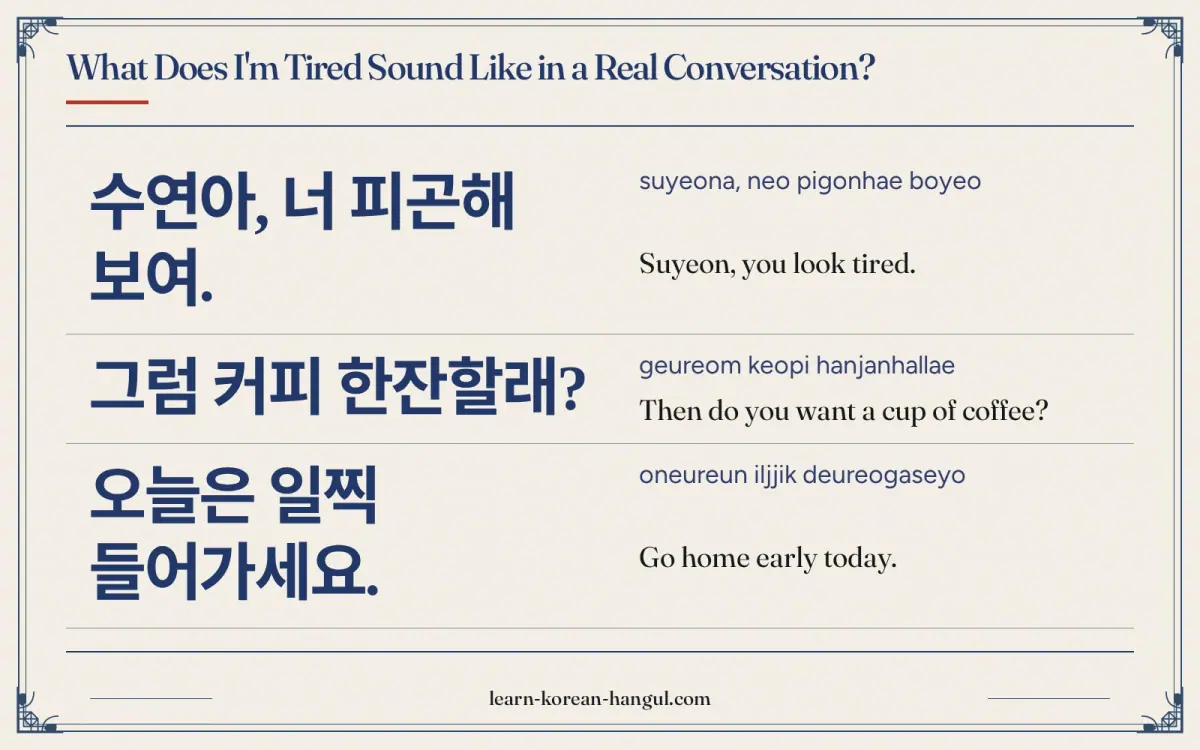
In real life, the line is followed by care, such as an offer of coffee or an early finish.
Friends in the Morning
Jiho
수연아, 너 피곤해 보여.
suyeona, neo pigonhae boyeo
Suyeon, you look tired.
Suyeon
응, 어제 세 시간밖에 못 잤어.
eung, eoje se siganbakke mot jasseo
Yes, I only slept three hours yesterday.
Jiho
그럼 커피 한잔할래?
geureom keopi hanjanhallae
Then do you want a cup of coffee?
What to notice: 피곤해 보여 joins the 해 form of 피곤하다 to 보이다 (to look, seem). The word 밖에 (bakke) means "only" and goes with a negative, as in 못 잤어.
At the Office
Manager
김 대리, 얼굴이 피곤해 보여요.
gim daeri, eolguri pigonhae boyeoyo
Assistant manager Kim, you look tired.
Kim
네, 어제 야근해서 조금 피곤해요.
ne, eoje yageunhaeseo jogeum pigonhaeyo
Yes, I worked overtime yesterday, so I'm a little tired.
Manager
오늘은 일찍 들어가세요.
oneureun iljjik deureogaseyo
Go home early today.
What to notice: the employee uses the polite 피곤해요 and adds 조금 (a little) to stay modest. The manager's 들어가세요 is a gentle, polite instruction.
How Is 피곤해요 Different from 졸려요, 지쳤어요 and 힘들어요?
English uses "tired" for many states. Korean separates them, and the right word makes you sound natural.
| Korean | Romanization | Meaning | Use it when |
|---|---|---|---|
| 피곤해요 | pigonhaeyo | tired in general | After work, travel or little rest |
| 졸려요 | jollyeoyo | sleepy | You want to close your eyes |
| 지쳤어요 | jichyeosseoyo | worn out, drained | After long effort or stress |
| 힘들어요 | himdeureoyo | hard, tough | A task or a day is difficult |
| 피곤해 죽겠어요 | pigonhae jukgesseoyo | dead tired | Joking, strong feeling |
The verb 지치다 (to be worn out) is an action-type verb in Korean, so its past form 지쳤어요 describes a state that has already happened. The word 힘들어요 can mean "I'm tired" or "this is hard", and context tells you which. To learn the sleepy word, see I'm sleepy in Korean, and for a busy day see I'm busy in Korean.
What Should You Know about the Culture behind I'm Tired?
Work and study are long for many people in Korea, so 피곤하다 is a very common word in daily talk. People say it to explain why they are quiet, why they cancel plans and why they want a break. It rarely sounds like a complaint, because everybody uses it.
- Caring remarks. 피곤해 보여요 is a way to show you notice someone. It is warm between friends and colleagues who know each other, but think twice with a stranger, because commenting on a face can feel personal.
- A thank-you for effort. After a long task, colleagues often say 수고하셨어요 (sugohasyeosseoyo, you worked hard). It recognises the effort behind the tiredness.
- Fatigue drinks. Convenience stores sell small 피로회복제 (pirohoebokje, fatigue-recovery drinks), and offering one is a friendly gesture.
An expert tip: the noun 피곤 on its own is not a sentence. To talk about a tiring task, use the describing form 피곤한 (pigonhan) before a noun, as in 피곤한 하루 (a tiring day).
What Mistakes Do Learners Make with I'm Tired in Korean?
Most mistakes come from treating 피곤 as a complete word and from mixing up similar feelings.
| Mistake | Why it is a problem | Fix |
|---|---|---|
| 피곤이에요 | 피곤 is a noun, not a state word here | Say 피곤해요 |
| 피곤하요 | Missing the contraction | Say 피곤해요 |
| [피곤하니다] for the formal form | The ㅂ turns into ㅁ | Say [피곤함니다] |
| 졸려요 for every kind of tiredness | Means sleepy | Say 피곤해요 |
| 피곤하세요 for yourself | The honorific is for others | Say 피곤해요 |
| 피곤합니다 to a friend | Too stiff | Say 피곤해 |
Learners also think English "I am tired of this" is the same. It is not. To say you are fed up, Korean uses 지겨워요 (jigyeowoyo) or 질렸어요 (jillyeosseoyo). Using 피곤해요 there means you are physically tired.
How Do You Ask Someone If They Are Tired?
You can turn the same words into a question by raising your voice at the end. To a friend, say 피곤해? (pigonhae?). To a colleague, say 피곤해요? (pigonhaeyo?). To an older person, use the honorific 피곤하세요? (pigonhaseyo?), which adds the respectful -시- to the stem. The honorific shows respect for the person you ask, so never use it for yourself.
| Listener | Question | Romanization |
|---|---|---|
| Close friend | 피곤해? | pigonhae |
| Colleague | 피곤해요? | pigonhaeyo |
| Elder or customer | 피곤하세요? | pigonhaseyo |
A kind follow-up is 좀 쉬세요 (jom swiseyo), which means "please rest a little". It uses the honorific command of 쉬다 (to rest). Combining the two lines is a natural way to show care.
Is It the Same as I Am Tired, Im Tired or I'm Exhausted?
Yes. The short answers below cover the other searches folded into this page.
- I am tired in Korean: 피곤해요 or the formal 피곤합니다.
- Im tired in Korean: the same sentence; the apostrophe makes no difference in English.
- Tired in Korean: 피곤한 (pigonhan) before a noun, as in 피곤한 얼굴 (a tired face).
- I'm so tired in Korean: 너무 피곤해요 or 진짜 피곤해요.
- I'm exhausted in Korean: 지쳤어요 or 피곤해 죽겠어요.
Now practise aloud.
Practice: Say It Aloud
Play the slow clip of 피곤해요 three times and keep the vowel in 곤 short. Then choose a phrase. Answers follow.
- You are with close friends and dead tired.
- You tell your teacher politely that you are tired.
- You give a formal report.
- How do you say "You look tired" to a colleague?
Answers
- 피곤해 죽겠어. (Casual; the polite version is 피곤해 죽겠어요.)
- 피곤해요.
- 피곤합니다.
- 피곤해 보여요.
The phrase flashcards drill these lines with audio.
Related Phrases to Learn Next
Tiredness leads to rest and to the words people say at the end of a day.
- I'm sleepy in Korean: 졸려요 when sleep is coming.
- Good night in Korean: 안녕히 주무세요 for bedtime.
- Take care in Korean: a warm line for someone who looks tired.
This guide belongs to the Korean feelings phrases collection. What this page does not cover: health problems, medicine and sick-day vocabulary. Remember that 피곤해요 is the safe polite form, add 너무 for emphasis, and keep 피곤해 죽겠어요 for friends, and you can say i'm tired in Korean naturally.
Frequently Asked Questions
How do you say I'm tired in Korean?
Say 피곤해요 (pigonhaeyo) in polite speech, 피곤해 (pigonhae) to a close friend and 피곤합니다 (pigonhamnida) in formal speech. The word comes from 피곤하다, which describes tiredness of the body or mind. Korean usually drops the subject, so 피곤해요 alone is a complete sentence and sounds natural.
What is the difference between 피곤해요 and 졸려요?
피곤해요 means you are tired in general, usually after work, travel or little rest. 졸려요 (jollyeoyo) means you are sleepy and want to sleep right now. You can be 피곤해요 without being 졸려요 after a long day, and 졸려요 can happen after lunch when you are not really tired.
How do I say I'm exhausted or dead tired in Korean?
Say 너무 피곤해요 for very tired, 지쳤어요 (jichyeosseoyo) for worn out, and 피곤해 죽겠어요 (pigonhae jukgesseoyo) for dead tired. The last form uses 죽겠다, literally I will die, as a playful exaggeration. It is pronounced [피곤해 죽께써요] and suits friends, family and light talk.
How do I say you look tired in Korean?
Say 피곤해 보여요 (pigonhae boyeoyo) to a colleague or acquaintance and 피곤해 보여 to a friend. With an older person, use 피곤해 보이세요 (pigonhae boiseyo). This is a caring remark, often followed by an offer of coffee or rest, but avoid it when you do not know the person well.
How do I ask someone if they are tired in Korean?
Ask 피곤해요? (pigonhaeyo?) with a rising tone, or 피곤해? to a friend. For an older person, use the honorific 피곤하세요? (pigonhaseyo?). Add 많이 (mani, a lot) to make it warmer: 많이 피곤하세요? Never use the honorific for yourself; it is only for the person you are asking about.
What mistake do learners make with I'm tired in Korean?
Learners often say 피곤이에요 or 피곤입니다, which is wrong because 피곤 is a noun meaning tiredness and the sentence needs the verb 피곤하다. Another slip is using 졸려요 for every kind of tiredness, or using 피곤합니다 with friends, which sounds like a speech. Use 피곤해요 as the safe choice.