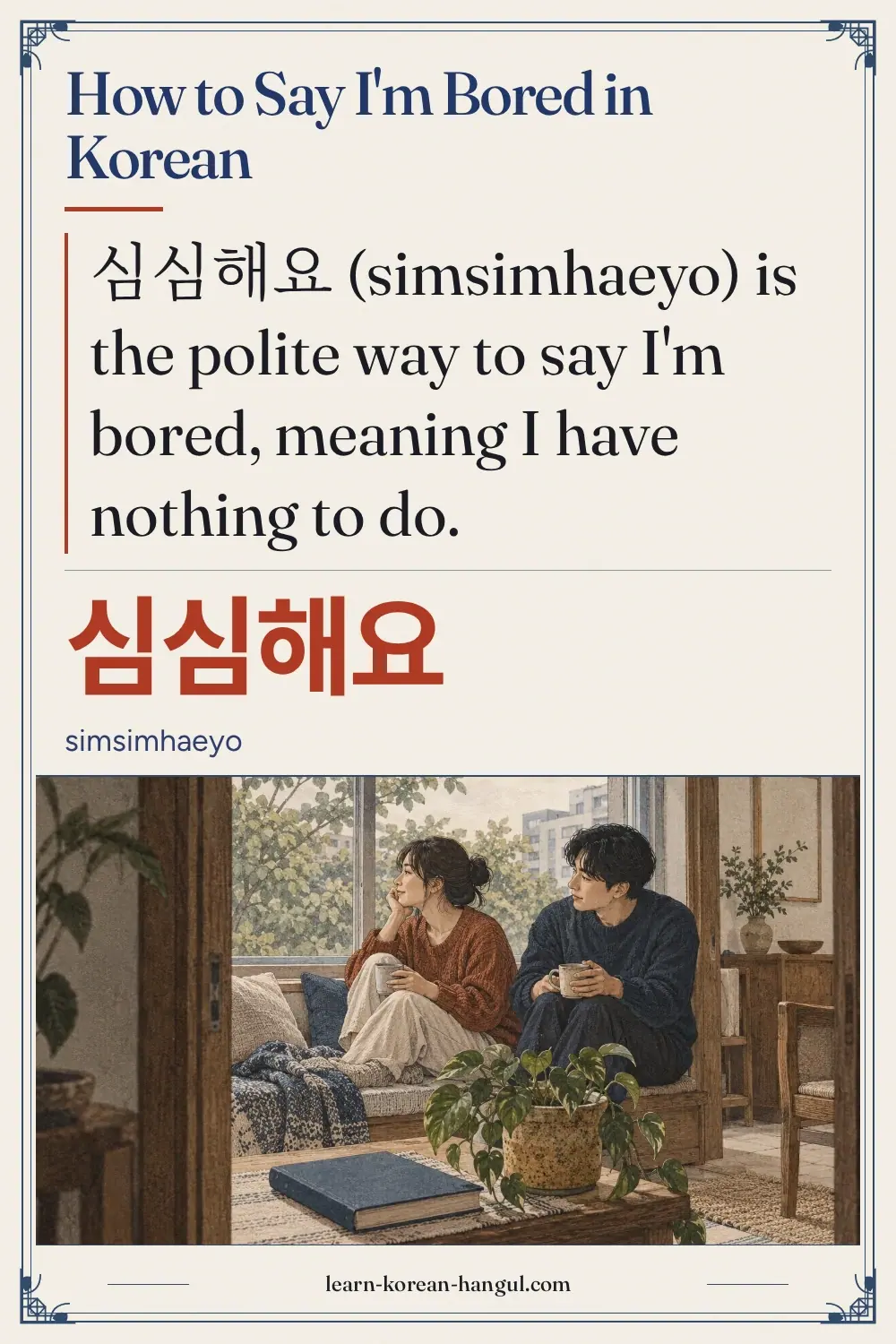
심심해요
심심해요
What you'll learn
- Say I'm bored with 심심해요, 심심합니다 or 심심해, depending on the listener.
- Choose between 심심해요 (nothing to do) and 지루해요 (dull and repetitive).
- See why 심심하다 becomes 심심해요.
- Pronounce 심심해요 with the soft "sh" sound of ㅅ before ㅣ.
Before you start: you only need to read Hangul. When you are busy again, learn I'm busy in Korean. Time: about 10 minutes. Audio plays only when you press a button.
How Do You Say I'm Bored in Korean?
The standard way to say I'm bored in Korean is 심심해요. The adjective 심심하다 describes the feeling of having nothing to do. Korean usually drops "I", so 심심해요 alone is a full sentence. It is not harsh or rude; it sounds light and can even be playful.
| Situation | Best form | Romanization | Why |
|---|---|---|---|
| Telling a coworker or a neighbour | 심심해요 | simsimhaeyo | Polite, natural |
| Texting a close friend | 심심해 | simsimhae | Casual |
| A formal reply or an interview answer | 심심합니다 | simsimhamnida | Formal |
| Something is dull | 지루해요 | jiruhaeyo | The thing is boring |
| Very bored | 심심해 죽겠어요 | simsimhae jukgesseoyo | Exaggeration |
The next section sorts these by listener.
What Are the Polite and Casual Ways to Say I'm Bored?
The forms follow the Korean speech levels, explained in the guide to Korean speech levels. The stem stays the same and the ending changes.
Polite: 심심해요 (simsimhaeyo)
Polite · 해요체심심해요 is the form to learn first. It suits coworkers, classmates and people you do not know well. Use it when you have free time and want to chat or plan something.
주말에 할 일이 없어서 심심해요.
jumare hal iri eopseoseo simsimhaeyo
I have nothing to do at the weekend, so I'm bored.
Casual: 심심해 (simsimhae)
Casual · 반말심심해 drops the polite ending. It is one of the most common texts between friends, and it is basically an invitation. A drawn-out 심심해~ sounds cute, especially to a partner.
나 지금 너무 심심해. 뭐 해?
na jigeum neomu simsimhae. mwo hae?
I'm so bored right now. What are you doing?
Formal: 심심합니다 (simsimhamnida)
Formal · 합쇼체심심합니다 is the formal form. You will rarely need it, because people seldom announce boredom in formal settings. It is pronounced [심심함니다].
Dull: 지루해요 (jiruhaeyo)
Polite · 해요체지루해요 is the word for something tedious, long or repetitive. The subject is often the thing that bores you, such as a lecture, a film or a trip. It can also describe your own feeling about it.
이 영화는 너무 지루해요.
i yeonghwaneun neomu jiruhaeyo
This film is so boring.
Both words are 하다 adjectives, and that gives a handy pattern.
Why Does 심심하다 Become 심심해요?
Both 심심하다 and 지루하다 end in 하다. In polite speech, 하다 becomes 해요 (haeyo). So 심심하다 → 심심해요, 지루하다 → 지루해요, and in the past 심심했어요 (simsimhaesseoyo, I was bored). This pattern has almost no exceptions, so once you know one, you know all.
- 심심하다 → 심심해요 (bored, nothing to do)
- 지루하다 → 지루해요 (dull, tedious)
- 피곤하다 → 피곤해요 (tired)
- 조용하다 → 조용해요 (quiet)
The casual form drops 요, giving 심심해, and the formal form uses -ㅂ니다, giving 심심합니다. There is a second meaning to know: 심심하다 can also describe food that is mild or bland, as in 국이 좀 심심해요 (the soup is a bit bland). The context makes it clear. Now the sounds.
How Do You Pronounce 심심해요?
심심해요 is pronounced [심심해요], sim-sim-hae-yo, in four syllables. It sounds just like it is written. The ㅅ before the vowel ㅣ is made with the tongue closer to the hard palate, so it sounds like a soft "sh". The final ㅁ is made with the lips closed.
- 심 (sim): "shim", with the lips closed at the end.
- 심 (sim): the same, again.
- 해 (hae): "heh", with a light h.
- 요 (yo): "yo".
Because both 심 syllables end in ㅁ, keep the two ㅁ closures short and even. The ㅎ in 해 is often faint in fast speech, but keep it light and present. Revised Romanization keeps the h, simsimhaeyo.
Sound Changes to Listen For
These notes follow the National Institute of Korean Language standard pronunciation rules (표준 발음법):
- ㅂ before ㄴ becomes ㅁ. 심심합니다 is [심심함니다] (Article 18). RR writes simsimhamnida. See Korean nasalization.
- The final ㅆ moves forward. 심심했어요 is [심심해써요] (Article 13).
- No change in 심심해요 itself. Say it as spelled.
With the sound clear, here is when each form fits.
When Should You Use 심심해요, and When Should You Not?
Use 심심해요 when you have free time and want to be social. Do not use it for something that is boring you in the moment; for that, use 지루해요.
Situations Where It Fits
- Texting a friend. 심심해, 뭐 해? (I'm bored, what are you doing?)
- Weekend small talk. 주말에 심심했어요. (I was bored at the weekend.)
- Fishing for plans. 오늘 좀 심심한데 같이 놀까요? (I'm a bit bored today, shall we hang out?)
Situations to Avoid
- Commenting on someone's class or talk. Saying 지루해요 about a speaker's presentation is rude. Keep it to yourself.
- At work in front of a boss. Saying you are bored may suggest you want more work.
- A formal event. Skip it; say nothing, or use 시간이 좀 남네요 (I have some spare time).
Two short conversations show how it sounds.
What Does I'm Bored Sound Like in a Real Conversation?
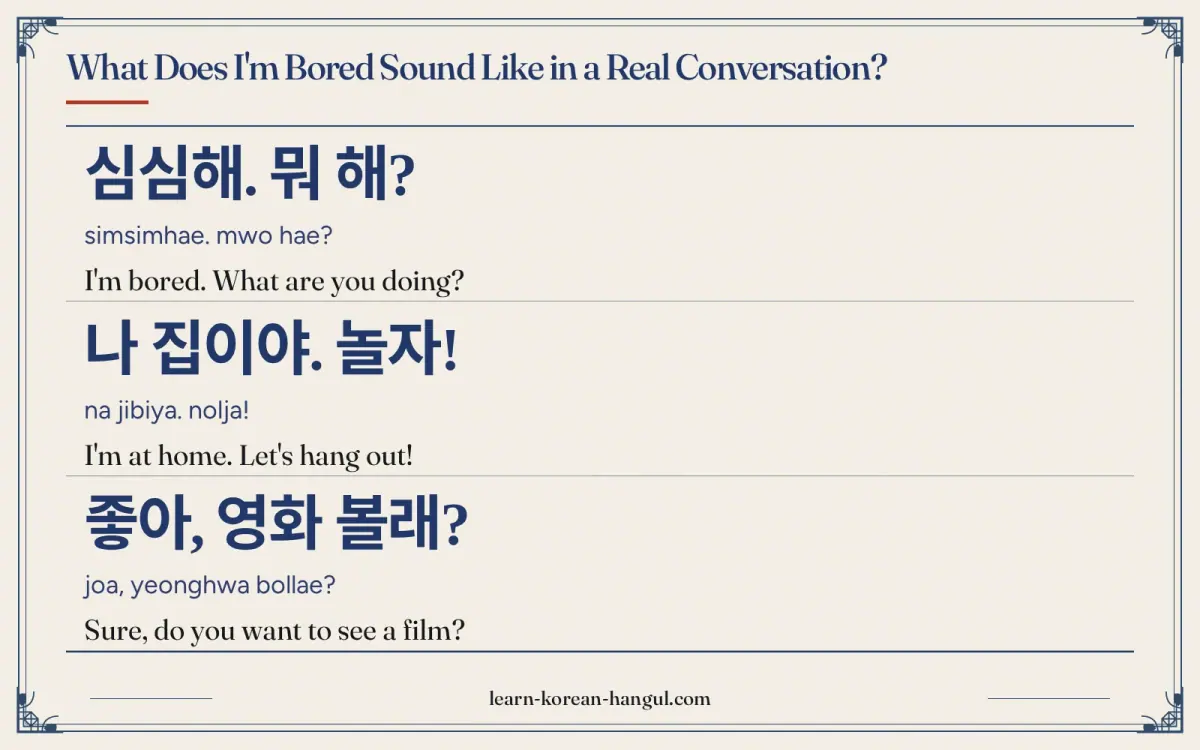
In real life, the line is followed by a question and a plan. Notice the answers.
A Text on Saturday
Jihun
심심해. 뭐 해?
simsimhae. mwo hae?
I'm bored. What are you doing?
Eunseo
나 집이야. 놀자!
na jibiya. nolja!
I'm at home. Let's hang out!
Jihun
좋아, 영화 볼래?
joa, yeonghwa bollae?
Sure, do you want to see a film?
What to notice: 뭐 해? is a wh-question, so the pitch does not shoot up at the end. The friend answers 놀자 (let's hang out), the usual reply to 심심해.
Monday at the Office
Colleague
주말에 뭐 하셨어요?
jumare mwo hasyeosseoyo?
What did you do at the weekend?
Jimin
집에서 쉬었는데 좀 심심했어요.
jibeseo swieonneunde jom simsimhaesseoyo
I rested at home, but I was a bit bored.
Colleague
다음에는 같이 산책해요.
daeumeneun gachi sanchaekaeyo
Next time, let's take a walk together.
What to notice: Jimin adds 좀 to keep the remark light. The colleague uses the honorific 하셨어요 to ask politely, then offers a plan.
What Should You Know about the Culture behind I'm Bored?
Saying 심심해 is basically an invitation. Friends reply with 뭐 해? or 놀자, and the exchange often ends in a meet-up. For this reason, 심심해요 feels warmer than the English "I'm bored", which can sound like a complaint. It can also be said cutely to a partner.
- Pastimes. 심심풀이 (simsimpuri) means something done to pass the time. 심심풀이 땅콩 (simsimpuri ttangkong) is a familiar phrase for snack peanuts, literally "peanuts to kill boredom".
- Gaming and cafés. Many people fill free time with a PC bang, a café or a walk.
- Honest limits. With a boss, keep it light, or choose 한가해요 (I'm free).
The word 심심하다 can also hint at a little loneliness. When someone says 혼자라서 심심해요 (I'm bored because I'm alone), a kind reply is 같이 놀아요 (let's hang out). The next section covers the mistakes learners make.
What Mistakes Do Learners Make with I'm Bored in Korean?
Most mistakes come from mixing 심심하다 with 지루하다 and from the register.
| Mistake | Why it is a problem | Fix |
|---|---|---|
| 지루해요 for "I have nothing to do" | It says the situation is dull | Say 심심해요 |
| 심심해요 for a dull lecture | It says you have free time | Say 지루해요 |
| 심심하요 | 하 + 여요 contracts to 해요 | Say 심심해요 |
| 재미없어요 for your own mood | It means "it's not fun" | Say 심심해요 |
| 심심해 to an elder | Too casual | Say 심심해요 |
The pair 심심하다 and 지루하다 matters most. 심심하다 is about you and an empty schedule: you want something to do. 지루하다 is about monotony: a film, a class or a wait is tedious. 재미없다 (jaemieopda, not fun) is plainer and is used for things, as in 이 게임은 재미없어요 (this game isn't fun).
How Do You Ask Someone If They Are Bored?
Let your pitch rise at the end, because this is a yes/no question. To a friend, say 심심해? (simsimhae?). To a colleague, say 심심해요? (simsimhaeyo?). To an elder, it is better to ask about time instead, with 시간 있으세요? (sigan isseuseyo?), which means "do you have time?". The honorific -(으)시- shows respect for the person you ask.
| Listener | Question | Romanization |
|---|---|---|
| Close friend | 심심해? | simsimhae |
| Colleague | 심심해요? | simsimhaeyo |
| Elder or customer | 시간 있으세요? | sigan isseuseyo |
A friendly follow-up is 우리 뭐 할까요? (uri mwo halkkayo?), which means "what shall we do?".
Is It the Same as I Am Bored, Bored or Boring?
Close. The short answers below cover the other searches folded into this page.
- I am bored in Korean: 심심해요, or 지루해요 if a thing is dull.
- Bored in Korean: 심심한 (simsimhan) before a noun, as in 심심한 하루 (a boring, empty day).
- Boring in Korean: 지루한 (jiruhan) before a noun, as in 지루한 영화 (a boring film), or 재미없어요.
- I'm so bored: 너무 심심해요 or 심심해 죽겠어요 (simsimhae jukgesseoyo, I'm dying of boredom).
- Boredom: 지루함 (jiruham).
Now practise aloud.
Practice: Say It Aloud
Play the slow clip of 심심해요 three times and keep the two ㅁ endings even. Then choose a phrase. Answers follow.
- You text a close friend that you are bored.
- You tell a coworker politely.
- A film is too long and dull.
- You say you are dying of boredom to a friend.
Answers
- 심심해.
- 심심해요.
- 지루해요.
- 심심해 죽겠어.
The phrase flashcards drill these lines with audio.
Related Phrases to Learn Next
Bored leads to busy and to asking about plans.
- I'm busy in Korean: 바빠요 for the opposite.
- What are you doing in Korean: 뭐 해요? as the usual reply.
- I'm sleepy in Korean: 졸려요 when the day drags.
This guide belongs to the Korean feelings phrases collection. What this page does not cover: hobby vocabulary, game words and making plans. Remember that 심심해요 means nothing to do, 지루해요 means dull, and 하다 turns into 해요, and you can say i'm bored in Korean naturally.
Frequently Asked Questions
How do you say I'm bored in Korean?
Say 심심해요 (simsimhaeyo) in polite speech, 심심해 (simsimhae) to a close friend and 심심합니다 (simsimhamnida) in formal speech. The adjective 심심하다 means to have nothing to do. If something is dull, such as a film or a class, use 지루해요 (jiruhaeyo) instead.
What is the difference between 심심해요 and 지루해요?
심심해요 is about you having nothing to do, so you want company or an activity. 지루해요 is about something being tedious, long or repetitive, such as a lecture or a film. So you say 주말에 심심해요 but 영화가 지루해요. 재미없어요 is a plainer "it isn't fun".
Why is 심심하다 pronounced with a soft sh sound?
The consonant ㅅ before the vowel ㅣ is made with the tongue closer to the hard palate, so it sounds like a soft "sh". This is a normal feature of Korean and has no special spelling. Revised Romanization writes it as s, so you see simsimhaeyo. The final ㅁ in each 심 syllable is made with the lips closed.
How do I say I'm so bored I could die in Korean?
Say 심심해 죽겠어요 (simsimhae jukgesseoyo) in polite speech, or 심심해 죽겠어 with friends. It uses 죽겠다, literally "I will die", as a light exaggeration. It is pronounced [심심해 죽께써요]. Use it in a joking mood, not in a formal setting.
Is it rude to say I'm bored in Korean?
Saying 심심해요 about your own free time is not rude and often invites plans. Saying 지루해요 about a person's talk, lesson or event can sound rude, so keep it private. With a boss or elder, mention free time with 시간이 좀 남아요 (I have some spare time) instead.