
열심히 하겠습니다
열심히 하겠습니다
What you'll learn
- Say 열심히 하겠습니다 aloud as [열씸히 하겓씀니다], with all the linked sounds.
- Choose between 열심히 하겠습니다, 최선을 다하겠습니다, 열심히 할게요 and 열심히 할게.
- Make a promise of effort to a boss, a teacher and a friend.
- Avoid using 열심히 해요 when you mean a promise.
Before you start: you need to read Hangul; romanization is shown as an aid and can be hidden. Time: about 9 minutes. Audio plays only when you press a button.
How Do You Say I'll Do My Best in Korean?
The direct answer is 열심히 하겠습니다. It has two parts: 열심히 (diligently) and 하겠습니다 (will do). The verb 하다 means "to do", the pre-final ending -겠- adds will or intention, and -습니다 makes the sentence formal. English has one phrase for this, but Korean has several, and the table shows how they differ.
| Form | Romanization | Meaning | Use it for |
|---|---|---|---|
| 열심히 하겠습니다 | yeolsimhi hagetseumnida | I will work hard | Bosses, interviews, ceremonies |
| 최선을 다하겠습니다 | choeseoneul dahagetseumnida | I will do my utmost | Serious vows, exams, big tasks |
| 열심히 할게요 | yeolsimhi halgeyo | I'll try hard | Colleagues and peers |
| 열심히 할게 | yeolsimhi halge | I'll do my best | Friends and family |
| 노력하겠습니다 | noryeokagetseumnida | I will make an effort | Careful, modest promises |
All five promise effort, and they differ in closeness and strength. The next section puts each in a sentence.
What Are the Formal, Polite and Casual Ways to Say I'll Do My Best?
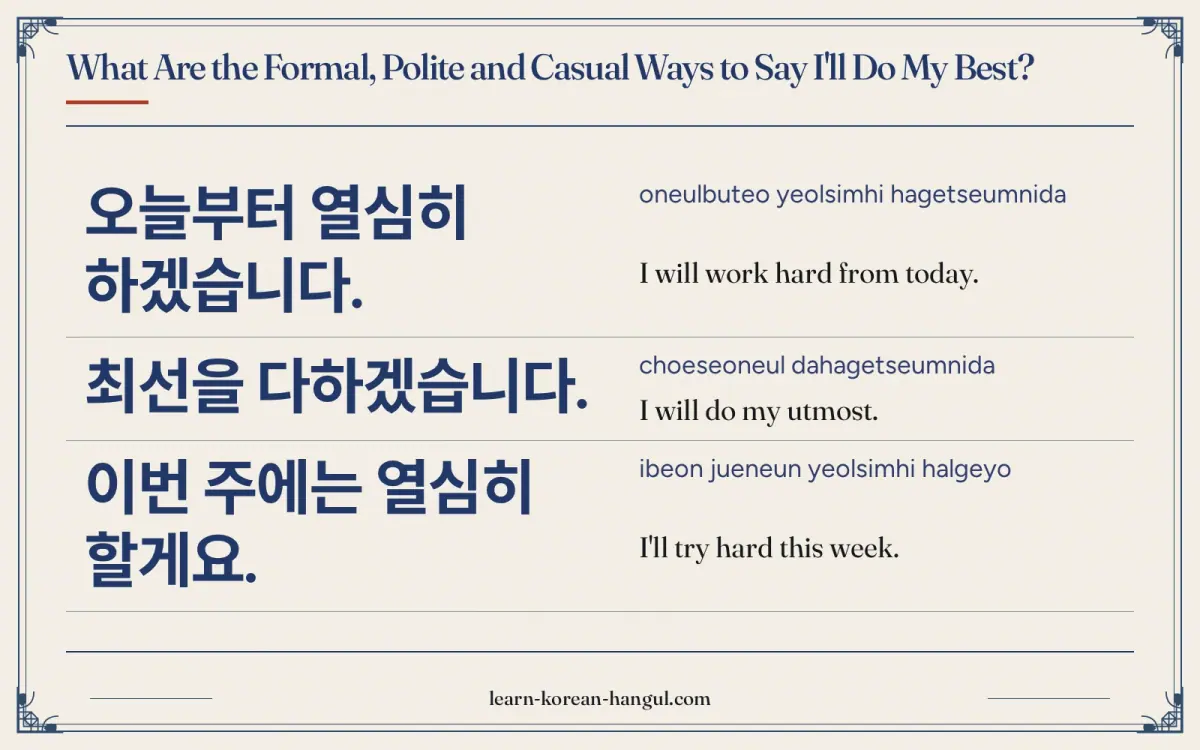
Which form you use depends on who is listening, following the Korean speech levels explained in the guide to Korean speech levels. Formal endings sound respectful and public, polite endings sound warm, and casual endings are for people you know well.
Formal: 열심히 하겠습니다 (yeolsimhi hagetseumnida)
Formal · 합쇼체This is the standard promise in an office or a school. Use it when a boss, a teacher or an interviewer gives you a task. Many people add the time: 오늘부터 (from today).
오늘부터 열심히 하겠습니다.
oneulbuteo yeolsimhi hagetseumnida
I will work hard from today.
Formal: 최선을 다하겠습니다 (choeseoneul dahagetseumnida)
Formal · 합쇼체최선 means "the best" and 다하다 means "to use up completely", so the phrase is "I will give it my all". It is a vow, so it fits an exam, a competition or a big project. Saying it for a small errand sounds too heavy.
최선을 다하겠습니다.
choeseoneul dahagetseumnida
I will do my utmost.
Polite: 열심히 할게요 (yeolsimhi halgeyo)
Polite · 해요체The ending -ㄹ게요 is a promise to the listener, in the polite -요 style. It suits colleagues of similar rank, a team leader in a friendly chat or someone older in a relaxed setting.
이번 주에는 열심히 할게요.
ibeon jueneun yeolsimhi halgeyo
I'll try hard this week.
Casual: 열심히 할게 (yeolsimhi halge)
Casual · 반말Without -요, the promise is casual. Use it with friends, siblings and people who are younger than you. It is a common answer when a friend asks you to study or train.
다음엔 열심히 할게.
daeumen yeolsimhi halge
I'll do my best next time.
Formal: 노력하겠습니다 (noryeokagetseumnida)
Formal · 합쇼체노력 means "effort". 노력하겠습니다 is humbler than 열심히 하겠습니다, because it promises to try and not to succeed. Choose it when the result is uncertain.
The forms differ in tone, not meaning, and the main one has a chain of sound changes worth practising.
How Do You Pronounce 열심히 하겠습니다?
열심히 하겠습니다 is pronounced [열씸히 하겓씀니다], yeolsimhi hagetseumnida in Revised Romanization, the official system for writing Korean in Latin letters.
- 열 (yeol): "yuhl", with a light l.
- 심 (sim): said tense, [씸], because of a rule in Chinese-based words.
- 히 (hi): "hee", and the h often fades in fast speech.
- 하겠습니다 (hagetseumnida): said [하겓씀니다].
Sound Changes to Listen For
- Tense s after ㄹ. In Chinese-based (Sino-Korean) words, a ㅅ after a final ㄹ becomes tense, so 열심 is [열씸]. This follows Article 26 of the Standard Pronunciation rules (표준 발음법); see the lesson on Korean tensification. In fast speech, the ㅎ in 열심히 often fades, giving [열씨미].
- Final ㅆ in 겠. Before another consonant, the final ㅆ of 겠 is said as ㄷ, and the next ㅅ becomes tense, so 겠습 is [겓씀].
- Nasalization. The ㅂ in 습 turns into ㅁ before the ㄴ of 니다, so 습니다 is [씀니다].
- Aspiration in 노력하겠습니다. The ㄱ of 력 meets ㅎ in 하 and becomes ㅋ, so it is [노려카겓씀니다], and Revised Romanization writes the aspirated sound as noryeokagetseumnida.
With the sounds clear, the next question is when to promise effort and when to stay quiet.
When Should You Use 열심히 하겠습니다, and When Should You Not?
Use 열심히 하겠습니다 when someone with authority gives you a task, a rule or a new role. Use 열심히 할게요 with equals, and use 열심히 할게 with friends and family.
Situations Where It Fits
- A job interview. It shows eagerness at the end of an answer.
- A new workplace or class. New people say it when they introduce themselves.
- After feedback. A boss points out a problem, and you promise to improve.
Situations to Avoid
- Small errands. 최선을 다하겠습니다 for buying coffee sounds too grand.
- When you cannot deliver. A formal promise is expected to be kept; use 노력하겠습니다 if you are not sure.
- With close friends. The formal ending sounds stiff or comic, so use 열심히 할게.
Hearing the promise in context makes the choice clearer, so here are three exchanges.
What Does I'll Do My Best Sound Like in a Real Conversation?
Promises of effort follow an instruction, a favour or good wishes. Listen for the ending the second speaker picks.
A New Employee on the First Day
Manager
오늘부터 같이 일해요.
oneulbuteo gachi ilhaeyo
We start working together today.
New Hire
네, 열심히 하겠습니다.
ne, yeolsimhi hagetseumnida
Yes, I will work hard.
What to notice: 같이 is said [가치], because ㅌ before 이 becomes ㅊ, and the manager uses the polite 해요 style with a new colleague.
A Friend before a Race
Friend
내일 달리기 대회지? 파이팅!
naeil dalligi daehoeji? paiting
Your running race is tomorrow, right? Go for it!
You
고마워. 열심히 할게.
gomawo. yeolsimhi halge
Thanks. I'll do my best.
What to notice: between friends, the casual 열심히 할게 is natural, and 파이팅 is a cheer you can read about in fighting in Korean.
A Student and a Teacher
Teacher
다음 주에 시험이에요.
daeum jue siheomieyo
The exam is next week.
Student
네, 최선을 다하겠습니다.
ne, choeseoneul dahagetseumnida
Yes, I will do my utmost.
What to notice: the student chooses the stronger vow for an exam, and 시험이에요 is said [시허미에요], with the ㅁ linking to the next syllable. The setting of such promises says a lot about Korean work and school culture.
What Should You Know about the Culture behind Promising Your Best?
In Korea, promising effort is part of how newcomers show respect. The promise matters more than a personal boast, and it usually comes with a bow.
- First-day greetings. New employees and trainees often introduce themselves with a short speech that ends with 열심히 하겠습니다, usually with a slight bow.
- Before exams and contests. Students and athletes say 최선을 다하겠습니다 to teachers and coaches.
- Effort over talent. Praise often goes to effort, so promising diligence is a safe, humble way to speak.
- Pair with a request. Newcomers often add 잘 부탁드립니다, covered in nice to work with you in Korean.
An expert insight: learners often assume "I'll do my best" in English is a casual phrase and look for a casual Korean equivalent. Actually, 열심히 하겠습니다 is the standard workplace form, and the casual one belongs only to friends. The mistakes below come from this mismatch.
What Mistakes Do Learners Make with I'll Do My Best in Korean?
Most mistakes come from the verb form or from mixing registers.
| Mistake | Why it is a problem | Fix |
|---|---|---|
| 열심히 해요 as a promise | States a habit, "I do it diligently" | Say 열심히 하겠습니다 or 열심히 할게요 |
| 열심히 하세요 about yourself | The 세요 form addresses another person | Use 하겠습니다 |
| 열심히 할게 to a boss | Casual ending sounds disrespectful | Use 열심히 하겠습니다 |
| Saying ha-gaet-seum-ni-da | Misses the sound chain | Say [하겓씀니다] |
| 최선을 다하겠습니다 for small things | Too heavy for the task | Use 열심히 하겠습니다 |
Learners often assume that a longer promise is a stronger one. Actually, over-promising can backfire, because Koreans expect a formal promise to be kept. When you are unsure, 노력하겠습니다 is safer.
Other Ways People Search for I'll Do My Best in Korean
People look up this phrase in a few shapes. The short answers below cover each one.
- Do my best in Korean: 최선을 다하겠습니다 for a vow, or 열심히 할게요 for daily use.
- Try my best in Korean: 노력하겠습니다, which promises an attempt.
- I will work hard in Korean: 열심히 하겠습니다, or 열심히 공부하겠습니다 for studying.
- I'll try in Korean: 한번 해 볼게요 (hanbeon hae bolgeyo), which means "I'll give it a try".
- Romanized: yeolsimhi hagetseumnida, following the Revised Romanization of Korean; romanization is an aid, not the real spelling.
Reading the forms is one thing; saying them on cue is another, so practise now.
Practice: Say It Aloud
Play the slow clip of 열심히 하겠습니다 and repeat it three times, linking [하겓씀니다]. Then say 열심히 할게 the way you would to a friend. Choose a phrase for each situation, and check the answers below.
- A manager gives you a new project.
- A friend asks if you will study this weekend.
- A coach asks if you are ready for the final match.
Answers
- 열심히 하겠습니다.
- 열심히 할게.
- 최선을 다하겠습니다.
Drill these lines with the phrase flashcards, which include audio for each form.
Related Phrases to Learn Next
Promising effort sits next to cheers and good wishes.
- Fighting in Korean: 파이팅, the cheer for effort.
- Good luck in Korean: wishing others success.
- Nice to work with you in Korean: the usual partner of this promise.
This guide belongs to the business Korean phrases collection. What this page does not cover: written work emails and long self-introductions. Use 열심히 하겠습니다 for authority, 열심히 할게요 for equals and 열심히 할게 for friends, and you will promise your best the way Koreans do.
Frequently Asked Questions
How do you say I'll do my best in Korean?
Say 열심히 하겠습니다 (yeolsimhi hagetseumnida) to a boss, an interviewer or a teacher. With colleagues or friends, say 열심히 할게요, or 열심히 할게 for close friends. 열심히 means "diligently", and the future ending -겠습니다 or -ㄹ게요 turns it into a promise. For a stronger vow, say 최선을 다하겠습니다.
How do you pronounce 열심히 하겠습니다?
It sounds like [열씸히 하겓씀니다], and in fast speech the ㅎ of 히 often fades to [열씨미 하겓씀니다]. The ㅆ of 겠 is said as ㄷ before ㅅ, which then becomes tense. Then ㅂ turns into ㅁ before ㄴ, so 습니다 is [씀니다]. Revised Romanization writes it yeolsimhi hagetseumnida.
What is the difference between 열심히 하겠습니다 and 최선을 다하겠습니다?
열심히 하겠습니다 promises effort, "I will work hard". 최선을 다하겠습니다 promises the maximum, "I will do my utmost". The second sounds more serious, so people use it at ceremonies, before an exam or after being given a big responsibility. In a daily meeting, the first one is enough and sounds more natural.
Is 열심히 하겠습니다 formal or casual?
It is formal. The ending -겠습니다 belongs to the formal style, which is used in interviews, presentations, announcements and with senior colleagues. For a polite but warmer tone, use 열심히 할게요. For friends and family, use 열심히 할게. All three mean the same promise, and only the closeness changes.
Can I use 열심히 하겠습니다 with friends, elders and strangers?
It suits elders, teachers, bosses and strangers well, because it is formal. With friends it sounds stiff, even funny, so use 열심히 할게 instead. With peers at work, 열심히 할게요 is the usual middle choice. If you are speaking to your boss in a casual chat, 열심히 하겠습니다 still sounds respectful.
What is the most common mistake with I'll do my best in Korean?
The most common mistake is saying 열심히 해요, which means "I do it diligently" as a habit, not as a promise. A promise needs the future form -겠습니다 or -ㄹ게요. A second mistake is saying 열심히 하세요 about yourself; that form tells another person to work hard, so it never describes your own effort.