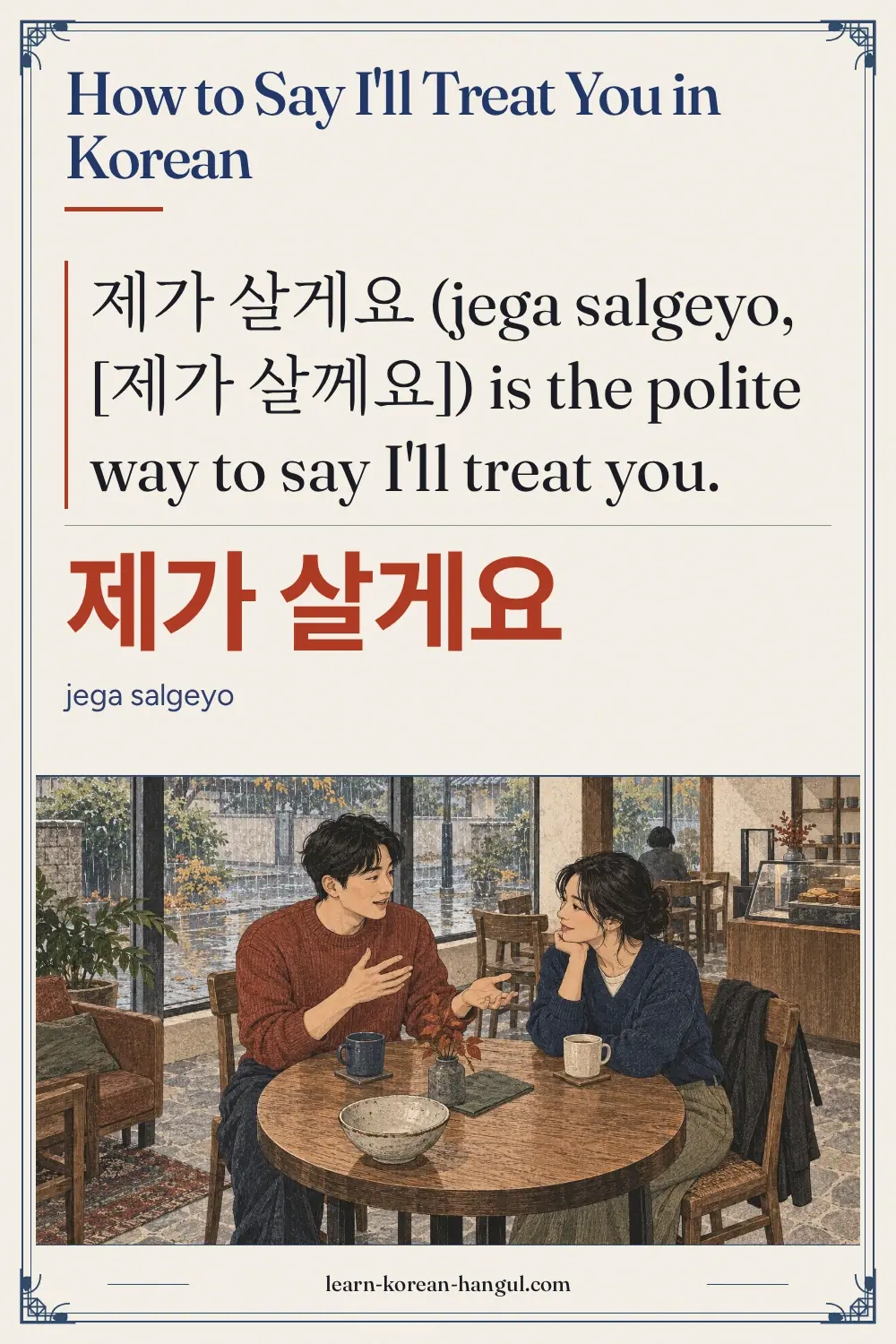
제가 살게요
제가 살게요
What you'll learn
- Say I'll treat you with 제가 살게요, 제가 낼게요 or 내가 쏠게, depending on the listener.
- Use the -(으)ㄹ게요 ending for promises and offers.
- Know who pays in Korea and how to offer politely.
- Pronounce 제가 살게요 as [제가 살께요].
Before you start: you only need to read Hangul. When the meal ends, learn the bill please in Korean. Time: about 10 minutes. Audio plays only when you press a button.
How Do You Say I'll Treat You in Korean?
The standard way to say I'll treat you in Korean is 제가 살게요. The verb 사다 means to buy, and in this setting it means to buy the meal for the other person. 제가 is the humble-polite "I" with the subject marker, so the sentence is clear and kind. Add what you are paying for to be specific: 오늘은 제가 살게요 (today I'll treat you) or 커피는 제가 살게요 (the coffee is on me).
| Situation | Best form | Romanization | Why |
|---|---|---|---|
| Treating a colleague or a new friend | 제가 살게요 | jega salgeyo | Polite, natural |
| Paying the bill at the counter | 제가 낼게요 | jega naelgeyo | I'll pay |
| Treating a close friend, playfully | 내가 쏠게 | naega ssolge | Casual, "my treat" |
| Treating to celebrate | 한턱낼게요 | hanteongnaelgeyo | I'll treat everyone |
| Splitting the bill | 각자 계산해요 | gakja gyesanhaeyo | Each pays their own |
The next section sorts these by listener.
What Are the Polite and Casual Ways to Say I'll Treat You?
The forms follow the Korean speech levels, explained in the guide to Korean speech levels. The verb changes, and the ending -ㄹ게요 stays.
Polite: 제가 살게요 (jega salgeyo)
Polite · 해요체제가 살게요 is the form to learn first. It suits colleagues, friends and people you have just met. Add 오늘은 (today) to make it warmer.
오늘은 제가 살게요. 많이 드세요.
oneureun jega salgeyo. mani deuseyo
Today I'll treat you. Please eat a lot.
Paying: 제가 낼게요 (jega naelgeyo)
Polite · 해요체제가 낼게요 uses 내다, "to pay". It fits best when you pay the whole bill at the end. It also works for a drink, a ticket or a taxi.
점심은 제가 낼게요.
jeomsimeun jega naelgeyo
I'll pay for lunch.
Casual: 내가 쏠게 (naega ssolge)
Casual · 반말내가 쏠게 uses the casual 내가 (I) and the slang verb 쏘다, which literally means "to shoot". Among friends, "shooting" a meal means treating everyone. Use it with close friends and people younger than you. Do not use it with a boss or an elder.
오늘은 내가 쏠게! 뭐 먹고 싶어?
oneureun naega ssolge! mwo meokgo sipeo?
My treat today! What do you want to eat?
Treating the Group: 한턱낼게요 (hanteongnaelgeyo)
Polite · 해요체한턱내다 means to treat others to a meal, often to celebrate. You say 월급 받았으니까 한턱낼게요 (I got paid, so I'll treat you all). It is pronounced [한텅낼께요]. A more formal word for treating a guest is 대접하다 (daejeopada).
The ending in all of these forms carries the key meaning.
Why Does the Ending -(으)ㄹ게요 Make It an Offer?
The ending -(으)ㄹ게요 means "I will, for you" or "I promise to". The speaker makes the decision right now, in response to the situation. After a vowel stem, add -ㄹ게요, and after a consonant stem, add -을게요.
- 사다 → 살게요 (I'll buy)
- 내다 → 낼게요 (I'll pay)
- 쏘다 → 쏠게요 (I'll treat, slang)
- 먹다 → 먹을게요 (I'll eat)
There are three rules to remember. First, the subject is always "I". Second, you cannot ask a question with it, so 살게요? is wrong; ask 제가 살까요? (jega salkkayo, shall I treat you?). Third, it differs from 살 거예요 (sal geoyeyo), which states a plan, such as "I will buy it later". Use 살게요 to offer at the table and 살 거예요 to describe plans. Next, the sounds.
How Do You Pronounce 제가 살게요?
제가 살게요 is pronounced [제가 살께요], je-ga sal-kke-yo, in five syllables. The first three sounds are as written. In 살게요, the ㄱ after the final ㄹ is pronounced as a tense ㄲ. It is a short, tight sound, with no puff of air.
- 제 (je): "jeh".
- 가 (ga): "gah".
- 살 (sal): "sahl", ending with the tongue tip on the ridge behind your upper teeth.
- 게 (kke): a tense k and "eh".
- 요 (yo): "yo".
The spelling uses 게, not 께, in statements, even though the sound is tense. Revised Romanization does not show tensing that comes from a neighbouring sound, so it writes jega salgeyo. In 내가 쏠게, the ㅆ is a written tense letter, so RR shows it: naega ssolge.
Sound Changes to Listen For
These notes follow the National Institute of Korean Language rules:
- Tense ㄲ after ㄹ. -(으)ㄹ게요 is heard as [-ㄹ께요]: [살께요], [낼께요], [쏠께요]. The spelling follows the Hangul Spelling Rules (한글 맞춤법), where statement endings keep ㄱ and question endings such as -ㄹ까요 are written with ㄲ. See Korean tensification.
- Nasalization. 한턱낼게요 is [한텅낼께요], because the ㄱ sound at the end of 턱 turns into ㅇ before ㄴ (Article 18). See Korean nasalization.
- Tense after ㄱ. 각자 is [각짜] (Article 23).
With the sound clear, here is when each form fits.
When Should You Use 제가 살게요, and When Should You Not?
Use 제가 살게요 when you have invited someone, when you earn more than they do, or when you want to say thanks. Be careful when a senior has already decided to pay.
Situations Where It Fits
- You invited the person. 제가 초대했으니까 제가 살게요. (I invited you, so I'll treat you.)
- To thank someone. 지난번에 도와주셔서 오늘은 제가 살게요. (You helped me last time, so I'll treat you today.)
- A celebration. 취직했으니까 한턱낼게요. (I got a job, so I'll treat you all.)
Situations to Avoid
- With a boss or senior. They usually pay. Offering is polite, but insisting can seem rude. Say 다음에는 제가 살게요 (next time, I'll treat you).
- With the slang 쏠게. Keep 내가 쏠게 for friends your own age or younger.
- A formal business meal. Let the host handle it, and say 잘 먹겠습니다 (jal meokgetseumnida, I will eat well).
Two short conversations show how it sounds.
What Does I'll Treat You Sound Like in a Real Conversation?
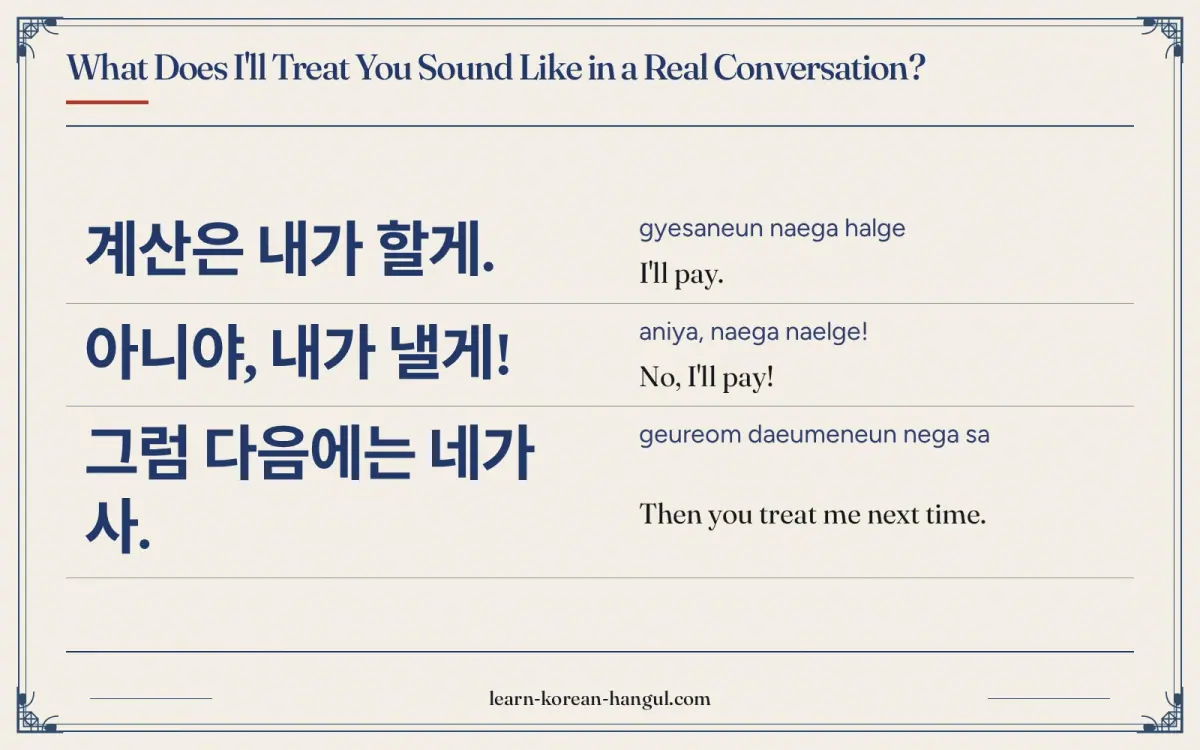
In real life, the offer meets a polite refusal, and then a compromise. Notice the answers.
At the Counter
Minjae
계산은 내가 할게.
gyesaneun naega halge
I'll pay.
Soyeon
아니야, 내가 낼게!
aniya, naega naelge!
No, I'll pay!
Minjae
그럼 다음에는 네가 사.
geureom daeumeneun nega sa
Then you treat me next time.
Soyeon
알았어, 다음에는 내가 쏠게!
arasseo, daeumeneun naega ssolge!
Okay, next time my treat!
What to notice: both friends offer, and the compromise is 다음에는 (next time). The pattern -ㄹ게 appears three times, and each is a promise.
Dinner with the Department Head
Department Head
오늘은 내가 살게. 많이 먹어.
oneureun naega salge. mani meogeo
Today I'll treat you. Eat a lot.
Staff
감사합니다, 부장님. 잘 먹겠습니다. 다음에는 제가 살게요.
gamsahamnida, bujangnim. jal meokgetseumnida. daeumeneun jega salgeyo
Thank you, sir. I will eat well. Next time I'll treat you.
What to notice: the senior speaks casually, as is normal for a senior to a junior, and the junior answers with thanks, the formal 잘 먹겠습니다 and a polite promise.
What Should You Know about the Culture behind I'll Treat You?
In Korea, the person who invited, the senior or the older person usually pays. Among friends of the same age, people often take turns, so one pays this time and the other pays the next. Because of this, "next time it's my turn" is the standard reply. Some people compete to reach the counter first, and this friendly fight over the bill is part of the ritual. Younger people also use 더치페이 (deochipei, "going Dutch") when they want to split.
- Taking turns. 번갈아 내요 (beongara naeyo) means to pay in turns.
- Thanking. After a meal, say 잘 먹었습니다 (jal meogeotseumnida, I ate well).
- Splitting. 각자 계산해요 or 더치페이 해요 is fine among colleagues and friends.
If someone treats you, return the kindness with coffee or dessert, and say 다음에는 제가 살게요. This keeps relationships balanced. The next section covers the mistakes learners make.
What Mistakes Do Learners Make with I'll Treat You in Korean?
Most mistakes come from the ending and from the register.
| Mistake | Why it is a problem | Fix |
|---|---|---|
| 제가 사요 | States a fact: "I buy" | Say 제가 살게요 |
| 제가 살 거예요 | A plan, not an offer | Say 제가 살게요 |
| 제가 살게요? | -ㄹ게요 cannot ask a question | Say 제가 살까요? |
| Saying 게 with a plain g | The ㄱ is tense in speech | Say [제가 살께요] |
| 내가 쏠게 to a boss | Slang and casual | Say 제가 살게요 |
| 제가 낼게요 for a gift | 내다 is about paying | Say 선물을 살게요 |
The most useful contrast is 살게요 and 살 거예요. 제가 살 거예요 says you plan to buy something, perhaps for yourself. 제가 살게요 is a reaction to the moment that offers to buy for someone else. An expert tip: to be clearly kind to a senior, say 제가 사 드릴게요 (jega sa deurilgeyo, I'll buy it for you), which adds the humble 드리다.
How Do You Ask Who Is Paying?
Use -(으)ㄹ까요 for suggestions. To offer, say 제가 살까요? (jega salkkayo?), "shall I treat?". To ask who pays, say 누가 낼까요? (nuga naelkkayo?). Wh-questions like this fall or rise-fall; they do not end with a sharp rise. To split, ask 각자 계산할까요? (gakja gyesanhalkkayo?).
| Purpose | Question | Romanization |
|---|---|---|
| Offer to treat | 제가 살까요? | jega salkkayo |
| Ask who pays | 누가 낼까요? | nuga naelkkayo |
| Suggest splitting | 각자 계산할까요? | gakja gyesanhalkkayo |
If someone insists on paying, a polite answer is 아니에요, 제가 낼게요 or 잘 먹었습니다.
Is It the Same as My Treat, I'll Pay, on Me or Treat?
Close. The short answers below cover the other searches folded into this page.
- My treat in Korean: 오늘은 제가 쏠게요 or, to friends, 내가 쏠게.
- I'll pay in Korean: 제가 낼게요 or 제가 계산할게요 (jega gyesanhalgeyo).
- On me in Korean: 이건 제가 살게요 (this one's on me).
- Treat in Korean: the noun is 한턱 (hanteok), the verb 한턱내다; for a treat as a small gift, say 선물 (seonmul).
- Next time is on me: 다음에는 제가 살게요.
Now practise aloud.
Practice: Say It Aloud
Play the slow clip of 제가 살게요 three times and make the ㄲ tight. Then choose a phrase. Answers follow.
- You invited a new colleague to lunch.
- You want to pay at the register.
- You treat a close friend playfully.
- Your boss paid, and you want to reply kindly.
Answers
- 제가 살게요.
- 제가 낼게요.
- 내가 쏠게!
- 감사합니다. 다음에는 제가 살게요.
The phrase flashcards drill these lines with audio.
Related Phrases to Learn Next
Treating leads to the bill, to thanks and to a toast.
- The bill please in Korean: 계산해 주세요 at the counter.
- Thank you for the meal in Korean: 잘 먹었습니다 after eating.
- Cheers in Korean: 건배 when the drinks arrive.
This guide belongs to the Korean restaurant phrases collection. What this page does not cover: ordering, menu words and tipping. Remember that -ㄹ게요 is a promise, say [살께요] with a tense ㄲ, and offer 다음에는 to keep things balanced, and you can say i'll treat you in Korean naturally.
Frequently Asked Questions
How do you say I'll treat you in Korean?
Say 제가 살게요 (jega salgeyo) in polite speech. It literally means "I will buy" and is understood as "I'll treat you". To say you will pay the bill, use 제가 낼게요 (jega naelgeyo). With close friends, say 내가 쏠게 (naega ssolge), "my treat". Add 오늘은 (today) to make it warmer.
What does -(으)ㄹ게요 mean in 제가 살게요?
-(으)ㄹ게요 shows that you decide, right now, to do something for the listener, like a promise. The subject is always "I", and you cannot turn it into a question. For a plan, use 살 거예요; for a suggestion or a question, use 살까요. After a vowel stem add -ㄹ게요, and after a consonant stem add -을게요.
How do you pronounce 제가 살게요?
It is pronounced [제가 살께요]. After the final ㄹ, the ㄱ of 게 becomes a tense ㄲ. The spelling keeps 게, and Revised Romanization writes jega salgeyo, because it does not show tensing that comes from a neighbouring sound. The ㄲ is short and tight, with no puff of air.
What is the difference between 제가 살게요 and 제가 낼게요?
살게요 means "I'll buy it for you", so it is the warm way to say you are treating. 낼게요 means "I'll pay", so it fits the moment at the register or when you cover a ticket or a drink. In practice both are used for meals, and Koreans understand them as an offer to pay.
Who pays for the meal in Korea?
The person who invited, the older person or the senior usually pays. Friends of similar age often take turns, so "next time I'll treat you" (다음에는 제가 살게요) is a common reply. Some groups split the bill with 더치페이 or 각자 계산해요. If you are unsure, offer once and accept the answer politely.
Can I say 내가 쏠게 to my boss?
No. 내가 쏠게 is casual and uses slang, so keep it for close friends and people younger than you. To a boss or elder, say 제가 살게요, or 제가 사 드릴게요 for an extra humble tone. A boss usually pays anyway, so thank them with 잘 먹겠습니다 and offer 다음에는 제가 살게요.