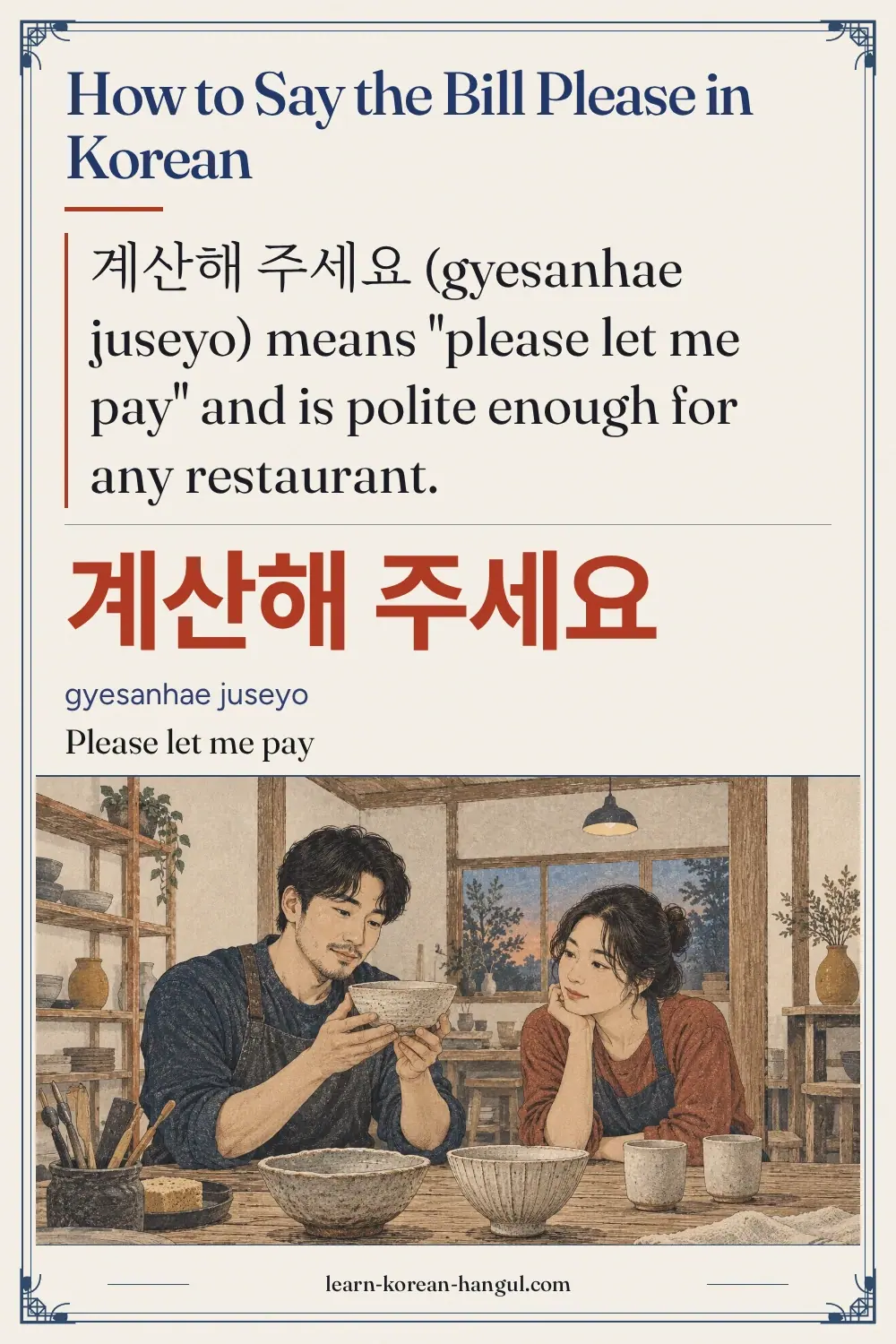
계산해 주세요
계산해 주세요
What you'll learn
- Say 계산해 주세요, 계산서 주세요 and 계산할게요 and pick the one that fits the moment.
- Pronounce 계산해 주세요, including the tense [께] in 계산할게요.
- Ask for separate bills and say who is paying.
- Understand how paying works in many Korean restaurants.
Before you start: if you have just finished eating, you may also want thank you for the meal in Korean. Time: about 12 minutes. Audio plays only when you press a button.
How Do You Say the Bill Please in Korean?
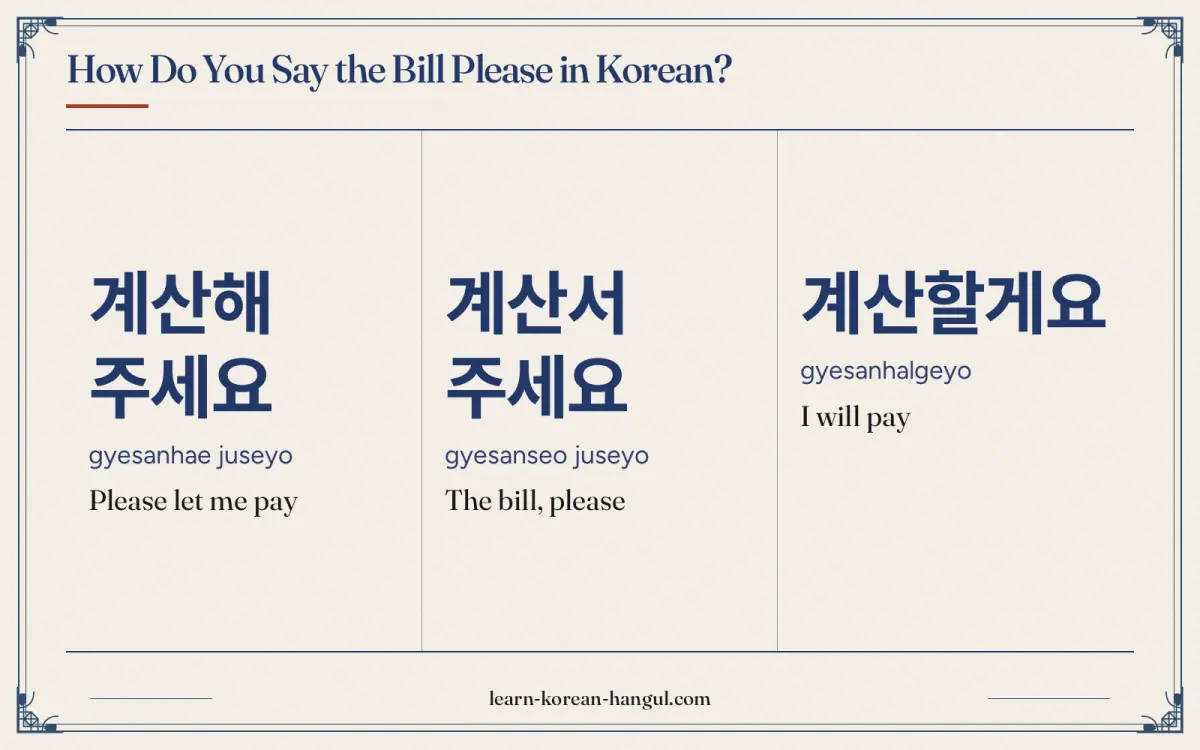
The standard way to say the bill please in Korean is 계산해 주세요. The noun 계산 means "calculation" and, in a shop or restaurant, "paying". Adding 하다 makes the verb 계산하다, "to calculate" or "to pay". The ending -아/어 주세요 turns a verb into a polite request. Together, the sentence asks the staff to settle the bill with you.
| Korean | Romanization | Meaning | Where you hear it |
|---|---|---|---|
| 계산해 주세요 | gyesanhae juseyo | Please let me pay | Any restaurant or cafe |
| 계산서 주세요 | gyesanseo juseyo | The bill, please | Table service, a slip is brought |
| 계산할게요 | gyesanhalgeyo | I will pay | At the counter, or when you offer to pay |
| 계산 부탁드립니다 | gyesan butakdeurimnida | Please take care of the payment (formal) | Hotels, formal dinners |
| 계산해 줘 | gyesanhae jwo | Pay for me / ring it up (casual) | Close friends only |
Revised Romanization (the South Korean government standard of 2000) is only a reading aid here. Learn the Hangul first. Next, the register ladder.
What Are the Polite and Casual Ways to Say the Bill Please?
The wording of the bill please in Korean depends on who you are talking to and what you want. You can ask staff to bring the slip, tell them you are ready to pay, or offer to pay for the group.
Polite: 계산해 주세요 (gyesanhae juseyo)
Polite · 해요체This is the safe default. Say it after catching the staff's attention with 여기요 (yeogiyo, "excuse me, over here"). The verb 계산하다 becomes 계산해 before 주세요.
여기요, 계산해 주세요.
yeogiyo, gyesanhae juseyo
Excuse me, the bill please.
Polite: 계산서 주세요 (gyesanseo juseyo)
Polite · 해요체In restaurants where staff bring the bill to the table, ask for the slip with 계산서 주세요. Here the noun 계산서 (the bill) replaces the verb, and 주세요 means "please give".
Separate Bills: 따로 계산해 주세요
Polite · 해요체따로 (ttaro) means "separately". Put it before 계산해 주세요 when each person in the group pays their own share.
따로 계산해 주세요.
ttaro gyesanhae juseyo
Separate bills, please.
Offering to Pay: 계산할게요 (gyesanhalgeyo)
Polite · 해요체계산할게요 does not ask staff for anything. It says "I will pay" and is what you say when you walk to the counter. The ending -(으)ㄹ게요 is a promise or a decision about your own action. Among friends, drop the 요: 계산할게. The easy way to treat others is 내가 낼게 (naega naelge), "I'll pay".
Formal: 계산 부탁드립니다 (gyesan butakdeurimnida)
Formal · 합쇼체부탁드립니다 is the formal, humble way to say "I ask you to do this". You hear it in hotels and at formal dinners, and you can use it when you want to sound especially careful. In everyday life it is more than you need, and 계산해 주세요 is fine.
Casual: 계산해 줘 (gyesanhae jwo)
Casual · 반말With a close friend or sibling you might say 계산해 줘 ("pay for me"), but this is rare. Friends more often say who is paying: 오늘은 내가 낼게. Use the polite forms with any staff member, even a young one. The next section covers the sound.
How Do You Pronounce 계산해 주세요?
계산해 주세요 is pronounced [계산해 주세요] in careful speech, with six syllables: gye-san-hae ju-se-yo. The first syllable is often relaxed to [게], so [게산해 주세요] is also normal and the Standard Pronunciation Rules (표준 발음법, Article 5) allow [ㅔ] for ㅖ in any syllable other than 예 and 례.
- 계 (gye): a short "ye"-like sound, or just "ge" in relaxed speech.
- 산 (san): a plain s, the vowel ㅏ, and a short n.
- 해 (hae): a light h and the vowel ㅐ. The ㅎ is soft after ㄴ.
- 주 (ju): a plain j and a rounded u.
- 세 (se): s plus ㅔ.
- 요 (yo): a short, light ending.
Sound Changes to Listen For
- Tense [께] in 계산할게요. After the -(으)ㄹ ending, the ㄱ of 게 becomes tense: [계산할께요]. The Revised Romanization still writes gyesanhalgeyo because it does not show tensing caused by a neighbouring sound. See Korean tensification.
- Tense [뜨] in 부탁드립니다. The ㄱ batchim in 탁 tenses the ㄷ of 드: [부탁뜨림니다]. The 립니다 ending also turns the ㅂ into [ㅁ].
- Tense [짜] in 각자. In 각자 계산하자, the ㅈ after ㄱ is tense: [각짜 계산하자].
- No tensing in 주세요. The ㅈ stays plain after 해: say [주세요], not "jjuseyo".
- Spacing. Write 계산해 주세요 with a space before 주세요.
- No rising pitch in a request. A request ends calmly. A sharp rise would turn it into a question.
Aim for a calm, level sentence ending and a clear 해. Now, when do you use each form?
When Should You Use 계산해 주세요, and When Should You Not?
Use 계산해 주세요 whenever you need staff to bring or ring up the bill. The choice between slip, payment and group payment depends on how the restaurant works.
Situations Where It Fits
- Table service. Catch the staff's eye, say 여기요, then 계산서 주세요.
- Counter service. Walk to the register and say 계산할게요 or just hand over your card.
- Group dinner. Say 따로 계산해 주세요 before the bill is added up, so the staff can split it.
Situations to Avoid
- 계산해 줘 with staff. Even if the waiter is your age, the casual form sounds rude.
- Waiting for a bill that will not come. In many restaurants nobody brings the bill unless you ask, so a long wait is normal.
- 계산해요 as a request. That form means "I pay" or "we pay", not "please let me pay".
What Does the Bill Please Sound Like in a Real Restaurant?
Three short scenes show the forms in use. Listen for the ending of each sentence.
Paying at the Table
Guest
여기요, 계산해 주세요.
yeogiyo, gyesanhae juseyo
Excuse me, the bill please.
Staff
네, 카드로 하시겠어요?
ne, kadeuro hasigesseoyo
Yes, will you pay by card?
Guest
네, 카드로 할게요.
ne, kadeuro halgeyo
Yes, I'll pay by card.
What to notice: The staff member says 하시겠어요 [하시게써요], the polite and honorific way to ask what you will do. The guest answers with 할게요 [할께요], the -ㄹ게요 promise form.
Friends Settle Up
Ji-Ho
오늘은 내가 낼게.
oneureun naega naelge
Today it's on me.
Su-Bin
아니야, 각자 계산하자.
aniya, gakja gyesanhaja
No, let's each pay our own.
What to notice: Both friends drop 요, because they are close. 낼게 sounds like [낼께], and 각자 sounds like [각짜]. 각자 계산하자 uses the suggestion ending -자.
At the Counter
Guest
계산할게요.
gyesanhalgeyo
I'd like to pay.
Staff
삼만 오천 원입니다.
samman ocheon wonimnida
That's 35,000 won.
Guest
카드 돼요?
kadeu dwaeyo
Can I use a card?
Staff
네, 됩니다.
ne, doemnida
Yes, you can.
What to notice: at a counter you say 계산할게요 [계산할께요] rather than ask for a slip. 원입니다 sounds like [워님니다], and 됩니다 sounds like [됨니다]. The yes-or-no question 카드 돼요? ends with a gentle rise. For more on cards, see do you take cards in Korean.
How Does Paying Work in Korean Restaurants?
These are general habits, not rules, and they vary by place.
- Pay at the counter. In many restaurants you take the bill slip to the register near the door when you leave. In others the staff come to the table.
- No tip. Tipping is not a normal custom, so the number on the bill is the amount you pay.
- One person treats. Groups often let one person pay for everyone and take turns next time. If you want to treat, see i'll treat you in Korean.
- Splitting. Friends sometimes use the loanword 더치페이 (deochipei) for splitting evenly, or 각자 계산 for paying separately.
- Receipt. A card slip is normally printed. To ask for a receipt, read receipt please in Korean.
An expert tip: 계산서 breaks into 계산 ("calculation") and 서 ("document"), so the bill is literally "the calculation paper". The same word 계산 appears in math class, which is why a Korean child can say 계산 문제 ("calculation problem") and 계산해 주세요 using one root. For how the endings carry politeness, see Korean speech levels.
What Mistakes Do Learners Make with the Bill Please in Korean?
Most errors come from mixing up the bill, the receipt and the act of paying.
| Mistake | Why it is a problem | Fix |
|---|---|---|
| Saying 영수증 주세요 to get the bill | 영수증 is the receipt after payment | Ask for 계산서 first |
| Saying 계산해요 to ask for the bill | It means "I pay" and is a statement | Say 계산해 주세요 |
| Using 계산해 줘 with a waiter | The casual form sounds rude | Use 계산해 주세요 |
| Saying 돈 주세요 ("give me money") | It sounds like asking for cash | Say 계산할게요 when you pay |
| Waiting for the bill to arrive on its own | Many restaurants expect you to ask | Say 여기요, then 계산서 주세요 |
Learners often translate "the check" word for word. In Korean, the object is the payment, so you ask to pay with 계산, not to receive a piece of paper.
Is It the Same as Check Please, Pay the Bill or Split the Bill?
Yes. Each of these English phrases maps onto one of the forms above.
- Check please in Korean: 계산서 주세요, or 계산해 주세요 if you are ready to pay.
- Pay the bill in Korean: 계산할게요 or 계산하다.
- Can I pay in Korean: 계산해도 돼요? (gyesanhaedo dwaeyo) literally "may I pay?", and the usual answer is 네 or a nod toward the counter.
- Split the bill in Korean: 나눠서 계산해 주세요 (nanwoseo gyesanhae juseyo) for dividing one total, or 따로 계산해 주세요 for separate slips.
- Separate checks in Korean: 따로 계산해 주세요.
Practice: Say It Aloud
Play the slow clip and repeat 계산해 주세요 three times. Then choose the best request for each scene. Answers follow.
- You are at a table and want the paper bill.
- Four colleagues want to pay separately.
- You are walking to the register to pay.
- A hotel dinner needs very careful wording.
Answers
- 계산서 주세요.
- 따로 계산해 주세요.
- 계산할게요.
- 계산 부탁드립니다.
The phrase flashcards drill these requests with audio.
Related Phrases to Learn Next
Once you can ask for the bill, these pages finish the restaurant visit.
- do you take cards in Korean: ask about payment methods before you pay.
- thank you for the meal in Korean: the polite thing to say when you leave.
- how much is it in Korean: ask the price in a shop.
- bill in Korean: the word on its own, with more meanings.
This guide belongs to the korean restaurant phrases collection. What this page does not cover: tax refunds, online payment apps and complaints about a wrong bill. Learn 계산해 주세요 and 따로 계산해 주세요, and you can say the bill please in Korean at any restaurant.
Frequently Asked Questions
How do you say the bill please in Korean?
Say 계산해 주세요 (gyesanhae juseyo) to a waiter or cashier. It means "please let me pay" and works almost everywhere. To ask for the paper bill itself, say 계산서 주세요. With a close friend who is paying, use 계산할게 or 내가 낼게.
How do you pronounce 계산해 주세요?
It has six syllables: gye-san-hae ju-se-yo. Many speakers say the first syllable as [게], so [게산해 주세요] is also common. The ㅎ in 해 is light after ㄴ. The ㅈ of 주세요 stays plain, with no tense sound.
Is 계산해 주세요 polite or formal?
It is polite. The ending 주세요 is a respectful request that suits waiters, cashiers and strangers. For very formal service, such as a hotel restaurant, 계산 부탁드립니다 is more careful. With friends, drop the ending and say 계산해 or 계산할게.
How do you ask to split the bill in Korean?
Say 따로 계산해 주세요 (ttaro gyesanhae juseyo) for separate bills, or 나눠서 계산해 주세요 for dividing one total. Among friends, 각자 계산하자 means "let us each pay our own". Staff may ask how many cards you will use.
What is the difference between 계산 and 계산서?
계산 is the act of paying, and it also means a calculation. 계산서 is the paper bill. So 계산해 주세요 asks to pay, and 계산서 주세요 asks for the slip. In practice, staff understand both requests and respond the same way.