How Do You Say I'm a Student in Korean?
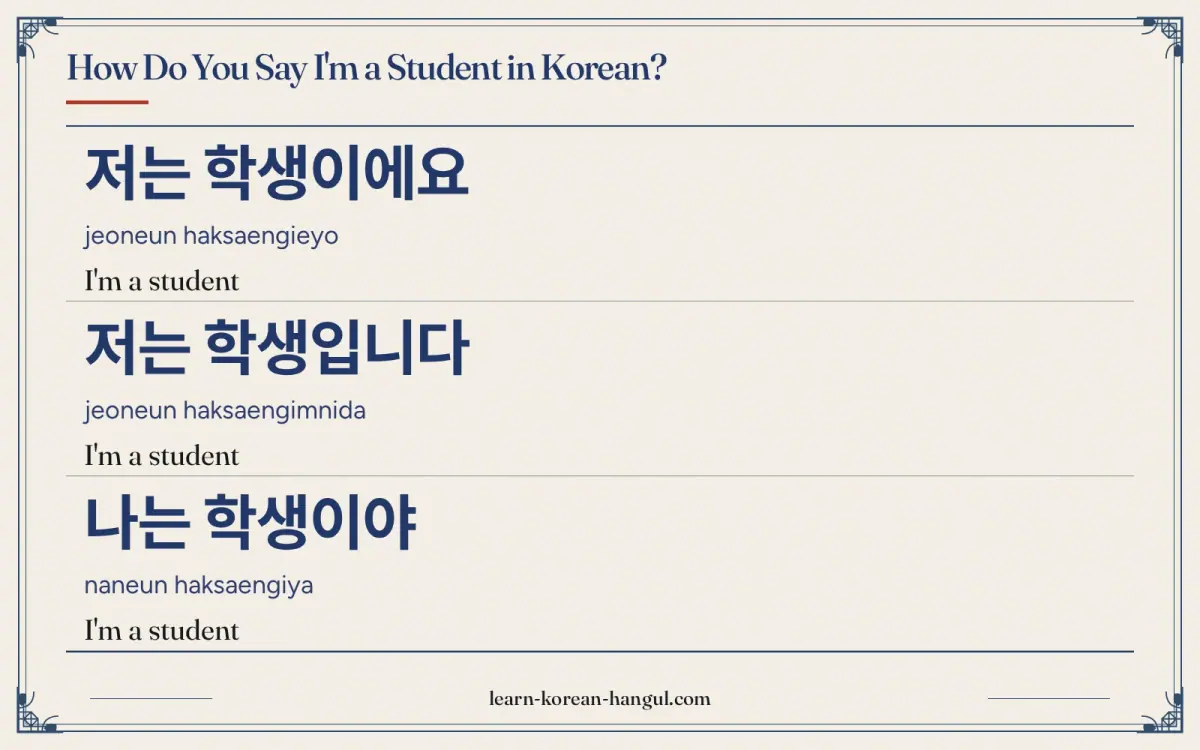
The standard polite way to say I'm a student in Korean is 저는 학생이에요 (jeoneun haksaengieyo). The sentence has three parts: 저는 (jeoneun, "I," humble, with the topic particle 는), 학생 (haksaeng, "student") and 이에요 (ieyo, "is"). Say it with a falling voice, because it is a statement.
Four forms cover most situations.
| Korean | Revised Romanization | Meaning | Register |
|---|---|---|---|
| 저는 학생이에요 | jeoneun haksaengieyo | I'm a student | polite (해요체) |
| 저는 학생입니다 | jeoneun haksaengimnida | I'm a student | formal (합쇼체) |
| 나는 학생이야 | naneun haksaengiya | I'm a student | casual (반말) |
| 대학생이에요 | daehaksaengieyo | I'm a college student | polite (해요체) |
Revised Romanization (the South Korean government standard of 2000) is a reading aid only. The Hangul is the real spelling. The next section sorts the forms by listener.
What Are the Formal, Polite and Casual Ways to Say I'm a Student?
All three levels use the same noun, 학생, and change only the pronoun and the ending. Korean speech levels explain the pattern: ㅂ니다 is formal, 이에요 is polite, and 이야 is casual. Pick the level from the listener, not from yourself.
Polite: 저는 학생이에요 (jeoneun haksaengieyo)
저는 학생이에요 means "I'm a student" and is the safe default. Use it with a teacher, a host family, a shop clerk or a new friend. Koreans often drop 저는 when the topic is clear, so 학생이에요 alone is also natural.
Example: 안녕하세요. 저는 학생이에요. (annyeonghaseyo. jeoneun haksaengieyo.) "Hello. I'm a student."
Formal: 저는 학생입니다 (jeoneun haksaengimnida)
저는 학생입니다 means "I'm a student" and sounds more serious. Use it in a speech, an interview, an application form or a first meeting with a professor. The ending ㅂ니다 is the formal style (합쇼체), and it is used for public speaking.
Example: 안녕하십니까? 저는 한국어를 공부하는 학생입니다. (annyeonghasimnikka? jeoneun hangugeoreul gongbuhaneun haksaengimnida.) "Hello. I'm a student who studies Korean."
Casual: 나는 학생이야 (naneun haksaengiya)
나는 학생이야 means "I'm a student" and uses the plain pronoun 나 (na, "I") and the casual ending 이야. It fits a close friend, a classmate your age or a younger person. Never use it with a teacher, an elder or a stranger, because 나 and 이야 together sound too direct.
Example: 나는 학생이야. 너는? (naneun haksaengiya. neoneun?) "I'm a student. And you?"
Polite and Exact: 대학생이에요 (daehaksaengieyo)
대학생이에요 means "I'm a college student" and is more exact than 학생이에요. The word 대학생 (daehaksaeng) combines 대학 (daehak, "college") and 생 (saeng, "student"). Add it when you want the listener to know your level.
Example: 저는 대학교 2학년이에요. (jeoneun daehakgyo i hangnyeonieyo.) "I'm in my second year of university."
Choosing a Form by Listener
The table gives one clear choice per listener.
| Listener | Best choice | Why |
|---|---|---|
| Teacher, host parent, clerk | 저는 학생이에요 | polite and safe |
| Interview, speech, application | 저는 학생입니다 | formal |
| Close friend or classmate | 나는 학생이야 | casual |
| Anyone, when your level matters | 대학생이에요 | exact and polite |
Once the form is chosen, the next step is how it sounds.
How Do You Pronounce 저는 학생이에요?
저는 학생이에요 is pronounced [저는 학쌩이에요], roughly "jeo-neun hak-ssaeng-i-e-yo," with seven syllables in two word groups. Play the slow clip, then the normal clip, and repeat each one aloud.
| Word | Spelled | Spoken | Revised Romanization |
|---|---|---|---|
| 저는 | 저-는 | [저는] | jeoneun |
| 학생 | 학-생 | [학쌩] | haksaeng |
| 이에요 | 이-에-요 | [이에요] | ieyo |
What Sound Changes Happen in 저는 학생이에요?
Three sound details matter. They follow the Standard Pronunciation Rules (표준 발음법) of the National Institute of Korean Language (국립국어원).
- 학생 becomes [학쌩]. After the final ㄱ of 학, the consonant ㅅ turns tense, so you hear "ssaeng." The page on Korean tensification explains this change.
- 생이에요 does not link. The final ㅇ of 생 is a nasal "ng" and stays in its own syllable, so 이에요 starts fresh with the vowel 이. Do not say "saeng-ni-eyo."
- 학생입니다 becomes [학쌩임니다]. The ㅂ of 입 sounds like ㅁ before ㄴ, which is why the romanization is haksaengimnida.
Revised Romanization does not mark the tense sound, so haksaeng looks softer than it sounds. With the sounds clear, the next question is when to use the phrase.
When Should You Use 저는 학생이에요, and When Should You Not?
Use 저는 학생이에요 when someone asks about you or when you introduce yourself, and add your school or subject to make it useful. A bare "I'm a student" ends the conversation, but 한국어를 공부하는 학생이에요 (hangugeoreul gongbuhaneun haksaengieyo, "I'm a student who studies Korean") invites questions.
Situations Where 저는 학생이에요 Fits
- A self-introduction. Say your name, then 저는 학생이에요, then your school.
- Answering "What do you do?" The guide to what do you do in Korean covers the question.
- A hostel, class or language exchange. It tells people why you are in Korea.
Situations to Avoid with 저는 학생이에요
- Using it after you graduate. Say what you do now.
- Using 나는 학생이야 with a teacher. Switch to 저는 학생이에요.
- Calling an adult 학생. A teacher may address a young learner as 학생, but you should not use it for an adult you have just met.
Should You Say 저는 or 제가?
Say 저는 when you introduce yourself, and say 제가 when the answer is "it is me, not someone else." The particle 는 marks the topic, so 저는 학생이에요 means "as for me, I'm a student" and gives information about you. The particle 가 marks new information, so in answer to "Who is the student?", 제가 학생이에요 means "I am the student." Use the second only when you are picking yourself out of a group.
Example: 학생이 누구예요? 제가 학생이에요. (haksaengi nuguyeyo? jega haksaengieyo.) "Who is the student? I am the student."
The next section shows how to name your level.
Which Word for Student Fits You?
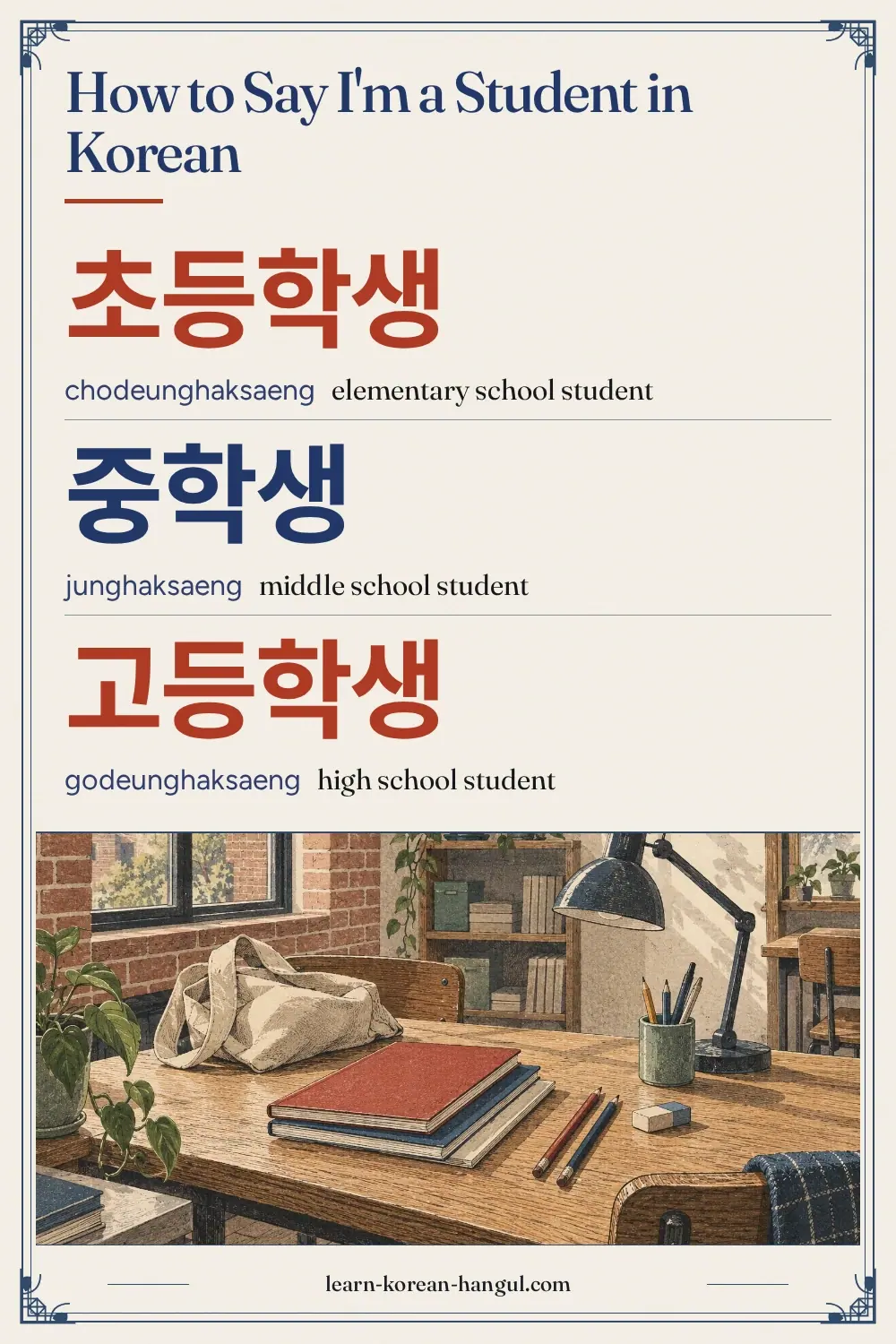
학생 (haksaeng) is the general word, and Korean adds a prefix to name the level. Pick the exact word when the listener needs it.
| Korean | Revised Romanization | Meaning |
|---|---|---|
| 초등학생 | chodeunghaksaeng | elementary school student |
| 중학생 | junghaksaeng | middle school student |
| 고등학생 | godeunghaksaeng | high school student |
| 대학생 | daehaksaeng | college student |
| 대학원생 | daehagwonsaeng | graduate student |
| 유학생 | yuhaksaeng | international student |
| 교환학생 | gyohwanhaksaeng | exchange student |
To add a subject, use the verb 전공하다 (jeongonghada, "to major in"). 저는 한국어를 전공해요 (jeoneun hangugeoreul jeongonghaeyo) means "I major in Korean," and the question 전공이 뭐예요? (jeongongi mwoyeyo?) asks "what is your major?" Here is the sentence for a high school student.
Once the level is named, you can build a longer introduction.
Building a Longer Student Introduction
A full student introduction has four short sentences, and each sentence carries one idea. Keep the same polite ending, 이에요 or 해요, in every sentence, because mixing 이에요 with 입니다 in one introduction sounds uneven.
| Step | Korean | Revised Romanization | Meaning |
|---|---|---|---|
| 1. Name | 저는 민지예요. | jeoneun minjiyeyo | I'm Minji. |
| 2. Level | 대학생이에요. | daehaksaengieyo | I'm a college student. |
| 3. Subject | 한국어를 전공해요. | hangugeoreul jeongonghaeyo | I major in Korean. |
| 4. Goal | 한국어를 잘하고 싶어요. | hangugeoreul jalhago sipeoyo | I want to be good at Korean. |
Say the four sentences in a row, with a falling voice at the end of each one: 저는 민지예요. 대학생이에요. 한국어를 전공해요. 한국어를 잘하고 싶어요. The name step uses 예요 because 민지 ends in a vowel, while the level step uses 이에요 because 학생 ends in a consonant. That small contrast is the most useful rule on this page, and the dialogues below put it to work.
Example Conversations with I'm a Student
Read each dialogue, play the clip, and say one role aloud.
Dialogue 1: Meeting someone new
- A: 무슨 일 하세요? (museun il haseyo?) "What do you do?"
- B: 저는 대학생이에요. 한국어를 공부하고 있어요. (jeoneun daehaksaengieyo. hangugeoreul gongbuhago isseoyo.) "I'm a college student. I'm studying Korean."
- A: 아, 그렇군요! (a, geureokunyo!) "Oh, I see!"
무슨 일 하세요? 저는 대학생이에요. 한국어를 공부하고 있어요. 아, 그렇군요!
Dialogue 2: A formal introduction
- A: 자기소개 부탁드립니다. (jagisogae butakdeurimnida.) "Please introduce yourself."
- B: 안녕하십니까? 저는 학생입니다. (annyeonghasimnikka? jeoneun haksaengimnida.) "Hello. I'm a student."
- B: 한국어를 열심히 공부하겠습니다. (hangugeoreul yeolsimhi gongbuhagetseumnida.) "I will study Korean hard."
자기소개 부탁드립니다. 안녕하십니까? 저는 학생입니다. 한국어를 열심히 공부하겠습니다.
Dialogue 3: Two friends
- A: 너는 요즘 뭐 해? (neoneun yojeum mwo hae?) "What do you do these days?"
- B: 나는 학생이야. 너는? (naneun haksaengiya. neoneun?) "I'm a student. And you?"
- A: 나도 학생이야. (nado haksaengiya.) "I'm a student too."
너는 요즘 뭐 해? 나는 학생이야. 너는? 나도 학생이야.
In Dialogue 1, 그렇군요 shows the listener learned something new. A cultural idea sits behind these exchanges.
What Should You Know about the Culture behind I'm a Student?
In Korea, saying what you study helps others place you, so a student introduction often includes a school and a year. A university student may say 저는 대학교 2학년이에요, using 학년 (hangnyeon, "school year"), and a high school student may name the grade. Other speakers then know how to talk to you and which topics fit.
Korean also uses 학생 as a form of address. A shopkeeper or an older stranger may call a young person 학생 ("student") without knowing their name, much as English speakers say "young man" or "miss." For learners from abroad, 유학생 (yuhaksaeng, "international student") tells people that you are studying in Korea for a while. With the custom clear, the common mistakes are easy to spot.
What Mistakes Do Learners Make with I'm a Student in Korean?
The most common mistake is writing 예요 after a consonant, where 이에요 is needed. Six mistakes appear again and again:
- Writing 학생예요. The noun 학생 ends in a consonant, so it takes 이에요. Fix: write 학생이에요. After a vowel, as in 의사 (uisa, "doctor"), use 예요: 의사예요.
- Linking the ㅇ. Saying "saeng-ni-eyo" adds a sound that is not there. Fix: say hak-ssaeng-i-e-yo.
- Missing the tense sound. Saying "haksaeng" with a soft s sounds foreign. Fix: say [학쌩].
- Using 나는 with a teacher. Fix: say 저는.
- Using 제가 for a simple introduction. 제가 학생이에요 sounds like "I am the student," which answers a question. Fix: say 저는 학생이에요.
- Translating the English "a." Korean has no article like "a." Fix: say 학생이에요, not "한 학생이에요."
These slips come from carrying English habits into Korean. A few related searches ask the same thing in other words, so they are answered next.
Is It the Same as I Am a Student or I Study?
Not exactly, because "I study" is a different verb. Four searches lead to this page, so each gets a short answer.
- I am a student in Korean and im a student in Korean: both mean 저는 학생이에요.
- Student introduction in Korean: use the pattern name, school, year, goal. For example, 저는 민지예요. 대학생이에요. 한국어를 공부해요.
- I study in Korean: the verb is 공부해요 (gongbuhaeyo, "I study"). 한국어를 공부해요 means "I study Korean."
After the answers, the next pages continue the conversation.
Related Phrases to Learn Next
Three phrases help you keep the conversation going:
- My name is in Korean: the sentence that usually comes first.
- What do you do in Korean: the question that leads to this answer.
- I'm learning Korean: the natural next sentence for a student of the language.
The complete list sits in the introduce yourself in Korean cluster.
Practice: Say It Aloud
Spend five minutes on this routine.
- Play the slow clip of 저는 학생이에요 and repeat it three times.
- Say it again with the tense sound: [학쌩], not "haksaeng."
- Build your own sentence with your level: 저는 대학생이에요, 저는 고등학생이에요.
- Hide the Romanization with the toggle and read the four forms from Hangul only.
- Drill the cluster with the phrase flashcards.
When the sentence comes out smoothly, you can say I'm a student in Korean in a way that fits every listener.
Frequently Asked Questions
The answers below add details about how to say I'm a student in Korean beyond the sections above.
How do you say I'm a student in Korean?
The standard polite sentence is 저는 학생이에요 (jeoneun haksaengieyo). In formal speech, say 저는 학생입니다 (jeoneun haksaengimnida). With a close friend, say 나는 학생이야 (naneun haksaengiya). To be more exact, name your level, as in 대학생이에요 for a college student. Korean speakers often drop 저는 when the topic is clear.
How do you pronounce 저는 학생이에요?
Say it as [저는 학쌩이에요], roughly jeo-neun hak-ssaeng-i-e-yo. The ㅅ in 학생 turns tense after the ㄱ, and the final ㅇ of 생 does not link to the next vowel. The Revised Romanization is jeoneun haksaengieyo and does not show the tense sound. Play the slow clip first, then repeat at normal speed.
What is the difference between 저는 학생이에요 and 저는 학생입니다?
Both mean I'm a student and use the humble pronoun 저는. 학생이에요 uses the polite 해요체 ending and suits daily talk with teachers, clerks and new friends. 학생입니다 uses the formal 합쇼체 ending and suits speeches, interviews and application forms. Choose by setting: spoken and friendly, or public and formal.
Is 저는 학생이에요 formal or casual?
저는 학생이에요 is polite, in the 해요체 style, so it sits between formal and casual. The formal version is 저는 학생입니다. The casual version is 나는 학생이야, which is only for close friends and younger people. If you are unsure, the polite version is the safe choice with nearly everyone.
Can I use 저는 학생이에요 with friends, elders and strangers?
Yes. 저는 학생이에요 works with elders, teachers, strangers and most friends, and it is never rude. With a close friend your age, 나는 학생이야 is natural. In a speech or an interview, 저는 학생입니다 sounds better. Avoid the casual form with anyone older or with a person you have just met.
What is the most common mistake with I'm a student in Korean?
Learners write 학생예요 instead of 학생이에요. A noun that ends in a consonant takes 이에요, and a noun that ends in a vowel takes 예요, as in 의사예요. A second frequent mistake is linking the final ㅇ and saying saeng-ni-eyo, which adds a sound that is not there.