무슨 일 하세요?
무슨 일 하세요?
What you'll learn
- Say 무슨 일 하세요? aloud, with the inserted n sound in [무슨닐].
- Choose between 무슨 일 하세요?, 직업이 뭐예요?, 뭐 하는 일이세요? and the answer 저는 회사원이에요.
- Answer with your job using 저는 + job + 이에요/예요.
- Avoid confusing 무슨 일 하세요? (what work do you do) with 뭐 해요? (what are you doing).
Before you start: you need to read Hangul; romanization is shown as an aid and can be hidden. Time: about 9 minutes. Audio plays only when you press a button.
How Do You Say What Do You Do in Korean?
The most natural way to ask what someone does for a living in Korean is 무슨 일 하세요?. It joins 무슨 (what kind of), 일 (work) and 하세요 (do, honorific). Four forms cover the question and its answer, and each fits a different moment.
| Form | Romanization | Register | Say it to |
|---|---|---|---|
| 무슨 일 하세요? | museun il haseyo | Polite (해요체, honorific) | Adults you have just met, colleagues, elders |
| 직업이 뭐예요? | jigeobi mwoyeyo | Polite (해요체) | Peers, forms and interviews, direct questions |
| 뭐 하는 일이세요? | mwo haneun irieseyo | Respectful (해요체, honorific) | Elders, customers, senior contacts |
| 저는 회사원이에요 | jeoneun hoesawonieyo | Polite (해요체), answer | Your reply when someone asks |
The table lists the choices. The next section shows each one in a sentence.
What Are the Formal, Polite and Casual Ways to Say What Do You Do?
Korean changes the sentence ending to match the listener's age, status and closeness. These endings are called speech levels, and the guide to Korean speech levels explains them in full. This question is nearly always polite or respectful, because it is asked of adults.
Polite: 무슨 일 하세요? (museun il haseyo)
Polite · 해요체무슨 일 하세요? uses the honorific -세요, which raises the listener. It is the standard small-talk question at parties, in taxis and at first meetings. A close friend or a younger person would ask the casual 무슨 일 해? (museun il hae).
안녕하세요. 무슨 일 하세요?
annyeonghaseyo. museun il haseyo
Hello. What do you do?
Polite: 직업이 뭐예요? (jigeobi mwoyeyo)
Polite · 해요체직업 means occupation, so 직업이 뭐예요? asks "What is your occupation?" It is more direct than 무슨 일 하세요? and appears on forms, in interviews and in language classes. In social talk, it can sound slightly like a questionnaire.
직업이 뭐예요? 저는 간호사예요.
jigeobi mwoyeyo? jeoneun ganhosayeyo
What's your job? I'm a nurse.
Respectful: 뭐 하는 일이세요? (mwo haneun irieseyo)
Formal · 합쇼체뭐 하는 일이세요? asks "What is your work, the thing you do?" The ending -이세요 is the honorific copula, so it is more respectful than 직업이 뭐예요?. Use it with elders, customers and senior contacts.
실례지만 뭐 하는 일이세요?
sillyejiman mwo haneun irieseyo
Excuse me, what kind of work do you do?
Answer: 저는 회사원이에요 (jeoneun hoesawonieyo)
Polite · 해요체The answer pattern is 저는 (I, humble) + job + 이에요/예요. Use 이에요 after a consonant (회사원이에요) and 예요 after a vowel (의사예요). If you want to name the field, add 일을 해요 (I work in), as in 마케팅 일을 해요. A short table of common jobs follows the example.
저는 회사원이에요. 마케팅 일을 해요.
jeoneun hoesawonieyo. maketing ireul haeyo
I'm an office worker. I work in marketing.
| Job | Romanization | Meaning |
|---|---|---|
| 학생 | haksaeng | student |
| 선생님 | seonsaengnim | teacher |
| 의사 | uisa | doctor |
| 간호사 | ganhosa | nurse |
| 회사원 | hoesawon | office worker |
| 요리사 | yorisa | cook, chef |
Four lines cover the question and answer. Saying the main question cleanly comes next.
How Do You Pronounce 무슨 일 하세요?
무슨 일 하세요? is pronounced [무슨닐 하세요] when the words run together as one phrase, which is the usual way, museun il haseyo, in six syllables. The surprise is an extra n sound: Korean inserts ㄴ before 일, so 무슨 일 sounds like 무슨닐.
- 무 (mu): a short "moo".
- 슨 (seun): "suhn" with the unrounded eu vowel.
- 일 (il): normally "eel", but after 무슨 it gains a light n, giving [닐].
- 하 (ha): a light breathy h.
- 세 (se): "seh".
- 요 (yo): "yoh"; the question word already marks the question, so the end usually falls or rises and then falls.
Sound Changes to Listen For
Three points matter here; the first two are rules of the National Institute of Korean Language Standard Pronunciation (표준 발음법).
- n-insertion in 무슨 일. When a word ending in a consonant meets a word starting with 이, the sound ㄴ may be inserted, so 무슨 일 is [무슨닐]. See n-insertion.
- Liaison in 직업이. The ㅂ of 업 moves onto 이, so 직업이 is [지거비]. See liaison (resyllabification).
- Romanization follows spelling. Revised Romanization writes museun il haseyo and jigeobi mwoyeyo, which show the letters but not the inserted ㄴ.
With the sound set, the next question is when to ask it.
When Should You Use 무슨 일 하세요?, and When Should You Not?
Ask 무슨 일 하세요? when you want to learn about someone's work in friendly small talk. Choose the more direct 직업이 뭐예요? for forms and interviews.
Situations Where It Fits
- A party or a first meeting. 무슨 일 하세요? starts friendly small talk.
- A taxi or a long train ride. It fits with a driver or a seatmate.
- A language class. 직업이 뭐예요? works well for practice drills.
- A customer or senior contact. 뭐 하는 일이세요? is the respectful form.
Situations to Avoid
- A very close friend. 무슨 일 하세요? sounds formal; use 무슨 일 해?.
- Asking too early or too personally. Questions about salary or position are personal in Korea; start with the field of work.
- Confusing it with 뭐 해요?. That asks what someone is doing now, as in what's up in Korean.
These choices are easier to feel in real exchanges, so here are three.
What Does What Do You Do Sound Like in a Real Conversation?
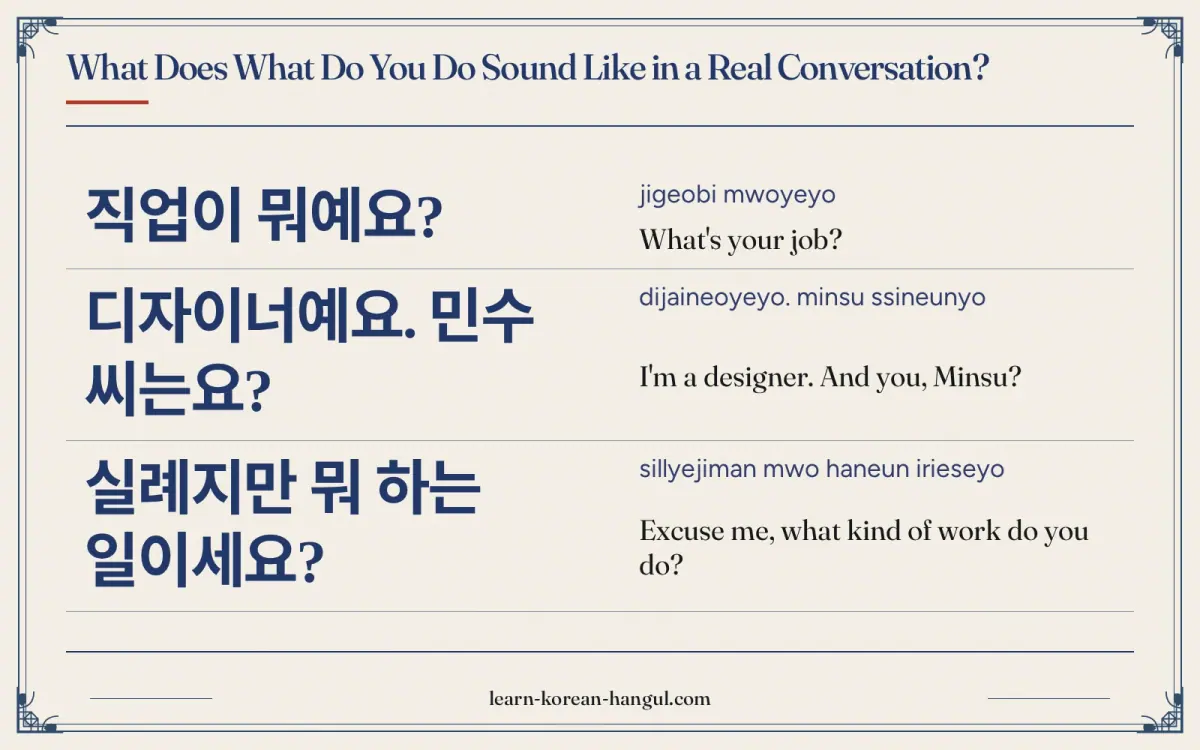
A Korean job exchange is short. The question comes after a greeting, and the answer is a job followed by a small detail.
Meeting a Neighbour
Daeho
안녕하세요. 무슨 일 하세요?
annyeonghaseyo. museun il haseyo
Hello. What do you do?
Sora
저는 선생님이에요. 초등학교에서 가르쳐요.
jeoneun seonsaengnimieyo. chodeunghakgyoeseo gareuchyeoyo
I'm a teacher. I teach at an elementary school.
What to notice: Sora adds where she works with 에서, a natural next detail.
At a Party
Min
직업이 뭐예요?
jigeobi mwoyeyo
What's your job?
Yuna
디자이너예요. 민수 씨는요?
dijaineoyeyo. minsu ssineunyo
I'm a designer. And you, Minsu?
What to notice: Yuna returns the question with 씨는요?, a polite way to say and you.
Talking to a Customer
Staff
실례지만 뭐 하는 일이세요?
sillyejiman mwo haneun irieseyo
Excuse me, what kind of work do you do?
Customer
저는 의사예요.
jeoneun uisayeyo
I'm a doctor.
What to notice: the staff member uses the respectful form. Titles lead to the culture around work questions.
What Should You Know about the Culture behind What Do You Do?
Work is a common topic of small talk in Korea, and a person's job often affects how people address them. Questions about it are usually friendly.
- Job as small talk. Koreans often ask about work, school or age soon after meeting.
- Company questions. People may follow with 어느 회사 다니세요? (which company do you work for?) when you say you are an office worker.
- Titles over names. At work Koreans address colleagues by title, such as 과장님 (manager), so the job and the form of address are linked.
- Students. For students, ask 학교 어디 다녀요? (which school do you go to?) or 전공이 뭐예요? (what is your major?).
An expert tip: Koreans may answer with the company name, not the job type, because a company name often tells the listener enough. So 삼성에 다녀요 (I work at Samsung) can answer 무슨 일 하세요?. This page covers friendly small talk. Interview questions, workplace titles and formal business introductions are not covered here.
What Mistakes Do Learners Make with What Do You Do in Korean?
Most mistakes with this question come from mixing it up with 뭐 해요?, from missing the answer pattern or from level.
| Mistake | Why it is a problem | Fix |
|---|---|---|
| Asking 뭐 해요? to learn someone's job | That asks what they are doing now | Use 무슨 일 하세요? |
| Answering with the title only, like 과장 | Missing 저는 and the copula | Say 저는 과장이에요 |
| Using 예요 after a consonant | 회사원예요 is wrong | Use 회사원이에요 |
| Asking a boss 무슨 일 해요? | Polite but not honorific | Use 무슨 일 하세요? |
| Linking 무슨 일 as [무스닐] | When the words run together, an extra ㄴ is inserted instead | Say [무슨닐] |
Learners often think a job title alone is enough as an answer. Korean usually adds 저는 and the ending: 저는 선생님이에요, which is more complete and polite.
Is It the Same as What Is Your Job or Occupation?
Mostly yes. The short answers below cover the other ways people search for this phrase.
- What is your job in Korean: 직업이 뭐예요? or 무슨 일 하세요?
- What's your job in Korean: the same two questions; the first is more direct.
- What's your occupation in Korean: 직업이 무엇입니까? (jigeobi mueosimnikka) in a formal register, and 직업이 뭐예요? in speech.
- What do you do for a living in Korean: 무슨 일 하세요?, since Korean does not need a phrase for living.
Reading the forms is one thing; producing them on cue is another, so practise now.
Practice: Say It Aloud
Play the slow clip of 무슨 일 하세요?, repeat it three times, then answer it with your own job. Then choose a form for each situation. Answers follow.
- You meet a neighbour of your parents' age.
- You fill in a form and need to ask a classmate.
- You are a nurse. How do you answer?
- Why does 무슨 일 sound like [무슨닐]?
Answers
- 무슨 일 하세요? or 뭐 하는 일이세요?
- 직업이 뭐예요?
- 저는 간호사예요.
- Korean inserts a light ㄴ between 무슨 and 일 (n-insertion).
The phrase flashcards drill all four lines with audio.
Related Phrases to Learn Next
The job question sits with other first-meeting phrases.
- Introduce yourself in Korean: the full set of self-introduction phrases.
- Where do you live in Korean: another common get-to-know-you question.
- Nice to meet you in Korean: 만나서 반갑습니다, for starting the conversation.
- I'm a student in Korean: one answer to the job question.
This guide belongs to the introducing yourself collection. What this page does not cover: job interviews and workplace titles. Pick 무슨 일 하세요? when in doubt, and you can ask what do you do in Korean to almost any adult.
Frequently Asked Questions
What is the difference between 무슨 일 하세요? and 직업이 뭐예요?
Both ask about work. 무슨 일 하세요? is friendly small talk and uses the honorific -세요. 직업이 뭐예요? is more direct and sounds like a form or an interview. In social settings, 무슨 일 하세요? is usually more natural and more polite.
Is 무슨 일 하세요? formal or casual?
It is polite and honorific, in the 해요체 style with -세요. It is not stiff, but it shows respect for the listener. With close friends or younger people, use the casual 무슨 일 해?. For very formal settings, use 무슨 일을 하십니까?.
Can I use 무슨 일 하세요? with friends, elders and strangers?
Yes with strangers and elders, where it is the best choice. With close friends it sounds a little formal, so say 무슨 일 해?. For elders and customers, 뭐 하는 일이세요? is slightly more respectful. Drop to 무슨 일 해? only when a friend invites casual speech.
How do you answer 무슨 일 하세요?
Answer with 저는 plus your job plus 이에요 or 예요, such as 저는 선생님이에요. Use 이에요 after a consonant and 예요 after a vowel. To name a field, say 일을 해요, as in 마케팅 일을 해요. A short company name also works.
What is the most common mistake with what do you do in Korean?
The most common mistake is using 뭐 해요?, which asks what someone is doing right now. Use 무슨 일 하세요? for work. The second is answering with the title alone; add 저는 and 이에요 or 예요 for a complete answer.