슬퍼요
슬퍼요
What you'll learn
- Say I'm sad with 슬퍼요, 슬퍼 or 슬픕니다, depending on the listener.
- Tell 슬퍼요 (sad) apart from 속상해요 (upset) and 우울해요 (down).
- Understand why 슬프- becomes 슬퍼-.
- Pronounce 슬픕니다 as [슬픔니다] and 속상해요 as [속쌍해요].
Before you start: you only need to read Hangul. When you want the happy side, learn I'm happy in Korean. Time: about 10 minutes. Audio plays only when you press a button.
How Do You Say I'm Sad in Korean?
The standard way to say I'm sad in Korean is 슬퍼요. The base word is the adjective 슬프다 (seulpeuda), "to be sad". An adjective in Korean works like the English "is sad", so 슬퍼요 can describe you, a film or a song. Korean usually drops "I", so one word is a whole sentence.
| Situation | Best form | Romanization | Why |
|---|---|---|---|
| Telling a colleague you feel sad | 슬퍼요 | seulpeoyo | Polite, natural |
| Telling a close friend | 슬퍼 | seulpeo | Casual |
| A speech or news report | 슬픕니다 | seulpeumnida | Formal |
| Very sad | 너무 슬퍼요 | neomu seulpeoyo | So sad |
| Disappointed or let down | 속상해요 | soksanghaeyo | Upset, not grief |
| Low and flat for days | 우울해요 | uulhaeyo | Down |
The next section sorts these forms by listener.
What Are the Polite, Formal and Casual Ways to Say I'm Sad?
The stem 슬프- stays the same and the ending changes with the speech level. The full system is in the guide to Korean speech levels.
Polite: 슬퍼요 (seulpeoyo)
Polite · 해요체슬퍼요 is the form to learn first. It is soft and sincere, and it fits a coworker, a teacher or a neighbour. The past tense is 슬펐어요 (seulpeosseoyo), "I was sad".
영화가 너무 슬퍼서 울었어요.
yeonghwaga neomu seulpeoseo ureosseoyo
The movie was so sad that I cried.
Here 슬퍼서 means "because it is sad", and the sad thing is the movie, not the speaker.
Casual: 슬퍼 (seulpeo)
Casual · 반말슬퍼 drops 요. Use it with close friends, siblings and people younger than you. A quiet 슬퍼... is also what people text when they want a friend to ask what is wrong.
Formal: 슬픕니다 (seulpeumnida)
Formal · 합쇼체슬픕니다 appears in speeches, announcements and news. In daily talk you will rarely say it. It is pronounced [슬픔니다].
Upset: 속상해요 (soksanghaeyo)
Polite · 해요체속상해요 is a very common everyday word. The parts are 속 (inside) and 상하다 (to be hurt), so it means "my inside is hurt". Use it for disappointment, worry over someone, or frustration about something that happened, where English would say "upset".
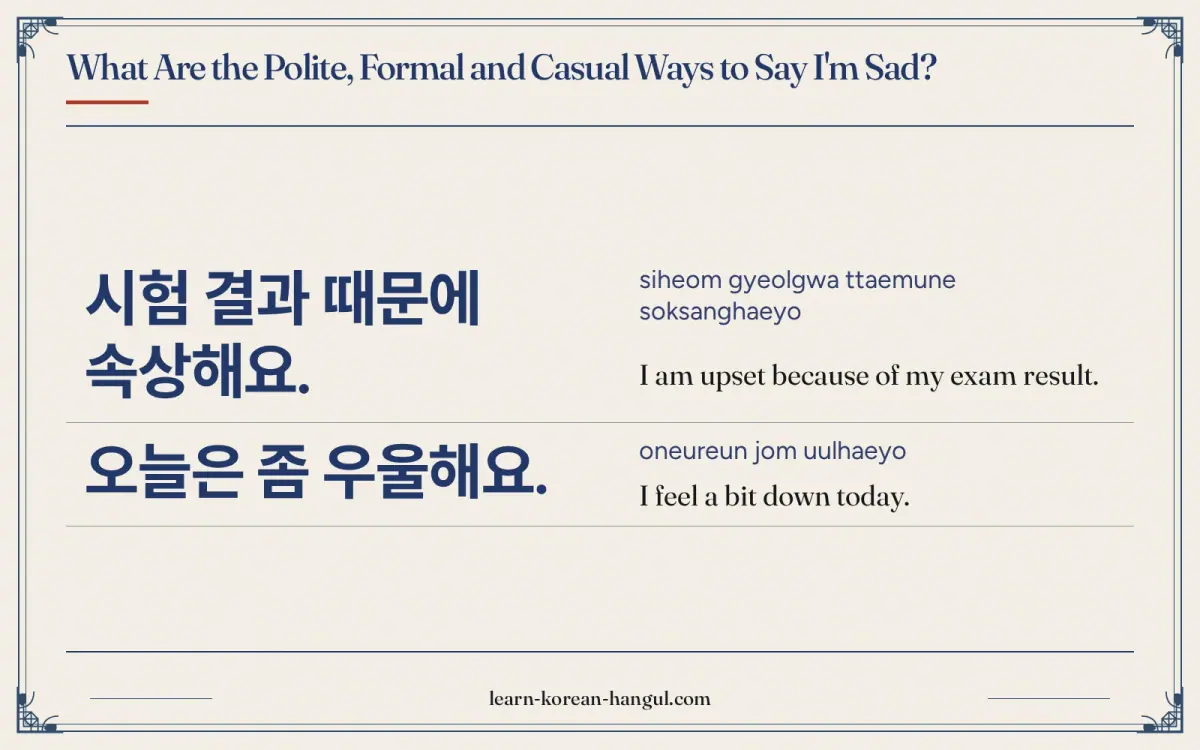
시험 결과 때문에 속상해요.
siheom gyeolgwa ttaemune soksanghaeyo
I am upset because of my exam result.
Down: 우울해요 (uulhaeyo)
Polite · 해요체우울해요 describes a low mood that stays for a while. It is heavier than a passing sad moment, so use it for a mood, not for one bad scene in a film.
오늘은 좀 우울해요.
oneureun jom uulhaeyo
I feel a bit down today.
Beneath these forms sits one small grammar rule.
Why Does 슬프다 Become 슬퍼요?
The stem 슬프- ends in the vowel ㅡ (eu). Before the endings -아요 or -어요, Korean drops that ㅡ. The ending is 아 if the vowel in the syllable before is ㅏ or ㅗ, and 어 otherwise. In 슬프다 the syllable before is 슬, whose vowel is ㅡ, so the ending is 어: 슬프 + 어요 becomes 슬퍼요.
- 슬프다 → 슬퍼요 (sad)
- 기쁘다 → 기뻐요 (glad)
- 예쁘다 → 예뻐요 (pretty)
- 아프다 → 아파요 (sick), where the 아 in front pulls the ending to 아
This is called ㅡ-dropping (으 탈락). School grammar counts it as regular, though many learner books teach it with the irregular verbs. Before consonant endings the ㅡ stays, which gives the formal 슬픕니다.
How Do You Pronounce 슬퍼요?
슬퍼요 is pronounced [슬퍼요], seul-peo-yo, in three syllables. It sounds like it is written.
- 슬 (seul): the vowel ㅡ is unrounded, so keep your lips flat and spread, then end with a light ㄹ.
- 퍼 (peo): ㅍ is a puff of air. The vowel ㅓ is also unrounded.
- 요 (yo): a short "yo".
Sound Changes to Listen For
These changes follow the National Institute of Korean Language standard pronunciation rules (표준 발음법):
- Tensing after a stop. 속상해요 is [속쌍해요]. The final ㄱ of 속 makes the ㅅ of 상 tense (Article 23). The romanization soksanghaeyo does not show this, because it comes from a neighbouring sound. See Korean tensification.
- ㅂ before ㄴ becomes ㅁ. 슬픕니다 is [슬픔니다] (Article 18). See Korean nasalization.
Next, who you can say it to.
When Should You Use 슬퍼요, and When Should You Not?
Use 슬퍼요 when you feel real sadness and want to share it. Pick a different word when the feeling is smaller.
Situations Where It Fits
- After a sad film or song. 이 노래 너무 슬퍼요 (this song is so sad).
- Saying goodbye. 헤어지니까 슬퍼요 (I am sad because we are parting).
- Telling a close friend. 나 오늘 좀 슬퍼.
Situations to Avoid
- A small disappointment. A late bus or a lost game is 속상해요, not 슬퍼요.
- A formal meeting. Keep feelings short, and prefer 유감입니다 (yugamimnida, I regret it) in formal writing.
- A long low mood. 우울해요 is closer, and a serious low mood is better shared with a doctor or a trusted person.
Two short conversations show how it sounds.
What Does I'm Sad Sound Like in a Real Conversation?
In real life the line is followed by care. Notice how the listener answers.
After the Movie
Sua
영화 어땠어?
yeonghwa eottaesseo?
How was the movie?
Jiho
너무 슬펐어. 계속 울었어.
neomu seulpeosseo. gyesok ureosseo
It was so sad. I cried the whole time.
Sua
괜찮아? 휴지 줄까?
gwaenchana? hyuji julkka?
Are you okay? Shall I give you a tissue?
What to notice: 슬펐어 is the casual past, and the friend answers with care, not advice.
A Rough Day at Work
Team Leader
오늘 기분이 안 좋아 보여요. 왜 그래요?
oneul gibuni an joa boyeoyo. wae geuraeyo?
You look down today. What's wrong?
Colleague
사실 좀 속상해요. 발표가 잘 안 됐어요.
sasil jom soksanghaeyo. balpyoga jal an dwaesseoyo
Honestly I'm a bit upset. My presentation did not go well.
Team Leader
힘내세요. 다음에는 더 잘될 거예요.
himnaeseyo. daeumeneun deo jaldoel geoyeyo
Cheer up. It will go better next time.
What to notice: the colleague picks 속상해요, not 슬퍼요, because a failed presentation is a setback, not a grief. The question 왜 그래요? (what's wrong?) is a wh-question, so it does not end with a sharp rise.
What Should You Know about the Culture behind I'm Sad?
Koreans often express sadness through shared activities, such as a long walk, a meal or a sad ballad. A ballad is a slow, emotional song, and the genre is a pillar of Korean pop music. Saying 슬퍼요 is natural between friends, but at work people tend to use gentler words like 속상해요 or 마음이 안 좋아요 (maeumi an joayo, my heart is not well).
There is also a familiar idea of 정 (jeong), the bond that grows between people. Sadness at parting, at a graduation or at moving house is often described through it, and friends answer with company, not with solutions. A friend who says 같이 있어 줄게 (gachi isseo julge, I'll stay with you) is offering exactly what the situation asks for.
An expert tip: when you want to comfort someone, say 마음이 아파요 (maeumi apayo, my heart hurts). It is a common way to speak about sadness over someone else's trouble, and it sounds warmer than 슬퍼요 when the other person is the one suffering.
What Mistakes Do Learners Make with I'm Sad in Korean?
Most mistakes come from the ㅡ-dropping stem and from using one word for every unhappy feeling.
| Wrong | Why it is a problem | Correct |
|---|---|---|
| 슬프어요 | The ㅡ must drop | 슬퍼요 |
| 슬프요 | The vowel ending is missing | 슬퍼요 |
| 슬퍼요 for a late train | Sounds like grief, not annoyance | 속상해요 or 짜증 나요 |
| [슬프니다] for the formal form | The ㅂ is not dropped: it is said as ㅁ before ㄴ | [슬픔니다] |
| 슬퍼 to a manager | Too casual | 슬퍼요 or 속상해요 |
Another trap is the honorific. The ending -시- shows respect for the person you talk about, so 슬프세요 asks "are you sad?" to someone older, and you never use it about yourself.
How Do You Ask Someone If They Are Sad?
Turn the same words into a question. To a friend, say 슬퍼? (seulpeo?). To a colleague, say 슬퍼요? (seulpeoyo?), with a gentle rise at the end, because this is a yes/no question. To ask why, use a question word: 왜 슬퍼요? (wae seulpeoyo?). A wh-question puts the stress on 왜 and usually ends with a fall or a rise-fall, not a sharp rise.
To an older person, ask 속상하세요? (soksanghaseyo?). It carries the honorific -시- and the softer word 속상하다. A kind follow-up is 무슨 일 있었어요? (museun il isseosseoyo?), "what happened?". In connected speech it is often [무슨 닐 이써써요], with ㄴ added before 일, while the romanization keeps the spaced words separate.
Is It the Same as I Am Sad, Im Sad or I Feel Sad?
Yes, for the main phrase. The short answers below cover the other searches folded into this page.
- I am sad in Korean: 슬퍼요 or the formal 슬픕니다.
- Im sad in Korean: the same sentence; the missing apostrophe makes no difference.
- Sad in Korean: the adjective is 슬프다. Before a noun it becomes 슬픈, as in 슬픈 영화 (a sad movie).
- I feel sad in Korean: 슬퍼요 again, or 마음이 슬퍼요 for "my heart is sad", which sounds a little poetic.
Related Phrases to Learn Next
- When someone near you is crying, use don't cry in Korean.
- To lift a friend's mood, learn cheer up in Korean.
- For the opposite feeling, see I'm happy in Korean.
- A sad feeling can turn into frustration, so compare I'm angry in Korean.
Every phrase in this group lives in the Korean feelings phrases collection.
Practice: Say It Aloud
Play the slow clip of 슬퍼요 three times, then say it with flat lips. Then choose a phrase. Answers follow.
- You are texting a close friend after a bad day.
- You tell a coworker politely that you feel sad.
- You are disappointed that your plan fell through.
- You want to say "I'm so sad" to a teacher.
Answers
- 슬퍼.
- 슬퍼요.
- 속상해요.
- 너무 슬퍼요.
Drill these with the phrase flashcards. Saying i'm sad in Korean gets easier once you can feel the difference between 슬퍼요, 속상해요 and 우울해요.
Frequently Asked Questions
How do you say I'm sad in Korean?
Say 슬퍼요 (seulpeoyo) in polite speech, 슬퍼 (seulpeo) to a close friend and 슬픕니다 (seulpeumnida) in formal speech. Korean usually drops the word for I, so 슬퍼요 alone is a full sentence. Add 너무 (neomu, so) to say I'm so sad.
How do you pronounce 슬퍼요?
슬퍼요 is three syllables, seul-peo-yo, and it is pronounced as it is written. The vowel ㅡ in 슬 is unrounded, so keep your lips flat, and ㅍ is a light puff of air. The related word 속상해요 is pronounced [속쌍해요], because ㅅ becomes tense after the final ㄱ of 속.
What is the difference between 슬퍼요 and 슬퍼?
They mean the same thing. 슬퍼요 has the polite ending 요 and suits colleagues, older friends and people you do not know well. 슬퍼 drops 요 and is for close friends, siblings and people younger than you.
Is 슬퍼요 formal or casual?
슬퍼요 is polite, the everyday middle level. It is not the most formal style, which is 슬픕니다, and it is not casual speech, which is 슬퍼. It is safe with almost any adult listener.
Can I use 슬퍼요 with friends, elders and strangers?
Yes. With friends use 슬퍼, with elders and strangers use 슬퍼요. To ask an older person whether they are sad, the honorific question 속상하세요? (soksanghaseyo?) is more natural than 슬프세요, and the honorific is never used about yourself.
What is the most common mistake with I'm sad in Korean?
Learners write 슬프어요 instead of 슬퍼요, or use 슬퍼요 when they only mean disappointed or annoyed. For a small setback, 속상해요 is the natural word, because 슬퍼요 sounds like real sorrow.