
조용히 해 주세요
조용히 해 주세요
What you'll learn
- Say 조용히 해 주세요 aloud with the right syllable rhythm.
- Choose between 조용히 해 주세요, 조용히 해 and 쉿 for a stranger, a friend and a child.
- Recognise 닥쳐 and 입 다물어 as rude, and explain why they are not for learners.
- Ask for quiet in a library, cinema or train without causing offence.
Before you start: knowing hello in Korean helps, because every form here uses the same polite and casual endings. Time: about 12 minutes. Audio plays only when you press a button.
How Do You Say Shut up in Korean?
The safe way to say shut up in Korean is 조용히 해 주세요, which really means "please be quiet". It is made of 조용히 (joyonghi, quietly), 해 (hae, do) and 주세요 (juseyo, please give or do for me). English "shut up" is a rude command, but Korean splits the idea into a polite request and a set of insults, and learners almost always want the polite request.
| Form | Romanization | Register | Say it to |
|---|---|---|---|
| 조용히 해 주세요 | joyonghi hae juseyo | Polite (해요체) | Strangers, seniors, staff, people in a shared space |
| 조용히 해 | joyonghi hae | Casual (해체) | Close friends, siblings, children |
| 쉿 | swit | Sound, neutral | Anyone, usually with a finger to the lips |
| 닥쳐 | dakchyeo | Rude, aggressive | No one; recognise it in dramas only |
| 입 다물어 | ip damureo | Rude, casual | No one; recognise it in dramas only |
One request and four other forms is a wide range, so the next section explains each form and the listener it suits.
What Are the Polite and Casual Ways to Say Shut Up?
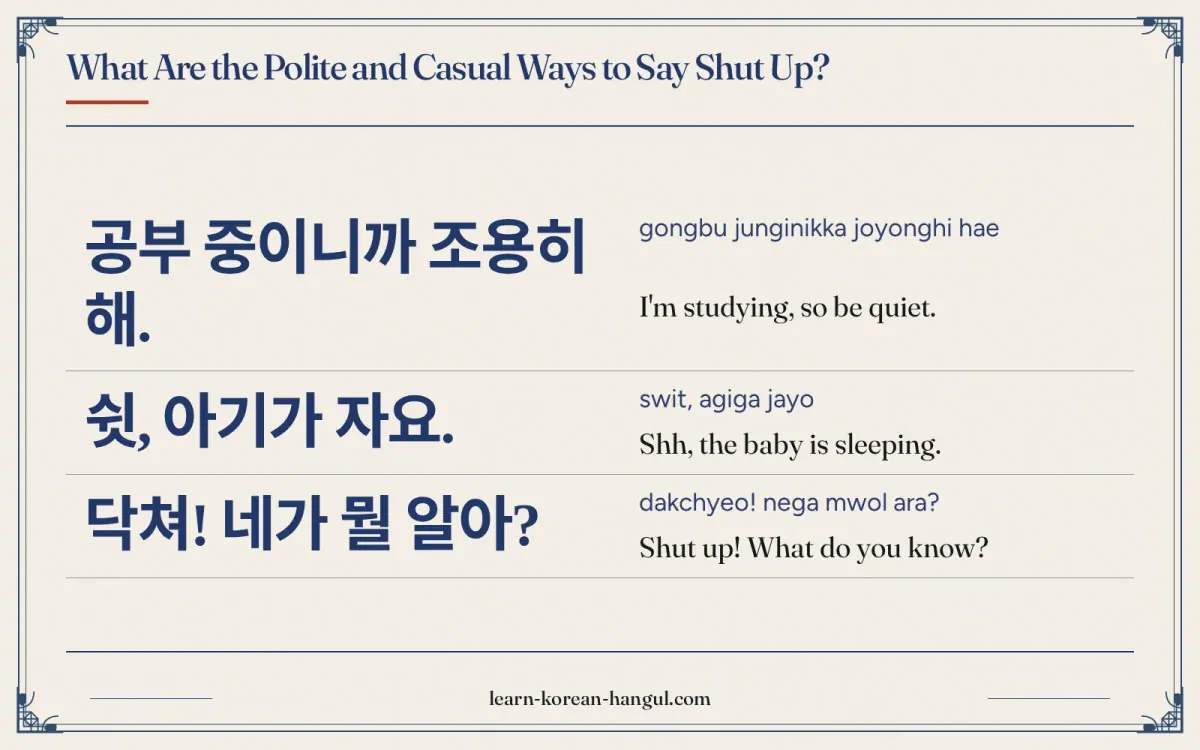
Shut up follows the Korean speech levels, explained in the guide to Korean speech levels. Here the range runs from a polite request to rude commands, so the label on each form matters as much as its meaning.
Polite: 조용히 해 주세요 (joyonghi hae juseyo)
Polite · 해요체조용히 해 주세요 is the useful form. It asks for quiet in a library, a cinema, a study room or a shared home. Add 죄송한데요 (joesonghandeyo, "sorry, but") before it to soften a request to a stranger, or add 좀 (jom, a bit) as in 조용히 좀 해 주세요.
도서관이니까 조용히 해 주세요.
doseogwanikka joyonghi hae juseyo
This is a library, so please be quiet.
Casual: 조용히 해 (joyonghi hae)
Casual · 반말조용히 해 drops the polite ending, so it is a casual command. It suits close friends, siblings and young children, usually with a smile or a reason. To a stranger or someone older it sounds like an order and can cause a quarrel.
공부 중이니까 조용히 해.
gongbu junginikka joyonghi hae
I'm studying, so be quiet.
Sound: 쉿 (swit)
Casual · 반말쉿 is the sound "shh". It is not rude, and people use it with a finger across the lips to ask a child or a group for quiet. It is the gentlest option when you cannot say much, such as in a sleeping baby's room.
쉿, 아기가 자요.
swit, agiga jayo
Shh, the baby is sleeping.
Rude: 닥쳐 (dakchyeo)
Casual · 반말닥쳐 is a harsh, aggressive "shut up". You hear it in dramas during fights and arguments, and subtitles often translate it simply as "shut up". It is here so you can recognise an insult, not so you can use it. Even as a joke it can start a real argument.
닥쳐! 네가 뭘 알아?
dakchyeo! nega mwol ara?
Shut up! What do you know?
Rude: 입 다물어 (ip damureo)
Casual · 반말입 다물어 literally means "close your mouth" (입, ip, is mouth; 다물다, damulda, is to keep shut). It is a blunt casual command and just as rude as 닥쳐. Recognise it in dramas and in arguments, and do not use it.
입 다물어! 아무 말도 하지 마.
ip damureo! amu maldo haji ma
Shut your mouth! Don't say anything.
Five forms come down to one rule: ask politely, and treat the rude ones as vocabulary to recognise. The sound of the polite request is next.
How Do You Pronounce 조용히 해 주세요?
조용히 해 주세요 is pronounced [조용히 해 주세요], joyonghi hae juseyo, in seven even syllables spread over three words: 조용히 / 해 / 주세요. Say the three words smoothly with a very short pause at each space.
- 조 (jo): a soft j and "oh".
- 용 (yong): "yohng", ending in the "ng" of "sing".
- 히 (hi): ㅎ plus 이, "hee", with a light h.
- 해 (hae): "heh".
- 주 (ju): a soft j and "oo".
- 세 (se): "seh".
- 요 (yo): "yoh".
Sound Changes to Listen For
Four details from the National Institute of Korean Language Standard Pronunciation Rules (표준 발음법) and natural speech matter here.
- 쳐 is said [처]. After ㅊ, the vowel ㅕ is pronounced like ㅓ (Article 5), so 닥쳐 is [닥처] even though it is spelled with ㅕ.
- Tensification in 입 다물어. After the final ㅂ, the ㄷ of 다 becomes tense, so 입 다물어 is [입 따무러]. The ㄹ of 물어 moves to the next syllable (liaison). The rule is explained in Korean tensification.
- The light ㅎ in 조용히. Between the ng sound and 이, ㅎ is said lightly, so 조용히 can sound close to "jo-yong-i" in fast speech. This is natural speech, not a spelling rule.
- The short ending of 쉿. Final ㅅ is said as an unreleased [t], so 쉿 is [쉳] and stops abruptly.
With the sounds covered, the next question is when each form is safe to use.
When Should You Use 조용히 해 주세요, and When Should You Not?
Use 조용히 해 주세요 whenever you need strangers or seniors to be quiet, and use 조용히 해 only with people you are close to. A teacher or announcer addressing a class uses the honorific command 조용히 하세요 (joyonghi haseyo), which is stronger than a request.
Situations Where It Fits
- A library or study room. 도서관이니까 조용히 해 주세요.
- A cinema or theatre. 죄송한데요, 조금만 조용히 해 주세요.
- A teacher in class. 조용히 하세요, a firm polite command.
- A sleeping baby or sibling. 쉿, or 조용히 해 to a child.
- Softer alternatives. 소리 좀 줄여 주세요 (sori jom juryeo juseyo, please turn the volume down) works for phones, music and TV.
Situations to Avoid
- A boss, teacher or elder. A command is a serious breach of politeness. Wait, or ask a question such as 잠깐 이야기해도 될까요? (may I speak for a moment?).
- A stranger, with the casual form. 조용히 해 to a stranger sounds like a challenge.
- An argument. 닥쳐 and 입 다물어 make a fight worse and can end friendships.
- A joke between friends. Even friends can take 닥쳐 badly. Use 쉿 with a smile instead.
The short scenes below show the polite request and the casual command in use.
What Does Shut up Sound Like in a Real Conversation?
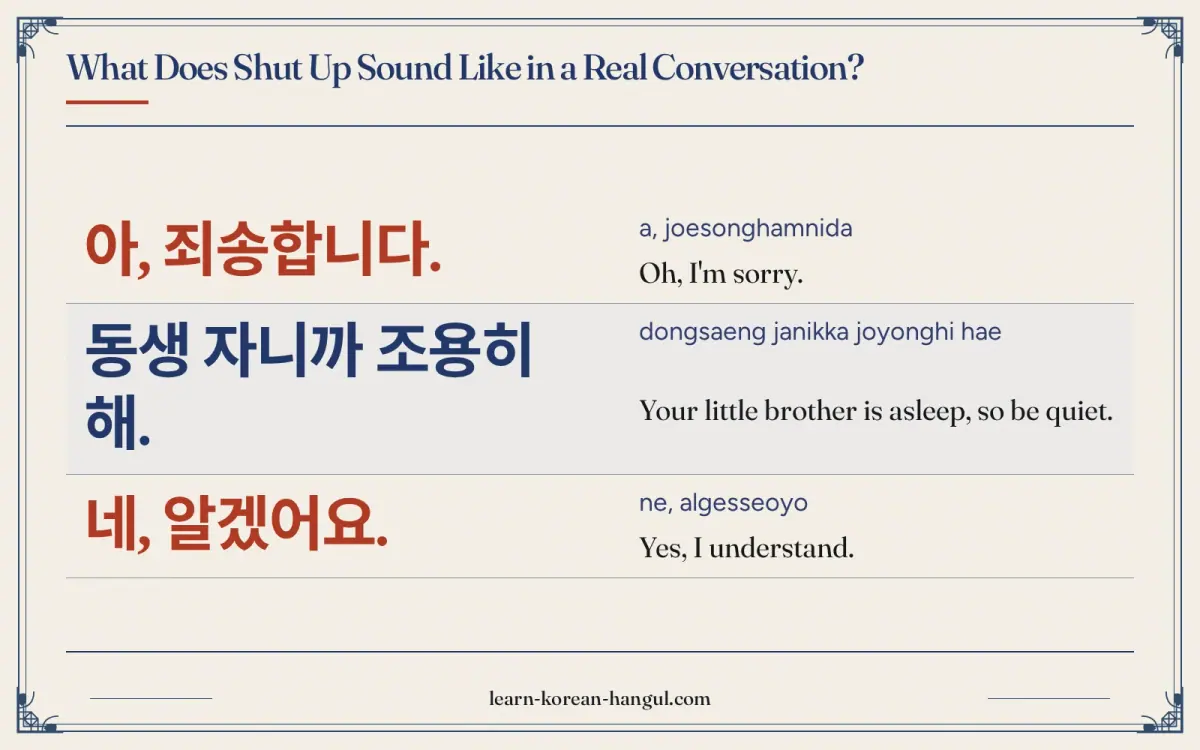
Asking for quiet in Korean is usually short, and the answer is an apology or agreement. Notice how the polite form gets an apology and the casual form gets a promise.
In a Cinema
Viewer A
죄송한데요, 조금만 조용히 해 주세요.
joesonghandeyo, jogeumman joyonghi hae juseyo
Excuse me, could you please be a little quieter?
Viewer B
아, 죄송합니다.
a, joesonghamnida
Oh, I'm sorry.
What to notice: 죄송한데요 softens the request, and the answer is the formal apology covered in sorry in Korean.
At Home with a Child
Mother
동생 자니까 조용히 해.
dongsaeng janikka joyonghi hae
Your little brother is asleep, so be quiet.
Child
네, 알겠어요.
ne, algesseoyo
Yes, I understand.
What to notice: the mother gives a reason before the casual command, and the child answers politely.
Before a Film with a Friend
Jiu
영화 시작했어. 쉿!
yeonghwa sijakhaesseo. swit!
The film has started. Shh!
Minho
알았어. 조용히 할게.
arasseo. joyonghi halge
Got it. I'll be quiet.
What to notice: friends use 쉿 and casual speech together. Quiet norms in public places are explained next.
What Should You Know about the Culture behind Shut Up?
Korean treats a request for silence as a matter of respect for people sharing the same space, so tone and wording carry more weight than the English phrase suggests.
- Seniority. Telling an older or unfamiliar person to shut up is among the most serious breaches of politeness in Korean. Even the casual 조용히 해 is safe only with close friends or children.
- Public quiet. Libraries, hospitals and many public places use the sign 정숙 (jeongsuk, silence) instead of a spoken request, and people often use gestures or just move away.
- Dramas exaggerate. 닥쳐 and 입 다물어 appear in angry scenes. Real speakers use them rarely, and mostly with intent to hurt.
- Command versus request. 조용히 하세요 is a command from a person with authority, while 조용히 해 주세요 is a request.
An expert insight: learners often reach for the casual 조용히 해 because it is short and matches the English shut up. In real use, the polite request with 죄송한데요 in front is both safer and more effective, since people respond better to an apology than to a command. The common mistakes below come from this mismatch.
What Mistakes Do Learners Make with Shut up in Korean?
Most mistakes with shut up come from translating the English word directly instead of picking a Korean form by listener.
| Mistake | Why it is a problem | Fix |
|---|---|---|
| Using 닥쳐 as a joke with friends | It is a harsh command that can start a real argument | Use 조용히 해 or 쉿 with a smile |
| Saying 조용히 해 to a stranger | A casual command sounds hostile | Say 죄송한데요, 조용히 해 주세요 |
| Saying 조용히 하세요 to a stranger on a train | It sounds like an order from a teacher or announcer | Soften it with 죄송한데요 and 해 주세요 |
| Saying 조용해 for "be quiet" | 조용하다 is the adjective "quiet", so 조용해 means "it is quiet" | Use the adverb: 조용히 해 |
| Using 입 다물어 to ask for quiet | It literally says "close your mouth" and is rude | Use 조용히 해 주세요 |
Learners often assume shut up has one Korean equivalent. Actually, Korean separates a polite request (조용히 해 주세요) from insults (닥쳐), so the English phrase maps onto a scale from polite to hostile. Choose by intention and listener rather than by translation.
Is It the Same as Shut up Korean?
The short answers below cover the other ways people search for this phrase.
- Shut up Korean: the rude forms are 닥쳐 and 입 다물어; the useful one is 조용히 해 주세요.
- Be quiet in Korean: 조용히 해 주세요 (polite), 조용히 해 (casual) or 조용히 하세요 (firm command).
- Quiet please in Korean: 조용히 해 주세요, or the written sign 정숙 (silence).
- Stop talking in Korean: 그만 얘기해 주세요 (geuman yaegihae juseyo, please stop talking); also see stop it in Korean.
- Keep quiet in Korean: to stay silent, 말하지 마세요 (malhaji maseyo, please don't speak); to keep a secret, 비밀로 해 주세요 (bimillo hae juseyo).
The next section turns these forms into a short practice routine.
Practice: Say It Aloud
Play the slow clip of 조용히 해 주세요 and repeat it three times, then try 조용히 해 and 쉿. Then choose the form for each case. Answers follow.
- A stranger is talking loudly in a cinema.
- Your younger sister is chatting while you study.
- You are a teacher and the class is noisy.
- A friend jokes by saying 닥쳐 to you. Should you say it back?
Answers
- 죄송한데요, 조금만 조용히 해 주세요.
- 공부 중이니까 조용히 해.
- 조용히 하세요.
- No. Answer with 쉿 or 조용히 해, and avoid the rude form.
The phrase flashcards drill the polite and casual forms with audio.
Related Phrases to Learn Next
Shut up sits beside other phrases you use when a situation gets tense or you need attention.
- Stop it in Korean: 그만하세요 and its casual form for stopping behaviour.
- Sorry in Korean: the apology that usually follows a request for quiet.
- Excuse me in Korean: how to get someone's attention politely.
- I'm angry in Korean: how to say you are angry without insults.
This guide belongs to the Korean responses and reactions collection. What this page does not cover: slang insults, swearing and legal or workplace complaints. Ask politely with 조용히 해 주세요, keep 조용히 해 for close friends, and you can say shut up in Korean without starting an argument.
Frequently Asked Questions
What is the difference between 조용히 해 주세요 and 조용히 해?
조용히 해 주세요 is a polite request, and 조용히 해 is a casual command. The first adds 주세요, which means "please do it for me". Use it with strangers, staff and people older than you. Use the second only with close friends, siblings and children, and soften it with a reason or a smile.
Is 조용히 해 주세요 formal or casual?
조용히 해 주세요 is polite, in the 해요체 style, not formal and not casual. It is safe for almost everyone. A formal version exists, 조용히 해 주십시오, but you mostly hear it in announcements. In daily life the polite form with 죄송한데요 before it is the best choice.
Can I use 조용히 해 주세요 with friends, elders and strangers?
Yes for strangers and elders, if you add 죄송한데요 or 좀 to soften it. With friends it is usually too stiff, so 조용히 해 is natural. With a boss or teacher, avoid asking them for quiet at all; wait, or ask a polite question instead of using a command.
Is 닥쳐 ever okay to say?
닥쳐 is a harsh command, and learners should not use it. Even between close friends it can sound like a real insult, and subtitles often soften it. Treat it as vocabulary to recognise in dramas and arguments. If you want a playful version, say 쉿 or 조용히 해 with a smile instead.
How do you say quiet please on a sign in Korean?
Signs use short nouns instead of spoken requests. 정숙 (jeongsuk) means "silence" and appears in libraries, hospitals and quiet areas. A longer polite sign reads 조용히 부탁드립니다, "quiet, please". When you speak to a person in the same place, change it to the spoken request 조용히 해 주세요.