졸려요
졸려요
What you'll learn
- Say I'm sleepy with 졸려요, 졸려 or 졸립니다, depending on the listener.
- Tell sleepy (졸려요) apart from tired (피곤해요) and wanting to sleep (자고 싶어요).
- Understand why 졸리다 becomes 졸려요.
- Pronounce the held ㄹ in 졸려요 and the nasal sound in 졸립니다.
Before you start: you only need to read Hangul. For the next step, learn I'm tired in Korean. Time: about 10 minutes. Audio plays only when you press a button.
How Do You Say I'm Sleepy in Korean?
The standard way to say I'm sleepy in Korean is 졸려요. The base word is 졸리다 (jollida), "to feel sleepy". Dictionaries list it as a verb, although it works like the English adjective "sleepy". It is related to the verb 졸다 (jolda), "to doze". Korean usually drops "I", so 졸려요 alone is a full sentence.
| Situation | Best form | Romanization | Why |
|---|---|---|---|
| Telling a coworker after lunch | 졸려요 | jollyeoyo | Polite, natural |
| Telling a close friend | 졸려 | jollyeo | Casual |
| A formal statement | 졸립니다 | jollimnida | Formal |
| Sleep is coming on | 잠이 와요 | jami wayo | Sleepy, a little softer |
| Tired from work | 피곤해요 | pigonhaeyo | Tired, not sleepy |
| Extremely sleepy | 졸려 죽겠어요 | jollyeo jukgesseoyo | Exaggeration |
The next section sorts these forms by listener.
What Are the Polite, Formal and Casual Ways to Say I'm Sleepy?
The stem stays the same and the ending changes with the speech level. The whole system is in the guide to Korean speech levels.
Polite: 졸려요 (jollyeoyo)
Polite · 해요체졸려요 is the form to learn first. It suits family, friends and colleagues. The past tense is 졸렸어요 (jollyeosseoyo), "I was sleepy".
점심을 먹고 나니까 너무 졸려요.
jeomsimeul meokgo nanikka neomu jollyeoyo
Since I ate lunch, I am so sleepy.
Polite and Softer: 잠이 와요 (jami wayo)
Polite · 해요체잠이 와요 means "sleep is coming", and it sounds a little gentler than 졸려요. It is pronounced [자미 와요], because the final ㅁ of 잠 links to the vowel of 이. Use it in a quiet or intimate moment, such as late at night.
Casual: 졸려 (jollyeo)
Casual · 반말졸려 drops the polite ending. Use it with close friends, siblings and children.
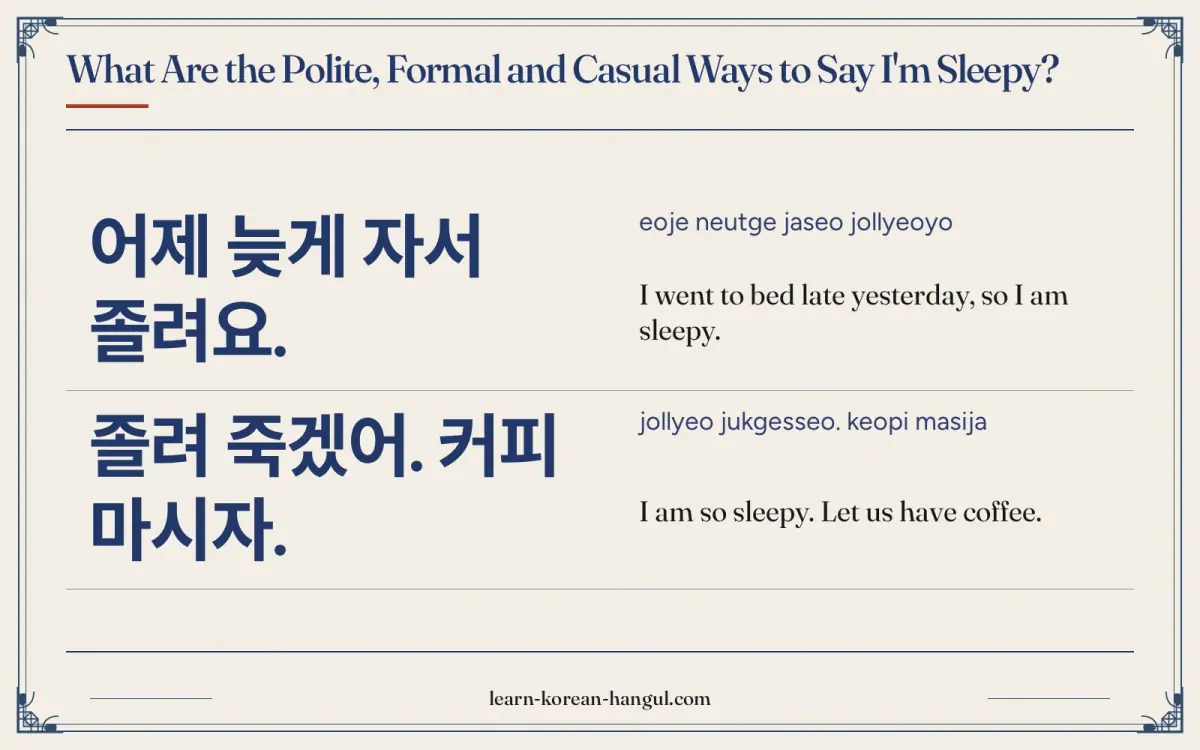
어제 늦게 자서 졸려요.
eoje neutge jaseo jollyeoyo
I went to bed late yesterday, so I am sleepy.
Formal: 졸립니다 (jollimnida)
Formal · 합쇼체졸립니다 is the formal form. It is rare in daily life. It is pronounced [졸림니다].
Tired, Not Sleepy: 피곤해요 (pigonhaeyo)
Polite · 해요체피곤해요 means tired from effort, like after work or a long trip. You can be 피곤해요 and still wide awake. Use 졸려요 only when your eyes want to close.
Strong: 졸려 죽겠어요 (jollyeo jukgesseoyo)
Polite · 해요체죽겠다, literally "I will die", is a common exaggeration. 졸려 죽겠어요 means "I'm so sleepy I could die". It is playful, so use it with friends and in light moods.
졸려 죽겠어. 커피 마시자.
jollyeo jukgesseo. keopi masija
I am so sleepy. Let us have coffee.
Behind these forms sits one small grammar rule.
Why Does 졸리다 Become 졸려요?
The stem 졸리- ends in the vowel ㅣ. Before the ending -어요, the two vowels merge: ㅣ + ㅓ becomes ㅕ. So 졸리 + 어요 becomes 졸려요. The ending 요 stays at the end.
- 졸리다 → 졸려요 (sleepy)
- 기다리다 → 기다려요 (to wait)
- 내리다 → 내려요 (to get off)
- 마시다 → 마셔요 (to drink)
This is regular, with no irregular change. Learners often forget it and write 졸리어요, which is not used in speech. Before consonant endings, nothing changes, so the formal form is 졸립니다.
How Do You Pronounce 졸려요?
졸려요 is pronounced [졸려요], jol-lyeo-yo, in three syllables. The spelling shows ㄹ at the end of 졸 and again at the start of 려, and in speech they join.
- 졸 (jol): a clear "jo" ending in a light ㄹ.
- 려 (lyeo): the ㄹ is held, so the two ㄹ sounds become one long "l". The vowel ㅕ is unrounded.
- 요 (yo): a short "yo".
Do not say jo-ryeo-yo with a quick tap, because that sounds like a different word.
Sound Changes to Listen For
These changes follow the National Institute of Korean Language standard pronunciation rules (표준 발음법):
- Double ㄹ. Both ㄹ in 졸려요 are pronounced, as one long lateral [ㄹㄹ]. That is the long l you hear in the clip.
- ㅂ before ㄴ becomes ㅁ. 졸립니다 is [졸림니다] (Article 18). See Korean nasalization.
- Tense after ㄱ. 죽겠어요 is [죽께써요]: the ㄱ of 죽 makes the next ㄱ tense (Article 23). See Korean tensification.
- Linking. 잠이 is [자미], because the final consonant moves to the vowel that follows (Article 13).
With the sound clear, here is when each form fits.
When Should You Use 졸려요, and When Should You Not?
Use 졸려요 when you feel drowsy and want company or coffee. Avoid it when the setting asks you to look alert.
Situations Where It Fits
- After lunch. 점심 먹고 나니까 졸려요 is almost a daily line.
- Early in the morning. 아침이라서 아직 졸려요 (it's morning, so I'm still sleepy).
- With a friend late at night. 나 졸려. 이제 자자 (I'm sleepy. Let's sleep now).
Situations to Avoid
- A meeting. Saying you are sleepy in a meeting can look careless, so stay quiet or wait for a break.
- A first meeting with elders. Look alert first.
- When you mean tired. If you are exhausted but awake, say 피곤해요.
Two short conversations show how it sounds.
What Does I'm Sleepy Sound Like in a Real Conversation?
In real life the line is followed by a fix. Notice the answers.
Friends in the Morning
Hana
졸려? 어제 몇 시에 잤어?
jollyeo? eoje myeot sie jasseo?
Are you sleepy? What time did you sleep yesterday?
Doyun
세 시에 잤어. 너무 졸려.
se sie jasseo. neomu jollyeo
I slept at three. I'm so sleepy.
Hana
커피 마실래?
keopi masillae?
Do you want some coffee?
Doyun
응, 좋아.
eung, joa
Yes, sounds good.
What to notice: 몇 시에 is pronounced [멷씨에], with a tense ㅅ after the final sound of 몇. The first question, 졸려?, is a yes/no question and rises; 몇 시에 잤어? is a wh-question and does not end with a sharp rise.
After Lunch at the Office
Colleague
점심 먹고 나니까 너무 졸려요.
jeomsim meokgo nanikka neomu jollyeoyo
Since lunch I'm so sleepy.
Team Leader
저도요. 커피 한 잔 할까요?
jeodoyo. keopi han jan halkkayo?
Me too. Shall we have a coffee?
Colleague
좋아요.
joayo
Sure.
What to notice: the polite 졸려요 comes with a shared fix, a coffee. The team leader answers 저도요 (me too), which keeps the tone friendly.
What Should You Know about the Culture behind I'm Sleepy?
Koreans have names for famous drowsy spells. 식곤증 (sikgonjeung) is sleepiness after a meal, and 춘곤증 (chungonjeung) is spring fatigue. Both are common reasons people give for yawning in the afternoon, so 점심 먹고 졸려요 meets a knowing smile, not a frown.
Coffee fills the gap. Cafés are everywhere, and a colleague who says 졸려요 often hears 커피 한 잔 할까요? as the answer. Drowsy driving is taken seriously too: highways have rest areas called 졸음쉼터 (joreumswimteo, drowsiness rest stop), where drivers are encouraged to stop.
Nodding off is described with the sound word 꾸벅꾸벅 (kkubeokkkubeok), as in 꾸벅꾸벅 졸다 (to nod off). A student in a lecture who does this is 졸고 있어요 (jolgo isseoyo, is dozing).
Students and office workers also talk about taking a short nap, a 낮잠 (natjam, daytime sleep) or a 쪽잠 (jjokjam, a snatched nap), to push through the afternoon. If a friend says 잠깐 눈 좀 붙일게 (jamkkan nun jom buchilge, I'll shut my eyes for a moment), they are asking for a few minutes of rest, not planning a full sleep.
An expert tip: to say you are not sleepy, use 안 졸려요 (an jollyeoyo). To say you got sleepy only for a moment, use the past, 졸렸어요.
What Mistakes Do Learners Make with I'm Sleepy in Korean?
Most mistakes come from mixing sleepy with tired or with a wish to sleep.
| Wrong | Why it is a problem | Correct |
|---|---|---|
| 졸리어요 | The vowels must contract | 졸려요 |
| 졸러요 | Wrong vowel | 졸려요 |
| 자고 싶어요 for sleepy | Means "I want to sleep" | 졸려요 |
| 졸아요 for sleepy | Means "I am dozing" | 졸려요 |
| Saying jo-ryeo-yo with a tap | The ㄹ must be held | 졸려요 |
| 졸려 to a boss | Too casual | 졸려요 |
One more trap is the slang 졸라. It sounds like 졸려, but it is a rude intensifier, so never use it for sleepy.
How Do You Ask Someone If They Are Sleepy?
Turn the words into a question with a rise at the end, because this is a yes/no question. To a friend, say 졸려? (jollyeo?). To a colleague, say 졸려요? (jollyeoyo?). To an elder, use the honorific 졸리세요? (jolliseyo?), which adds -시- to show respect to them.
A gentle follow-up is 커피 한 잔 할래요? (keopi han jan hallaeyo?). To ask why someone is sleepy, use a question word: 왜 졸려요? (wae jollyeoyo?). The stress goes on 왜, and the pitch falls or rises and falls, not a sharp rise.
Is It the Same as I Am Sleepy, Sleepy or Im Sleepy?
Yes. The short answers below cover the other searches folded into this page.
- I am sleepy in Korean: 졸려요 or the formal 졸립니다.
- Im sleepy in Korean: the same sentence; the apostrophe makes no difference in English.
- Sleepy in Korean: before a noun, the form is 졸린, as in 졸린 얼굴 (a sleepy face).
- Sleepy vs tired: 졸려요 for drowsy and 피곤해요 for tired.
Related Phrases to Learn Next
- If you are worn out, say I'm tired in Korean.
- Before bed, use good night in Korean.
- If you are restless, not sleepy, compare I'm bored in Korean.
Every phrase in this group lives in the Korean feelings phrases collection.
Practice: Say It Aloud
Play the slow clip of 졸려요 three times and hold the ㄹ. Then choose a phrase. Answers follow.
- You are with a close friend at midnight.
- You tell a coworker politely after lunch.
- You are tired but wide awake.
- How do you say "I'm not sleepy"?
Answers
- 졸려.
- 졸려요.
- 피곤해요.
- 안 졸려요.
Drill these with the phrase flashcards. Saying i'm sleepy in Korean gets easier when you hold the ㄹ and keep 졸려요 apart from 피곤해요.
Frequently Asked Questions
How do you say I'm sleepy in Korean?
Say 졸려요 (jollyeoyo) in polite speech, 졸려 (jollyeo) to a close friend and 졸립니다 (jollimnida) in formal speech. Korean usually drops the word for I, so 졸려요 alone is a full sentence. You can also say 잠이 와요 (jami wayo), which means sleep is coming.
How do you pronounce 졸려요?
졸려요 has three syllables, jol-lyeo-yo, and is pronounced [졸려요]. The ㄹ at the end of 졸 and the ㄹ at the start of 려 meet and make one held, long l sound, so do not say jo-ryeo-yo. The vowel ㅕ in 려 is unrounded.
What is the difference between 졸려요 and 졸려?
They mean the same. 졸려요 has the polite ending 요 and suits colleagues, older friends and strangers. 졸려 drops 요 and is for close friends, siblings and people younger than you.
Is 졸려요 formal or casual?
졸려요 is polite, the everyday middle level. The formal level is 졸립니다, pronounced [졸림니다], and the casual level is 졸려. The polite form is safe with almost any adult.
Can I use 졸려요 with friends, elders and strangers?
Yes. With friends use 졸려, and with elders or strangers use 졸려요. In a meeting, saying you are sleepy can look careless, so many people say 피곤해요 or stay quiet. To ask an older person, use the honorific 졸리세요? (jolliseyo?), never about yourself.
What is the most common mistake with I'm sleepy in Korean?
Learners say 자고 싶어요 for sleepy, but it means I want to sleep, a wish. Others say 졸아요, which means someone is actually dozing off. Writing 졸리어요 instead of 졸려요 is also wrong. Do not shorten the word to 졸라, which is a rude slang intensifier.