뭐 해요?
뭐 해요?
What you'll learn
- Say 뭐 해요? aloud as [뭐 해요] and 하고 있어요 as [하고 이써요].
- Choose between 뭐 해요?, 뭐 하세요? and 뭐 해? for a coworker, an elder and a friend.
- Tell "right now" (지금 뭐 하고 있어요?) apart from "plans" (내일 뭐 해요?).
- Answer with a short sentence such as 집에서 쉬고 있어요.
Before you start: you need to read Hangul; romanization is shown as an aid and can be hidden. Time: about 10 minutes. Audio plays only when you press a button.
How Do You Say What Are You Doing in Korean?
The most natural way to ask "what are you doing?" is 뭐 해요? (mwo haeyo). It joins 뭐 (what) with 해요, the polite form of 하다 (to do). Four forms cover the question, from friends to elders.
| Form | Romanization | Meaning | Register | Say it to |
|---|---|---|---|---|
| 뭐 해요? | mwo haeyo | what are you doing? | Polite (해요체) | Peers, coworkers, acquaintances |
| 뭐 하세요? | mwo haseyo | what are you doing? | Polite, honorific | Elders, teachers, customers |
| 뭐 해? | mwo hae | what are you doing? | Casual (반말) | Close friends, younger people |
| 지금 뭐 하고 있어요? | jigeum mwo hago isseoyo | what are you doing now? | Polite (해요체) | Anyone you address politely |
The table lists the forms. The next section shows each one in a sentence.
What Are the Polite and Casual Ways to Say What Are You Doing?
Korean changes the ending of a sentence to match the listener's age, status and closeness. These endings are called speech levels, and the guide to Korean speech levels explains them in full. This question also adds the honorific -시- when you ask about an elder's actions.
Polite: 뭐 해요? (mwo haeyo)
Polite · 해요체뭐 해요? is the everyday polite question. It uses 해요체, the style Koreans speak with coworkers, classmates and people they have just met. It can ask about the moment, a habit or a plan, and the context tells you which.
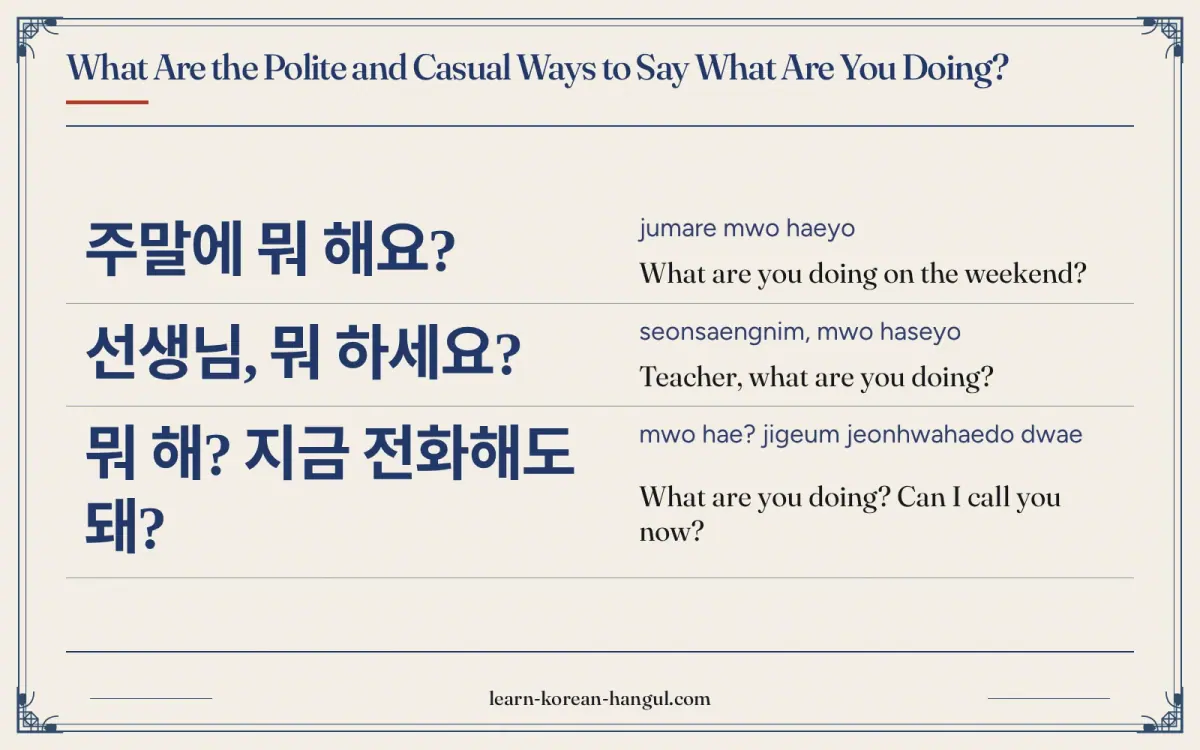
주말에 뭐 해요?
jumare mwo haeyo
What are you doing on the weekend?
Polite: 뭐 하세요? (mwo haseyo)
Polite · 해요체뭐 하세요? adds the honorific -세요, which shows respect to the person doing the action, here the listener. It fits a teacher, a grandparent, a customer or any person clearly older than you. The verb 하다 becomes 하세요. The honorific is about respect for the listener, not about distance, so it is warm, not cold.
선생님, 뭐 하세요?
seonsaengnim, mwo haseyo
Teacher, what are you doing?
Casual: 뭐 해? (mwo hae)
Casual · 반말뭐 해? drops the polite ending 요. It is 반말 (casual speech) for close friends, siblings and younger people. In a text or a call it is also a common opener, which leads to the culture section below.
뭐 해? 지금 전화해도 돼?
mwo hae? jigeum jeonhwahaedo dwae
What are you doing? Can I call you now?
Polite: 지금 뭐 하고 있어요? (jigeum mwo hago isseoyo)
Polite · 해요체This longer form uses -고 있다, the present progressive, which means "be doing." 지금 (now) makes the moment clear. Use it when you want the answer for this very minute, such as when you call someone and want to know whether they are free.
지금 뭐 하고 있어요?
jigeum mwo hago isseoyo
What are you doing now?
Four forms and four sentences are enough to ask. How they sound comes next.
How Do You Pronounce 뭐 해요?
뭐 해요? is pronounced [뭐 해요], in three syllables across two words. 뭐 starts with a quick "w" glide: say "mwo," not "muh-wo."
- 뭐 (mwo): lips round for "w," then open to "o" as in "law" without rounding.
- 해 (hae): "heh," with a light ㅎ that can almost disappear in fast speech.
- 요 (yo): "yoh." Put the stress on 뭐 and let the end fall, or rise and then fall. A sharp final rise turns 뭐 into "something": 뭐 해요? ↗ then means "Are you doing something?"
Sound Changes to Listen For
Two rules and one habit shape this phrase.
- 있어요 sounds like 이써요. In 하고 있어요, the ㅆ of 있 moves onto 어. The result is [하고 이써요].
- Light ㅎ. In 뭐 해요, the ㅎ is weak between voiced sounds, so the phrase runs together. Revised Romanization (the South Korean government standard of 2000) still writes mwo haeyo.
- Answer 아무것도 안 해요. This reply, "I'm not doing anything," is pronounced [아무걷또 안 해요]. The final ㅅ of 것 becomes [ㄷ], and the next ㄷ is tensed. The page on Korean tensification explains this rule.
With the sounds set, the next question is who you can ask.
When Should You Use 뭐 해요?, and When Should You Not?
Ask 뭐 해요? of anyone your age or in your team, 뭐 하세요? of anyone older, and 뭐 해? only of friends. Ask only when you have some reason to be interested.
Situations Where It Fits
- A coworker is away from their desk. 뭐 해요? is a friendly check-in.
- A friend answers a call. 뭐 해? opens the conversation.
- A teacher is busy at their desk. 뭐 하세요? is respectful.
- A weekend plan. 주말에 뭐 해요? invites a plan.
Situations to Avoid
- 뭐 해요? to a teacher or grandparent. It needs 뭐 하세요?.
- A cold 뭐 해? to an acquaintance. It sounds like you are checking up on them.
- Using 뭐 해요? when you mean "what is your job?" For work, ask 무슨 일 하세요?, covered on the page about what do you do in Korean.
These rules are easier to feel in real exchanges, so here are three.
What Does What Are You Doing Sound Like in a Real Conversation?
A "what are you doing" exchange is short. The asker uses the polite or casual form, and the answer is a simple present or progressive verb.
Friends on the Phone
Minho
뭐 해?
mwo hae
What are you doing?
Jisu
그냥 집에 있어. 너는?
geunyang jibe isseo. neoneun
Just at home. And you?
What to notice: Jisu answers with 그냥 (just), which downplays the answer. 너는? (and you?) hands the turn back.
Colleagues
Hana
지금 뭐 하고 있어요?
jigeum mwo hago isseoyo
What are you doing now?
Taeho
보고서 쓰고 있어요.
bogoseo sseugo isseoyo
I'm writing a report.
What to notice: the answer repeats -고 있어요 with a new verb, 쓰다 (to write).
A Grandmother
Grandchild
할머니, 뭐 하세요?
halmeoni, mwo haseyo
Grandma, what are you doing?
Grandmother
텔레비전 보고 있어.
tellebijeon bogo isseo
I'm watching TV.
What to notice: the grandchild uses the honorific, and the grandmother answers in casual speech, which elders may use with younger family. The next section explains why this question is often more than a question.
What Should You Know about the Culture behind What Are You Doing?
In everyday Korean, 뭐 해? often works as an opener, not a literal question. When a friend texts on KakaoTalk or calls with 뭐 해?, the sender may want to chat, share news or suggest meeting. The reply is usually short, followed by a question back.
- It can be a hint. 뭐 해? often means "are you free?" or "want to hang out?"
- Short replies are enough. 그냥 있어요 (just here) or 집에서 쉬고 있어요 (resting at home) is normal.
- Ask back. With friends, say 너는? (and you?). In polite speech, ask 지금 바쁘세요? (are you busy now?) or repeat the question.
- Not for strangers. Asking a stranger 뭐 해요? sounds nosy.
An expert tip: the verb 하다 is a general "do," so Korean often uses a noun plus 하다 for the real activity, such as 공부하다 (study) or 운동하다 (exercise). The reply 공부해요 (I study) is as natural as 공부하고 있어요 (I'm studying). This page covers the spoken question. Full present-progressive grammar is covered in grammar lessons.
What Mistakes Do Learners Make with What Are You Doing in Korean?
Most mistakes with this question come from honorifics, meaning and the present progressive.
| Mistake | Why it is a problem | Fix |
|---|---|---|
| Saying 뭐 해요? to a teacher | The listener is older and deserves the honorific | Say 뭐 하세요? |
| Using 뭐 해? with a stranger | The casual ending is too familiar | Use 뭐 해요? |
| Using 뭐 해요? for "what is your job?" | It asks about the moment | Say 무슨 일 하세요? |
| Writing 뭐 하고 있어요 for plans | -고 있어요 stresses the present moment | Say 내일 뭐 해요? |
| Reading 있어요 as separate sounds | The final ㅆ moves onto the next vowel | Say [이써요] |
Learners often think 뭐 해요 equals the English "what are you doing" in every case. It is wider: 뭐 해요? can ask about now, habit or plans, while the English phrase mostly asks about now. Context and 지금 (now) make the meaning clear.
How Do You Say What R U Doing or Doing in Korean?
The text spellings "what r u doing" and "what you doing" have the same answer, 뭐 해요? or 뭐 해?. "Doing" on its own is 하고 있다. The short answers below cover each search.
- What r u doing in Korean / what are u doing in Korean: these are text spellings of "what are you doing." The Korean answer is the same: 뭐 해요? or 뭐 해?
- What you doing in Korean: a short chat form of the question. Use 뭐 해? with friends.
- Doing in Korean: the verb is 하다 (to do), and -고 있다 makes it "doing." 하고 있어요 means "I am doing."
- What are you doing tomorrow in Korean: 내일 뭐 해요? (naeil mwo haeyo).
Knowing the forms is one thing; saying them on cue is another, so practise now.
Practice: Say It Aloud
Play the slow clip of 뭐 해요?, repeat it three times, then answer it with 집에서 쉬고 있어요. Then choose a form for each situation. Answers follow.
- A close friend answers your phone call.
- Your teacher is reading at a desk.
- You want to know what a coworker is doing right now.
- How do you say "I'm not doing anything"?
Answers
- 뭐 해?
- 뭐 하세요?
- 지금 뭐 하고 있어요?
- 아무것도 안 해요 ([아무걷또 안 해요]).
The phrase flashcards drill all four lines with audio.
Related Phrases to Learn Next
Asking what someone is doing sits with the other small talk phrases.
- Korean small talk: the collection that lists every phrase in this cluster.
- Where are you going in Korean: the natural next question.
- What's up in Korean: the casual greeting that often comes first.
- Are you free in Korean: the direct version of the hint inside 뭐 해?.
- I'm busy in Korean: a common answer.
What this page does not cover: the full grammar of -고 있다, and questions about jobs. Pick 뭐 해요? when in doubt, and you can ask what are you doing in Korean to almost anyone you speak to politely.
Frequently Asked Questions
How do you say what are you doing in Korean?
Say 뭐 해요? (mwo haeyo) in the polite style. 뭐 means "what" and 해요 means "do." To an elder or a teacher, use 뭐 하세요? (mwo haseyo). To a close friend, say 뭐 해? (mwo hae). To stress the moment, say 지금 뭐 하고 있어요? (jigeum mwo hago isseoyo).
How do you pronounce 뭐 해요?
Say [뭐 해요]: "mwo" with a quick w glide, then "hae" and "yo." The ㅎ in 해 is light, so the two words run together smoothly. Stress 뭐 and let the end fall; a sharp rise makes it "are you doing something?" For 하고 있어요, say [하고 이써요], because 있어요 sounds like 이써요.
What is the difference between 뭐 해요? and 뭐 하세요?
Both ask "what are you doing?" 뭐 해요? is plain polite and fits peers and coworkers. 뭐 하세요? adds the honorific -세요 and fits teachers, grandparents and customers. The first is friendly, and the second shows more respect. Choose the honorific whenever the listener is clearly older or senior.
Is 뭐 해요? formal or casual?
It is polite but not formal. It uses the 해요체 ending, the everyday polite style. Formal speech would use 무엇을 하십니까?, which is rare in conversation. Casual speech drops the ending and says 뭐 해?. Most daily conversations with colleagues and new friends use the polite 뭐 해요?.
Can I use 뭐 해요? with friends, elders and strangers?
Use 뭐 해요? with peers, coworkers and new acquaintances. With elders and teachers say 뭐 하세요?. With close friends say 뭐 해?. With strangers you rarely need the question at all, because it assumes some closeness, so greet them first and ask something more neutral.
What is the most common mistake with what are you doing in Korean?
The most common mistake is saying 뭐 해요? to a teacher or grandparent, which needs the honorific 뭐 하세요?. The second is meaning. 뭐 해요 can also ask about plans, so 내일 뭐 해요? means "what are you doing tomorrow?" Use 지금 뭐 하고 있어요? when you mean "right now."