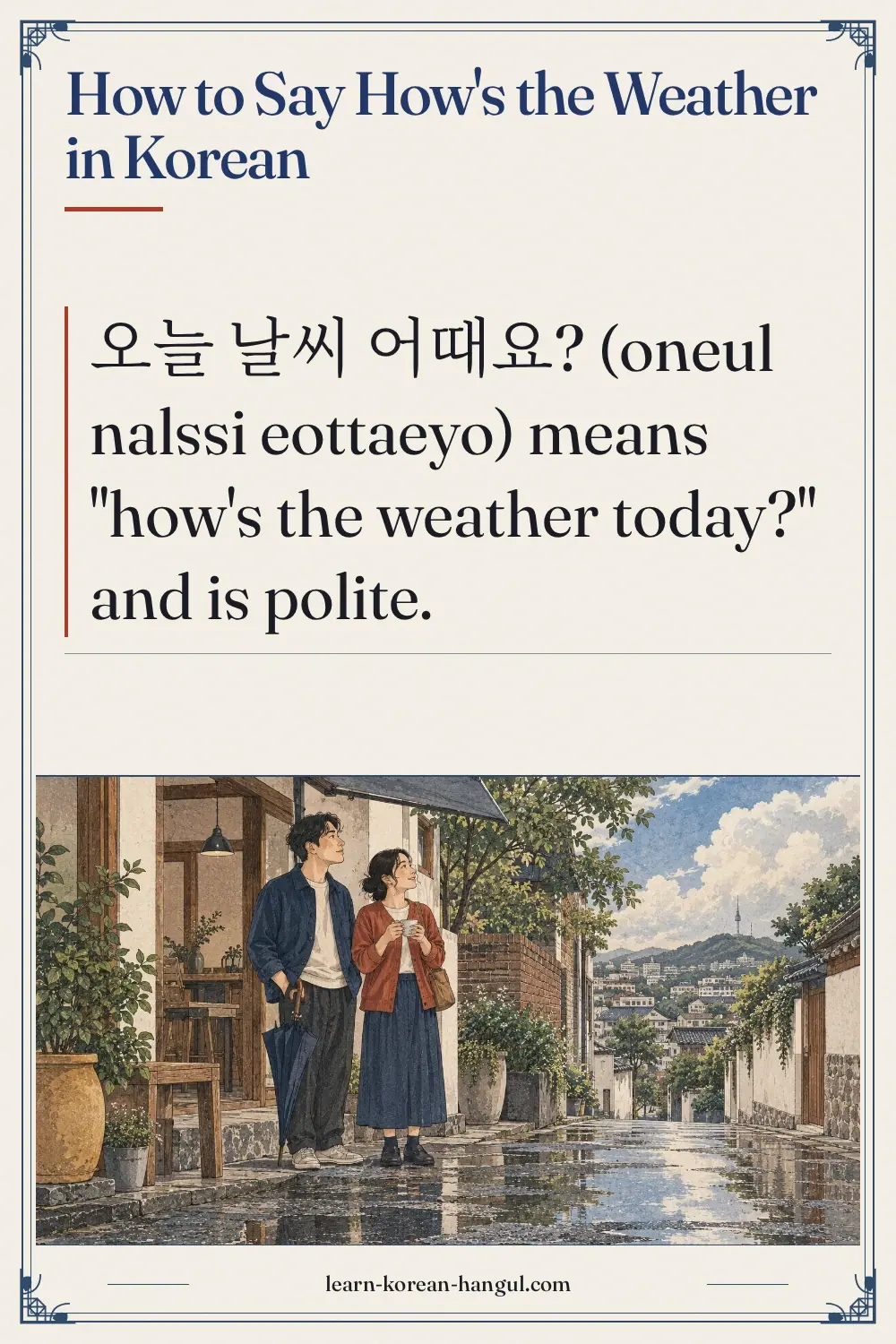
오늘 날씨 어때요?
오늘 날씨 어때요?
What you'll learn
- Ask 오늘 날씨 어때요? and comment with 날씨가 좋네요, 오늘 춥네요 and 오늘 덥네요.
- Explain what the ending -네요 adds when you notice something.
- Say the nasal sound changes in 좋네요 and 춥네요 correctly.
- Pick the right word for hot weather and avoid 뜨겁다.
Before you start: the lesson on Korean speech levels explains the polite -요 ending used below. Time: about 11 minutes. Audio plays only when you press a button.
How Do You Say How's the Weather in Korean?
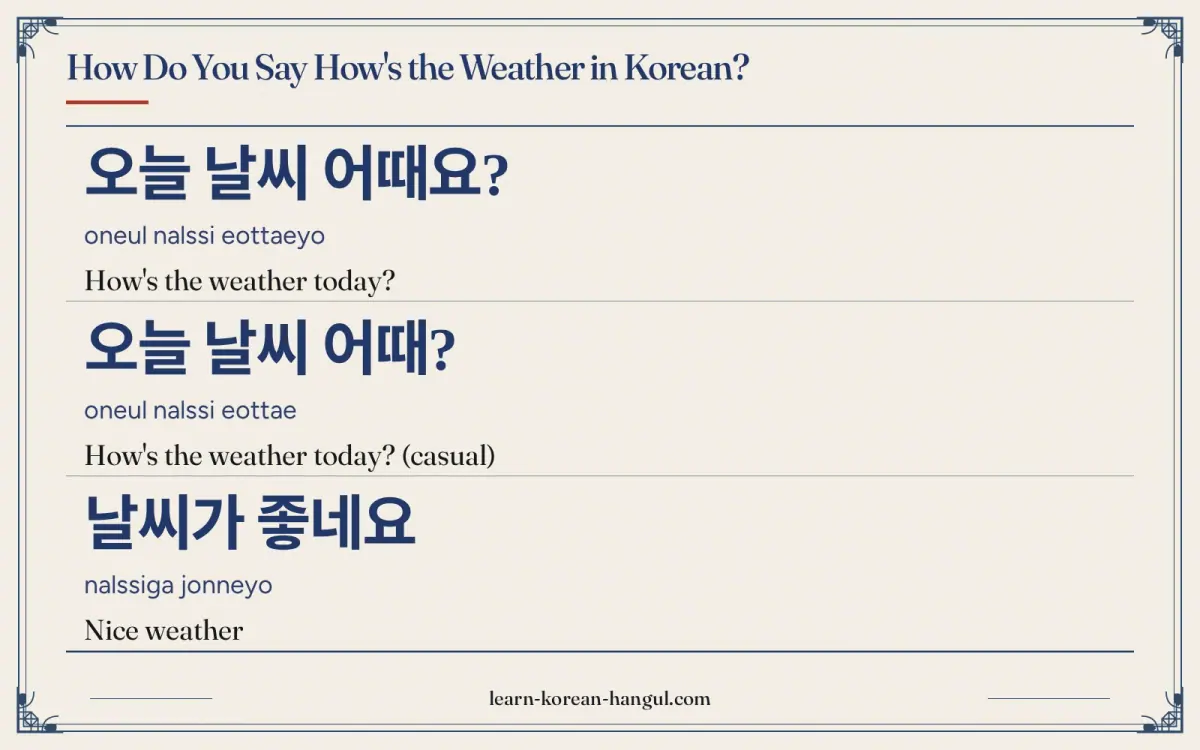
The standard way to say how's the weather in Korean is 오늘 날씨 어때요? The sentence has three parts: 오늘 (today), 날씨 (weather) and 어때요 (how is it?). 어때요 comes from the adjective 어떻다 (to be how), so the whole sentence asks for a description of the weather.
| Situation | Korean | Romanization | Meaning |
|---|---|---|---|
| Asking a coworker or neighbour | 오늘 날씨 어때요? | oneul nalssi eottaeyo | How's the weather today? |
| Asking a friend | 오늘 날씨 어때? | oneul nalssi eottae | How's the weather today? (casual) |
| Commenting on a sunny day | 날씨가 좋네요 | nalssiga jonneyo | Nice weather |
| Commenting on cold | 오늘 춥네요 | oneul chumneyo | It's cold today |
| Commenting on heat | 오늘 덥네요 | oneul deomneyo | It's hot today |
Revised Romanization (the South Korean government standard of 2000) is only a reading aid here. Learn the Hangul first. The next section explains who each form suits.
What Are the Polite Ways to Say How's the Weather?
Korean speakers rarely ask a weather question and then wait for a forecast. Most of the time they either ask 오늘 날씨 어때요? to start a chat or make a short comment with -네요. The ending -네요 means "I notice this right now", so it sounds natural, friendly and a little surprised.
Polite: 오늘 날씨 어때요? (oneul nalssi eottaeyo)
Polite · 해요체오늘 날씨 어때요? is the everyday polite question. Use it when you do not know the weather yet, for example before leaving the house or when a colleague has just come in from outside. It is a wh-question, so the stress falls on 어때요 and the pitch does not need a sharp rise at the end.
오늘 날씨 어때요? 우산 필요해요?
oneul nalssi eottaeyo? usan piryohaeyo
How is the weather today? Do I need an umbrella?
Polite: 날씨가 좋네요 (nalssiga jonneyo)
Polite · 해요체날씨가 좋네요 is a comment, not a question. The subject particle 가 marks 날씨, and 좋네요 comes from 좋다 (to be good) plus -네요. People say it when they step outside, look out of a window or meet someone on a bright day. A natural reply is 그러게요 (it really is).
날씨가 좋네요. 산책할까요?
nalssiga jonneyo. sanchaekalkkayo
Nice weather. Shall we take a walk?
Polite: 오늘 춥네요 (oneul chumneyo)
Polite · 해요체오늘 춥네요 comes from the adjective 춥다 (to be cold). Its polite present form is 추워요, but with -네요 the stem 춥- stays unchanged. Use it to share the feeling and to start a short exchange. If you are the one who is cold, a related phrase is I'm cold in Korean.
오늘 춥네요. 겉옷 챙기세요.
oneul chumneyo. geodot chaenggiseyo
It is cold today. Take a jacket.
Polite: 오늘 덥네요 (oneul deomneyo)
Polite · 해요체오늘 덥네요 is the hot-weather comment, from 덥다 (to be hot). Its polite present form is 더워요. Both 춥다 and 덥다 are ㅂ-irregular, which means the ㅂ becomes 우 before endings that start with a vowel, but -네요 begins with a consonant, so nothing changes. The related page is I'm hot in Korean.
오늘 덥네요. 물 많이 마셔요.
oneul deomneyo. mul mani masyeoyo
It is hot today. Drink lots of water.
Casual: 오늘 날씨 어때? (oneul nalssi eottae)
Casual · 반말Drop -요 and you get the casual question. Friends, family and classmates your own age use it. With seniors, keep -요, and with formal situations use 오늘 날씨가 어떻습니까? (oneul nalssiga eotteoseumnikka), which sounds like [어떠씀니까].
Pronunciation comes next, because two of these sentences hide a sound change.
How Do You Pronounce 오늘 날씨 어때요?
오늘 날씨 어때요? is pronounced [오늘 날씨 어때요], in seven syllables: o-neul nal-ssi eo-ttae-yo. There is no sound change inside the sentence, but three details matter.
- 날 (nal): the ㄹ at the end is a light lateral, the tongue touching the ridge behind the upper teeth.
- 씨 (ssi): ㅆ is a tense sound. Press the tongue and let the sound out sharply, with no puff of air.
- 어때요 (eo-ttae-yo): ㅓ is an unrounded vowel, so do not round your lips as in English "aw". The ㄸ is tense, like ㅆ.
Sound Changes to Listen For
The comments with -네요 show the clearest sound changes. The Standard Pronunciation Rules of the National Institute of Korean Language (국립국어원) cover them under the ㅎ rule (Article 12) and nasalization (비음화, Article 18).
- 좋네요 sounds like [존네요]. A final ㅎ is pronounced [ㄴ] before ㄴ (Article 12), so 좋 becomes [존] before the ㄴ of 네요. RR writes the sound you hear: jonneyo.
- 춥네요 sounds like [춤네요]. The final ㅂ turns into ㅁ before ㄴ. RR writes chumneyo.
- 덥네요 sounds like [덤네요]. The same ㅂ to ㅁ change gives deomneyo.
- 맑아요 sounds like [말가요]. This one is linking, not nasalization: the ㄱ of the double final ㄺ moves to the next syllable when a vowel follows (Article 14).
The Korean nasalization lesson shows the full pattern with audio. Say 좋다, then 좋네요, and notice how the final sound moves from the throat to the nose. Pronunciation helps only if you also know when to use these lines.
When Should You Use 오늘 날씨 어때요?, and When Should You Not?
Use 오늘 날씨 어때요? to open friendly small talk. Do not use it as a real request for a forecast when the other person has no way of knowing.
Situations Where It Fits
- A coworker arrives from outside. 오늘 날씨 어때요? shows interest and starts the day gently.
- A neighbour at the lift. 오늘 날씨 좋네요 is a safe line for a short, polite exchange.
- A taxi ride. Drivers often talk about traffic and weather, so 오늘 덥네요 gets a friendly answer.
- Planning a trip. Ask 내일 날씨 어때요? (how's the weather tomorrow?) before a picnic or a hike.
Situations to Avoid
- Hot weather with 뜨겁다. Say 더워요 for the air, not 뜨거워요.
- Answering a question with a question. If someone asks 오늘 날씨 어때요?, reply with 춥네요 or 좋네요, not with 어때요 again.
- Using casual 어때? with seniors. Keep the -요 ending with anyone older or unfamiliar.
The best way to hear the difference is in a conversation, so here are three short ones.
What Does How's the Weather Sound Like in a Real Conversation?
Weather talk is brief and warm. Listen for the soft, falling tone on 어때요 and the slightly surprised tone on -네요.
Neighbours at the Lift
Neighbour A
오늘 날씨 어때요?
oneul nalssi eottaeyo
How is the weather today?
Neighbour B
좀 춥네요. 겉옷 챙기세요.
jom chumneyo. geodot chaenggiseyo
It is a bit cold. Take a jacket.
What to notice: 좀 softens the comment, and 챙기세요 adds the honorific -세요 for a friendly suggestion.
A Passenger and a Taxi Driver
Passenger
오늘 날씨 좋네요.
oneul nalssi jonneyo
The weather is nice today.
Driver
네, 정말 맑아요.
ne, jeongmal malgayo
Yes, it is really clear.
What to notice: 맑아요 is written with ㄺ, but you hear [말가요]. The adjective 맑다 means clear and fine, and it is the usual word for a sunny sky.
Two Coworkers
Min-Su
오늘 덥네요.
oneul deomneyo
It is hot today.
Ji-Won
그러게요. 아이스 커피 마셔요.
geureogeyo. aiseu keopi masyeoyo
It really is. Let's get iced coffee.
What to notice: 그러게요 agrees with a comment, as in "you are right, it is". It is the natural answer to a -네요 sentence. The culture around the weather also shapes what people say.
What Should You Know about the Culture behind How's the Weather?
Korea has four clear seasons, so the weather changes what people wear, eat and do. That makes it an easy and safe topic for strangers.
- 장마 (jangma). This is the rainy season in early summer. People mention it often, with remarks such as 장마가 시작됐네요 (the rainy season has started).
- 미세먼지 (misemeonji). Fine dust is a daily concern in some seasons, and many people check a fine-dust forecast along with the weather before going out.
- Short comments. Koreans usually comment on the weather in a few words, then move on to the day's plan, such as lunch or a walk.
An expert insight: -네요 is the ending that makes weather talk sound natural. A learner who says only 날씨 좋아요 sounds correct, while 날씨가 좋네요 sounds like someone who just noticed the sky. The mistakes below mostly come from word choice.
What Mistakes Do Learners Make with How's the Weather in Korean?
Most weather mistakes are word-choice errors.
| Mistake | Why it is a problem | Fix |
|---|---|---|
| 날씨가 뜨거워요 for hot weather | 뜨겁다 describes hot objects such as soup or a pan | Say 더워요 or 덥네요 |
| Answering 오늘 날씨 어때요? with 어때요 | It repeats the question | Answer with 좋네요 or 춥네요 |
| Writing 좋네요 as it sounds, 존네요 | Spelling keeps the original letters | Write 좋네요, say [존네요] |
| Casual 어때? to a senior | Too familiar | Keep the -요 ending |
| Sharp rise on 어때요 | Wh-questions usually fall or rise-fall | Stress 어때요 and let the pitch fall |
Learners often think weather needs a separate verb. Actually, the adjectives 춥다, 덥다 and 좋다 do the work, and -네요 adds the natural tone.
Is It the Same as Weather, What's the Weather and Nice Weather?
Four short searches lead to this page, and each has a short answer.
- Weather in Korean: the noun is 날씨 (nalssi). The dictionary page weather in Korean covers the word on its own.
- What's the weather in Korean: the same question, 오늘 날씨 어때요?, or 날씨가 어때요? with no time word.
- Weather today in Korean: 오늘 날씨 (oneul nalssi), as in 오늘 날씨 확인했어요? (did you check today's weather?).
- Nice weather in Korean: 날씨가 좋네요, or 날씨 좋다 with friends.
Practice: Say It Aloud
Play the slow clip and repeat 오늘 날씨 어때요? three times, keeping 씨 and 때 tense. Then choose a sentence for each situation. Answers follow.
- You step outside and the sky is bright.
- It is freezing and you tell a coworker.
- You ask a neighbour about the weather.
- How do you write the sentence you hear as [춤네요]?
Answers
- 날씨가 좋네요.
- 오늘 춥네요.
- 오늘 날씨 어때요?
- 춥네요.
The phrase flashcards drill these forms with audio.
Related Phrases to Learn Next
Weather talk leads naturally into feelings and daily chat.
- I'm cold in Korean: saying how you feel in winter.
- I'm hot in Korean: the summer counterpart.
- How are you in Korean: the other classic opener.
- What are you doing in Korean: the next question in many chats.
This guide belongs to the Korean small talk collection. What this page does not cover: forecasts, rain and snow vocabulary, and the full conjugation of 춥다 and 덥다. Ask 오늘 날씨 어때요? with a smile, and you can say how's the weather in Korean naturally.
Frequently Asked Questions
How do you say how's the weather in Korean?
Say 오늘 날씨 어때요? (oneul nalssi eottaeyo) in polite speech. It means "how's the weather today?" and works with coworkers, neighbours and drivers. With friends, drop the ending to get 오늘 날씨 어때?. To comment instead of asking, say 날씨가 좋네요 for nice weather or 오늘 춥네요 for cold.
How do you pronounce 오늘 날씨 어때요?
Say o-neul nal-ssi eo-ttae-yo in seven syllables. The ㅆ in 씨 and the ㄸ in 때 are tense sounds, made with a firm tongue and no puff of air. The vowel ㅓ is unrounded. A wh-question like this does not need a sharp final rise, so let the pitch fall after 어때요.
What is the difference between 오늘 날씨 어때요? and 날씨가 좋네요?
오늘 날씨 어때요? asks about the weather and expects an answer. 날씨가 좋네요 is a comment that shares what you notice. The ending -네요 shows you have just noticed something, so it sounds friendly and a little surprised. Use the question when you do not know the weather and the comment when you can see it.
Can I use 오늘 날씨 어때요? with friends, elders and strangers?
Yes, the polite -요 form is safe with strangers, coworkers and elders. With close friends, use 오늘 날씨 어때?. For a formal setting such as a meeting or a broadcast, 오늘 날씨가 어떻습니까? is more suitable. Weather is a neutral topic, so it rarely offends anyone.
What is the most common mistake with how's the weather in Korean?
Using 뜨겁다 for hot weather. 날씨가 뜨거워요 sounds odd because 뜨겁다 describes hot objects such as soup or a pan. Say 더워요 or 오늘 덥네요 instead. Another mistake is answering 오늘 날씨 어때요? with 어때요 again instead of with a comment like 춥네요.