창피해요
창피해요
What you'll learn
- Say I'm embarrassed with 창피해요, 창피합니다 or 창피해, depending on the listener.
- Choose between 창피해요, 부끄러워요 and 민망해요.
- See when a feeling word takes 해요 and when it takes 워요.
- Pronounce 창피해요 with a clear ㅍ, and say 낯을 가려요 as [나츨 가려요].
Before you start: you only need to read Hangul. When your nerves rise instead, learn I'm nervous in Korean. Time: about 10 minutes. Audio plays only when you press a button.
How Do You Say I'm Embarrassed in Korean?
The standard way to say I'm embarrassed in Korean is 창피해요. The adjective 창피하다 describes the feeling of losing face because others saw a mistake or a flaw. Korean usually drops "I", so 창피해요 alone is a full sentence. You can use it for a small slip or for a bigger moment.
| Situation | Best form | Romanization | Why |
|---|---|---|---|
| Telling a colleague or a stranger | 창피해요 | changpihaeyo | Polite, natural |
| Telling a close friend | 창피해 | changpihae | Casual |
| A formal apology or statement | 창피합니다 | changpihamnida | Formal |
| Shy or ashamed | 부끄러워요 | bukkeureowoyo | Feeling shy |
| Awkward moment | 민망해요 | minmanghaeyo | Awkward embarrassment |
The next section sorts these by listener and feeling.
What Are the Polite Ways to Say I'm Embarrassed?
The forms follow the Korean speech levels, explained in the guide to Korean speech levels. Here the feeling changes the word, and the ending changes the level.
Polite: 창피해요 (changpihaeyo)
Polite · 해요체창피해요 is the form to learn first. It suits coworkers, neighbours and friends. Use it right after a mistake that others noticed.
사람들 앞에서 넘어져서 창피해요.
saramdeul apeseo neomeojyeoseo changpihaeyo
I fell in front of everyone, so I'm embarrassed.
Casual: 창피해 (changpihae)
Casual · 반말창피해 drops the polite ending. Use it with close friends, siblings and people younger than you. A stronger version for friends is 너무 창피해.
나 발음 틀려서 너무 창피해.
na bareum teullyeoseo neomu changpihae
I got the pronunciation wrong, so I'm so embarrassed.
Formal: 창피합니다 (changpihamnida)
Formal · 합쇼체창피합니다 is the formal form. It is rare in speech, but you may see it in written replies and speeches. It is pronounced [창피함니다].
Shy or Ashamed: 부끄러워요 (bukkeureowoyo)
Polite · 해요체부끄러워요 means you feel shy, bashful or ashamed, often about yourself or your own act. It can be soft, like blushing when praised, or serious, like feeling ashamed of a wrong.
부끄러워서 말을 못 했어요.
bukkeureowoseo mareul mot haesseoyo
I was too shy to speak.
The two main words end differently, and this is worth a closer look.
Which Ending: 해요 or 워요?
Both 창피하다 and 민망하다 end in 하다, so they become 해요. In contrast, 부끄럽다 and 쑥스럽다 end in ㅂ and are ㅂ-irregular adjectives. Before a vowel ending, the ㅂ turns into 우 and joins the ending: 부끄럽 + 어요 → 부끄러우 + 어요 → 부끄러워요.
- 창피하다 → 창피해요 (embarrassed)
- 민망하다 → 민망해요 (awkward)
- 부끄럽다 → 부끄러워요 (shy, ashamed)
- 쑥스럽다 → 쑥스러워요 (bashful, a bit awkward)
A good habit is to look at the last syllable of the dictionary form. If it ends in 하다, say 해요. If it ends in 럽다, expect 러워요. The past forms follow the same logic: 창피했어요 (changpihaesseoyo) and 부끄러웠어요 (bukkeureowosseoyo). The ㅂ comes back before consonants, as in 부끄럽지 않아요 (I'm not ashamed). Next, the sounds.
How Do You Pronounce 창피해요?
창피해요 is pronounced [창피해요], chang-pi-hae-yo, in four syllables. It sounds just like it is written. The ㅍ is aspirated, so release a small puff of air. The ㅇ at the end of 창 is the "ng" sound, and it does not link to the ㅍ.
- 창 (chang): "chahng", with an aspirated ch, as in "chair".
- 피 (pi): a puff of air with ㅍ, "pee".
- 해 (hae): "heh", with a light h.
- 요 (yo): "yo".
Revised Romanization writes every letter here, so you see changpihaeyo; in fast speech the h of 해 between vowels becomes very weak. In 부끄러워요, the ㄲ is tense and written, and the ㅓ in 러 is unrounded, so keep your lips relaxed, not rounded.
Sound Changes to Listen For
These notes follow the National Institute of Korean Language standard pronunciation rules (표준 발음법):
- ㅂ before ㄴ becomes ㅁ. 창피합니다 is [창피함니다] (Article 18). RR writes changpihamnida. See Korean nasalization.
- The final ㅆ moves forward. 창피했어요 is [창피해써요] (Article 13).
- A final ㅊ stays ㅊ before a vowel. 낯을 가려요 is [나츨 가려요] (Article 13), and RR writes nacheul garyeoyo.
With the sound clear, here is when each form fits.
When Should You Use 창피해요, and When Should You Not?
Use 창피해요 when others have seen a slip and you want to admit it lightly. Use another word when your feeling is shyness or awkwardness.
Situations Where It Fits
- After a visible mistake. 이름을 잘못 불러서 창피해요. (I called the wrong name, so I'm embarrassed.)
- Laughing at yourself. 아, 창피해! 다들 봤어요? (Ah, how embarrassing! Did everyone see?)
- Explaining a blush. 칭찬받아서 쑥스러워요. (I'm bashful because I was praised.)
Situations to Avoid
- Describing meeting new people. Use 낯을 가려요 (I'm shy with strangers), not 창피해요.
- A serious wrong. Use 부끄러워요 or 죄송해요, which admit responsibility.
- Very casual slang. You may hear 쪽팔려, which is only for close friends and not for polite speech.
Two short conversations show how it sounds.
What Does I'm Embarrassed Sound Like in a Real Conversation?
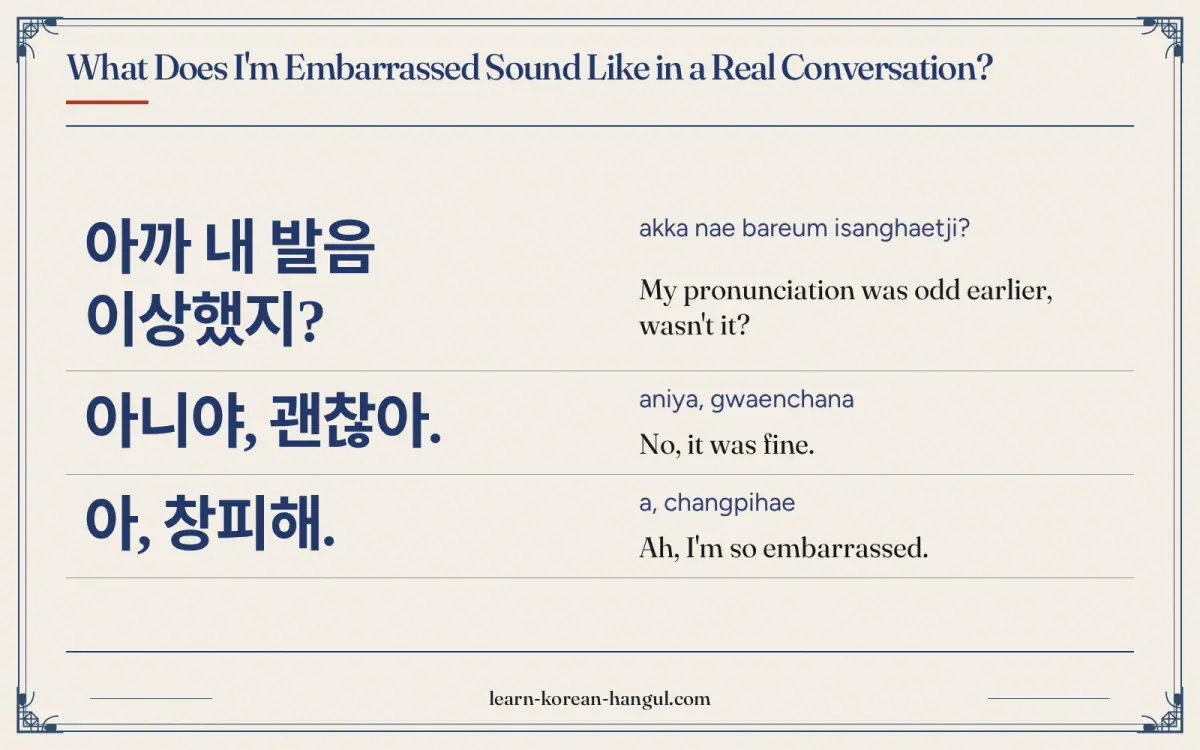
In real life, the line is followed by comfort. Notice the answers.
After a Presentation
Sua
아까 내 발음 이상했지?
akka nae bareum isanghaetji?
My pronunciation was odd earlier, wasn't it?
Taemin
아니야, 괜찮아.
aniya, gwaenchana
No, it was fine.
Sua
아, 창피해.
a, changpihae
Ah, I'm so embarrassed.
What to notice: 이상했지? ends with a rise because it seeks agreement. The friend uses a casual comfort line, and Sua keeps the casual 창피해.
A Wrong Meeting Time
Staff
팀장님, 회의 시간을 잘못 알았어요. 창피해요.
timjangnim, hoeui siganeul jalmot arasseoyo. changpihaeyo
Team leader, I got the meeting time wrong. I'm embarrassed.
Team Leader
괜찮아요. 누구나 실수해요.
gwaenchanayo. nuguna silsuhaeyo
It's okay. Everyone makes mistakes.
What to notice: the staff member admits the slip first and names the feeling. The team leader answers with a comforting line, 누구나 실수해요.
What Should You Know about the Culture behind I'm Embarrassed?
Losing 체면 (chemyeon, face or social dignity) in public is a strong concern in Korean life. For this reason, 창피하다 is often used about being seen to do something wrong, such as tripping, mispronouncing a word or forgetting a name in front of others. The same event may feel mild to some people and sharp to others.
- Comfort lines. Friends often answer with 괜찮아요 (it's okay) or 다들 그래요 (everyone does that).
- Humour. Laughing at yourself, with 아, 창피해!, is a common way to reduce the tension.
- Compliments. When praised, people say 아니에요, 쑥스러워요 (no, I'm bashful) instead of simply thanking.
For a learner, this matters in language practice. If you make a mistake in front of Korean friends, saying 창피해요 and smiling usually invites help. The next section covers the mistakes learners make.
What Mistakes Do Learners Make with I'm Embarrassed in Korean?
Most mistakes come from mixing the three embarrassment words and from the endings.
| Mistake | Why it is a problem | Fix |
|---|---|---|
| 부끄러워요 for a social blunder | It says shy or ashamed | Say 창피해요 |
| 창피해요 for meeting strangers | It does not mean shy | Say 낯을 가려요 |
| 부끄럽어요 | The ㅂ must change | Say 부끄러워요 |
| 창피하요 | 하 + 여요 contracts to 해요 | Say 창피해요 |
| 창피해 to an elder | Too casual | Say 창피해요 |
The key difference is cause. 창피하다 comes from being seen, so it needs other people. 부끄럽다 comes from your own feelings or conscience, so it can happen alone. 민망하다 is the small, awkward feeling of a moment that did not go well, such as a joke that fell flat. As a rule of thumb, choose 창피해요 for a slip, 부끄러워요 for shyness and 민망해요 for an awkward moment.
How Do You Ask Someone If They Are Embarrassed?
Raise your voice at the end for a yes/no question. To a friend, say 창피해? (changpihae?). To a colleague, say 창피해요? (changpihaeyo?). To an elder, a more respectful way is the honorific 창피하세요? (changpihaseyo?), though it is usually kinder not to ask at all. Instead, offer comfort: 괜찮으세요? (gwaenchaneuseyo?), which means "are you okay?".
| Listener | Question | Romanization |
|---|---|---|
| Close friend | 창피해? | changpihae |
| Colleague | 창피해요? | changpihaeyo |
| Elder or customer | 괜찮으세요? | gwaenchaneuseyo |
A good follow-up is 신경 쓰지 마세요 (singyeong sseuji maseyo), which means "don't worry about it".
Is It the Same as I Am Embarrassed, Embarrassed or Shy?
Partly. The short answers below cover the other searches folded into this page.
- I am embarrassed in Korean: 창피해요 or the formal 창피합니다.
- Embarrassed in Korean: 창피한 (changpihan) before a noun, as in 창피한 일 (an embarrassing thing).
- Shy in Korean: 부끄러워요 for bashful, 쑥스러워요 for awkward-shy, and 낯을 가려요 for shy with strangers.
- How embarrassing!: 아, 창피해! or 민망하네요 (what an awkward moment).
- I'm so embarrassed: 너무 창피해요.
Now practise aloud.
Practice: Say It Aloud
Play the slow clip of 창피해요 three times and keep the ㅍ clear. Then choose a phrase. Answers follow.
- You tell a friend you are so embarrassed about a mistake.
- You tell a coworker politely.
- You are too shy to speak.
- You feel awkward after a failed joke.
Answers
- 나 너무 창피해.
- 창피해요.
- 부끄러워요.
- 민망해요.
The phrase flashcards drill these lines with audio.
Related Phrases to Learn Next
Embarrassed leads to nerves and to comfort.
- I'm nervous in Korean: 떨려요 before a big moment.
- It's okay in Korean: 괜찮아요 as a comfort reply.
- I'm sorry in Korean: 죄송합니다 when you owe an apology.
This guide belongs to the Korean feelings phrases collection. What this page does not cover: apologies, manner rules and slang. Remember that 창피해요 is for being seen, 부끄러워요 is for shyness, and 하다 gives 해요 while 럽다 gives 러워요, and you can say i'm embarrassed in Korean naturally.
Frequently Asked Questions
How do you say I'm embarrassed in Korean?
Say 창피해요 (changpihaeyo) in polite speech, 창피해 (changpihae) to a close friend and 창피합니다 (changpihamnida) in formal speech. The adjective 창피하다 describes embarrassment from being seen making a mistake. Korean usually drops 저는, so 창피해요 alone is a full sentence.
What is the difference between 창피해요, 부끄러워요 and 민망해요?
창피해요 is embarrassment because others saw a slip, such as falling over. 부끄러워요 is feeling shy or ashamed, and it can happen when you are alone. 민망해요 is the awkward feeling of a moment that went badly, such as a joke nobody laughed at. 쑥스러워요 is bashful, often after a compliment.
How do I say I'm shy in Korean?
Say 부끄러워요 (bukkeureowoyo) for feeling bashful, 쑥스러워요 for being a little awkward-shy, and 낯을 가려요 (nacheul garyeoyo) for being shy with strangers. Do not use 창피해요 for shyness, because it means embarrassed by exposure. 낯을 가려요 is pronounced [나츨 가려요].
Why is it 부끄러워요 and not 부끄럽어요?
부끄럽다 is a ㅂ-irregular adjective. Before a vowel ending, its final ㅂ turns into 우, and 우 + 어 joins as 워. So 부끄럽 + 어요 becomes 부끄러워요. The ㅂ stays before consonants, as in 부끄럽지 않아요. 창피하다 is different, because it ends in 하다 and becomes 창피해요.
How do you pronounce 창피합니다?
It is pronounced [창피함니다]. The ㅂ in 합 sits before the ㄴ of 니다, so it becomes ㅁ (Article 18 of the standard pronunciation rules). Revised Romanization writes changpihamnida. The ㅍ in 피 stays aspirated, with a small puff of air.
What do Koreans say when they feel embarrassed after a mistake?
Friends often say 아, 창피해! and laugh. A polite version is 창피해요 or 죄송해요, 창피하네요 (sorry, how embarrassing). The listener usually answers 괜찮아요 (it's okay) or 누구나 실수해요 (everyone makes mistakes). Smiling and naming the feeling invites help instead of silence.