배불러요
배불러요
What you'll learn
- Say I'm full with 배불러요, 배부릅니다 or 배불러, depending on the listener.
- Refuse more food kindly with 많이 먹었어요 and 잘 먹었습니다.
- Understand why 배부르- becomes 배불러-.
- Pronounce 배불러요 with its long ㄹ and 배부릅니다 as [배부름니다].
Before you start: you only need to read Hangul. If you are not full yet, learn I'm hungry in Korean first. Time: about 10 minutes. Audio plays only when you press a button.
Key facts
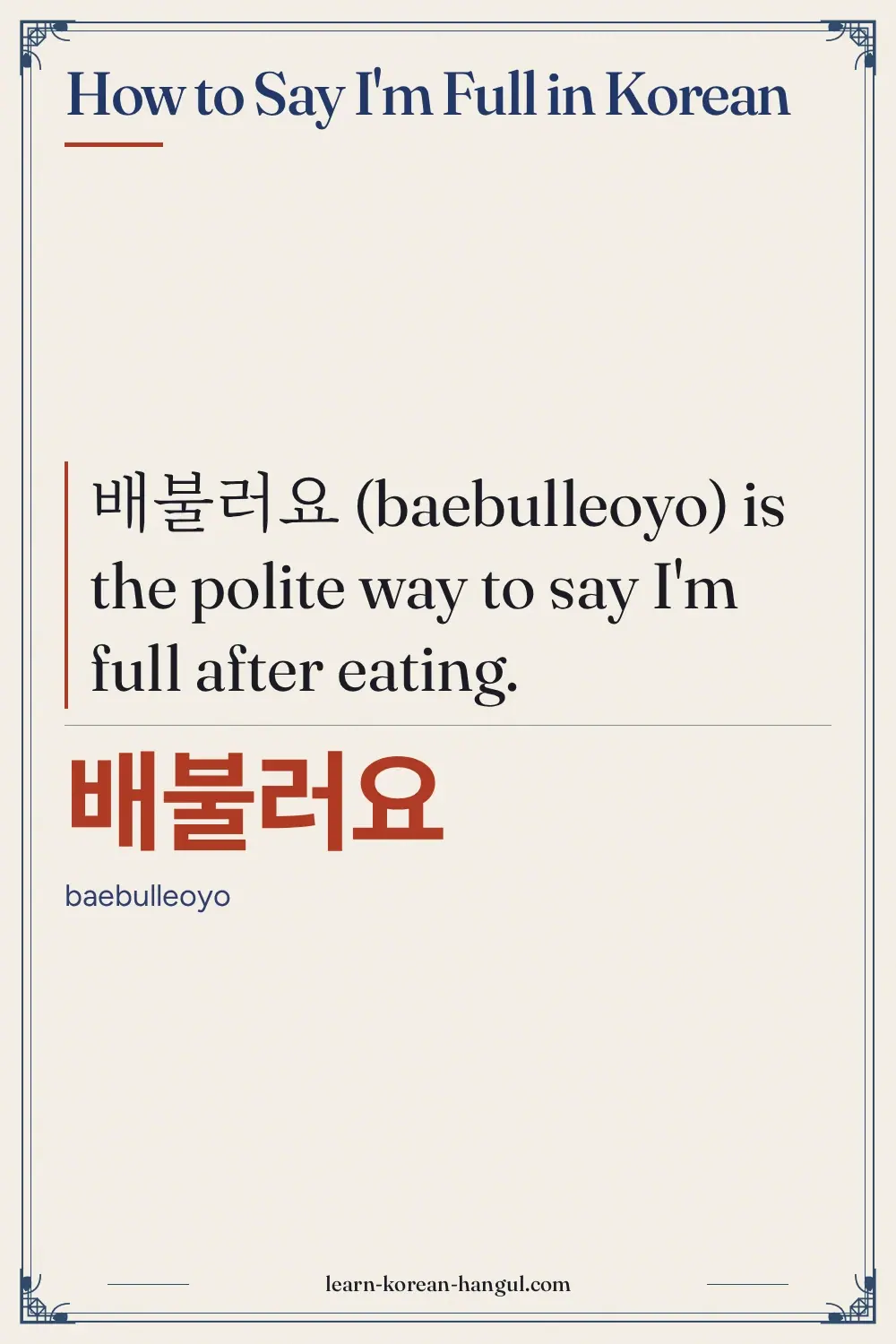
- 배불러요 (baebulleoyo) is the polite way to say I'm full.
- 배부르다 is a 르 irregular adjective, so 배부르 + 어요 becomes 배불러요, not 배부르어요.
- 많이 먹었어요 (mani meogeosseoyo) means I ate a lot.
How Do You Say I'm Full in Korean?
The standard way to say I'm full in Korean is 배불러요. The word 배 (bae) means belly, and 부르다 means to be swollen or round. So the literal meaning is "my belly is swollen", which Korean uses for a full stomach. Korean usually drops "I", so 배불러요 alone is a full sentence. It has four syllables: bae-bul-leo-yo.
| Situation | Best form | Romanization | Why |
|---|---|---|---|
| Turning down more food from a colleague | 배불러요 | baebulleoyo | Polite, natural |
| Telling a close friend | 배불러 | baebulleo | Casual |
| A formal speech or announcement | 배부릅니다 | baebureumnida | Formal |
| Saying what you did | 많이 먹었어요 | mani meogeosseoyo | I ate a lot |
| Stuffed to the limit | 배불러 죽겠어요 | baebulleo jukgesseoyo | Exaggeration |
You can also say 배가 불러요 (baega bulleoyo), with the subject marker 가. The next section sorts the forms by level.
What Are the Polite and Casual Ways to Say I'm Full?
The forms follow the Korean speech levels, explained in the guide to Korean speech levels. Here the stem stays the same and the ending changes the level.
Polite: 배불러요 (baebulleoyo)
Polite · 해요체배불러요 is the form to learn first. It suits family, friends, colleagues and hosts. It is warm without being stiff, and it works at a restaurant as well as at a home meal.
점심을 많이 먹어서 배불러요.
jeomsimeul mani meogeoseo baebulleoyo
I ate a lot of lunch, so I'm full.
Casual: 배불러 (baebulleo)
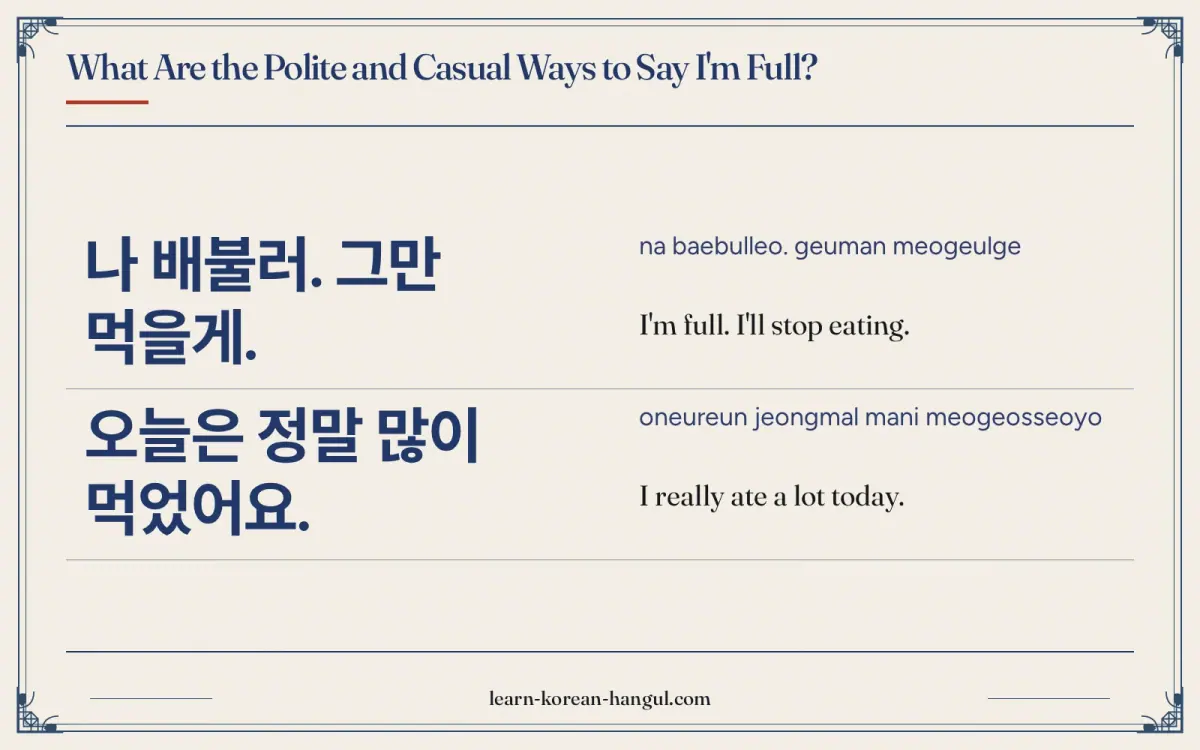
Casual · 반말배불러 drops the polite 요. Use it with close friends, siblings and children. It often comes with a plan to stop eating, such as 그만 먹을게 (geuman meogeulge, I'll stop eating), pronounced [그만 머글께].
나 배불러. 그만 먹을게.
na baebulleo. geuman meogeulge
I'm full. I'll stop eating.
Polite: 많이 먹었어요 (mani meogeosseoyo)
Polite · 해요체많이 먹었어요 does not describe your belly. It tells what you did: you ate a lot. Many Koreans prefer it when a host keeps offering food, because it praises the meal at the same time. It is pronounced [마니 머거써요].
오늘은 정말 많이 먹었어요.
oneureun jeongmal mani meogeosseoyo
I really ate a lot today.
Formal: 배부릅니다 (baebureumnida)
Formal · 합쇼체배부릅니다 is the formal form. It appears in speeches or very formal settings, and in daily life you will rarely need it. Notice that the stem keeps 르 here, because the ending 습니다 begins with a consonant. The grammar is next.
Strong: 배불러 죽겠어요 (baebulleo jukgesseoyo)
Polite · 해요체죽겠어요 literally means "I will die" and is a common exaggeration for strong feelings. 배불러 죽겠어요 means "I'm so stuffed I could die". It is playful, and it matches 배고파 죽겠어요 for hunger. Use it with friends and family. You may also hear 배 터지겠어요 (bae teojigesseoyo), "my belly is going to burst".
Why Does 배부르다 Become 배불러요?
배부르다 is a 르 irregular adjective. The stem 배부르- ends in 르. Before an ending that begins with 아 or 어, the 르 changes in two steps. The ㅡ drops, and the ㄹ moves into the syllable before. That syllable then gains an extra ㄹ, so 부 turns into 불, and the ending gets 러 instead of 어.
- 배부르다 → 배불러요 (full)
- 다르다 → 달라요 (different)
- 빠르다 → 빨라요 (fast)
- 모르다 → 몰라요 (not know)
The ending is 러 here because the vowel in 부 is ㅜ, which takes 어. After ㅏ or ㅗ the ending would be 라, as in 다르다 → 달라요. Before a consonant, the stem does not change, so the formal form is 배부릅니다 and the negative is 배부르지 않아요 (baebureuji anayo). The past form is 배불렀어요 (baebulleosseoyo), which means "I was full". Next, the pronunciation.
How Do You Pronounce 배불러요?
배불러요 is pronounced [배불러요] and has four syllables: bae-bul-leo-yo. It sounds just as written, but with one detail: the ㄹ ending 불 and the ㄹ starting 러 meet, so you hold a longer "l" sound.
- 배 (bae): a soft b and "eh".
- 불 (bul): "bool", with the tongue touching the ridge behind your teeth.
- 러 (leo): keep the tongue there for a moment, then open to the ㅓ vowel. The ㅓ is unrounded, so keep your lips relaxed.
- 요 (yo): "yo".
Sound Changes to Listen For
These changes follow the National Institute of Korean Language standard pronunciation rules (표준 발음법):
- ㅂ before ㄴ becomes ㅁ. 배부릅니다 is [배부름니다] (Article 18). See Korean nasalization.
- Liaison and a tense ㅆ. 많이 먹었어요 is [마니 머거써요]: ㅎ in 많 is silent before 이, and the final ㄱ of 먹 moves onto the next syllable.
- Tense ㄱ after ㄱ. 죽겠어요 is [죽께써요] (Article 23). RR does not show this tensing, so it writes jukgesseoyo; the ss there is simply the written ㅆ. See Korean tensification.
With the sound clear, here is when each form fits.
When Should You Use 배불러요, and When Should You Not?
Use 배불러요 when you have finished eating and want to say no to more, or when you simply want to share how you feel. Do not use it as an opening line before a meal has started.
Situations Where It Fits
- A host keeps offering food. 배불러요, 정말 맛있었어요. (I'm full, it was really delicious.)
- Dessert after a big dinner. 나 배불러, 커피만 마실게. (I'm full, I'll only have coffee.)
- Leaving a buffet. 배불러서 더 못 먹겠어요. (I'm too full to eat any more.)
Situations to Avoid
- A restaurant that has no seats. That is not 배불러요. Say 자리가 없어요 (jariga eopseoyo, there are no seats).
- Without thanking a host. Say 잘 먹었습니다 (jal meogeotseumnida, thank you for the meal) as well, or your host may feel you did not like the food.
- Talking about another person's belly. Avoid comments about anyone's shape. Use 배불러요 for your own feeling only.
Two short conversations show how it sounds.
What Does I'm Full Sound Like in a Real Conversation?
In real life, the line is followed by thanks or a small compromise. Notice the answers.
Friends after Dinner
Jiho
디저트 먹을래?
dijeoteu meogeullae?
Do you want dessert?
Suyeon
아니, 배불러. 너무 많이 먹었어.
ani, baebulleo. neomu mani meogeosseo
No, I'm full. I ate too much.
Jiho
그럼 커피만 마시자.
geureom keopiman masija
Then let's just have coffee.
What to notice: the casual 배불러 comes with a reason, 너무 많이 먹었어, and the friend offers an easy alternative.
At a Relative's Table
Aunt
밥 더 드세요.
bap deo deuseyo
Please have more rice.
Guest
배불러요. 잘 먹었습니다.
baebulleoyo. jal meogeotseumnida
I'm full. Thank you for the meal.
Aunt
그럼 과일이라도 드세요.
geureom gwairirado deuseyo
Then at least have some fruit.
What to notice: the aunt uses the honorific 드세요 (the respectful form of eat), and the guest answers with polite 배불러요 and a thank-you.
What Should You Know about the Culture behind I'm Full?
Food is a way of showing care in Korea, so hosts often offer more and more. A guest who says 배불러요 once may hear 조금만 더 드세요 (have just a little more). That is hospitality, not rudeness. The answer is to stay friendly: smile, say 정말 배불러요, and thank them.
- Refusing once is normal. Hosts expect a second offer, and a second polite refusal usually ends it.
- Praise the food. 맛있게 먹었어요 (I really enjoyed the meal) or 잘 먹었습니다 makes the refusal warm.
- Leaving food. Taking a little less at the start is better than leaving a lot on the plate, so serve small portions first.
The page for thank you for the meal in Korean explains the closing phrase, and Delicious in Korean gives more ways to praise food. These are general habits rather than rules, and families differ.
What Mistakes Do Learners Make with I'm Full in Korean?
Most mistakes come from the 르 irregular stem and from translating English "full".
| Mistake | Why it is a problem | Fix |
|---|---|---|
| 배부르어요 | The stem must become 불러 | Say 배불러요 |
| 배불어요 | The ㄹ is missing | Say 배불러요 |
| 가득해요 for a full stomach | 가득 describes containers and places | Say 배불러요 |
| 배불러 to an elder | Too casual | Say 배불러요 |
| [배부러요] with one ㄹ | The doubled ㄹ is part of the sound | Say [배불러요] |
Learners also forget the tense. For a meal that is over, use the past 배불렀어요: 어제는 너무 배불렀어요, I was too full yesterday. The adjective takes the subject marker 가 when you name the belly, as in 배가 불러요.
How Do You Ask Someone If They Are Full?
Turn the same words into a question with a rising voice. To a friend, say 배불러? (baebulleo?). To a colleague or stranger, say 배불러요? (baebulleoyo?). To an elder, use the honorific 배부르세요? (baebureuseyo?), which adds the respectful -시- to the stem. The honorific shows respect for the person you ask, so never use it for yourself.
| Listener | Question | Romanization |
|---|---|---|
| Close friend | 배불러? | baebulleo |
| Colleague | 배불러요? | baebulleoyo |
| Elder or customer | 배부르세요? | baebureuseyo |
A kind follow-up is 더 드실래요? (deo deusillaeyo?), which means "would you like more?". It sounds friendly to a guest.
Is It the Same as Full, I Am Full or Stuffed?
Yes. The short answers below cover the other searches folded into this page.
- I am full in Korean: 배불러요 or the formal 배부릅니다.
- Full in Korean: 배부른 (baebureun) before a noun, as in 배부른 사람 (a person who is full). For a seat or room, say 자리가 없어요.
- Stuffed in Korean: 배불러 죽겠어요 or 배 터지겠어요.
Now practise aloud.
Practice: Say It Aloud
Play the slow clip of 배불러요 three times and hold the double ㄹ. Then choose a phrase. Answers follow.
- You are with a close friend after dinner.
- A colleague offers you more rice, and you refuse politely.
- You want to thank your host after the meal.
- How do you say "I'm not full yet"?
Answers
- 배불러.
- 배불러요.
- 잘 먹었습니다.
- 아직 배 안 불러요.
The phrase flashcards drill these lines with audio.
Related Phrases to Learn Next
Fullness connects to hunger and to the words that close a meal.
- I'm hungry in Korean: 배고파요 before you eat.
- Thank you for the meal in Korean: the phrase for the host.
- Delicious in Korean: 맛있어요 for good food.
This guide belongs to the Korean feelings phrases collection. What this page does not cover: ordering food, table manners and the full list of food words. Remember that the 르 changes to 불러, pick a level and thank your host, and you can say i'm full in Korean naturally.
Frequently Asked Questions
How do you say i'm full in Korean?
Say 배불러요 (baebulleoyo) in polite speech, 배불러 (baebulleo) to a close friend and 배부릅니다 (baebureumnida) in formal speech. The phrase joins 배 (belly) and 부르다 (to be swollen or full). You can also say 배가 불러요 with the subject marker 가, which means the same.
How do you pronounce 배불러요?
배불러요 has four syllables, bae-bul-leo-yo, and sounds as written: [배불러요]. The ㄹ at the end of 불 and the ㄹ that starts 러 join into one long, slightly held l sound. Keep the ㅓ unrounded, with relaxed lips. The formal 배부릅니다 is pronounced [배부름니다].
What is the difference between 배불러요 and 많이 먹었어요?
배불러요 describes your body: your belly is full right now. 많이 먹었어요 describes what you did: I ate a lot. Both refuse more food politely. At a host's table, 많이 먹었어요 sounds a little more modest, and 배불러요 sounds more direct but still friendly.
Is 배불러요 formal or casual?
It is polite, which sits in the middle. Formal speech uses 배부릅니다, which is rare in daily life. Casual speech uses 배불러, for friends and family. In most meals with colleagues, neighbours or relatives, 배불러요 is the right level.
Can I use 배불러요 with friends, elders and strangers?
Yes. 배불러요 is polite enough for elders and strangers, and friends will understand it. To an elder host, add 잘 먹었습니다 (jal meogeotseumnida), thank you for the meal, because thanking the host matters as much as saying you are full.
What is the most common mistake with i'm full in Korean?
Learners conjugate the stem regularly and say 배부르어요, or they invent 가득해요 for a full stomach. 가득 describes containers and places. The correct polite form is 배불러요, because 배부르다 is a 르 irregular, so the stem becomes 불러 with a doubled ㄹ.