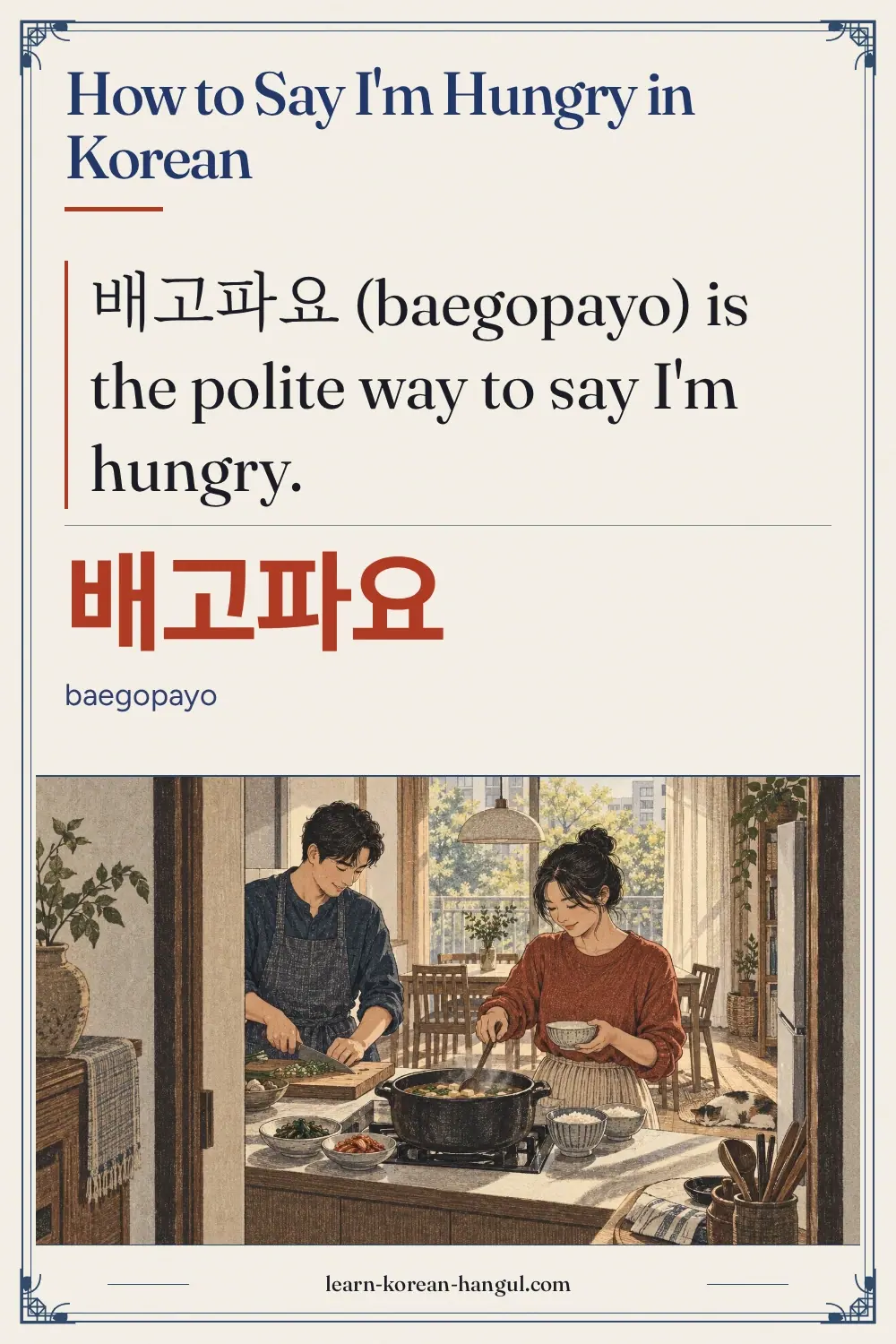
배고파요
배고파요
What you'll learn
- Say I'm hungry with 배고파요, 배고픕니다 or 배고파, depending on the listener.
- Say so hungry and starving with 너무 and 죽겠어요.
- Understand why 배고프- becomes 배고파-.
- Pronounce 배고픕니다 as [배고픔니다].
Before you start: you only need to read Hangul. When you are done eating, learn I'm full in Korean. Time: about 10 minutes. Audio plays only when you press a button.
How Do You Say I'm Hungry in Korean?
The standard way to say I'm hungry in Korean is 배고파요. The word 배 (bae) means belly, and 고프다 means to be empty. So the literal meaning is "my belly is empty". Korean usually drops "I", so 배고파요 alone is a full sentence.
| Situation | Best form | Romanization | Why |
|---|---|---|---|
| Telling a colleague at lunchtime | 배고파요 | baegopayo | Polite, natural |
| Telling a close friend | 배고파 | baegopa | Casual |
| A formal meeting or announcement | 배고픕니다 | baegopeumnida | Formal |
| Very hungry | 너무 배고파요 | neomu baegopayo | So hungry |
| Starving | 배고파 죽겠어요 | baegopa jukgesseoyo | Exaggeration |
You can also say 배가 고파요 (baega gopayo), with the subject marker 가. The next section sorts the forms by level.
What Are the Formal, Polite and Casual Ways to Say I'm Hungry?
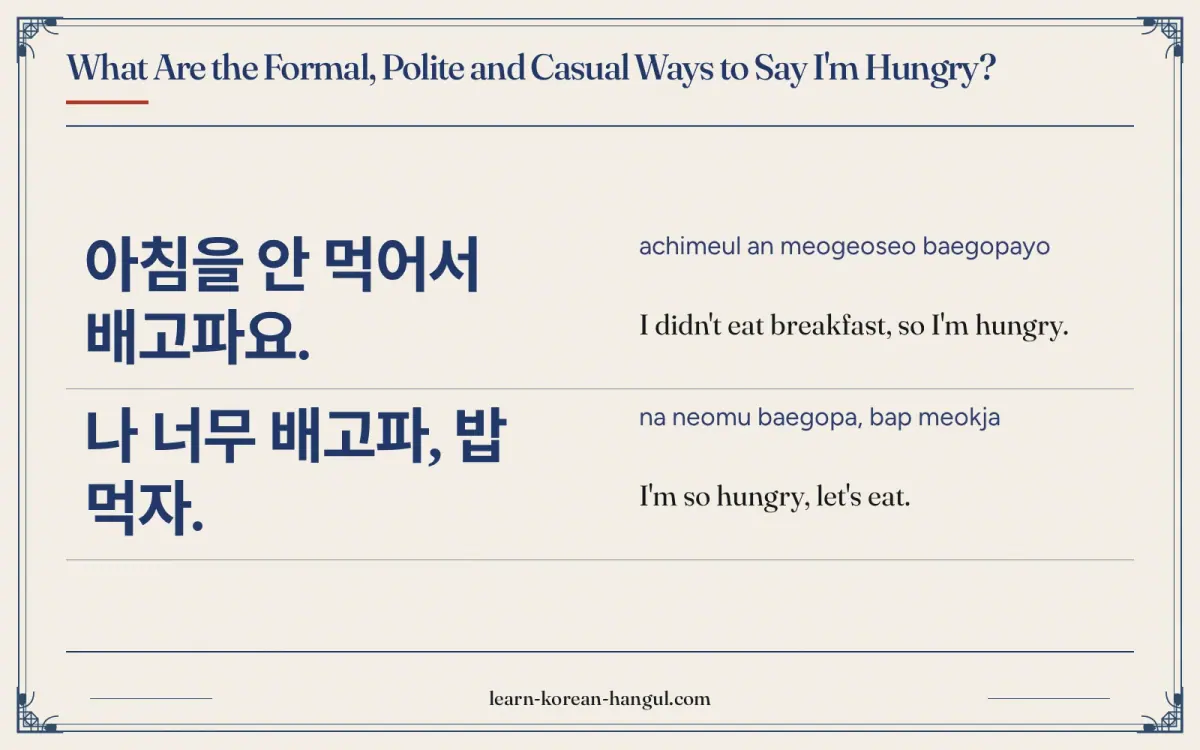
The forms follow the Korean speech levels, explained in the guide to Korean speech levels. Here the stem stays the same and the ending changes.
Polite: 배고파요 (baegopayo)
Polite · 해요체배고파요 is the form to learn first. It suits family, friends and colleagues. It is warm without being stiff.
아침을 안 먹어서 배고파요.
achimeul an meogeoseo baegopayo
I didn't eat breakfast, so I'm hungry.
Polite: 배가 고파요 (baega gopayo)
Polite · 해요체배가 고파요 is the expanded form. The particle 가 marks the belly as the subject. Use it when you want to sound a little fuller or add a word before it, as in 저는 배가 고파요 or 배가 너무 고파요.
Casual: 배고파 (baegopa)
Casual · 반말배고파 drops the polite ending. Use it with close friends, siblings and children. A drawn-out 배고파~ is a cute way to hint at lunch.
나 너무 배고파, 밥 먹자.
na neomu baegopa, bap meokja
I'm so hungry, let's eat.
Formal: 배고픕니다 (baegopeumnida)
Formal · 합쇼체배고픕니다 is the formal form. It appears in announcements and in military or news style. In daily life you will not need it often. It is pronounced [배고픔니다].
Strong: 배고파 죽겠어요 (baegopa jukgesseoyo)
Polite · 해요체배고파 죽겠어요 uses 죽겠다, literally "I will die", as an exaggeration for "I'm starving". Koreans use the pattern for many strong feelings, such as 피곤해 죽겠어요 (I'm dead tired). It sounds playful.
점심을 못 먹어서 배고파 죽겠어요.
jeomsimeul mot meogeoseo baegopa jukgesseoyo
I couldn't eat lunch, so I'm starving.
The forms look regular, but there is a small grammar rule behind them.
Why Does 배고프다 Become 배고파요?
The stem 배고프- ends in the vowel ㅡ (eu). Before the endings -아요 or -어요, Korean drops that ㅡ. The ending is then 아 if the vowel in the syllable before is ㅏ or ㅗ, and 어 otherwise. Here the vowel before is ㅗ in 고, so the ending is 아: 배고프 + 아요 → 배고파요.
- 배고프다 → 배고파요 (hungry)
- 바쁘다 → 바빠요 (busy)
- 아프다 → 아파요 (sick, painful)
- 예쁘다 → 예뻐요 (pretty)
This is called ㅡ-dropping (으 탈락). School grammar counts it as regular, though learner books often teach it with the irregular verbs. The same stem keeps its ㅡ before consonant endings, so the formal form is 배고픕니다. Next, the pronunciation.
How Do You Pronounce 배고파요?
배고파요 is pronounced [배고파요], bae-go-pa-yo, in four syllables. It sounds just like it is written, with a light, clean ㅍ.
- 배 (bae): a soft b and "eh".
- 고 (go): "goh".
- 파 (pa): a puff of air with ㅍ, "pah".
- 요 (yo): "yo".
Sound Changes to Listen For
These changes follow the National Institute of Korean Language standard pronunciation rules (표준 발음법):
- ㅂ before ㄴ becomes ㅁ. 배고픕니다 is [배고픔니다] (Article 18). See Korean nasalization.
- Tense after ㄱ. 죽겠어요 is [죽께써요]: the ㄱ in 죽 makes the next ㄱ tense, and 겠 moves its ㅆ forward (Article 23). See Korean tensification.
With the sound clear, here is when each form fits.
When Should You Use 배고파요, and When Should You Not?
Use 배고파요 when you want to tell people you need to eat. Do not use it as a hint to a host in a formal visit, where Korean prefers a quiet approach.
Situations Where It Fits
- Lunchtime at work. 배고파요, 점심 먹으러 갈까요? (I'm hungry, shall we go to lunch?)
- Travelling with friends. 나 너무 배고파.
- Choosing a place with friends. 배고파요, 저기 들어갈까요? (I'm hungry, shall we go in there?)
Situations to Avoid
- A meeting. Wait for a break.
- A first meeting with elders. Say 식사하셨어요? (have you eaten?) and wait to be offered.
- A formal dinner with a host. Wait until food is offered, and say 맛있게 먹겠습니다 (I will eat well) when you start.
Two short conversations show how it sounds.
What Does I'm Hungry Sound Like in a Real Conversation?
In real life, the line is followed by a suggestion. Notice the answers.
Friends at Noon
Jiho
나 너무 배고파. 뭐 먹을까?
na neomu baegopa. mwo meogeulkka?
I'm so hungry. What shall we eat?
Suyeon
김밥 어때?
gimbap eottae?
How about gimbap?
Jiho
좋아! 가자.
joa! gaja
Great! Let's go.
What to notice: the casual 배고파 comes with a question and an easy answer, 좋아.
Lunch at the Office
Colleague
팀장님, 저 배고파요. 점심 같이 드실래요?
timjangnim, jeo baegopayo. jeomsim gachi deusillaeyo?
Team leader, I'm hungry. Would you like to have lunch together?
Team Leader
좋아요. 저도 배고팠어요.
joayo. jeodo baegopasseoyo
Sure. I was hungry too.
Colleague
어디로 갈까요?
eodiro galkkayo?
Where shall we go?
What to notice: the colleague uses the honorific 드실래요 for the team leader, and the polite 배고파요 for herself.
What Should You Know about the Culture behind I'm Hungry?
Food is central to Korean social life. A common greeting is 밥 먹었어요? (did you eat?), and it means "how are you?" as much as "did you eat?". Saying 배고파요 is natural, but Koreans often wait for the group, because meals are shared. The page for did you eat in Korean explains this greeting.
- Sharing. Dishes are placed in the middle, and people start together.
- Hosts. A host will often press more food on you; 배불러요 (I'm full) is the polite stop.
- Snack culture. 간식 (gansik, snacks) is a normal reply to 배고파요.
Hunger also shapes small talk. Colleagues who skip breakfast may say 아침 못 먹어서 벌써 배고파요 (I couldn't eat breakfast, so I'm already hungry), and the usual reply is 일단 간식부터 드세요 (have a snack first). Offering food in return is a way to show care, and accepting it with a thank you completes the exchange.
An expert tip: a rumbling stomach is described by the sound word 꼬르륵 (kkoreureuk). Koreans joke 배에서 꼬르륵 소리가 나요 (my belly is going kkoreureuk) to hint at lunch in a friendly way.
What Mistakes Do Learners Make with I'm Hungry in Korean?
Most mistakes come from the ㅡ-dropping stem and from similar words.
| Mistake | Why it is a problem | Fix |
|---|---|---|
| 배고프어요 | The ㅡ must drop | Say 배고파요 |
| 배고프요 | Missing the vowel ending | Say 배고파요 |
| 배 아파요 for hungry | Means "my stomach hurts" | Say 배고파요 |
| [배고프니다] for the formal form | The ㅂ turns into ㅁ | Say [배고픔니다] |
| 배고파 to an elder | Too casual | Say 배고파요 |
Learners often assume the belly is an object, as in English "I have an empty belly". Actually, 배 is the subject of 고프다 and takes 가, as in 배가 고파요, so 배를 고파요 is wrong.
How Do You Ask Someone If They Are Hungry?
You can turn the same words into a question by raising your voice at the end. To a friend, say 배고파? (baegopa?). To a colleague or stranger, say 배고파요? (baegopayo?). To an elder, use the honorific form 배고프세요? (baegopeuseyo?), which adds the respectful -시- to the stem; the word 시장하세요? (sijanghaseyo?) is even more respectful. The honorific shows respect for the person you ask, so never use it for yourself.
| Listener | Question | Romanization |
|---|---|---|
| Close friend | 배고파? | baegopa |
| Colleague | 배고파요? | baegopayo |
| Elder or customer | 배고프세요? | baegopeuseyo |
A kind follow-up is 뭐 먹고 싶어요? (mwo meokgo sipeoyo?), which means "what do you want to eat?". It uses the -고 싶다 pattern for wants. The answer can be a food word, such as 국수 (noodles), 김밥 (gimbap) or 비빔밥 (bibimbap). Combining the two questions is a natural way to start any meal plan in Korean.
Is It the Same as I Am Hungry, Hungry or Starving?
Yes. The short answers below cover the other searches folded into this page.
- I am hungry in Korean: 배고파요 or the formal 배고픕니다.
- Im hungry in Korean: the same sentence; the apostrophe makes no difference in English.
- Hungry in Korean: 배고픈 (baegopeun) before a noun, as in 배고픈 사람 (a hungry person).
- I'm so hungry in Korean: 너무 배고파요 or 진짜 배고파요.
- I'm starving in Korean: 배고파 죽겠어요.
Now practise aloud.
Practice: Say It Aloud
Play the slow clip of 배고파요 three times and keep the ㅍ crisp. Then choose a phrase. Answers follow.
- You are with friends and starving.
- You tell your team leader politely.
- You make an announcement in formal speech.
- How do you say "I'm not hungry"?
Answers
- 배고파 죽겠어.
- 배고파요.
- 배고픕니다.
- 배 안 고파요.
The phrase flashcards drill these lines with audio.
Related Phrases to Learn Next
Hunger leads to eating and to the words that follow.
- I'm full in Korean: 배불러요 when you have eaten.
- I'm thirsty in Korean: 목말라요 for drink.
- Delicious in Korean: 맛있어요 for good food.
This guide belongs to the Korean feelings phrases collection. What this page does not cover: ordering in restaurants, food vocabulary and table manners. Remember that the ㅡ drops, pick a level and add 너무 for emphasis, and you can say i'm hungry in Korean naturally.
Frequently Asked Questions
How do you say I'm hungry in Korean?
Say 배고파요 (baegopayo) in polite speech, 배고파 (baegopa) to a close friend and 배고픕니다 (baegopeumnida) in formal speech. The phrase combines 배 (belly) and 고프다 (to be empty). You may also say 배가 고파요 with the subject marker 가, which is equally correct and sounds a little fuller in a sentence.
How do you say I'm so hungry or starving in Korean?
Say 너무 배고파요 for so hungry and 배고파 죽겠어요 (baegopa jukgesseoyo) for starving, literally hungry enough to die. The second form is a common exaggeration and is not dark. It is pronounced [배고파 죽께써요]. Use it with friends and family, and with colleagues only in a light mood.
Why is it 배고파요 and not 배고프어요?
The stem 배고프- ends in ㅡ, and Korean drops that vowel before the -아/어 endings. It then adds the vowel 아 because the vowel before ㅡ is ㅗ, which takes 아. So 배고프 + 아요 becomes 배고파요. The same pattern gives 바쁘다 → 바빠요 and 아프다 → 아파요.
What is the difference between 배고파요 and 배가 고파요?
They mean the same. 배고파요 is the short, common form, and 배가 고파요 marks 배 (belly) as the subject with 가, so it feels a little more complete. Spelling follows the dictionary, which lists 배고프다 as one word, while 배가 고프다 is the expanded form. Both are correct in daily speech.
How do I say I am not hungry in Korean?
Say 배 안 고파요 (bae an gopayo) or 배고프지 않아요. Both are polite. With a friend, say 배 안 고파. If you are full instead of just not hungry, say 배불러요 (baebulleoyo), which means my belly is full. Use these when someone offers food and you want to say no politely.
What is the most common mistake with I'm hungry in Korean?
Learners say 배고프어요, 배고프요 or 배 아파요. The correct polite form is 배고파요, because the ㅡ drops. 배 아파요 means my stomach hurts, which is a different problem. Another slip is using 저는 배고파요 in every sentence; Korean usually drops 저는, and the plain 배고파요 sounds natural.