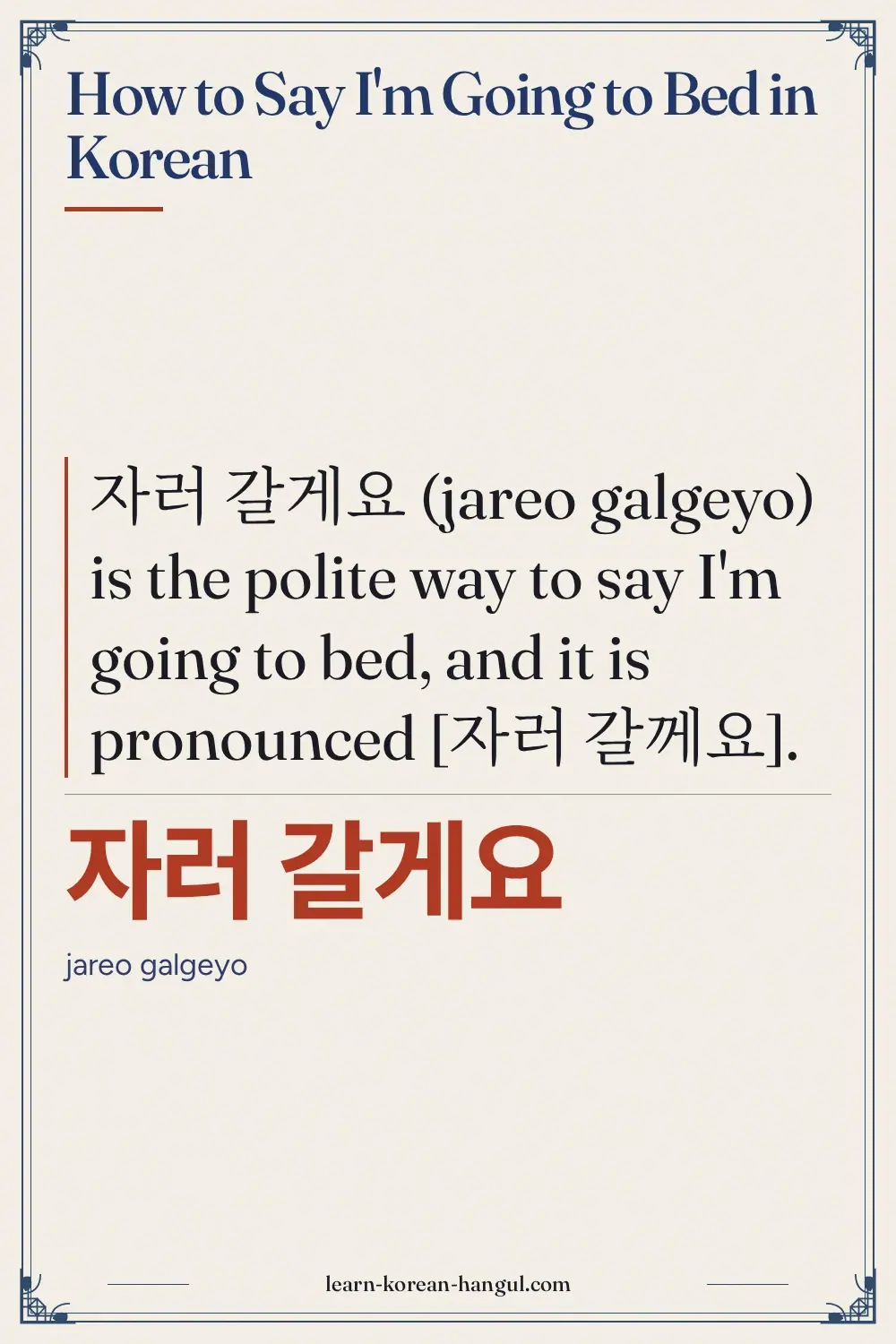
자러 갈게요
자러 갈게요
What you'll learn
- Say I'm going to bed with 자러 갈게요, 이제 잘게요 or 먼저 잘게, depending on the listener.
- Understand the endings -(으)러 (in order to) and -(으)ㄹ게요 (I will, for you).
- Wish someone good sleep with 잘 자요 and 안녕히 주무세요.
- Pronounce 갈게요 as [갈께요].
Before you start: you only need to read Hangul. For the closing wish itself, see Good night in Korean. Time: about 10 minutes. Audio plays only when you press a button.
Key facts
- 자러 갈게요 (jareo galgeyo) is the polite way to say I'm going to bed, pronounced [자러 갈께요].
- 먼저 잘게 (meonjeo jalge) is casual, and 이제 잘게요 (ije jalgeyo) means I'll sleep now.
- 잘 자요 (jal jayo) is sleep well, and elders hear 안녕히 주무세요 (annyeonghi jumuseyo).
- Plain 자요 only says sleep, so it does not announce that you are leaving.
How Do You Say I'm Going to Bed in Korean?
The standard way to say I'm going to bed in Korean is 자러 갈게요. It has two parts. 자러 (jareo) means "in order to sleep" and 갈게요 (galgeyo) means "I'll go, for you to know". Put together, it means "I'm going off to sleep". Korean usually drops "I", so the phrase stands alone. It has five syllables: ja-reo-gal-ge-yo.
| Situation | Best form | Romanization | Why |
|---|---|---|---|
| Leaving a late chat with a colleague | 자러 갈게요 | jareo galgeyo | Polite, natural |
| Telling a close friend | 먼저 잘게 | meonjeo jalge | Casual, "I'll sleep first" |
| Staying in the chat and signing off | 이제 잘게요 | ije jalgeyo | "I'll sleep now" |
| Wishing someone good sleep | 잘 자요 | jal jayo | Polite wish |
| Telling a grandparent | 안녕히 주무세요 | annyeonghi jumuseyo | Honorific wish |
The next section sorts the forms by the person you are talking to.
What Are the Polite and Casual Ways to Say I'm Going to Bed?
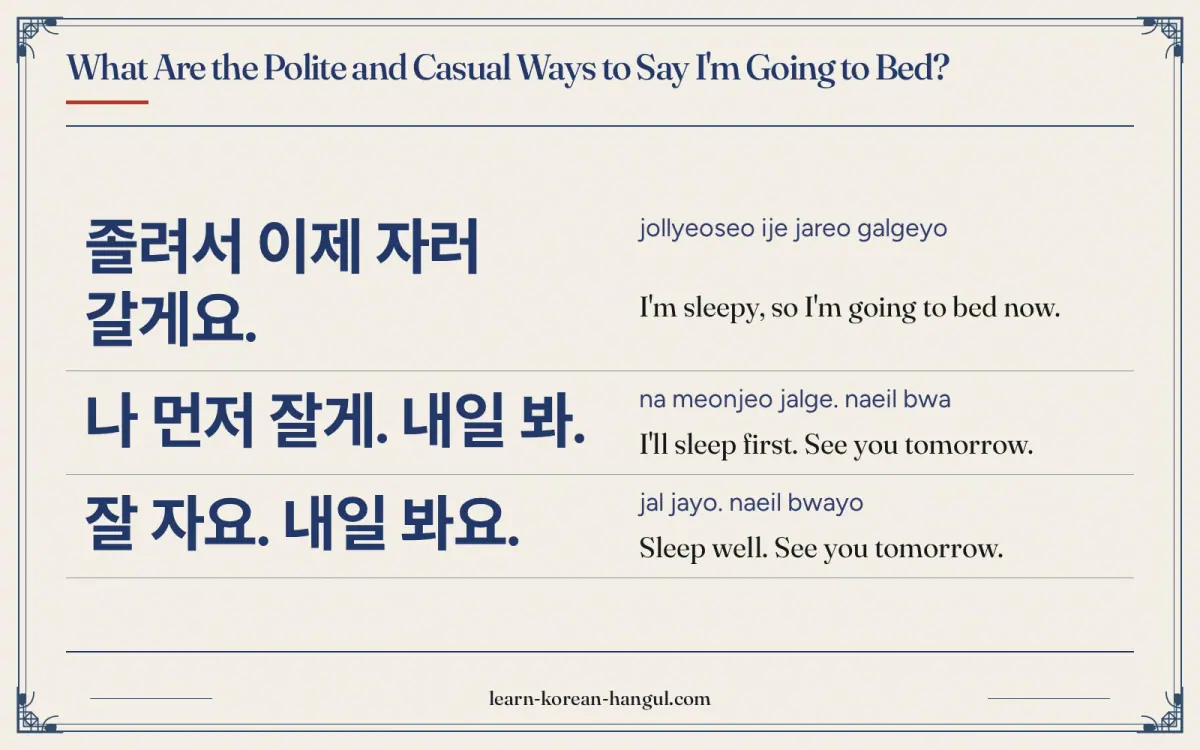
The forms follow the Korean speech levels, explained in the guide to Korean speech levels. The same plan is said with different endings and a few small words.
Polite: 자러 갈게요 (jareo galgeyo)
Polite · 해요체자러 갈게요 is the form to learn first. It suits family, friends, colleagues and neighbours. It tells the listener that you are leaving, so it fits when the other person may still be awake.
졸려서 이제 자러 갈게요.
jollyeoseo ije jareo galgeyo
I'm sleepy, so I'm going to bed now.
Polite: 이제 잘게요 (ije jalgeyo)
Polite · 해요체이제 잘게요 means "I'll sleep now". 이제 (ije) means "now" or "from now on". Use it when you stay in the same place, such as in a text chat, and just stop talking. It is pronounced [이제 잘께요].
내일 일찍 일어나서 이제 잘게요.
naeil iljjik ireonaseo ije jalgeyo
I get up early tomorrow, so I'll sleep now.
Casual: 먼저 잘게 (meonjeo jalge)
Casual · 반말먼저 잘게 means "I'll sleep first". 먼저 (meonjeo) means "before you", which is a friendly touch when others stay up. It drops the polite 요. Use it with close friends, siblings and partners, often followed by 잘 자. It is pronounced [먼저 잘께].
나 먼저 잘게. 내일 봐.
na meonjeo jalge. naeil bwa
I'll sleep first. See you tomorrow.
Polite: 잘 자요 (jal jayo)
Polite · 해요체잘 자요 is not about your own plan. It wishes the other person good sleep: 잘 means "well" and 자요 means "sleep". Friends say 잘 자, and elders hear 안녕히 주무세요 instead, because 주무시다 is the honorific word for sleep.
잘 자요. 내일 봐요.
jal jayo. naeil bwayo
Sleep well. See you tomorrow.
Formal: 자러 가겠습니다 (jareo gagetseumnida)
Formal · 합쇼체자러 가겠습니다 is the formal form. It appears at a formal stay or in a very respectful announcement. In daily life you will rarely need it. It is pronounced [자러 가겓씀니다]. The grammar behind these phrases comes next.
Why Do We Say 자러 갈게요?
Two endings do the work. The first is -(으)러, which means "in order to" and connects a movement verb such as 가다 (go) or 오다 (come) with a purpose. 자 + 러 gives 자러, and 먹으러 가요 means "I go to eat". The second is -(으)ㄹ게요, which tells the listener what you will do. It attaches to the stem, and 가 + ㄹ게요 gives 갈게요.
- 자러 가요 → I go in order to sleep (a fact).
- 자러 갈게요 → I'm going off to sleep (I'm telling you).
- 이제 잘게요 → I'll sleep now.
- 잘 거예요 → I'm going to sleep (a plan, no promise to the listener).
-(으)ㄹ게요 has a promise-like tone toward the listener, so use it only for your own actions, and never for another person's. It is also not used in questions: to ask the listener, say 잘 거예요? instead. You will hear it often in phrases like 먼저 갈게요 (I'll go first). Next, the pronunciation.
How Do You Pronounce 자러 갈게요?
자러 갈게요 is pronounced [자러 갈께요] and has five syllables: ja-reo-gal-ge-yo. The sound changes in the last two syllables.
- 자 (ja): a soft j, then "ah".
- 러 (reo): a quick tap of the tongue, then the open ㅓ vowel. The ㅓ is unrounded, so keep your lips relaxed.
- 갈 (gal): "gal", ending in a light l.
- 께 (kke): the ㄱ here is tense, so say it with a firm, unaspirated "kk".
- 요 (yo): "yo".
Sound Changes to Listen For
The one change to know is the tense ㄱ. It follows the National Institute of Korean Language standard pronunciation rules (표준 발음법, Article 27 and its note on endings that start with -(으)ㄹ).
- Tense ㄱ after ㄹ. 갈게요 is [갈께요], and 잘게요 is [잘께요]. The ending -(으)ㄹ게요 makes its ㄱ tense. RR keeps the plain spelling galgeyo and jalgeyo, because it does not show tensing caused by a neighbouring sound. See Korean tensification.
- Tense ㅅ in formal speech. 가겠습니다 is [가겓씀니다]: the final ㅆ turns into ㄷ before ㅅ, the ㅅ becomes tense, and the ㅂ turns into ㅁ. RR writes it gagetseumnida.
With the sound clear, here is when to use each form.
When Should You Use 자러 갈게요, and When Should You Not?
Use 자러 갈게요 when you end an evening with someone who is still around, in person, on the phone or in a chat. It is a small politeness that keeps the conversation friendly.
Situations Where It Fits
- A late-night chat. 저는 이제 자러 갈게요. (I'm going to bed now.)
- A family home. 저 먼저 자러 갈게요. (I'm going to bed first.)
- A shared trip. 내일 일찍 일어나야 해서 먼저 갈게요. (I need to get up early, so I'm going first.)
Situations to Avoid
- A group of guests. Leaving a party without a word is rude. Say a short 먼저 갈게요 or 자러 갈게요 and wish people well.
- Another person's plan. -(으)ㄹ게요 is for your own action. For someone else, say 주무세요 (please sleep) or 자요.
- A very formal setting. With a boss on a company trip, choose the formal 자러 가겠습니다 instead of the casual forms.
Two short conversations show how it sounds.
What Does I'm Going to Bed Sound Like in a Real Conversation?
In real life, the line is followed by a good-night wish. Notice the answers.
Friends in a Late-Night Chat
Minsu
나 먼저 잘게.
na meonjeo jalge
I'll sleep first.
Yuna
벌써? 그래, 잘 자.
beolsseo? geurae, jal ja
Already? OK, sleep well.
Minsu
응, 너도 잘 자.
eung, neodo jal ja
Yes, you sleep well too.
What to notice: the casual 먼저 잘게 is answered with 잘 자, and the reply 너도 잘 자 means "you too".
At Grandmother's House
Grandchild
할머니, 저 먼저 자러 갈게요.
halmeoni, jeo meonjeo jareo galgeyo
Grandma, I'm going to bed first.
Grandmother
그래, 잘 자.
geurae, jal ja
OK, sleep well.
Grandchild
안녕히 주무세요.
annyeonghi jumuseyo
Good night, please sleep well.
What to notice: the grandchild uses the humble 저 and the polite 갈게요, and adds the honorific 안녕히 주무세요, while the grandmother answers casually.
How Do You Wish Someone a Good Night?
To a friend, say 잘 자 (jal ja). To a colleague or acquaintance, say 잘 자요 (jal jayo). To an elder, use the honorific 안녕히 주무세요 (annyeonghi jumuseyo), where 주무시다 replaces 자다 to show respect. The honorific shows respect for the person you speak to, so never use it for yourself.
| Listener | Wish | Romanization |
|---|---|---|
| Close friend | 잘 자 | jal ja |
| Colleague | 잘 자요 | jal jayo |
| Elder or customer | 안녕히 주무세요 | annyeonghi jumuseyo |
A child in many Korean homes says 안녕히 주무세요 to parents and grandparents before bed. See Good night in Korean for the full phrase.
What Should You Know about the Culture behind I'm Going to Bed?
In texts and group chats, people write 먼저 잘게 or 자러 갈게 to sign off, often followed by 잘 자. The word 먼저 means "before you" and is a polite touch when others stay up, a sign that you do not want to leave the group suddenly.
- Leaving a group. Telling the group that you are leaving first is a common courtesy in chats.
- Saying goodnight at home. Younger family members greet elders with 안녕히 주무세요 before bed.
- Sleep and work. Staying up late is common, so 먼저 잘게 is often said with a bit of an apology.
These are general habits rather than rules, and families differ.
What Mistakes Do Learners Make with I'm Going to Bed in Korean?
Most mistakes come from the endings and from the honorific words.
| Mistake | Why it is a problem | Fix |
|---|---|---|
| 자요 for "I'm going to bed" | It states sleep, a question or an order | Say 자러 갈게요 |
| 자러 가요 | It is a plain fact, with no announcement | Say 자러 갈게요 |
| 자러 갈까요 | It asks "shall we go to bed?" | Say 자러 갈게요 |
| 잘 자요 to an elder | Too plain | Say 안녕히 주무세요 |
| 주무세요 for yourself | The honorific is for others | Say 자요 or 잘게요 |
Learners also forget the tense. For something done earlier, use the past 잤어요 (jasseoyo): 어제는 일찍 잤어요, I went to bed early yesterday.
Is It the Same as Going to Sleep or Time for Bed?
Mostly. The short answers below cover the other searches folded into this page.
- Going to sleep in Korean: 이제 잘게요 (I'll sleep now) or 자러 갈게요 (I'm going off to sleep).
- Time for bed in Korean: 이제 잘 시간이에요 (ije jal siganieyo), which means "it's time to sleep now". Use it for a child or about the time itself.
- Sleepy in Korean: 졸려요 (jollyeoyo) describes the feeling that comes before bed. See I'm sleepy in Korean.
Now practise aloud.
Practice: Say It Aloud
Play the slow clip of 자러 갈게요 three times and make the 께 firm. Then choose a phrase. Answers follow.
- You tell a close friend that you will sleep first.
- You tell a colleague politely that you are going to bed.
- You wish your grandmother a good night.
- How do you say "I'm tired" before bed?
Answers
- 먼저 잘게.
- 자러 갈게요.
- 안녕히 주무세요.
- 피곤해요 (pigonhaeyo). See I'm tired in Korean for more.
The phrase flashcards drill these lines with audio.
Related Phrases to Learn Next
Going to bed connects to goodnight wishes and to tiredness.
- Good night in Korean: 잘 자요 and 안녕히 주무세요 in full.
- I'm sleepy in Korean: 졸려요 before bed.
- I'm tired in Korean: 피곤해요 after a long day.
This guide belongs to the Korean feelings phrases collection. What this page does not cover: sleep vocabulary, dreams and bedtime routines. Remember the tense 께 in 갈게요, pick a level and wish your listener well, and you can say i'm going to bed in Korean naturally.
Frequently Asked Questions
How do you say i'm going to bed in Korean?
Say 자러 갈게요 (jareo galgeyo) in polite speech. It announces that you are leaving to sleep. With a close friend, say 자러 갈게 or 먼저 잘게. If you simply start sleeping now, say 이제 잘게요 (ije jalgeyo), which means I'll sleep now.
How do you pronounce 자러 갈게요?
자러 갈게요 has five syllables, ja-reo-gal-ge-yo, and is pronounced [자러 갈께요]. The ㄱ after the ㄹ in -(으)ㄹ게요 becomes tense, so 게 sounds like 께. Keep the ㅓ in 러 relaxed, with unrounded lips, and say the words as one flowing phrase.
What is the difference between 자러 갈게요 and 이제 잘게요?
자러 갈게요 means I'm going off in order to sleep, so it fits when you leave a chat, a room or a call. 이제 잘게요 means I'll sleep now, and it fits when you stay where you are, such as in a text conversation. Both announce the plan to the listener.
Is 자러 갈게요 formal or casual?
It is polite, which sits in the middle. Formal speech uses 자러 가겠습니다 (jareo gagetseumnida). Casual speech uses 자러 갈게 or 먼저 잘게. For a grandparent or other elder at home, add 저 and a good-night wish: 안녕히 주무세요.
Can I use 자러 갈게요 with friends, elders and strangers?
Yes. 자러 갈게요 is polite enough for elders and acquaintances, and friends will understand it. With elders, say 저 먼저 자러 갈게요 and then 안녕히 주무세요. Strangers rarely need it, because you seldom announce bedtime to someone you do not know.
What is the most common mistake with i'm going to bed in Korean?
Learners say 자요, which on its own means I sleep, do you sleep, or sleep, so it does not announce a plan. Another slip is 자러 가요 without -ㄹ게요, which sounds like a plain statement of fact. Use 자러 갈게요 to tell the listener that you are leaving.