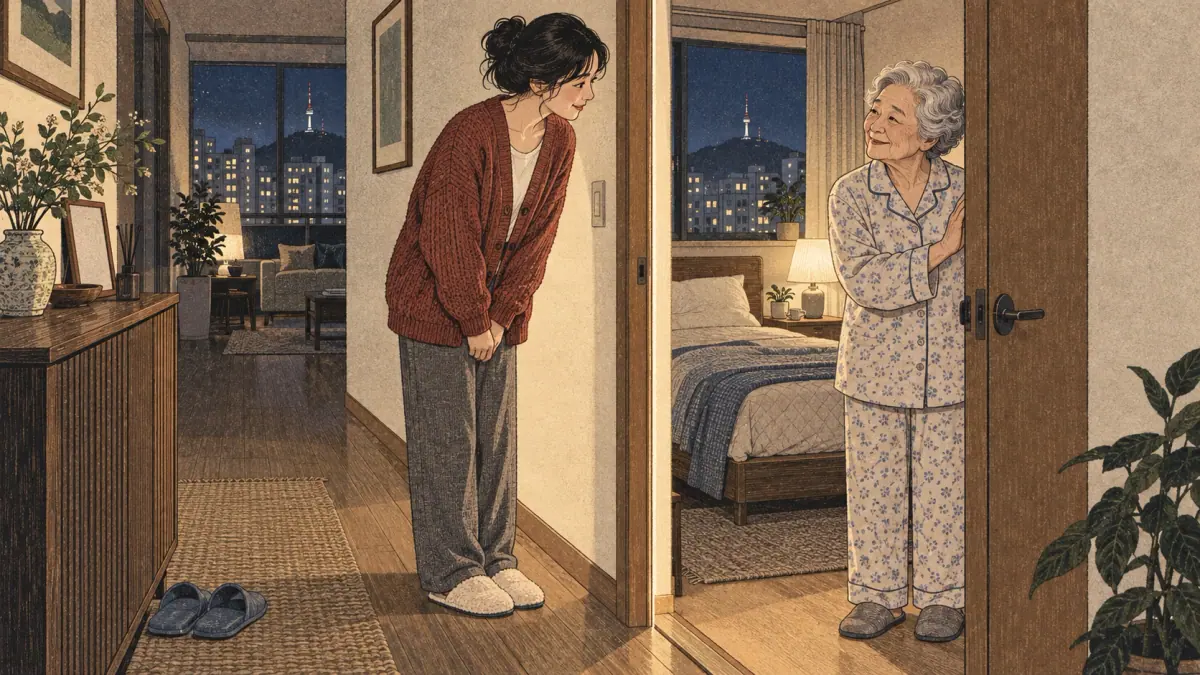
안녕히 주무세요
안녕히 주무세요
What you'll learn
- Say 안녕히 주무세요 aloud in six even syllables.
- Choose between 안녕히 주무세요, 잘 자요 and 잘 자 for an elder, a partner and a friend.
- Explain why the respectful form uses a different verb, 주무시다, instead of 자다.
- Pronounce 좋은 밤 되세요 with the silent ㅎ, as [조은 밤 되세요].
Before you start: knowing hello in Korean helps, because 안녕히 comes from the same word 안녕. Time: about 12 minutes. Audio plays only when you press a button.
How Do You Say Good Night in Korean?
The respectful way to say good night in Korean is 안녕히 주무세요, and the everyday way between equals is 잘 자요 or 잘 자. Korean has no single phrase for every listener, because the verb for sleep itself changes with respect.
| Form | Romanization | Literal meaning | Say it to |
|---|---|---|---|
| 안녕히 주무세요 | annyeonghi jumuseyo | Sleep in peace (honorific) | Parents, grandparents, hosts, a boss on a work trip |
| 잘 자요 | jal jayo | Sleep well (polite) | A partner, a friend you speak politely with, a younger colleague |
| 잘 자 | jal ja | Sleep well (casual) | Close friends, siblings, partners, children |
| 좋은 밤 되세요 | joeun bam doeseyo | Have a good night | Polite contacts in messages, customers, radio listeners |
The table shows two families of phrases. 안녕히 주무세요 is built like the polite goodbyes, with 안녕히 (in peace) plus a respectful verb. 잘 자요 and 잘 자 use 잘 (well) plus the ordinary verb 자다 (to sleep). The next section looks at each form in a sentence.
What Are the Formal, Polite and Casual Ways to Say Good Night?
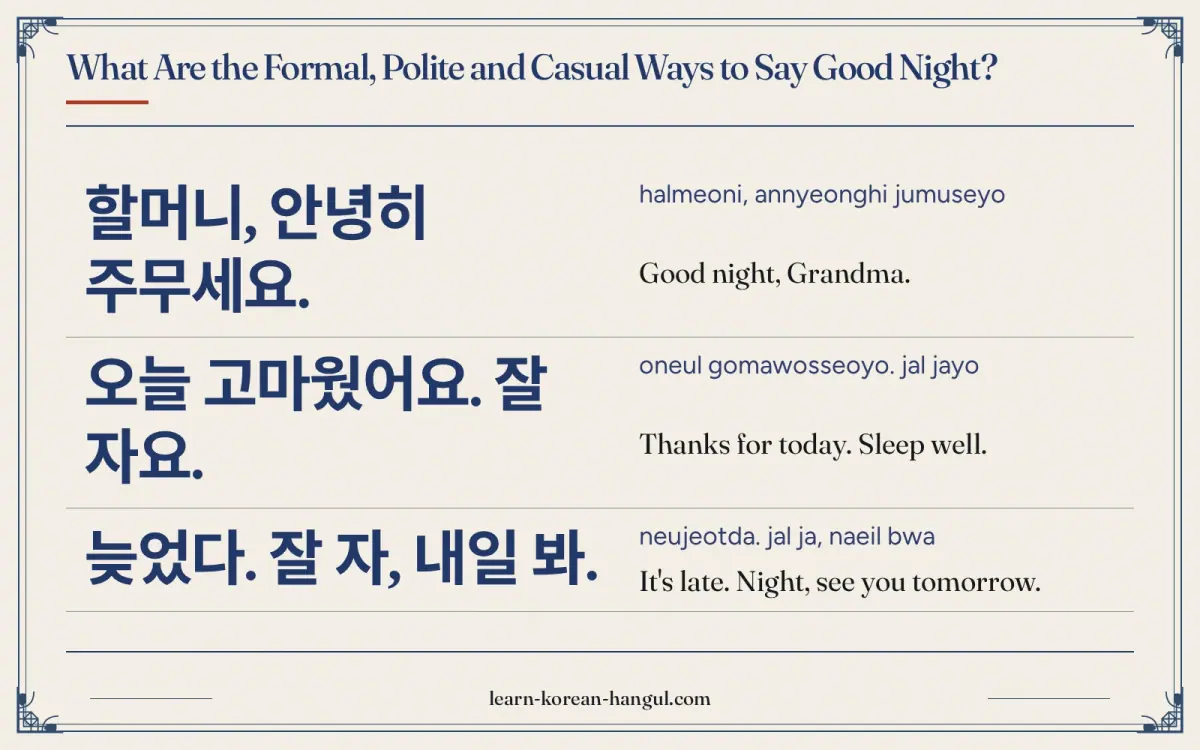
Good night follows the Korean speech levels, the system of endings that changes with the listener's age and closeness, explained in the guide to Korean speech levels. Good night adds one twist: for respected listeners, the verb itself is replaced.
Polite: 안녕히 주무세요 (annyeonghi jumuseyo)
Polite · 해요체안녕히 주무세요 uses 주무시다, the honorific verb for to sleep, in the polite -세요 ending. Korean has a handful of these special honorific verbs, such as 계시다 for to stay and 드시다 for to eat, listed in the lesson on honorific verbs. The ordinary verb 자다 would be too plain for an elder.
할머니, 안녕히 주무세요.
halmeoni, annyeonghi jumuseyo
Good night, Grandma.
In very formal settings, such as a hotel or a guest house run by staff, you may hear 안녕히 주무십시오 (annyeonghi jumusipsio), the formal-style version.
Polite: 잘 자요 (jal jayo)
Polite · 해요체잘 자요 adds the polite ending -요 to 잘 자. It is warm and friendly but uses the plain verb 자다, so it suits people you are close to but still speak politely with: a partner early in a relationship, a friend you met as an adult, or a younger coworker on a trip.
오늘 고마웠어요. 잘 자요.
oneul gomawosseoyo. jal jayo
Thanks for today. Sleep well.
Casual: 잘 자 (jal ja)
Casual · 반말잘 자 is the casual good night, said between close friends, siblings and partners, and by parents to children. It is the bedtime phrase you hear most often in Korean dramas.
늦었다. 잘 자, 내일 봐.
neujeotda. jal ja, naeil bwa
It's late. Night, see you tomorrow.
Formal: 좋은 밤 되세요 (joeun bam doeseyo)
Formal · 합쇼체좋은 밤 되세요 means "have a good night". It is polite, slightly formal wording used in messages to acquaintances, by radio presenters signing off, and by staff to customers in the evening. It is a wish, not a bedtime phrase, so families rarely use it at the bedroom door.
오늘도 수고하셨습니다. 좋은 밤 되세요.
oneuldo sugohasyeotseumnida. joeun bam doeseyo
Thank you for your hard work today. Have a good night.
Four phrases cover almost every bedtime and evening situation. Saying the main one smoothly is the next step.
How Do You Pronounce 안녕히 주무세요?
안녕히 주무세요 is pronounced as written, [안녕히 주무세요], annyeonghi jumuseyo: six syllables with a small pause after 안녕히 and no strong stress.
- 안녕 (annyeong): hold the double n slightly, then end in "ng" as in "sing".
- 히 (hi): a soft h and a short "ee".
- 주 (ju): a soft j, closer to "choo" without the puff of air, then "oo".
- 무 (mu): "moo".
- 세 (se): "seh".
- 요 (yo): short and level; let it fade.
Sound Changes to Listen For
No spelling-based sound change applies to 안녕히 주무세요 itself, but the other forms have two that matter:
- The silent ㅎ in 좋은. Under the National Institute of Korean Language Standard Pronunciation rules (표준 발음법, article 12), a final ㅎ before a vowel is not pronounced. So 좋은 is [조은], and 좋은 밤 되세요 is [조은 밤 되세요]. The rule is explained with more words in ㅎ batchim pronunciation.
- 되 can sound like 뒈. The vowel ㅚ in 되세요 may be said as a single vowel or as the glide [ㅞ]; both are allowed by the same rules, and most Seoul speakers use the glide.
- Tensing in the formal form. In 주무십시오, the ㅂ of 십 tenses the next ㅅ, giving [주무십씨오].
With pronunciation settled, the bigger risk is saying good night to the wrong person or at the wrong time.
When Should You Use 안녕히 주무세요, and When Should You Not?
Use 안녕히 주무세요 at bedtime with anyone you owe respect: older relatives, your partner's parents, a host family, or a senior colleague when you share a hotel corridor on a work trip. Do not use it as an evening goodbye when nobody is going to bed.
Situations Where It Fits
- Staying with a host family. Say 안녕히 주무세요 to the parents before you go to your room.
- Visiting your partner's parents. It is one of the phrases that most impresses Korean elders when a foreign guest says it naturally.
- A work trip. When you part from a manager at the hotel lift, 안녕히 주무세요 is the respectful closing.
- Calling grandparents at night. End the call with 안녕히 주무세요.
Situations to Avoid
- Leaving a restaurant at 9 p.m. Nobody is heading straight to bed. Use 안녕히 가세요 or 안녕히 계세요, explained in goodbye in Korean.
- Your best friend. 안녕히 주무세요 sounds stiff or teasing; say 잘 자.
- Elders with 잘 자 or 잘 자요. Both use the plain verb 자다 and can sound like you are talking down to them.
- Small children. Parents say 잘 자 to children; 안녕히 주무세요 would sound like a joke.
The conversations below show these choices inside real family and friendship talk.
What Does Good Night Sound Like in a Real Conversation?
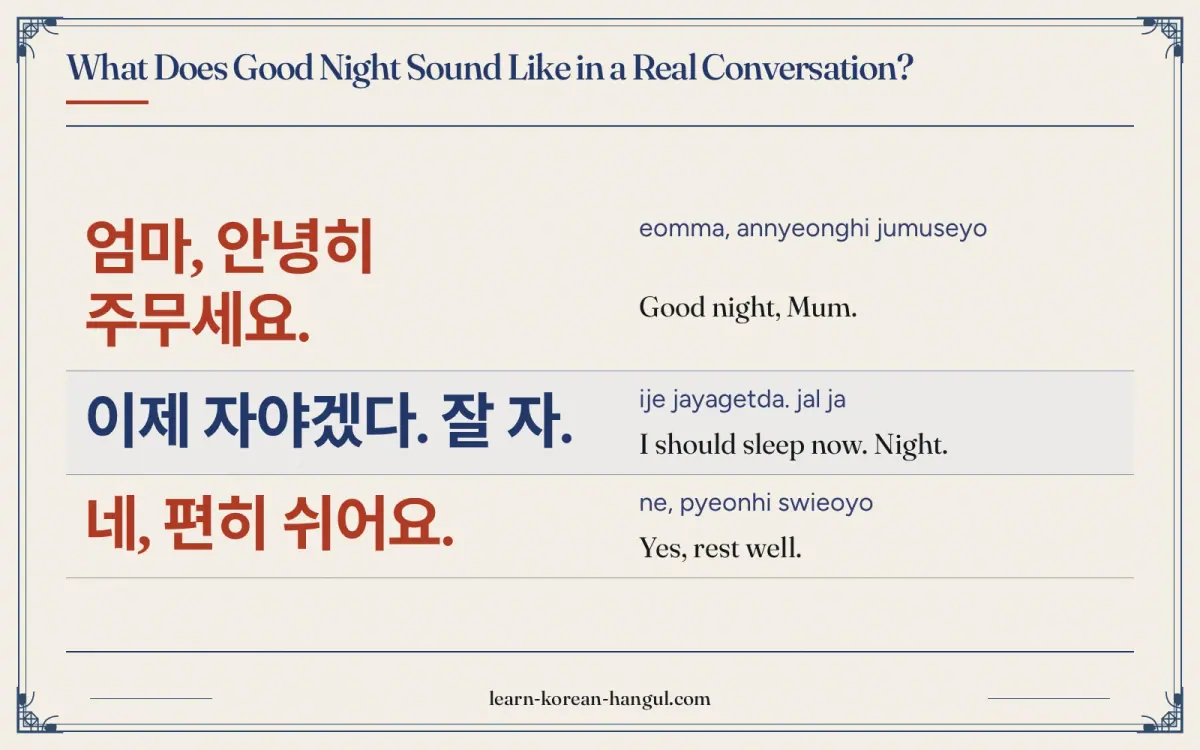
A Korean good night is usually a short exchange in which each person uses the form that suits the other. Notice that the older speaker and the younger speaker use different words.
Bedtime at Home
Son
엄마, 안녕히 주무세요.
eomma, annyeonghi jumuseyo
Good night, Mum.
Mother
그래, 잘 자. 내일 일찍 일어나.
geurae, jal ja. naeil iljjik ireona
Okay, sleep well. Get up early tomorrow.
What to notice: the son uses the honorific verb; the mother answers with casual 잘 자, which is natural from a parent.
A Couple on the Phone
Jiwoo
이제 자야겠다. 잘 자.
ije jayagetda. jal ja
I should sleep now. Night.
Daniel
응, 너도 잘 자. 좋은 꿈 꿔.
eung, neodo jal ja. joeun kkum kkwo
Yeah, you too. Sweet dreams.
What to notice: 너도 (you too) turns the phrase back to the speaker, and 좋은 꿈 꿔 is the Korean "sweet dreams".
A Homestay Guest
Guest
오늘 저녁 정말 맛있었어요. 안녕히 주무세요.
oneul jeonyeok jeongmal masisseosseoyo. annyeonghi jumuseyo
Dinner was really delicious tonight. Good night.
Host
네, 편히 쉬어요.
ne, pyeonhi swieoyo
Yes, rest well.
What to notice: the host uses 편히 쉬어요 (rest comfortably), another common bedtime wish. The habit of wishing elders good night has a cultural root worth knowing.
What Should You Know about the Culture behind Good Night?
A Korean good night carries the same respect for age that runs through the whole language, and the elder version is part of a daily family routine.
- Children greet parents at bedtime. In many families, children say 안녕히 주무세요 to parents and grandparents before going to bed, and 안녕히 주무셨어요? (did you sleep well?) in the morning. That morning question is covered in good morning in Korean.
- The verb carries the respect. 주무시다 is one of a small set of verbs that Korean replaces entirely for respected people. Using it shows you know the system, not just a phrase.
- Couples keep it casual. Partners say 잘 자 and often add a playful line such as 내 꿈 꿔 (dream of me).
An expert insight: learners often overuse 좋은 밤 되세요 because it looks like a direct translation of "have a good night". It is correct but sounds like a customer-service or radio sign-off, so it rarely fits a bedtime moment with family. The mistakes below follow from these patterns.
What Mistakes Do Learners Make with Good Night in Korean?
Most good night errors come from choosing the plain verb 자다 for someone who expects 주무시다, or from using good night as a farewell.
| Mistake | Why it is a problem | Fix |
|---|---|---|
| Saying 잘 자 to an older relative | Casual ending and plain verb | Say 안녕히 주무세요 |
| Saying 잘 자요 to a host or boss | Polite ending but plain verb | Say 안녕히 주무세요 |
| Using good night as an evening goodbye | It implies the person is going to bed | Say 안녕히 가세요 or 안녕히 계세요 |
| Using 좋은 밤 되세요 at family bedtime | Sounds like a radio sign-off | Say 잘 자 or 안녕히 주무세요 |
| Pronouncing the ㅎ in 좋은 | The ㅎ is silent before a vowel | Say [조은] |
Learners often assume that adding -요 makes any phrase polite enough for elders. Actually, -요 only sets the speech level; respect for the listener also needs the honorific -시- or an honorific verb, which is why 잘 자요 still falls short with a grandparent.
Is It the Same as Goodnight?
Yes, "goodnight" written as one word and "good night" are the same phrase in English, and both are 안녕히 주무세요 or 잘 자 in Korean. The short answers below cover the other ways people search for it.
- Goodnight in Korean: 안녕히 주무세요 to elders; 잘 자 to friends.
- Sleep well in Korean: 잘 자요 (polite) or 잘 자 (casual); literally "sleep well".
- Good night formal in Korean: 안녕히 주무세요, or 안녕히 주무십시오 in formal service.
- Good night casual in Korean: 잘 자, or the texting slang 굿밤.
- Sweet dreams in Korean: 좋은 꿈 꿔요 (polite) or 좋은 꿈 꿔 (casual).
- Night as a word: 밤 (bam); the word itself is covered in night in Korean.
Before moving on, practise the choice aloud with real people in mind.
Practice: Say It Aloud
Play the slow clip of 안녕히 주무세요 and repeat it three times, then try 잘 자요 and 좋은 밤 되세요. Then choose a phrase for each person. Answers follow.
- Your host father at a homestay, as you go to your room.
- Your younger brother.
- A customer leaving your guest house reception in the evening.
- Why does 안녕히 주무세요 use 주무세요 and not 자세요?
Answers
- 안녕히 주무세요.
- 잘 자.
- 좋은 밤 되세요, or 안녕히 주무십시오 if they are staying overnight.
- Because 주무시다 is the honorific verb for to sleep, and respected listeners get the honorific verb, not only an honorific ending.
The phrase flashcards drill all four forms with audio.
Related Phrases to Learn Next
Good night sits at the end of the day's greetings, so the natural next phrases are the morning and parting ones.
- Good morning in Korean: 안녕히 주무셨어요? and 좋은 아침.
- Goodbye in Korean: the two-way goodbye for evening partings.
- I miss you in Korean: 보고 싶어, often heard in the same late-night phone call.
This guide belongs to the Korean greetings collection. What this page does not cover: dialect bedtime phrases and the full honorific system, which lives in the speech levels guide. Choose the verb for the listener, keep the ending light, and you can say good night in Korean to anyone in the family.
Frequently Asked Questions
How do you say sweet dreams in Korean?
Sweet dreams is 좋은 꿈 꿔요 (joeun kkum kkwoyo) in polite speech and 좋은 꿈 꿔 (joeun kkum kkwo) in casual speech, literally dream a good dream. Couples sometimes say 내 꿈 꿔 (dream of me) as a playful line. With an elder, skip the dream wish and say 안녕히 주무세요.
What do Koreans say in the morning after good night?
The morning partner of 안녕히 주무세요 is 안녕히 주무셨어요? (annyeonghi jumusyeosseoyo), did you sleep well, said to parents and grandparents. Between friends or to a child, 잘 잤어요? or casual 잘 잤어? does the same job. These questions work as a morning greeting, much like good morning in English.
Can I say 안녕히 주무세요 to my boyfriend or girlfriend?
You can, but it will sound very formal or even playful. Couples normally say 잘 자 or 잘 자요, often with a sweet extra such as 좋은 꿈 꿔. Keep 안녕히 주무세요 for your partner's parents, which is exactly where it earns you a good impression.
How do you say good night in a text message in Korean?
In texts to friends, 잘 자, 굿밤 (a blend of English good and Korean 밤, night) or 잘 자요 are common. To a polite contact, 좋은 밤 되세요 or 편히 쉬세요 (rest well) fits. To an elder, 안녕히 주무세요 is still the safe choice, even in a family group chat.
Is 잘 자요 polite enough for a teacher?
Not quite. 잘 자요 has the polite ending -요 but keeps the ordinary verb 자다, so it lacks the honorific a teacher, boss or elder expects. For them, use 안녕히 주무세요. If you are not saying goodnight at bedtime, for example leaving class in the evening, use 안녕히 계세요 or 안녕히 가세요 instead.