
사랑에 빠졌어요
사랑에 빠졌어요
What you'll learn
- Say 사랑에 빠졌어요 with its tense ㅃ and the linked ending [빠져써요].
- Choose between 사랑에 빠졌어요, 사랑하게 됐어요, 너한테 빠졌어 and 반했어요 for a friend, a senior and a partner.
- Know why 너랑 사랑에 빠졌어 reports news, while 너한테 빠졌어 confesses.
- Understand why Korean uses the past tense for "I'm in love".
Before you start: you need to read Hangul and know the basic polite ending -요; romanization is shown as an aid and can be hidden. Time: about 10 minutes.
Key facts
- 사랑에 빠졌어요 (sarange ppajyeosseoyo) means "I fell in love", a change that began and still holds, so Korean uses the past tense.
- 사랑해요 (saranghaeyo) is the usual "I love you"; 사랑에 빠졌어요 describes the moment of falling.
- 당신 (dangsin) sounds odd for "you" with a new acquaintance, so use the person's name plus 씨.
How Do You Say I'm in Love with You in Korean?
The most natural way to say i'm in love with you in Korean is 사랑하게 됐어요 (I have come to love you) after the person's name, or, between partners, 너한테 빠졌어. Korean has no exact twin of "I'm in love", so it says "I fell in love" (사랑에 빠졌어요), and the table shows how the pieces fit.
| Form | Romanization | Meaning | Register |
|---|---|---|---|
| 사랑에 빠졌어요 | sarange ppajyeosseoyo | I fell in love | Polite |
| 지민 씨를 사랑하게 됐어요 | jimin ssireul saranghage dwaesseoyo | I have come to love you, Jimin | Polite, sincere |
| 사랑에 빠졌습니다 | sarange ppajyeotseumnida | I have fallen in love | Formal |
| 너한테 빠졌어 | neohante ppajyeosseo | I've fallen for you | Casual |
| 너한테 반했어 | neohante banhaesseo | I fell for you | Casual |
| 당신에게 반했어요 | dangsinege banhaesseoyo | I fell for you | Polite, literary |
| 첫눈에 반했어요 | cheonnune banhaesseoyo | I fell for you at first sight | Polite |
Why the past tense? The verb 빠지다 (ppajida) means "to fall into", and falling is a change that has already happened. Once you have fallen, you are in love now, so Korean says 빠졌어요 for "I'm in love" and keeps 빠져요 for "falls in love" in general. The next section sorts the forms by listener and by kind of falling.
What Are the Polite and Casual Ways to Say I'm in Love with You?
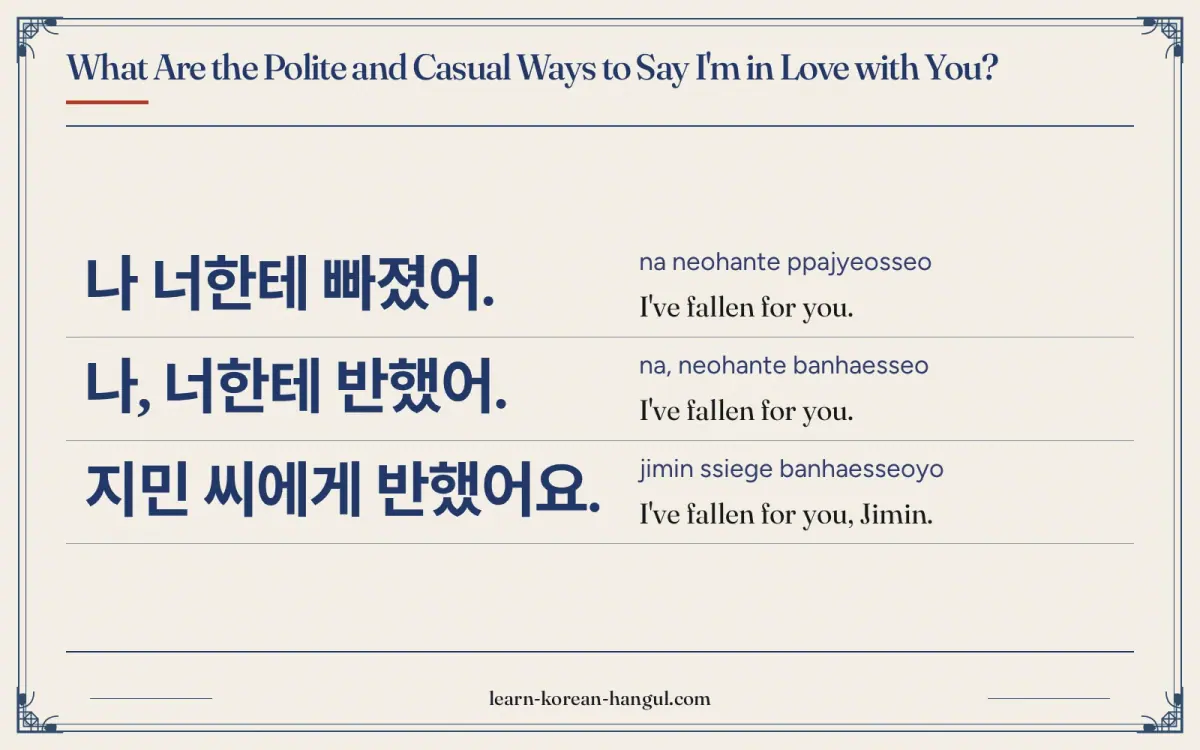
I'm in love with you in Korean follows the Korean speech levels, the endings that change with the listener's age, status and closeness, explained in the guide to Korean speech levels. Here a second choice matters too: 사랑에 빠지다 describes a slower fall, while 반하다 describes a quick one.
Polite: 사랑에 빠졌어요 (sarange ppajyeosseoyo)
Polite · 해요체사랑에 빠졌어요 says "I fell in love", and 에 means "into", so it is literally "I fell into love". With no person named, it is news about yourself. With 와/과 or 랑 (with), it reports that two people fell in love together, which suits news told to a third person. To the person you love, say 지민 씨를 사랑하게 됐어요 (I have come to love you, Jimin) instead.
저는 지민 씨와 사랑에 빠졌어요.
jeoneun jimin ssiwa sarange ppajyeosseoyo
Jimin and I have fallen in love.
Casual: 너한테 빠졌어 (neohante ppajyeosseo)
Casual · 반말With a partner or close friend, drop -요. The person you fall for takes 한테 (to), and 사랑에 can be left out, so 너한테 빠졌어 means "I've fallen for you" and sounds intimate. Avoid 너랑 사랑에 빠졌어 as a confession: 랑 means "together with", so it reports that the two of you fell in love.
나 너한테 빠졌어.
na neohante ppajyeosseo
I've fallen for you.
Casual: 너한테 반했어 (neohante banhaesseo)
Casual · 반말반하다 means "to be taken with" or "to fall for". It describes the first strong pull, such as a smile, a voice or a look. The person you fall for takes 한테 (to, at), so 너한테 반했어 means "I fell for you". It fits a crush and a first confession more than a deep love.
나, 너한테 반했어.
na, neohante banhaesseo
I've fallen for you.
Polite: 당신에게 반했어요 (dangsinege banhaesseoyo)
Polite · 해요체에게 is the written, slightly more formal twin of 한테. 당신에게 반했어요 is correct, but 당신 is a loaded word. Married couples use it for each other, and songs and dramas use it for dramatic effect. To a new acquaintance, use the name: 지민 씨에게 반했어요.
지민 씨에게 반했어요.
jimin ssiege banhaesseoyo
I've fallen for you, Jimin.
Polite: 첫눈에 반했어요 (cheonnune banhaesseoyo)
Polite · 해요체첫눈 means "first sight" and 에 marks the moment, so 첫눈에 반했어요 is "I fell for you at first sight". It is a common line in dramas and in telling a friend how you met your partner.
처음 봤을 때 첫눈에 반했어요.
cheoeum bwasseul ttae cheonnune banhaesseoyo
When I first saw you, I fell for you at first sight.
Formal: 사랑에 빠졌습니다 (sarange ppajyeotseumnida)
Formal · 합쇼체The formal ending -습니다 turns the phrase into a statement for a speech, a letter or an announcement. It is rare in love talk, but it appears in written confessions and in toasts.
The sentences are short, but the sounds hide a few changes. Pronunciation comes next.
How Do You Pronounce 사랑에 빠졌어요?
사랑에 빠졌어요 is pronounced [사랑에 빠져써요]. The phrase has six syllables, and the key sounds are the tense ㅃ and the linked ㅆ. Follow these steps:
- 사랑에 (sa-rang-e): "sah-rang-eh". The ㅇ at the end of 랑 is the "ng" sound, and the 에 is a plain "eh".
- 빠 (ppa): a tense ㅃ. Close the lips tightly, hold, then release with no puff of air.
- 졌 (jyeot): the vowel ㅕ is "yeo". The final ㅆ is not said on its own.
- 어 (eo): this syllable picks up the ㅆ sound, so you hear [써].
- 요 (yo): "yo", with a gentle fall.
Sound Changes to Listen For
- Tense ㅃ in 빠. The ㅃ is a tense consonant (경음, a double letter said with tight muscles). It is part of the spelling, so it is not a sound change. The contrast between plain ㅂ, tense ㅃ and aspirated ㅍ is covered in the guide to b, pp and p.
- Linking in 빠졌어요 and 반했어요. A final ㅆ moves onto a following vowel, so 빠졌어요 is [빠져써요] and 반했어요 is [반해써요]. This is the liaison rule (연음) of the standard pronunciation rules (표준 발음법).
- A final ㅆ before ㅅ. In 빠졌습니다, the final ㅆ is said as [ㄷ] before 습, and the ㅅ turns tense, giving [빠젇씀니다]. The ㅂ then becomes ㅁ before ㄴ, as explained in Korean nasalization.
Revised Romanization, the official system for writing Korean in Latin letters, writes ppajyeosseoyo and banhaesseoyo. Romanization is only a guide; the Hangul is the real spelling. Sound is one thing, and choosing the right moment to say it is another.
When Should You Use 사랑에 빠졌어요, and When Should You Not?
Use 사랑에 빠졌어요 when you tell someone, often a friend, that you have fallen in love. Use 반했어요 for a first strong attraction. Keep a direct confession to someone you already know.
Situations Where It Fits
- Telling a friend. 나 요즘 사랑에 빠졌어 (I've fallen in love lately) is a typical news line.
- Confessing to a partner. 너를 사랑하게 됐어 or 너한테 빠졌어 sounds sincere and personal.
- Describing how you met. 첫눈에 반했어요 is the standard story line.
- Writing a card or a letter. The polite and formal forms read well.
Situations to Avoid
- A first meeting. Korean speakers do not usually announce love to a stranger.
- 당신 with someone you have just met. It sounds odd, a little dramatic or even confrontational.
- A casual form with a senior. 사랑에 빠졌어 sounds too familiar to a teacher or boss.
Real conversations make the difference clear, so here are three.
What Does I'm in Love with You Sound Like in a Real Conversation?
Real confessions are gentle, with a small build-up before the line. Listen for the softeners.
A Confession at a Cafe
Hana
지민 씨, 할 말이 있어요.
jimin ssi, hal mari isseoyo
Jimin, I have something to say.
Hana
처음 봤을 때부터 반했어요.
cheoeum bwasseul ttaebuteo banhaesseoyo
I have liked you since the first time I saw you.
What to notice: the first line prepares the listener, and 반했어요 follows without 당신.
News between Close Friends
Sua
나 요즘 사랑에 빠진 것 같아.
na yojeum sarange ppajin geot gata
I think I've fallen in love lately.
Minsu
정말? 누구한테 반했는데?
jeongmal? nuguhante banhaenneunde?
Really? Who did you fall for?
What to notice: friends use 사랑에 빠진 것 같아 ("I think...") to soften the news, and 누구한테 반했는데 repeats 반하다 with 한테.
A Sincere Line between Partners
Jun
나 너한테 완전히 빠졌어.
na neohante wanjeonhi ppajyeosseo
I've completely fallen for you.
Hana
나도. 나도 사랑해.
nado. nado saranghae
Me too. I love you too.
What to notice: the reply is a short 나도 and the more common 사랑해. These scenes follow a cultural pattern.
What Should You Know about the Culture behind I'm in Love with You?
Many Koreans do not say 사랑해요 early in a relationship, because the phrase feels heavy. A softer 좋아해요 (I like you) or 반했어요 often comes first, and 사랑해 follows when both people are sure. Dramas show this ladder, where a character admits 너한테 반했어 many episodes before saying 사랑해.
- Two verbs, two speeds. 반하다 is quick and about attraction; 사랑에 빠지다 is deeper and often slower.
- Softening with 것 같아. Saying "I think I've fallen in love" is a gentle way to share feelings.
- Names, not 당신. Using the name plus 씨 keeps the line warm and respectful.
- A later step. The next steps on the ladder are 사랑해요 and, much later, proposals. See i love you in Korean.
An expert insight: learners expect Korean to have a present-tense "am in love" and are surprised by the past tense. In fact, the past form is the natural one, because falling is a completed event whose result lasts. Use the present only for habits, like "she falls in love easily". The mistakes below come from this and from the particles.
What Mistakes Do Learners Make with I'm in Love with You in Korean?
Most mistakes come from the particle, the tense and the choice of 당신.
| Mistake | Why it is a problem | Fix |
|---|---|---|
| 너를 사랑에 빠졌어 | 를 does not fit this verb | Say 너한테 빠졌어 or 너한테 반했어 |
| 사랑에 빠져요 for "I'm in love" | Present tense means "falls in love" in general | Say 사랑에 빠졌어요 |
| 너랑 사랑에 빠졌어 as a confession | 랑 means "together with", so it reports that you both fell in love | Say 너한테 빠졌어 or 너를 사랑하게 됐어 |
| 당신에게 반했어요 to a new acquaintance | 당신 sounds odd or dramatic | Say the name plus 씨 |
| Pronouncing ㅃ like English b | Loses the tense sound | Close the lips tightly, release with no puff |
Learners often assume that the most dramatic phrase is the most romantic. In fact, a soft 반했어요 with a name sounds sincere, while an over-dramatic 당신 can sound like a line from a script.
Other Ways People Search for I'm in Love with You in Korean
People search for i'm in love with you in Korean in several forms. The short answers below cover each one.
- Fall in love in Korean: 사랑에 빠지다 (sarange ppajida) is the verb phrase, and 반하다 means to fall for someone.
- I fell in love in Korean: 사랑에 빠졌어요 (polite) or 사랑에 빠졌어 (casual).
- In love in Korean: Korean has no separate adjective. Say 사랑에 빠졌어요 for "I'm in love" or 사랑하고 있어요 (I am loving) for an ongoing feeling.
Understanding the forms is the first step; saying them calmly is the next, so practise now.
Practice: Say It Aloud
Play the slow clip of 사랑에 빠졌어요, repeat it three times with a tight ㅃ, then try 반했어요. Then choose a form for each situation. Answers follow.
- You tell a close friend you have just fallen in love.
- You confess to a coworker you have liked for months.
- You tell your partner of two years how you feel.
- You tell a friend how you met your partner.
Answers
- 나 사랑에 빠졌어.
- 지민 씨에게 반했어요.
- 너를 사랑하게 됐어, or 너한테 완전히 빠졌어.
- 첫눈에 반했어요, or 첫눈에 반했어 with a close friend.
Drill 사랑에 빠졌어요 and the related phrases with the phrase flashcards, which include audio for each form.
Related Phrases to Learn Next
I'm in love with you is one step in a ladder of romantic phrases.
- I like you in Korean: 좋아해요, the usual first confession.
- I love you in Korean: 사랑해요 and its forms.
- I love you so much in Korean: 너무 사랑해요 for stronger feeling.
- Korean love phrases: the full list of romantic phrases.
This guide belongs to the korean love phrases collection. What this page does not cover: song lyrics, written confessions and regional forms. Use 반했어요 for a first crush, 사랑에 빠졌어요 for deeper feeling, and the name plus 씨 instead of 당신, and you can say i'm in love with you in Korean without sounding scripted.
Frequently Asked Questions
How do you say i'm in love with you in Korean?
Say 지민 씨를 사랑하게 됐어요 (I have come to love you, Jimin) politely, or 너한테 빠졌어 (neohante ppajyeosseo, I have fallen for you) casually. 사랑에 빠졌어요 on its own means I am in love, and 반했어요 is for a sudden crush. Avoid 너랑 사랑에 빠졌어 as a confession, because it reports that you both fell in love.
How do you pronounce 사랑에 빠졌어요?
It is pronounced [사랑에 빠져써요], in six syllables. The first sound of 빠 is a tense ㅃ, tight and without a puff of air, unlike the English b. The ㅆ at the end of 졌 moves onto the next syllable, so you hear 써. Say sah-rang-eh ppa-jyeo-sseo-yo, and keep every syllable even.
What is the difference between 사랑에 빠졌어요 and 너한테 반했어?
사랑에 빠졌어요 is polite and describes falling in love, often slowly with someone you know. 너한테 반했어 is casual and means "I fell for you", often fast and at first sight. The first suits colleagues and elders, and the second suits friends and partners. Both use the past tense, because falling happens once.
Is 사랑에 빠졌어요 formal or casual?
사랑에 빠졌어요 is polite, because it ends in -요. The formal form is 사랑에 빠졌습니다 (sarange ppajyeotseumnida), used in speeches and writing, and the casual form is 사랑에 빠졌어, kept for close friends and partners. The meaning stays the same, and only the ending changes with the listener.
Can I use 사랑에 빠졌어요 with friends, elders and strangers?
Use it with friends and partners, usually as news about yourself. With elders, the polite form is acceptable when you talk about your feelings. With strangers, avoid confessions altogether. To tell someone you fell for them, 반했어요 with their name plus 씨 is safer than 당신, which sounds strange to a new acquaintance.
What is the most common mistake with i'm in love with you in Korean?
The most common mistake is the particle. Learners say 너를 사랑에 빠졌어, or confess with 너랑 사랑에 빠졌어, which reports that the two of you fell in love. Say 너한테 빠졌어 or 너한테 반했어 instead. The second mistake is the present tense 빠져요, which describes falling in love in general, not I am in love now.