
The Korean ㅂ ㅍ ㅃ difference is a difference in breath and tension at the lips: plain ㅂ is soft, tense ㅃ is tight with almost no puff, and aspirated ㅍ has a strong puff of air. Only the first letter changes in 불 (fire), 뿔 (horn) and 풀 (grass), yet each word has a different meaning.
What you'll learn
- Pronounce 불, 뿔 and 풀 distinctly.
- Explain why ㅂ is neither English b nor English p.
- Predict how ㅂ sounds at the start, in the middle and at the end of a word.
- Say 감사합니다 with the correct [m] sound.
Prerequisites: Korean Consonant Sounds and the overview Plain Tense Aspirated Consonants. Estimated time: 25 minutes.
What Is the Korean ㅂ ㅍ ㅃ Difference?
The Korean ㅂ ㅍ ㅃ difference is the three-way contrast that Korean makes with the two lips. English has b and p. Korean has three lip stops, and each one forms a different word with the same vowel and the same final consonant.
| Letter | Name | Type | Breath after release | Throat | Example |
|---|---|---|---|---|---|
| ㅂ | 비읍 (bieup) | plain (평음) | light | relaxed | 불 (fire) |
| ㅃ | 쌍비읍 (ssangbieup) | tense (경음) | almost none | tight | 뿔 (horn) |
| ㅍ | 피읖 (pieup) | aspirated (격음) | strong | relaxed | 풀 (grass; glue) |
All three close the lips completely and then open them. The differences lie in what the throat does and how much air follows. The letter shapes help: ㅃ is two ㅂ letters side by side, and ㅍ is a separate shape that looks like a ㅂ with the lines opened. Each letter has its own lesson: ㅂ, ㅃ and ㅍ. The first problem is why English hearing resists this system.
Why Do English Speakers Mix up ㅂ, ㅃ and ㅍ?
English speakers mix up ㅂ, ㅃ and ㅍ because English separates b from p by voicing, and Korean separates its three lip sounds by breath and tension. In English "bin" and "pin" differ because the vocal cords vibrate for b. Korean ㅂ at the start of a word does not vibrate, so the ear files it under p, while the Revised Romanization spelling "b" pushes the learner to voice it.
Three habits cause most of the errors:
- Voicing ㅂ at the start of a word. Learners say 불 as "bul" with a full English b.
- Hearing ㅃ as ㅂ. English has no tense stop, so the ear ignores the tightness.
- Pushing air on ㅃ. Learners say 빵 like "pang" with a puff because they think the doubled letter means "more".
English holds all three sounds in a different arrangement. The p in "pin" has a strong puff and is close to ㅍ. The p in "spin" has no puff and is close to ㅃ, though ㅃ is tighter. English speakers treat these as one sound spelled p. The following section describes each Korean sound on its own.
How Do ㅂ, ㅃ and ㅍ Sound on Their Own?

Each letter has one clear mouth recipe at the start of a syllable. The examples below keep the vowel ㅜ or ㅏ, so only the consonant changes.
ㅂ: the Plain Sound
Plain ㅂ is a soft, relaxed p with a light puff and a low start to the vowel. Close the lips lightly, keep the throat loose and open with a small breath. Example: 불 (fire) and 바다 (sea). The sound sits between English "p" and "b". An English listener may hear "bul" or "pul", and context usually settles the meaning.
ㅃ: the Tense Sound
Tense ㅃ is a tight, short p with almost no puff and a higher start to the vowel. Press the lips together firmly, tighten the throat for a second as if holding your breath, then open without pushing air. Example: 뿔 (horn) and 빵 (bread). The sound is not louder than ㅂ. It is tighter.
ㅍ: the Aspirated Sound
Aspirated ㅍ is a p with a strong, audible puff of air and a high start to the vowel. Open the lips and let a clear breath follow, like a small sigh. Example: 풀 (grass; glue) and 포도 (grape). English speakers already make this sound at the start of "pin" and "pie".
Plain: a Little Breath; Tense: None; Aspirated: a Lot
| Korean | Romanization | Meaning | Sound |
|---|---|---|---|
| 불 | bul | fire | |
| 뿔 | ppul | horn | |
| 풀 | pul | grass; glue |
Play the three clips in order, then play them again with your eyes closed and name each first consonant. The most common question follows from the sound of ㅂ itself.
Is Korean ㅂ a B or a P?

Korean ㅂ is neither a pure b nor a pure p; it is one sound that shifts with its neighbours. The change is predictable: plain stops are voiced between voiced sounds. This is a phonetic detail described in Korean phonetics textbooks rather than a numbered rule of the Standard Pronunciation Rules (표준 발음법), because it never changes which letter a listener hears.
| Position of ㅂ | What you hear | Example | Revised Romanization |
|---|---|---|---|
| start of a word | voiceless, light puff, close to p | 바다 (sea) | bada |
| between two vowels | voiced, close to b | 아버지 (father) | abeoji |
| end of a syllable | unreleased, no puff | 밥 (rice) | bap |
Take 아버지 as a model. The ㅂ sits between ㅏ and ㅓ, so the voice carries through the lips and the sound is a b. In 바다, the first ㅂ begins the word and sounds closer to a soft p, while the ㄷ in the middle becomes a d. RR writes the same letter b in both words, which hides the difference.
Voicing applies to plain ㅂ only. The tense and aspirated sounds keep their character between vowels, and that is the best way to hear the contrast between 아빠 and 아파요.
Why Does 아빠 Sound Different from 아파요?
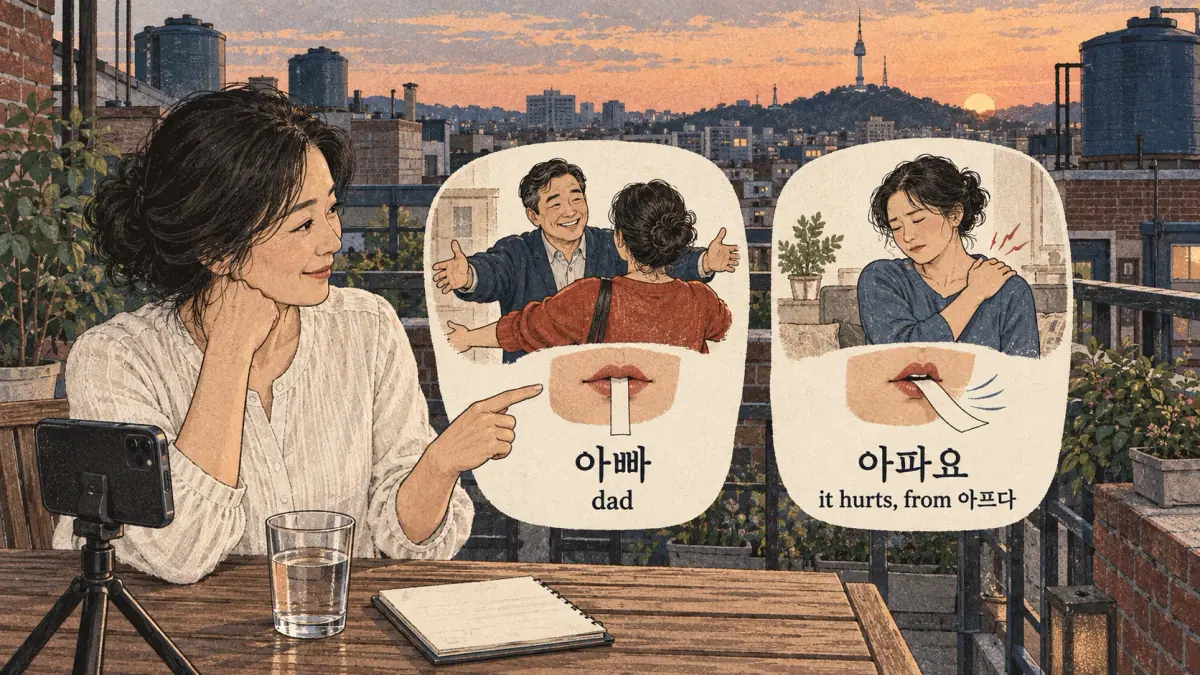
아빠 and 아파요 sound different because the middle consonant is tense in one and aspirated in the other. 아빠 (dad) has ㅃ: the lips press together, the closure is held a moment longer and the release carries almost no air, so the word sounds like [appa]. 아파요 (it hurts, from 아프다) has ㅍ, where the lips open with a clear puff.
| Word | Middle consonant | Closure | Release | Meaning |
|---|---|---|---|---|
| 아빠 | ㅃ | tight, slightly longer | no puff | dad |
| 아파요 | ㅍ | relaxed | strong puff | it hurts |
| 아버지 | ㅂ (voiced) | relaxed, voiced | small | father |
The related word 오빠 (older brother, said by a woman) uses the same tense ㅃ. A learner who says 오파 with an aspirated ㅍ produces a sound that is not the word 오빠. The word 빨리 (quickly) begins with tense ㅃ, so it is also a good practice word; Koreans often double it as 빨리빨리, "hurry up".
For the tense sounds as a group, How to Pronounce Korean Tense Consonants gives a four-step method. The last position to check is the end of a syllable.
What Happens to ㅂ and ㅍ at the End of a Syllable?

At the end of a syllable, ㅂ and ㅍ both sound like an unreleased [ㅂ]. The lips close and the sound stops without a puff, so the contrast is neutralized. A consonant in this position is a batchim (받침), and the ㅂ batchim lesson gives the full rule.
| Written | Meaning | Spoken | Final letter |
|---|---|---|---|
| 밥 | rice, meal | [밥] | ㅂ |
| 앞 | front | [압] | ㅍ |
| 잎 | leaf | [입] | ㅍ |
| 값 | price | [갑] | ㅄ (a double final) |
ㅃ never appears as a final letter, so the three-way contrast has only two members at the end of a syllable and merges to one sound. The original consonant returns when a vowel follows: 앞에 (in front of) is [아페], and 잎이 (the leaf, as subject) is [이피]. An English speaker should close the lips and stop, and should not add a small "uh" after the p. With the endings sorted, one common word needs a special note.
Why Is 감사합니다 Spoken with an M?
감사합니다 (thank you) is spoken [감사함니다] because a final ㅂ turns into ㅁ before ㄴ. This is nasalization (비음화): the lips are already closed for ㅂ, and the nose opens to let ㅁ through when ㄴ follows. The written form is 합니다, but the spoken form is [함니다].
| Written | Spoken | Meaning |
|---|---|---|
| 감사합니다 | [감사함니다] | thank you |
| 입니다 | [임니다] | is, am, are (formal) |
| 앞마당 | [암마당] | front yard |
This lesson only previews the rule. The full explanation is in Korean ㅂ Nasalization, and a single-word walk-through is in how to pronounce 감사합니다. The three lip sounds can now be tested together in one worked example.
Worked Example: 불, 뿔, 풀
The worked example takes the three words in order and checks each against breath, tension and pitch.
- Set your mouth. For all three words, close both lips and prepare the vowel ㅜ with slightly rounded lips.
- Say 불. Open the lips gently with a small puff and a relaxed throat. The vowel starts low. The final ㄹ is a light l, with the tongue tip on the ridge.
- Say 뿔. Press the lips together, tighten the throat, then open with almost no air. The vowel starts higher and sounds clipped.
- Say 풀. Open the lips with a clear puff, like a short sigh. The vowel starts high.
- Check with your hand. Hold a palm 5 cm (2 inches) from your lips. A little air for 불, almost none for 뿔 and a strong push for 풀.
You will know it worked when a listener, or the clip, can tell the three apart without seeing the letters. Note that 풀 has two meanings: it can be grass or glue, and the context tells the listener which is meant. A second test is useful at home.
How Can You Test the Difference at Home?

You can test the difference at home with a breath check and a lip check. Both take under a minute and need no equipment.
- Breath check. Hold the palm of your hand 5 cm in front of your mouth. Say 파, 바 and 빠 in turn. 파 should push the most air, 바 a little, and 빠 almost none.
- Lip check. Press a finger lightly on your lips. For 빠 you should feel the lips press firmly before the release. For 바 the press is gentle.
- Order check. Record 바 빠 파, 바 빠 파 and listen back. If two of the three sound the same, repeat the weaker one slowly three times.
Compare your three attempts with each other, not with a fixed amount, because distance and loudness change how much air your hand feels. With the tests done, the main mistakes are easy to name.
Common Learner Mistakes
Four mistakes cause most of the confusion among ㅂ, ㅃ and ㅍ. Each follows the same pattern: what learners assume, what is true and the reason.
Learners often assume ㅂ is b; actually it sounds closer to a soft p at the start of a word, because Korean plain stops are voiceless there. Fix: say 바다 with a light p and a b only in the middle of a word, as in 아버지.
Learners often assume ㅃ is a long or loud p; actually it is a tight p, because the doubled letter shows tension, not volume. Fix: tighten, then release quickly with no air.
Learners often assume 앞 ends with the sound of ㅍ; actually it ends with an unreleased [ㅂ], because aspiration is lost at the end of a syllable. Fix: close the lips and stop.
Learners often assume 합니다 is read hap-ni-da; actually it is spoken [함니다], because ㅂ becomes ㅁ before ㄴ. Fix: let the lips close and hum before the n.
A final point looks like a mistake but is a rule: after a final stop, a plain ㅂ can become tense. For example, 국밥 (rice soup) is spoken [국빱]. That change is covered in Korean tensification, and it explains why ㅃ-like sounds appear in words spelled with ㅂ. More examples sit in the consonant mistakes page.
Practice and Answer Key
Work through the exercises in order. The answers follow after Exercise 4.
Exercise 1: listen and choose. Play each clip once, then write ㅂ, ㅃ or ㅍ for the first consonant.
Practice · Read
Show answer
불
listen-first clip 1: 불, fire (plain ㅂ)
Show answer
뿔
listen-first clip 2: 뿔, horn (tense ㅃ)
Show answer
풀
listen-first clip 3: 풀, grass or glue (aspirated ㅍ)
Show answer
아버지
voicing: 아버지, father
Show answer
아빠
tense ㅃ between vowels: 아빠, dad
Show answer
아파요
aspirated ㅍ between vowels: 아파요, it hurts
Show answer
빨리
tense ㅃ at the start: 빨리, quickly
Show answer
밥 앞 잎
final position: 밥, 앞, 잎 in a row
Show answer
감사합니다
ㅂ before ㄴ: 감사합니다, thank you, spoken [감사함니다]
Show answer
불 뿔 풀
worked example: 불, 뿔, 풀 in a row
Exercise 2: sort the letters. Name the type (plain, tense or aspirated) of the first letter in each word: 1 빵 (bread), 2 포도 (grape), 3 바다 (sea), 4 뽀뽀 (kiss), 5 파도 (wave).
Exercise 3: predict the sound. Say whether the ㅂ in each word is closer to p or b: 1 바다 (first ㅂ), 2 아버지, 3 불.
Exercise 4: final position. Write how each word is pronounced: 1 밥, 2 앞, 3 잎, 4 감사합니다.
Answers.
Exercise 2: 1 tense. 2 aspirated. 3 plain. 4 tense. 5 aspirated.
Exercise 3: 1 p-like (start of the word). 2 b-like (between vowels). 3 p-like (start of the word).
Exercise 4: 1 [밥]. 2 [압]. 3 [입]. 4 [감사함니다].
If your written answers are right but Exercise 1 is shaky, your hearing is behind your knowledge, which is typical. Repeat the clips daily for a week and add the plain, tense and aspirated listening practice. The minimal pairs page has more triplets.
Where to Go Next
Continue with Korean ㅈ ㅊ ㅉ Difference, which applies the same cues to the tongue-blade set. The lesson Korean ㄷ ㅌ ㄸ Difference covers the tongue-tip set if you skipped it. For the b and p switch in detail, read Korean Consonant Voicing, and for the full list return to Plain, Tense and Aspirated Sounds. Letter shapes are in the Hangul consonants section.
This lesson covers ㅂ, ㅃ and ㅍ at the start, middle and end of a syllable, plus the ㅂ to ㅁ change in 합니다. It does not cover every nasalization pattern, tensification between words, regional differences or the acoustic measurements behind the pitch cue. Those topics have their own pages.
The Korean ㅂ ㅍ ㅃ difference comes down to breath and tension at the lips: ㅍ is a strong puff, ㅂ is a soft p that turns into b between vowels, and ㅃ is tight with none. Learn the three by ear and hand, and trust the audio over the romanization.
Frequently Asked Questions
Is Korean ㅂ a b or a p? Korean ㅂ is neither alone; it is one sound that changes with position. At the start of a word it is a soft, nearly unvoiced p with a light puff. Between vowels it is voiced and sounds like b. At the end of a syllable it is an unreleased p. Revised Romanization writes b or p for it.
How do I pronounce ㅃ? Close both lips firmly, tighten the throat as if holding your breath, and release without any puff of air. The result is shorter and tighter than ㅂ, close to the p in English 'spin'. Practise with 빵 (bread) and 아빠 (dad), and hold a hand in front of your mouth: it should feel almost no air.
Why does 아빠 sound different from 아파? 아빠 has a tense ㅃ and 아파 has an aspirated ㅍ, and Korean treats them as different sounds. 아빠 means dad, and the lips close tightly with almost no air. 아파 is the form of 아프다 (to be sick or in pain) in 아파요, and it has a strong puff after the lips open.
Does the order of letters ㅂ ㅃ ㅍ matter? Not for pronunciation, but for learning. Dictionaries list ㅂ, then ㅃ, with ㅍ placed later in the alphabet. This lesson uses the plain, tense, aspirated order (ㅂ, ㅃ, ㅍ) because it follows the breath scale from light to none to strong, which is the order that explains the contrast most clearly.
What happens to ㅂ and ㅍ at the end of a syllable? Both become the same unreleased p. The lips close and the sound stops without a puff, so 밥 (rice) is [밥] and 앞 (front) is [압]. The contrast with ㅃ never appears there, because ㅃ is never a final letter. When a vowel follows, the original consonant returns, as in 앞에 [아페].