외로워요
외로워요
What you'll learn
- Say I'm lonely with 외로워요, 외로워 or 쓸쓸해요, depending on the listener and the mood.
- Tell 외로워요 (lonely), 심심해요 (bored) and 혼자예요 (I'm alone) apart.
- Understand why 외롭다 becomes 외로워요 and not 외롭어요.
- Pronounce 외 like 웨 and hear [외롭따] in the dictionary form.
Before you start: you only need to read Hangul. When loneliness comes with missing someone, learn I miss you in Korean. Time: about 10 minutes. Audio plays only when you press a button.
Key facts
- 외롭다 is a ㅂ irregular adjective, so the polite form is 외로워요, never 외롭어요.
- 심심해요 (simsimhaeyo) means bored, and 혼자예요 (honjayeyo) states that you are alone.
- 외 is often said like 웨, so 외로워요 sounds like we-ro-wo-yo.
How Do You Say I'm Lonely in Korean?
The standard way to say I'm lonely in Korean is 외로워요. It describes a feeling of missing company or connection, and you can feel it alone or in a crowd. Korean usually drops "I", so 외로워요 alone is a full sentence. It has four syllables: oe-ro-wo-yo.
| Situation | Best form | Romanization | Why |
|---|---|---|---|
| Telling a trusted colleague | 외로워요 | oerowoyo | Polite, natural |
| Telling a close friend | 외로워 | oerowo | Casual |
| A quiet, wistful mood | 쓸쓸해요 | sseulsseulhaeyo | Desolate, gentle |
| Saying you are alone | 혼자예요 | honjayeyo | A fact, not a feeling |
| Asking your grandmother | 외로우세요? | oerouseyo | Honorific question |
The next section sorts the forms by the person you are talking to.
What Are the Polite and Casual Ways to Say I'm Lonely?
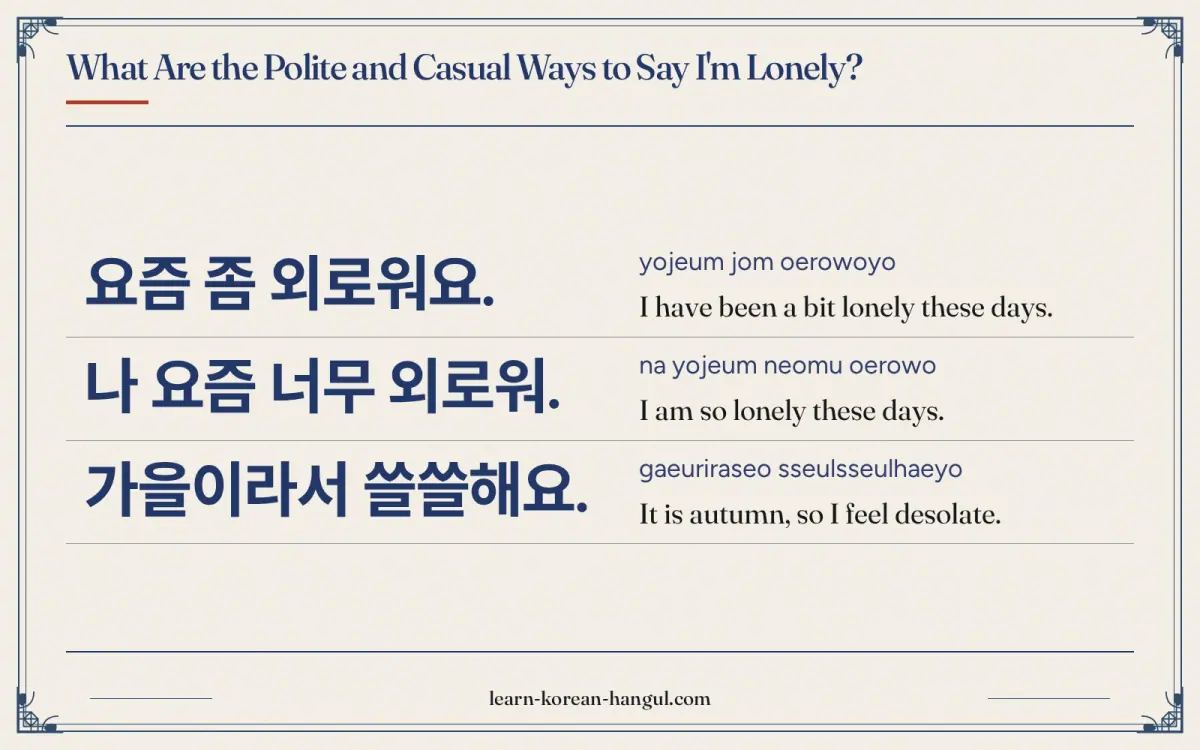
The forms follow the Korean speech levels, explained in the guide to Korean speech levels. The stem stays close to the same, and the ending changes the level.
Polite: 외로워요 (oerowoyo)
Polite · 해요체외로워요 is the form to learn first. It suits friends, family and colleagues you trust. It is honest without being dramatic, and adding 요즘 (these days) or 좀 (a bit) makes it softer.
요즘 좀 외로워요.
yojeum jom oerowoyo
I have been a bit lonely these days.
Casual: 외로워 (oerowo)
Casual · 반말외로워 drops the polite 요. Use it with close friends, siblings and partners. It often comes with a hint that you want a call or a meal together.
나 요즘 너무 외로워.
na yojeum neomu oerowo
I am so lonely these days.
Polite: 쓸쓸해요 (sseulsseulhaeyo)
Polite · 해요체쓸쓸해요 is a quieter, wistful loneliness, like a house that has gone quiet or a street in late autumn. People use it for a mood that comes with a place or a season more than for a need for company. The stem is 쓸쓸하다, a regular 하다 adjective, so the polite form is 쓸쓸해요 and the casual form is 쓸쓸해.
가을이라서 쓸쓸해요.
gaeuriraseo sseulsseulhaeyo
It is autumn, so I feel desolate.
Formal: 외롭습니다 (oeropseumnida)
Formal · 합쇼체외롭습니다 is the formal form. It appears in speeches, essays and songs, and you will rarely need it in conversation. It is pronounced [외롭씀니다]: the 습 is tense after the ㅂ, and the ㅂ of 습 turns into ㅁ before ㄴ. The grammar behind 외로워요 is next.
Why Does 외롭다 Become 외로워요?
외롭다 is a ㅂ irregular adjective. When the stem ends in ㅂ and the next ending starts with a vowel, the ㅂ becomes 우 (u) and joins the ending. So 외롭 + 어요 turns into 외로워요, and the written form 외롭어요 is wrong. The same change gives these forms.
- 외롭다 → 외로워요 (lonely)
- 덥다 → 더워요 (hot)
- 그립다 → 그리워요 (missed, longed for)
- 어렵다 → 어려워요 (difficult)
Before a consonant, the ㅂ stays, so the formal form is 외롭습니다 and the plain negative is 외롭지 않아요 (oeropji anayo). Before the honorific -(으)세요, the ㅂ also becomes 우: 외로우세요 (oerouseyo). Only two common words differ: 돕다 and 곱다 turn into 도와요 and 고와요. Next, the pronunciation.
How Do You Pronounce 외로워요?
외로워요 is pronounced [외로워요] and has four syllables: oe-ro-wo-yo. In everyday speech the first syllable is often said like 웨, so the whole word sounds like we-ro-wo-yo.
- 외 (oe): the letter ㅚ is officially a single vowel, but most speakers say it like "weh".
- 로 (ro): a quick tap of the tongue, between "r" and "l".
- 워 (wo): start with a quick w, then the open ㅓ sound. The ㅓ is unrounded, so keep your lips relaxed.
- 요 (yo): "yo".
Sound Changes to Listen For
The one change to know is on the dictionary form. It follows the National Institute of Korean Language standard pronunciation rules (표준 발음법, Article 23).
- Tense ㄷ after ㅂ. 외롭다 is [외롭따]: after the final ㅂ, the next ㄷ becomes tense. RR shows the plain spelling oeropda, because it does not show tensing caused by a neighbouring sound. See Korean tensification.
- No change in 외로워요. Once the ㅂ has become 우, there is no final consonant left, so nothing else changes.
With the sound clear, here is when to use each form.
When Should You Use 외로워요, and When Should You Not?
Use 외로워요 when you want to be honest about a feeling with someone who cares. It invites a kind answer, such as a call or a meal.
Situations Where It Fits
- A friend asks how you are. 요즘 좀 외로워요. (I've been a bit lonely lately.)
- Living far from home. 혼자 살아서 가끔 외로워요. (I live alone, so I'm sometimes lonely.)
- A quiet holiday. 명절에 혼자 있으면 외로워요. (When I'm alone on a holiday, I feel lonely.)
Situations to Avoid
- Boredom. If you have nothing to do, say 심심해요 (simsimhaeyo), not 외로워요.
- A plain fact. If you only want to say you are by yourself, say 혼자예요 (honjayeyo, I'm alone) or 혼자 있어요 (honja isseoyo, I'm by myself).
- A first meeting. Telling a stranger that you are lonely is unusual. Wait until you know each other better.
Two short conversations show how it sounds.
What Does I'm Lonely Sound Like in a Real Conversation?
In real life, the line is followed by a caring question. Notice the answers.
Friends on the Phone
Minsu
나 요즘 좀 외로워.
na yojeum jom oerowo
I've been a bit lonely lately.
Yuna
왜? 무슨 일 있어?
wae? museun il isseo?
Why? Is something wrong?
Minsu
그냥 혼자 있는 시간이 많아서.
geunyang honja inneun sigani manaseo
It's just that I spend a lot of time alone.
What to notice: the casual 외로워 comes with a gentle reason, and the friend responds with a caring question rather than advice.
Colleagues after Work
Hana
저 요즘 조금 외로워요.
jeo yojeum jogeum oerowoyo
I've been a little lonely lately.
Seojun
그래요? 이번 주말에 같이 밥 먹을까요?
geuraeyo? ibeon jumare gachi bap meogeulkkayo?
Really? Shall we have a meal together this weekend?
Hana
좋아요. 고마워요.
joayo. gomawoyo
Sure. Thank you.
What to notice: Hana uses the polite 저 and 외로워요, and adds 조금 to soften the feeling. The invitation shows how Koreans answer loneliness with a shared meal.
How Do You Ask Someone Whether They Are Lonely?
To a friend, say 외로워? (oerowo?) with a rising voice. To a colleague or stranger, say 외로워요? (oerowoyo?). To an elder, use the honorific 외로우세요? (oerouseyo?), which adds the respectful -시- to the stem. The honorific shows respect for the person you ask, so never use it for yourself.
| Listener | Question | Romanization |
|---|---|---|
| Close friend | 외로워? | oerowo |
| Colleague | 외로워요? | oerowoyo |
| Elder or customer | 외로우세요? | oerouseyo |
What Should You Know about the Culture behind I'm Lonely?
Living alone and eating alone are common topics in modern Korea. You will see 혼밥 (honbap, eating alone) and 혼술 (honsul, drinking alone) in daily talk, and 1인 가구 (irin gagu, a one-person household) in news and research. 외롭다 often frames these conversations, although many people enjoy time alone and do not feel lonely at all.
- Meals together. A shared meal is the usual cure for loneliness, so expect an invitation like 같이 밥 먹을까요? (shall we eat together?).
- Weather and season. Autumn, rain and holidays are linked with 쓸쓸하다, and songs use the word often.
- Opening up. Telling a friend 외로워 is a sign of trust. A casual reply such as 나도 (me too) is a kind answer.
These are general habits rather than rules, and individuals differ.
What Mistakes Do Learners Make with I'm Lonely in Korean?
Most mistakes come from the ㅂ irregular and from mixing up three words that English translates as "alone" or "bored".
| Mistake | Why it is a problem | Fix |
|---|---|---|
| 외롭어요 | The ㅂ must change to 우 | Say 외로워요 |
| 심심해요 for lonely | 심심해요 means bored | Say 외로워요 |
| 외로워요 for being alone | It names a feeling, not a fact | Say 혼자예요 |
| 외로워 to an elder | Too casual | Say 외로워요 |
| 외로우세요 for yourself | The honorific is for others | Say 외로워요 |
Learners also forget the tense. For a feeling that is over, use the past 외로웠어요 (oerowosseoyo): 어릴 때 많이 외로웠어요, I was very lonely when I was young.
Is It the Same as Lonely, I Feel Lonely or Alone?
Mostly. The short answers below cover the other searches folded into this page.
- Lonely in Korean: 외로워요 for the feeling. Before a noun, use 외로운 (oeroun), as in 외로운 사람 (a lonely person).
- I feel lonely in Korean: 외로움을 느껴요 (oeroumeul neukkyeoyo) is a book-like phrase, and 외로워요 is the everyday one.
- Alone in Korean: 혼자 (honja) as in 혼자예요 (I'm alone), and 혼자 있어요 (I'm by myself). The word 혼자 says nothing about feelings.
Now practise aloud.
Practice: Say It Aloud
Play the slow clip of 외로워요 three times and say 외 like 웨. Then choose a phrase. Answers follow.
- You tell a close friend that you feel lonely.
- You say it politely to a colleague you trust.
- You ask your grandmother whether she is lonely.
- You have nothing to do on a rainy afternoon. Which word fits?
Answers
- 외로워.
- 외로워요.
- 외로우세요?
- 심심해요.
The phrase flashcards drill these lines with audio.
Related Phrases to Learn Next
Loneliness often leads to missing someone and to comfort.
- I miss you in Korean: 보고 싶어요 when you miss a person.
- I'm sad in Korean: 슬퍼요 for a sad mood.
- Cheer up in Korean: 힘내요 for comforting a friend.
This guide belongs to the Korean feelings phrases collection. What this page does not cover: talking about mental health, counselling vocabulary and what to say in an emergency. Remember that the ㅂ changes to 우, pick a level and keep 심심해요 separate, and you can say i'm lonely in Korean naturally.
Frequently Asked Questions
How do you say i'm lonely in Korean?
Say 외로워요 (oerowoyo) in polite speech. It is the right level for colleagues, neighbours and most adults. With a close friend, say 외로워 (oerowo). For a quieter, wistful feeling, say 쓸쓸해요 (sseulsseulhaeyo). All three describe a feeling, not the simple fact of being alone.
How do you pronounce 외로워요?
외로워요 has four syllables, oe-ro-wo-yo, and is written [외로워요]. In everyday speech the first syllable 외 is often said like 웨, so it sounds like we-ro-wo-yo. Keep the ㅓ in 워 relaxed, with unrounded lips. The dictionary form 외롭다 is pronounced [외롭따].
What is the difference between 외로워요 and 외로워?
Both mean I'm lonely. 외로워요 ends in the polite 요 and fits almost everyone. 외로워 drops 요 and is casual speech for close friends, siblings and children. Using 외로워 to a boss or an older stranger sounds too familiar, so add 요 whenever you are unsure of the relationship.
Is 외로워요 formal or casual?
It is polite, which sits in the middle. Formal speech uses 외롭습니다 (oeropseumnida), pronounced [외롭씀니다], which you may hear in speeches or writing. Casual speech uses 외로워. In daily life 외로워요 is safe in almost every situation, though it is a personal thing to say.
Can I use 외로워요 with friends, elders and strangers?
Yes, grammatically with all three, but think about closeness. Telling a stranger that you are lonely is unusual and can feel heavy. With friends and family it is natural. To ask an elder how they feel, use the honorific question 외로우세요? (oerouseyo?).
What is the most common mistake with i'm lonely in Korean?
Learners say 심심해요, which means bored, when they feel lonely. You say 심심해요 when you have nothing to do and 외로워요 when you miss company. The second slip is 외롭어요, which forgets that 외롭다 is a ㅂ irregular. The correct polite form is 외로워요.