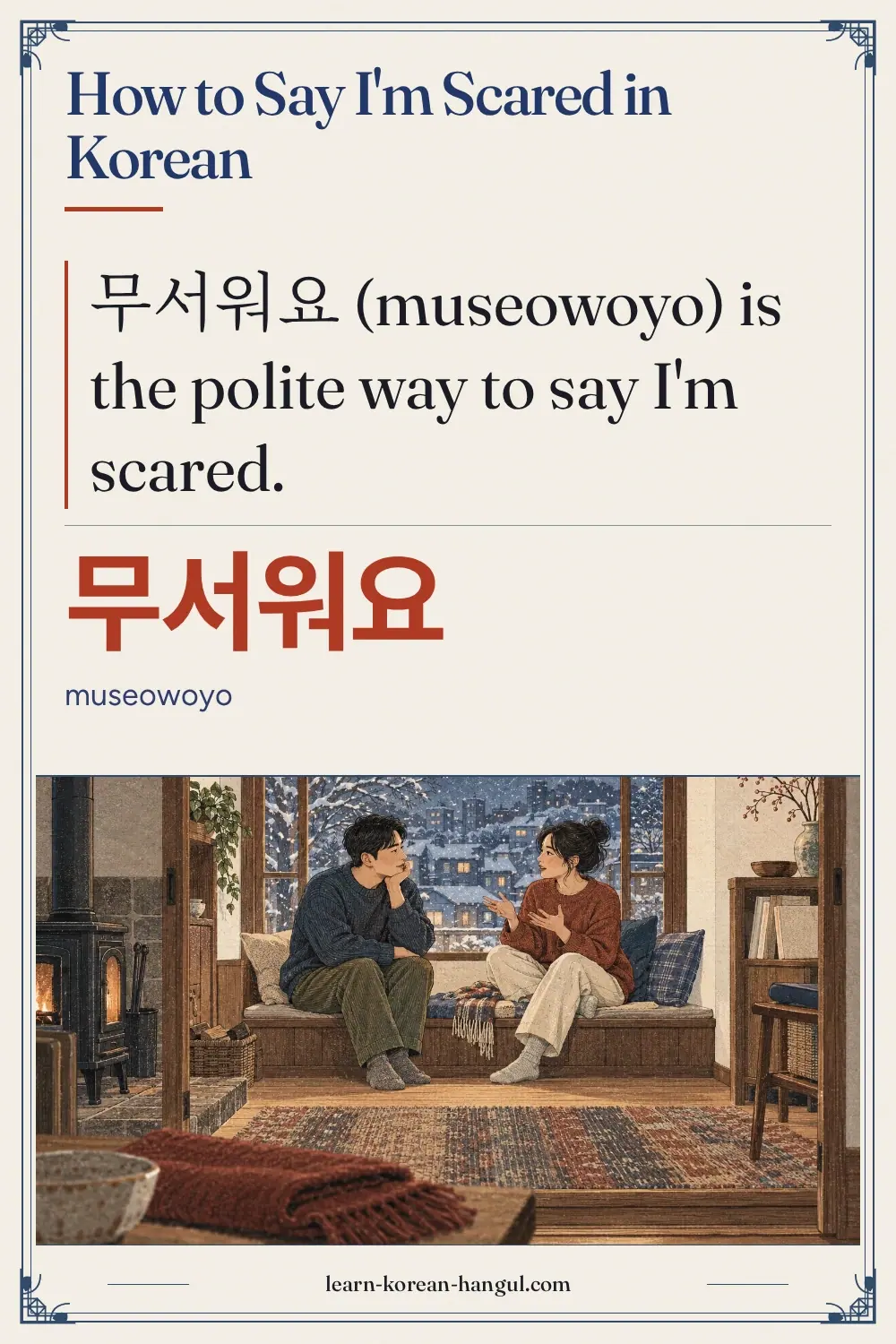
무서워요
무서워요
What you'll learn
- Say I'm scared with 무서워요, 무서워 or 무섭습니다, depending on the listener.
- Say what scares you with 가/이, and tell 무서워요 apart from 겁나요.
- Understand why 무섭- becomes 무서워-.
- Pronounce 무섭습니다 as [무섭씀니다] and 겁나요 as [검나요].
Before you start: you only need to read Hangul. If your fear is closer to worry, learn I'm nervous in Korean. Time: about 10 minutes. Audio plays only when you press a button.
How Do You Say I'm Scared in Korean?
The standard way to say I'm scared in Korean is 무서워요. The base word is the adjective 무섭다 (museopda), "to be frightening" or "to be scary". Because it describes a feeling in the speaker, 무서워요 also means "I'm scared". Korean usually drops "I", so one word is a whole sentence.
| Situation | Best form | Romanization | Why |
|---|---|---|---|
| Telling a colleague you are scared | 무서워요 | museowoyo | Polite, natural |
| Telling a close friend | 무서워 | museowo | Casual |
| A formal statement | 무섭습니다 | museopseumnida | Formal |
| Very scared | 너무 무서워요 | neomu museowoyo | So scared |
| Afraid of a risk or result | 겁나요 | geomnayo | Fear of what may happen |
The next section sorts these forms by listener.
What Are the Polite, Formal and Casual Ways to Say I'm Scared?
The stem 무섭- stays the same and the ending changes with the speech level. The whole system is in the guide to Korean speech levels.
Polite: 무서워요 (museowoyo)
Polite · 해요체무서워요 is the form to learn first. It suits family, colleagues and strangers. The past tense is 무서웠어요 (museowosseoyo), "I was scared".
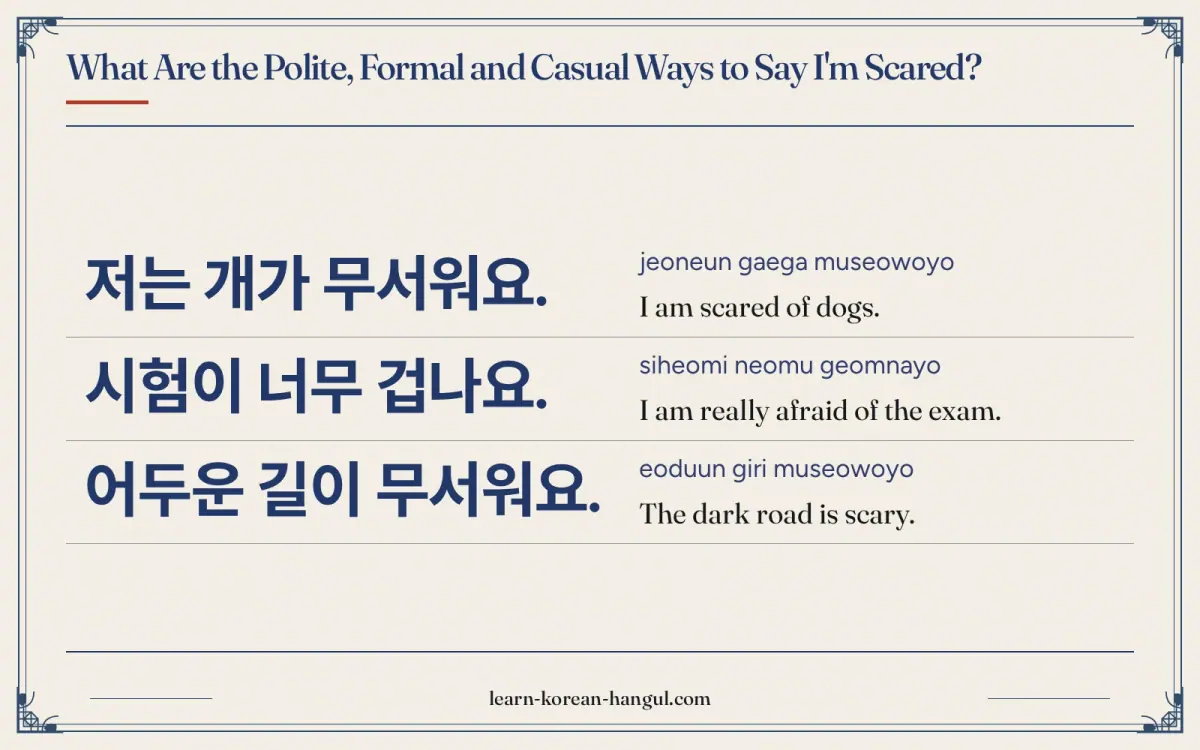
Korean also lets you name the thing that scares you. The feared thing takes 이 or 가, because in Korean it is the subject that "is scary":
저는 개가 무서워요.
jeoneun gaega museowoyo
I am scared of dogs.
Word for word, it says "as for me, dogs are scary". This pattern works with any noun: 높은 곳이 무서워요 (high places scare me).
Casual: 무서워 (museowo)
Casual · 반말무서워 drops 요. Use it with close friends, siblings and people younger than you. Said with a longer vowel, 무서워~, it can be playful.
Formal: 무섭습니다 (museopseumnida)
Formal · 합쇼체무섭습니다 is the formal form. It appears in announcements, news and speeches, and in daily life you will rarely need it. It is pronounced [무섭씀니다].
Afraid of a Risk: 겁나요 (geomnayo)
Polite · 해요체겁나요 comes from 겁 (fear) and 나다 (to come up), so it means "fear comes up in me". Use it when you dread what might happen: a hard test, a flight, a big decision. 무서워요 is for something that frightens you right now, such as a dark road, and 겁나요 looks ahead.
시험이 너무 겁나요.
siheomi neomu geomnayo
I am really afraid of the exam.
어두운 길이 무서워요.
eoduun giri museowoyo
The dark road is scary.
Behind these forms sits one grammar rule.
Why Does 무섭다 Become 무서워요?
무섭다 is a ㅂ-irregular adjective. When a vowel follows, the final ㅂ of the stem changes to 우, and 우 + 어 joins into 워. So 무섭 + 어요 becomes 무서워요. Before a consonant ending, the ㅂ stays, which gives the formal 무섭습니다.
- 무섭다 → 무서워요 (scary)
- 어렵다 → 어려워요 (difficult)
- 춥다 → 추워요 (cold)
- 쉽다 → 쉬워요 (easy)
Before the modifier ending -(으)ㄴ the same change gives 무서운, as in 무서운 영화 (a scary movie). Not every verb with a final ㅂ does this: 입다 (to wear) stays regular and becomes 입어요.
How Do You Pronounce 무서워요?
무서워요 is pronounced [무서워요], mu-seo-wo-yo, in four syllables. It sounds as it is written.
- 무 (mu): a short "moo".
- 서 (seo): ㅓ is unrounded, so relax your lips and do not round them as for "o".
- 워 (wo): a quick glide from "oo" to the vowel.
- 요 (yo): a short "yo".
Sound Changes to Listen For
These changes follow the National Institute of Korean Language standard pronunciation rules (표준 발음법):
- Tense after ㅂ. 무섭습니다 is [무섭씀니다]. The final ㅂ makes the next ㅅ tense (Article 23). The romanization museopseumnida does not show this, because it comes from a neighbouring sound. See Korean tensification.
- ㅂ before ㄴ becomes ㅁ. In the same word, the ㅂ of 습 is followed by ㄴ and turns into ㅁ (Article 18).
- ㅂ before ㄴ in 겁나요. It is [검나요]. See Korean nasalization.
With the sound clear, here is when each form fits.
When Should You Use 무서워요, and When Should You Not?
Use 무서워요 when something frightens you now. Use another word when the feeling is worry or nerves.
Situations Where It Fits
- A horror film. 이 영화 너무 무서워요 (this movie is so scary).
- A dark place. 불을 끄면 무서워요 (it is scary when I turn off the light).
- A fear you share. 저는 벌레가 무서워요 (I'm scared of bugs).
Situations to Avoid
- Before a test or a speech. The feeling is nerves, so say 긴장돼요.
- When you worry about someone. 걱정돼요 is the right word.
- Describing a person. Calling a person 무서워요 says they are scary to you, which can sound rude if they hear it.
Two short conversations show how it sounds.
What Does I'm Scared Sound Like in a Real Conversation?
In real life, the line is followed by comfort. Notice how the listener answers.
Choosing a Movie
Minho
호러 영화 볼래?
horeo yeonghwa bollae?
Do you want to watch a horror movie?
Yuna
싫어. 나 무서워.
sireo. na museowo
No. I get scared.
Minho
괜찮아, 같이 보면 안 무서워.
gwaenchana, gachi bomyeon an museowo
It's okay, it's not scary if we watch together.
What to notice: 안 무서워 is the casual "not scary", and the friend offers company as the cure.
At the Clinic
Patient
주사가 무서워요.
jusaga museowoyo
I'm scared of injections.
Nurse
괜찮아요. 금방 끝나요.
gwaenchanayo. geumbang kkeunnayo
It's okay. It ends quickly.
Patient
숨을 크게 쉴게요.
sumeul keuge swilgeyo
I'll take a deep breath.
What to notice: the patient names the feared thing with 가, and the polite level stays on both sides because they are strangers.
What Should You Know about the Culture behind I'm Scared?
Fear is a favourite entertainment in Korea. Horror films, haunted-house attractions and ghost stories are popular, and a classic summer tradition is the ghost-story special on TV and radio called 납량 특집 (namnyang teukjip, [남냥 특찝]). The idea is to cool off through a chill, which explains why many people go to a scary film on a hot night.
When a scene is truly frightening, Koreans say 소름 돋아요 (soreum dodayo), "I got goosebumps". The word for ghost is 귀신 (gwisin), and a person who gets scared easily is called 겁쟁이 (geopjaengi), a coward or scaredy-cat. Used on a friend, the word is teasing, so say it only to someone close.
An expert tip: in everyday talk, people often soften their fear with a joke. A friend who says 나 완전 쫄았어 (na wanjeon jjorasseo, I totally froze up) is using a casual slang verb, so keep it for friends.
What Mistakes Do Learners Make with I'm Scared in Korean?
Most mistakes come from the ㅂ-irregular stem and from using one word for fear, worry and nerves.
| Wrong | Why it is a problem | Correct |
|---|---|---|
| 무섭어요 | The ㅂ must change to 우 | 무서워요 |
| 무서우요 | The ending 어 is missing | 무서워요 |
| 무서워요 before an interview | Sounds like real fear | 긴장돼요 |
| 개를 무서워요 | The feared thing is the subject | 개가 무서워요 |
| [무섭숨니다] for the formal form | The ㅅ is tense and the ㅂ turns to ㅁ | [무섭씀니다] |
One more trap is the honorific. The ending -시- shows respect for the person you talk about, so 무서우세요? asks an older person "are you scared?" and is never used about yourself.
How Do You Ask Someone If They Are Scared?
Turn the words into a question. To a friend, say 무서워? (museowo?). To a colleague, say 무서워요? (museowoyo?) with a gentle rise, because this is a yes/no question. To an elder, use 무서우세요? (museouseyo?).
To ask what scares someone, use a question word: 뭐가 무서워요? (mwoga museowoyo?). The stress goes on 뭐, and the pitch falls or rises and falls at the end instead of rising sharply. A sharp rise can turn 뭐 into "something", which changes the meaning to "is something scary?".
Is It the Same as I Am Scared, Scared or Afraid?
Mostly yes. The short answers below cover the other searches folded into this page.
- I am scared in Korean: 무서워요 or the formal 무섭습니다.
- Scared in Korean: the adjective is 무섭다. Before a noun it becomes 무서운, as in 무서운 이야기 (a scary story).
- Afraid in Korean: 겁나요 for fear of a risk, or the more written 두려워요 (duryeowoyo) for deep dread. The conversational choice is almost always 무서워요.
Related Phrases to Learn Next
- When you are anxious rather than frightened, learn I'm nervous in Korean.
- In danger, you need help in Korean.
- To calm a scared friend, say don't worry in Korean.
Every phrase in this group lives in the Korean feelings phrases collection.
Practice: Say It Aloud
Play the slow clip of 무서워요 three times and keep your lips relaxed on 서. Then choose a phrase. Answers follow.
- You are texting a close friend about a horror movie.
- You tell a coworker politely that insects scare you.
- You are afraid of tomorrow's exam.
- You want to ask an older neighbour whether the dark scares them.
Answers
- 무서워.
- 저는 벌레가 무서워요.
- 시험이 겁나요.
- 어두운 게 무서우세요?
Drill these with the phrase flashcards. Saying i'm scared in Korean is easiest when you remember that the feared thing is the subject and the stem is ㅂ-irregular.
Frequently Asked Questions
How do you say I'm scared in Korean?
Say 무서워요 (museowoyo) in polite speech, 무서워 (museowo) to a close friend and 무섭습니다 (museopseumnida) in formal speech. Korean usually drops the word for I, so 무서워요 alone is a full sentence. To say what you fear, add the thing with 가 or 이, as in 개가 무서워요.
How do you pronounce 무서워요?
무서워요 has four even syllables, mu-seo-wo-yo, and is pronounced as it is written. The vowel in 서 is the unrounded ㅓ, so keep your lips relaxed, and 워 is a quick wo. The formal form 무섭습니다 is pronounced [무섭씀니다] because ㅅ becomes tense after ㅂ and ㅂ turns into ㅁ before ㄴ.
What is the difference between 무서워요 and 무서워?
They mean the same. 무서워요 has the polite ending 요 and suits colleagues, older friends and strangers. 무서워 drops 요 and is for close friends, siblings and younger people.
Is 무서워요 formal or casual?
무서워요 is polite, the everyday middle level. The most formal style is 무섭습니다, and casual speech is 무서워. The polite form is safe with almost any adult listener.
Can I use 무서워요 with friends, elders and strangers?
Yes. With friends use 무서워, with elders and strangers use 무서워요. If you ask an older person whether something frightens them, add the honorific: 무서우세요? (museouseyo?). Never use that honorific about yourself.
What is the most common mistake with I'm scared in Korean?
Learners write 무섭어요 instead of 무서워요, because the ㅂ in 무섭다 changes to 우 before 어. Another slip is using 무서워요 when you mean nervous or worried. For a test or a speech, 긴장돼요 or 걱정돼요 fits better.