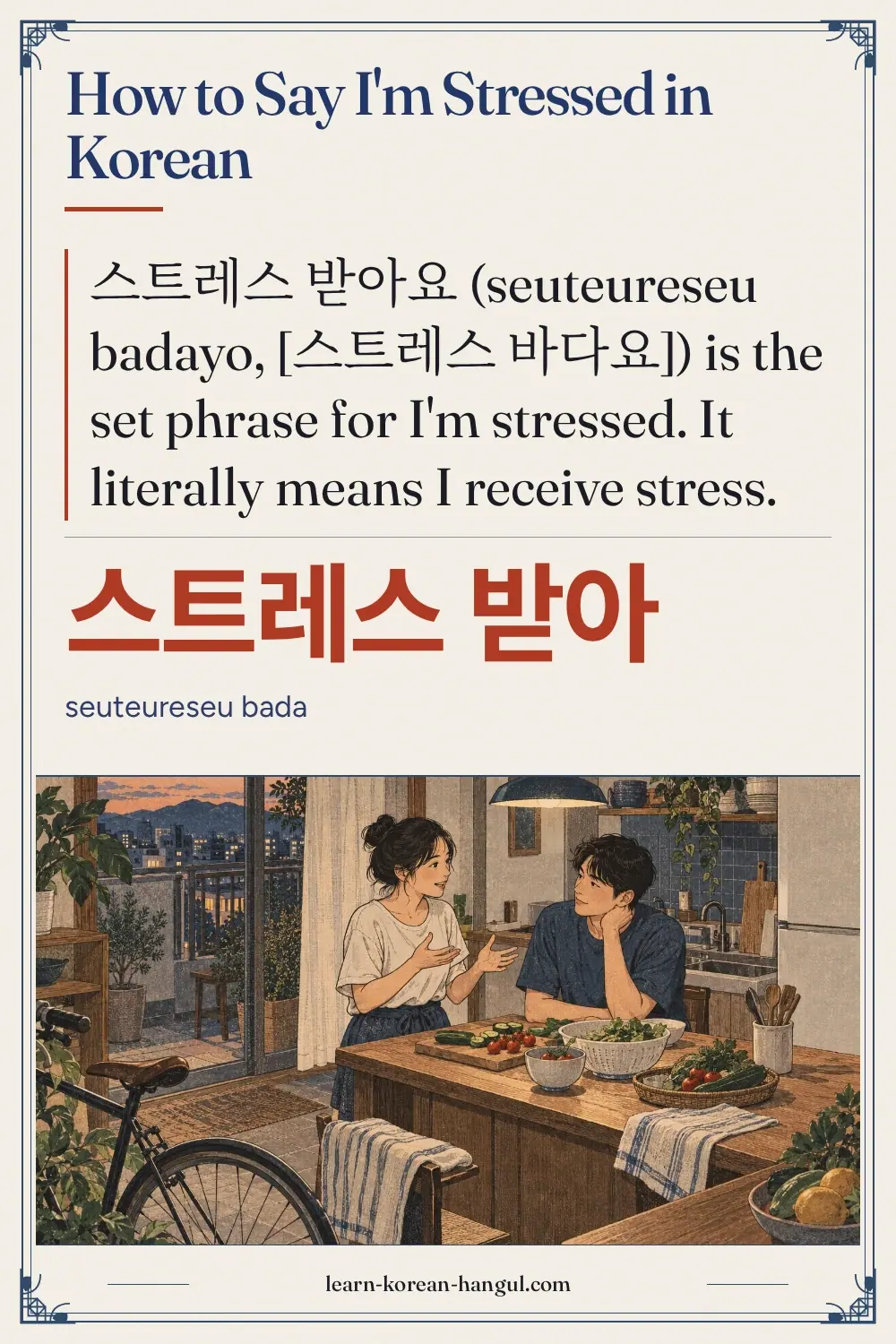
스트레스 받아요
스트레스 받아요
What you'll learn
- Say I'm stressed with 스트레스 받아요, and say stress is piling up with 스트레스 쌓여요.
- Describe a tangled head with 머리가 복잡해요.
- Avoid the common error 스트레스해요.
- Pronounce [스트레스 바다요], [스트레스 싸여요] and [머리가 복짜패요].
Before you start: you only need to read Hangul. When stress turns into exhaustion, learn I'm tired in Korean. Time: about 10 minutes. Audio plays only when you press a button.
How Do You Say I'm Stressed in Korean?
The standard way to say I'm stressed in Korean is 스트레스 받아요. Korean treats stress as something you receive, in the same way that you can receive a gift or a call. So the verb is 받다 (batda), and the noun stays 스트레스. Korean usually drops "I", so 스트레스 받아요 alone is a full sentence.
| Situation | Best form | Romanization | Why |
|---|---|---|---|
| Telling a colleague after a hard day | 스트레스 받아요 | seuteureseu badayo | Polite, natural |
| Telling a close friend | 스트레스 받아 | seuteureseu bada | Casual |
| Stress building for weeks | 스트레스 쌓여요 | seuteureseu ssayeoyo | Piling up |
| Mind full of worries | 머리가 복잡해요 | meoriga bokjapaeyo | Tangled head |
| Wanting relief | 스트레스 풀고 싶어요 | seuteureseu pulgo sipeoyo | I want to unwind |
The next section sorts these forms by situation.
What Are the Polite Ways to Say I'm Stressed?
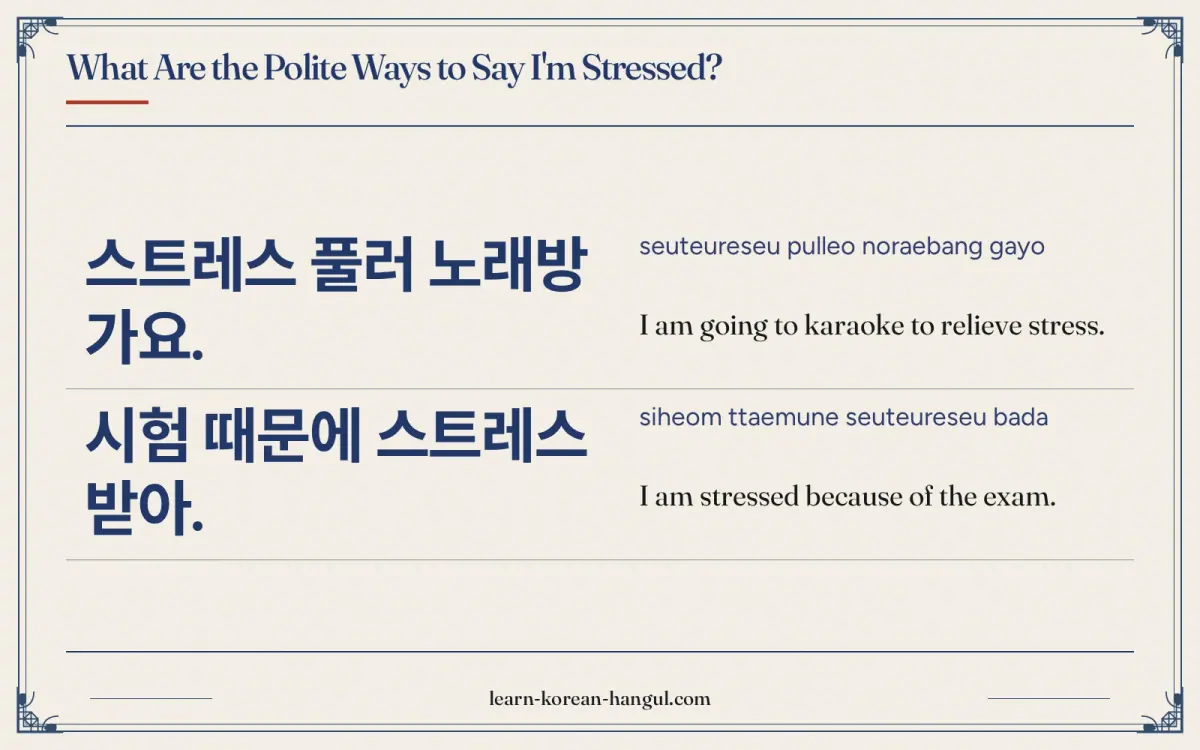
All the forms below are polite, and each one describes a different kind of stress. For the full system of levels, read the guide to Korean speech levels.
Polite: 스트레스 받아요 (seuteureseu badayo)
Polite · 해요체스트레스 받아요 is the form to learn first. It suits colleagues, classmates and friends, and it says that something around you is causing pressure. The past tense is 스트레스 받았어요 (seuteureseu badasseoyo), "I was stressed".
일이 너무 많아서 스트레스 받아요.
iri neomu manaseo seuteureseu badayo
I have too much work, so I am stressed.
Polite, Piled up: 스트레스 쌓여요 (seuteureseu ssayeoyo)
Polite · 해요체쌓이다 (ssaida) means "to be piled up". 스트레스 쌓여요 describes stress as a heap that keeps growing, so use it after weeks of overtime or exams. It is pronounced [스트레스 싸여요].
Polite, Tangled: 머리가 복잡해요 (meoriga bokjapaeyo)
Polite · 해요체복잡하다 (bokjapada) means "to be complicated". 머리가 복잡해요 is literally "my head is complicated", and it describes a mind full of tangled thoughts or decisions. It is quieter than 스트레스 받아요 and does not blame anyone. It is pronounced [머리가 복짜패요].
Polite, Wish: 스트레스 풀고 싶어요 (seuteureseu pulgo sipeoyo)
Polite · 해요체풀다 (pulda) means "to untie" or "to release", so 스트레스를 풀다 is to relieve stress. The ending -고 싶어요 means "I want to". Use it to suggest a break or a night out.
스트레스 풀러 노래방 가요.
seuteureseu pulleo noraebang gayo
I am going to karaoke to relieve stress.
Casual and Formal
Casual · 반말With close friends, drop the 요 and say 스트레스 받아. Use it with friends, siblings and people younger than you.
시험 때문에 스트레스 받아.
siheom ttaemune seuteureseu bada
I am stressed because of the exam.
The formal form is 스트레스를 받습니다, with the particle 를. It is rare in daily life and appears in reports and announcements. It is pronounced [스트레스를 받씀니다].
Behind these phrases sit a few sound rules.
How Do You Pronounce 스트레스 받아요?
스트레스 받아요 is pronounced [스트레스 바다요]. Count the syllables: 스트레스 has four (seu-teu-re-seu), and 받아요 has three (ba-da-yo), so there are seven in all.
- 스 (seu): the vowel ㅡ is unrounded, so keep your lips flat and spread.
- 트 (teu): the same flat vowel with a light t.
- 레 (re): a single tap of ㄹ and a clear "eh".
- 스 (seu): flat again.
- 받아요 (ba-da-yo): the final ㄷ-sound of 받 moves onto the vowel and sounds like ba-da-yo.
Sound Changes to Listen For
These changes follow the National Institute of Korean Language standard pronunciation rules (표준 발음법):
- Linking. 받아요 is [바다요], because a final consonant moves to the next vowel (Article 13).
- Silent ㅎ. 쌓여요 is [싸여요]. The final ㅎ of 쌓 is silent before a vowel (Article 12).
- Tense and aspirated sounds. 복잡해요 is [복짜패요]. The final ㄱ of 복 makes the ㅈ tense (Article 23), and the ㅂ meets the ㅎ and becomes ㅍ (Article 12). Romanization shows only the second change: bokjapaeyo. See Korean tensification and aspiration in Korean.
- Tense and nasal. 받습니다 is [받씀니다]: the ㅅ after ㄷ is tense (Article 23) and the ㅂ before ㄴ becomes ㅁ (Article 18).
With the sound clear, here is when each form fits.
When Should You Use 스트레스 받아요, and When Should You Not?
Use 스트레스 받아요 when you want to share pressure with someone friendly. Use a softer phrase when you only want to say that you are busy.
Situations Where It Fits
- After a hard day. 오늘 진짜 스트레스 받았어요 (I was really stressed today).
- During exam season. 시험 기간이라서 스트레스 쌓여요.
- Planning relief. 주말에 스트레스 풀고 싶어요.
Situations to Avoid
- Blaming a person to their face. 스트레스 받아요 can sound like "you are the cause". Say 요즘 좀 힘들어요 (yojeum jom himdeureoyo, things are a bit hard lately) instead.
- A first meeting with elders. Keep it light and wait for a closer relationship.
- When you only mean busy. If you are just occupied, learn I'm busy in Korean.
Two short conversations show how it sounds.
What Does I'm Stressed Sound Like in a Real Conversation?
In real life the line is followed by a plan. Notice the answers.
After a Hard Day at Work
Colleague
오늘 일이 너무 많아서 스트레스 받아요.
oneul iri neomu manaseo seuteureseu badayo
I have too much work today, so I'm stressed.
Team Leader
저도요. 맛있는 거 먹으러 갈까요?
jeodoyo. masinneun geo meogeureo galkkayo?
Me too. Shall we go and eat something good?
Colleague
좋아요.
joayo
Sure.
What to notice: 저도요 (me too) shows sympathy, and the team leader answers stress with food, a very common Korean response. The question ends with 갈까요?, which proposes a plan.
Friends before Exams
Dahye
시험 때문에 스트레스 받아.
siheom ttaemune seuteureseu bada
I'm stressed because of the exam.
Yejun
나도. 같이 노래방 갈래?
nado. gachi noraebang gallae?
Me too. Do you want to go to karaoke together?
Dahye
좋아! 스트레스 풀자.
joa! seuteureseu pulja
Sure! Let's blow off some steam.
What to notice: 풀자 is the casual "let's", from 풀다. 같이 is pronounced [가치].
What Should You Know about the Culture behind I'm Stressed?
Stress is a daily topic in Korean offices and schools, where long hours and exams are common. The phrase 스트레스 받다 is so common that it appears in everyday chat without much weight. A coworker who says 스트레스 받아요 is usually asking for company, not help.
Koreans have a long list of ways to relieve stress. A visit to a 노래방 (noraebang, a private karaoke room) is a classic, and so is eating something spicy: people often say 매운 거 먹으면 스트레스가 풀려요 (maeun geo meogeumyeon seuteureseuga pullyeoyo, spicy food relieves stress). A company dinner, 회식 (hoesik), is meant to bond a team, though for some it adds to the stress.
More recently the word 힐링 (hilling, from English "healing") is used for time spent resting, such as a trip or a quiet café. If a friend says 힐링하러 가자 (hillinghareo gaja, let's go to heal), they are suggesting a break.
An expert tip: you can show sympathy by replying 힘들겠어요 (himdeulgesseoyo, that must be hard) before offering any advice.
What Mistakes Do Learners Make with I'm Stressed in Korean?
Most mistakes come from using the wrong verb with 스트레스.
| Wrong | Why it is a problem | Correct |
|---|---|---|
| 스트레스해요 | 스트레스 is not a 하다 verb | 스트레스 받아요 |
| 스트레스 있어요 | Sounds like owning stress as an object | 스트레스 받아요 |
| 스트레스 먹어요 | Wrong verb: 먹다 means to eat | 스트레스 받아요 |
| 스트레스 쌓아요 | 쌓다 is transitive, "I pile it" | 스트레스 쌓여요 |
| Saying bat-a-yo with a hard ㄷ | The final consonant links to 아 | [스트레스 바다요] |
| 스트레스 받아 to a manager | Too casual | 스트레스 받아요 |
An honorific trap: the ending -시- shows respect for the person you talk about, so 스트레스 받으세요? asks an older person "are you stressed?". Never use it about yourself.
How Do You Ask Someone If They Are Stressed?
Turn the words into a question with a rise, because this is a yes/no question. To a friend, say 스트레스 받아? (seuteureseu bada?). To a colleague, say 스트레스 받아요? (seuteureseu badayo?). To an elder, say 스트레스 받으세요? (seuteureseu badeuseyo?).
To ask what is causing it, use a question word: 뭐 때문에 스트레스 받아요? (mwo ttaemune seuteureseu badayo?). The stress goes on 뭐, and the pitch falls or rises and falls, not a sharp rise. A sharp rise would turn 뭐 into "something", and the question would sound like "are you stressed about something?".
Is It the Same as I Am Stressed, Stressed or Stress?
Mostly yes. The short answers below cover the other searches folded into this page.
- I am stressed in Korean: 스트레스 받아요.
- Stressed in Korean: as a state, 스트레스 받아요 or 스트레스 쌓여요. Before a noun, use 스트레스 받는 (seuteureseu banneun, [스트레스 반는]), as in 스트레스 받는 일 (stressful work).
- Stress in Korean: the noun is 스트레스 (seuteureseu), from English. Stress relief is 스트레스 해소 (seuteureseu haeso).
- Stressful in Korean: 스트레스 받는 일 (a stressful job) or 힘든 (himdeun, hard).
Related Phrases to Learn Next
- After stress comes tiredness, so learn I'm tired in Korean.
- To comfort a stressed friend, say cheer up in Korean.
- If the cause is simply a full schedule, see I'm busy in Korean.
Every phrase in this group lives in the Korean feelings phrases collection.
Practice: Say It Aloud
Play the slow clip of 스트레스 받아요 three times and link the ㄷ into 아. Then choose a phrase. Answers follow.
- You tell a close friend that exams are stressing you.
- You tell a coworker politely after a hard day.
- You say stress has been piling up for weeks.
- You suggest going to karaoke to relieve stress.
Answers
- 시험 때문에 스트레스 받아.
- 스트레스 받아요.
- 스트레스 쌓여요.
- 스트레스 풀러 노래방 가요.
Drill these with the phrase flashcards. Saying i'm stressed in Korean is easier when you remember that the verb is 받다 and that stress can "pile up".
Frequently Asked Questions
How do you say I'm stressed in Korean?
Say 스트레스 받아요 (seuteureseu badayo) in polite speech and 스트레스 받아 (seuteureseu bada) to a close friend. The verb is 받다 (to receive), so the phrase literally means I'm receiving stress. You can add the particle 를, as in 스트레스를 받아요, with the same meaning.
How do you pronounce 스트레스 받아요?
스트레스 받아요 is pronounced [스트레스 바다요]. The final ㄷ-sound of 받 links to the vowel of 아, so you hear ba-da-yo. The vowels ㅡ in 스 and 트 are unrounded, so keep your lips flat, and the loanword has four syllables: seu-teu-re-seu.
What is the difference between 스트레스 받아요 and 스트레스 쌓여요?
스트레스 받아요 says that something is stressing you now or today. 스트레스 쌓여요 says that stress is piling up over time, like a heap that keeps growing. Both are polite. Use the second one after weeks of overtime or exams.
Can I use 스트레스 받아요 with friends, elders and strangers?
Yes. With friends use 스트레스 받아, and with elders or strangers use 스트레스 받아요. To ask an older person whether they feel stress, use the honorific 스트레스 받으세요? (seuteureseu badeuseyo?), and never use the honorific about yourself.
Is it 스트레스 받아요 or 스트레스를 받아요?
Both are correct and mean the same. Korean often drops the object particle 를 in speech, so 스트레스 받아요 is the more common form. The particle makes the sentence a little fuller or more careful, for example in writing.
What is the most common mistake with I'm stressed in Korean?
Learners say 스트레스해요, as if stress were a 하다 verb. The correct patterns are 스트레스를 받아요 or 스트레스가 쌓여요. Another slip is 스트레스 있어요, which sounds like owning stress as an object, and 스트레스 먹어요, which uses the wrong verb.