맵지 않게 해 주세요
맵지 않게 해 주세요
What you'll learn
- Ask for a mild dish with 맵지 않게 해 주세요 or the shorter 안 맵게 해 주세요.
- Ask for "a little less" with 덜 맵게 해 주세요 when a dish cannot be fully mild.
- Say 너무 매워요 when the food is already too hot.
- Hear the tense ㅈ in 맵지 and the ㅋ sound in 않게.
Before you start: you should be able to read Hangul and know 주세요 ("please give me"). The pages on water please in Korean and delicious in Korean make a good warm-up. Time: about 10 minutes. Audio plays only when you press a button.
Key facts
- 맵지 않게 해 주세요 (maepji anke hae juseyo) means "please make it not spicy" and is polite.
- 안 맵게 해 주세요 (an maepge hae juseyo) is the shorter spoken version.
- 덜 맵게 해 주세요 (deol maepge hae juseyo) means "a little less spicy, please".
- 너무 매워요 (neomu maewoyo) means "it is too spicy".
- Ask when you order, because the heat is usually part of the recipe.
How Do You Say Not Spicy Please in Korean?
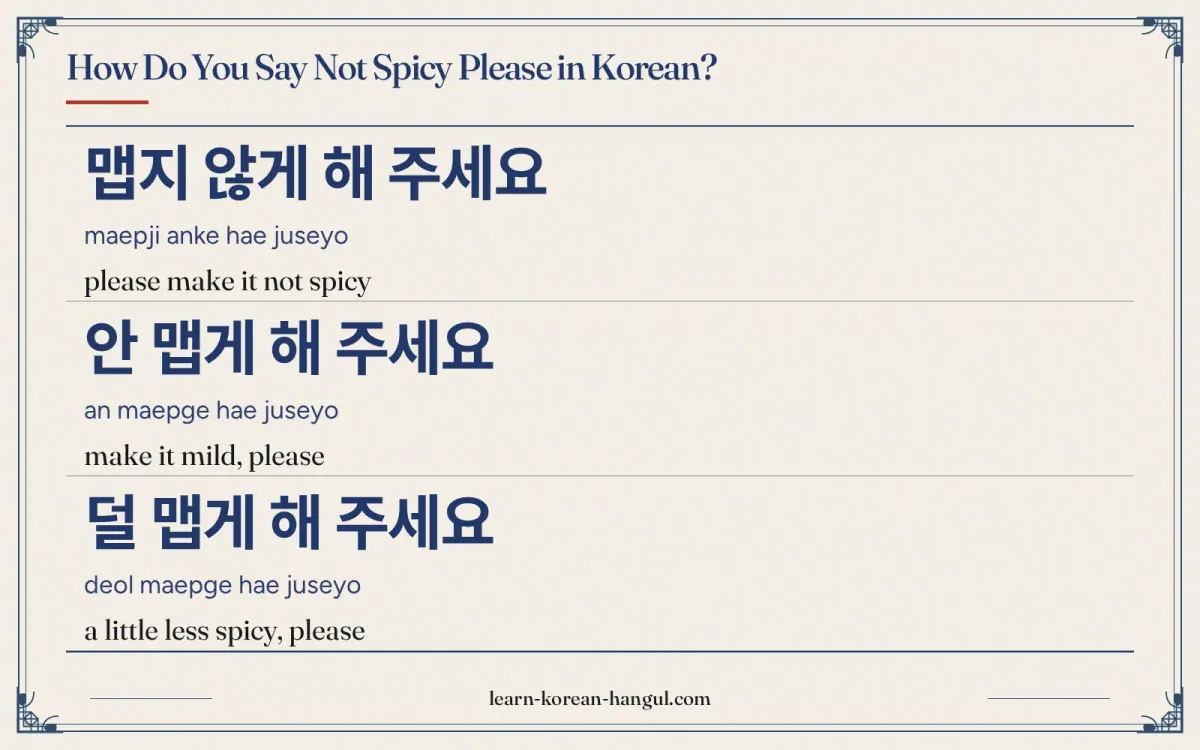
The standard answer is 맵지 않게 해 주세요. It is built from four small parts, and each one is useful on its own:
- 맵다 (maepda) is the adjective "to be spicy". Adding -지 않다 makes the negative "is not spicy": 맵지 않다.
- -게 turns that into an adverb: 맵지 않게 means "so that it is not spicy".
- 해 is the casual form of 하다 "to do", so 해 주다 means "to do something for someone".
- 주세요 is the polite request, "please".
Put together, the sentence says "please do it so that it is not spicy". The table lists the forms you will meet on this page.
| Korean | Romanization | Meaning | Style |
|---|---|---|---|
| 맵지 않게 해 주세요 | maepji anke hae juseyo | please make it not spicy | polite |
| 안 맵게 해 주세요 | an maepge hae juseyo | make it mild, please | polite |
| 덜 맵게 해 주세요 | deol maepge hae juseyo | a little less spicy, please | polite |
| 하나도 안 맵게 해 주세요 | hanado an maepge hae juseyo | not spicy at all, please | polite, firm |
| 너무 매워요 | neomu maewoyo | it is too spicy | polite statement |
| 맵지 않게 해 줘 | maepji anke hae jwo | make it not spicy (to a friend) | casual |
Notice that the adjective changes shape. 맵다 is a ㅂ-irregular adjective, so 맵 + 어요 becomes 매워요 (maewoyo), and the form before a noun is 매운 (maeun), as in 매운 음식 (maeun eumsik, "spicy food"). Before -지 and -게 it keeps the plain stem 맵, which is why 맵지 and 맵게 look regular.
What Are the Polite Ways to Say Not Spicy Please?
All the restaurant forms below end in 요 or 세요, so they are polite. The choice between them is mostly about how strongly you want the change and how the kitchen works.
Polite: 맵지 않게 해 주세요 (maepji anke hae juseyo)
Polite · 해요체This is the safest full sentence. Say the dish first, then this request. If you point at the menu, you can say only the request.
순두부찌개 하나 주세요. 맵지 않게 해 주세요.
sundubujjigae hana juseyo. maepji anke hae juseyo
One soft tofu stew, please. Please make it not spicy.
Polite: 안 맵게 해 주세요 (an maepge hae juseyo)
Polite · 해요체안 is the short negative word "not", placed before the adjective. The meaning is the same as the longer form, and it is what many people say at a busy counter.
Polite: 덜 맵게 해 주세요 (deol maepge hae juseyo)
Polite · 해요체덜 means "less". This request is humbler, because you ask for a reduction and not for no heat at all. A cook can usually do this, even for a dish built on chili paste.
Polite Statement: 너무 매워요 (neomu maewoyo)
Polite · 해요체너무 means "too" or "very much", and 매워요 is the polite form of 맵다. Use this after you taste the dish. It is a comment, not a request, so follow it with a request such as water or rice.
너무 매워요. 물 좀 주세요.
neomu maewoyo. mul jom juseyo
It is too spicy. Some water, please.
Casual: 맵지 않게 해 줘 (maepji anke hae jwo)
Casual · 반말With a close friend or a family member who is cooking, drop 세요 for the casual 줘. The guide to Korean speech levels explains why the ending changes. In a restaurant, stay with 주세요. Next, the sounds.
How Do You Pronounce 맵지 않게 해 주세요?
맵지 않게 해 주세요 has eight syllables (맵, 지, 않, 게, 해, 주, 세, 요). Spoken at normal speed it sounds like [맵찌 안케 해 주세요], which is also eight syllables.
Two sound changes shape the phrase, following the National Institute of Korean Language Standard Pronunciation rules (표준 발음법):
- 맵지 is [맵찌]. After a final ㅂ, the ㅈ becomes tense (Article 23). Revised Romanization does not mark tensing that comes from a neighbouring sound, so it still writes maepji.
- 않게 is [안케]. The final ㅎ of 않 (written ㄶ) joins the ㄱ of 게 and makes the aspirated sound ㅋ (Article 12). The ㅎ before ㄱ is not pronounced separately. Revised Romanization shows this as anke.
Another form follows the same tensing rule: 맵게 is [맵께], so 안 맵게 sounds like [안 맵께] and 덜 맵게 like [덜 맵께]. The vowel in 맵 and in 매워요 is ㅐ, which most Seoul speakers pronounce like the ㅔ in 게. The ㅓ in 너무 is an unrounded vowel, so keep your lips relaxed and do not round them as for "o".
매워요 is pronounced as it is written: mae-wo-yo, three syllables. Do not turn the ㅝ into a long "oo".
Now that you can say it, the next question is when to use it.
When Should You Use 맵지 않게 해 주세요, and When Should You Not?
Use it at the moment you order. Many Korean dishes are cooked with the heat already built in, such as chili paste in a stew base, so a request after the dish arrives usually comes too late.
Situations Where It Fits
- Ordering a stew or a stir-fry. Name the dish, then add the request.
- Eating with a child or a guest who dislikes chili. Ask for 덜 맵게 for the whole table.
- Ordering delivery. Many ordering apps have a note field where you can type 맵지 않게 해 주세요.
- Asking staff about a dish. Try 이거 많이 매워요? (igeo mani maewoyo, "Is this very spicy?"), which is a yes/no question and rises at the end.
Situations to Avoid
- Dishes that are spicy by definition. A request for a mild version of some chili-based dishes may only reduce the heat a little. Ask 덜 맵게 instead of a full "not spicy".
- Pointing out heat after you have eaten. Use 너무 매워요 and ask for water, not a remake.
- Using 안 매워요 as a request. It says the dish is not spicy, which is a different message.
What Does Not Spicy Please Sound Like in a Real Conversation?
Real orders are short. The waiter often asks a spice-level question, and the customer answers with one of the forms above. Listen for the polite 요 endings in both parts.
Ordering a Stew
Waiter
주문하시겠어요?
jumunhasigesseoyo
Would you like to order?
Guest
김치찌개 하나 주세요. 맵지 않게 해 주세요.
gimchijjigae hana juseyo. maepji anke hae juseyo
One kimchi stew, please. Please make it not spicy.
Waiter
네, 조금 순하게 해 드릴게요.
ne, jogeum sunhage hae deurilgeyo
Yes, I will make it a bit mild.
What to notice: the waiter says 순하게 (sunhage), which means "mildly", and 드릴게요 is the humble "I will do it for you". The kitchen may say "a bit mild" because a full removal of chili would change the dish.
Checking and Adjusting
Guest
이거 많이 매워요?
igeo mani maewoyo
Is this very spicy?
Waiter
조금 매워요. 덜 맵게 해 드릴까요?
jogeum maewoyo. deol maepge hae deurilkkayo
It is a little spicy. Shall I make it less spicy?
Guest
네, 덜 맵게 해 주세요.
ne, deol maepge hae juseyo
Yes, please make it less spicy.
What to notice: the waiter's 드릴까요 means "shall I do it for you?" The guest echoes the waiter's word 덜 맵게, which is a natural way to confirm.
What Should You Know about the Culture behind Not Spicy Please?
Spice is a normal part of Korean cooking, but a lot of Korean food is not hot at all. A waiter will not be offended by your request, and asking is better than leaving a dish untouched.
- Heat is part of the recipe. In a stew, the red colour often comes from chili flakes or paste added at the start. That is why you ask before cooking.
- Some dishes are mild by nature. Soups such as 설렁탕 (seolleongtang, ox-bone soup) and 갈비탕 (galbitang, short-rib soup) are not made with chili, and 불고기 (bulgogi) is sweet and savoury.
- Menus may help. Some restaurants mark spicy dishes with a chili icon, so look for it before you ask.
- Side dishes are often spicy. Kimchi and several 반찬 (banchan, small side dishes) carry chili, even when the main dish does not.
- Asking again is fine. If the answer is unclear, repeat with 덜 맵게 해 주세요.
An expert tip: if you cannot eat chili for a health reason, say so with a separate sentence such as 매운 음식을 못 먹어요 (maeun eumsigeul mot meogeoyo, "I cannot eat spicy food"), because 못 먹어요 sounds like [몬머거요] and tells the staff it is a limit, not a taste.
What Mistakes Do Learners Make with Not Spicy Please in Korean?
Most mistakes mix up a description with a request or leave out the word 해 주세요.
| Mistake | Why it is a problem | Fix |
|---|---|---|
| 안 매워요 to ask for a change | It says "it is not spicy" | 안 맵게 해 주세요 |
| 맵지 않게 주세요 | The word 해 is missing, so the sentence reads "give it not spicy" | 맵지 않게 해 주세요 |
| Saying only 안 매운 | It is an unfinished phrase | 안 매운 걸로 주세요 (the not-spicy one, please) |
| Asking after the dish arrives | The cook cannot change the base | Ask when ordering |
| Reading 맵지 as [맵지] | It sounds like [맵찌] | Make the ㅈ tense |
The first mistake is the most common. Korean has two different jobs: 안 매워요 describes, while 안 맵게 해 주세요 asks. A third option, 안 매운 걸로 주세요, means "the one that is not spicy, please" and is useful when a menu offers two versions.
Is It the Same as No Spicy?
Close, but Korean needs a full phrase. English "no spicy" has no direct short form, so the related searches map to the forms you now know.
- No spicy in Korean: 맵지 않게 해 주세요, or 하나도 안 맵게 해 주세요 for "not spicy at all".
- Mild please in Korean: 순하게 해 주세요 (sunhage hae juseyo), using 순하다 "to be mild".
- Less spicy in Korean: 덜 맵게 해 주세요.
- Too spicy in Korean: 너무 매워요.
- Spicy food in Korean: 매운 음식 (maeun eumsik).
Also note 고추 빼 주세요 (gochu ppae juseyo, "please leave out the chili") for a dish where a fresh chili sits on top, and use it only for visible chili.
Related Phrases to Learn Next
Food requests come in sets, so learn these in the same visit:
- I'm vegetarian in Korean: a request about ingredients.
- I have an allergy in Korean: the serious version of a food request.
- Delicious in Korean: the happy comment at the end.
- Water please in Korean: what you will ask for after a hot bite.
This guide belongs to the Korean restaurant phrases collection. What this page does not cover: the full list of Korean dishes and their heat levels, which depends on the restaurant, and allergy wording, which has its own page.
Practice: Say It Aloud
Play the slow clip of 맵지 않게 해 주세요 and repeat it three times, listening for the tense [찌] and the [케].
Then choose the right phrase for each situation. Answers follow.
- You are ordering a stew and want it mild.
- You have tasted the soup and it burns.
- The waiter offers a milder version and you want to confirm.
- A friend is cooking for you and you want it gentle.
Answers
- 맵지 않게 해 주세요, or 안 맵게 해 주세요.
- 너무 매워요. 물 좀 주세요.
- 네, 덜 맵게 해 주세요.
- 맵지 않게 해 줘.
The phrase flashcards drill these requests with audio. Say 맵지 않게 해 주세요 at the start of the order, and you can say not spicy please in Korean with confidence.
Frequently Asked Questions
How do you say not spicy please in Korean?
맵지 않게 해 주세요 (maepji anke hae juseyo) is the standard polite way to say not spicy please in Korean. It literally means "please make it so that it is not spicy". Say it right after you name the dish, and add 덜 for "less" if a fully mild version is not possible.
How do you pronounce 맵지 않게 해 주세요?
It sounds like [맵찌 안케 해 주세요]. The ㅈ in 맵지 turns tense after the final ㅂ, and the ㅎ in 않 joins the following ㄱ to make a ㅋ sound. Revised Romanization writes maepji anke hae juseyo, so it shows the ㅋ but not the tense ㅈ.
What is the difference between 맵지 않게 해 주세요 and 안 맵게 해 주세요?
Both mean "make it not spicy" and both are polite. 맵지 않게 is the longer, slightly more careful form. 안 맵게 uses the short negative 안 and is more common in quick spoken orders. Staff understand both, so choose whichever you can say more smoothly.
Can I use 맵지 않게 해 주세요 with friends, elders and strangers?
Yes for elders and strangers, because 주세요 is polite. With close friends who are cooking for you, drop to the casual 맵지 않게 해 줘 (maepji anke hae jwo). Very formal 해 주십시오 is rare in restaurants, so you rarely need it.
What is the most common mistake with not spicy please in Korean?
Learners say 안 매워요, which means "it is not spicy" and does not ask for a change. Use 안 맵게 해 주세요 (make it not spicy) when you want the kitchen to change something, and use 안 매워요 only to describe food you have already tasted.