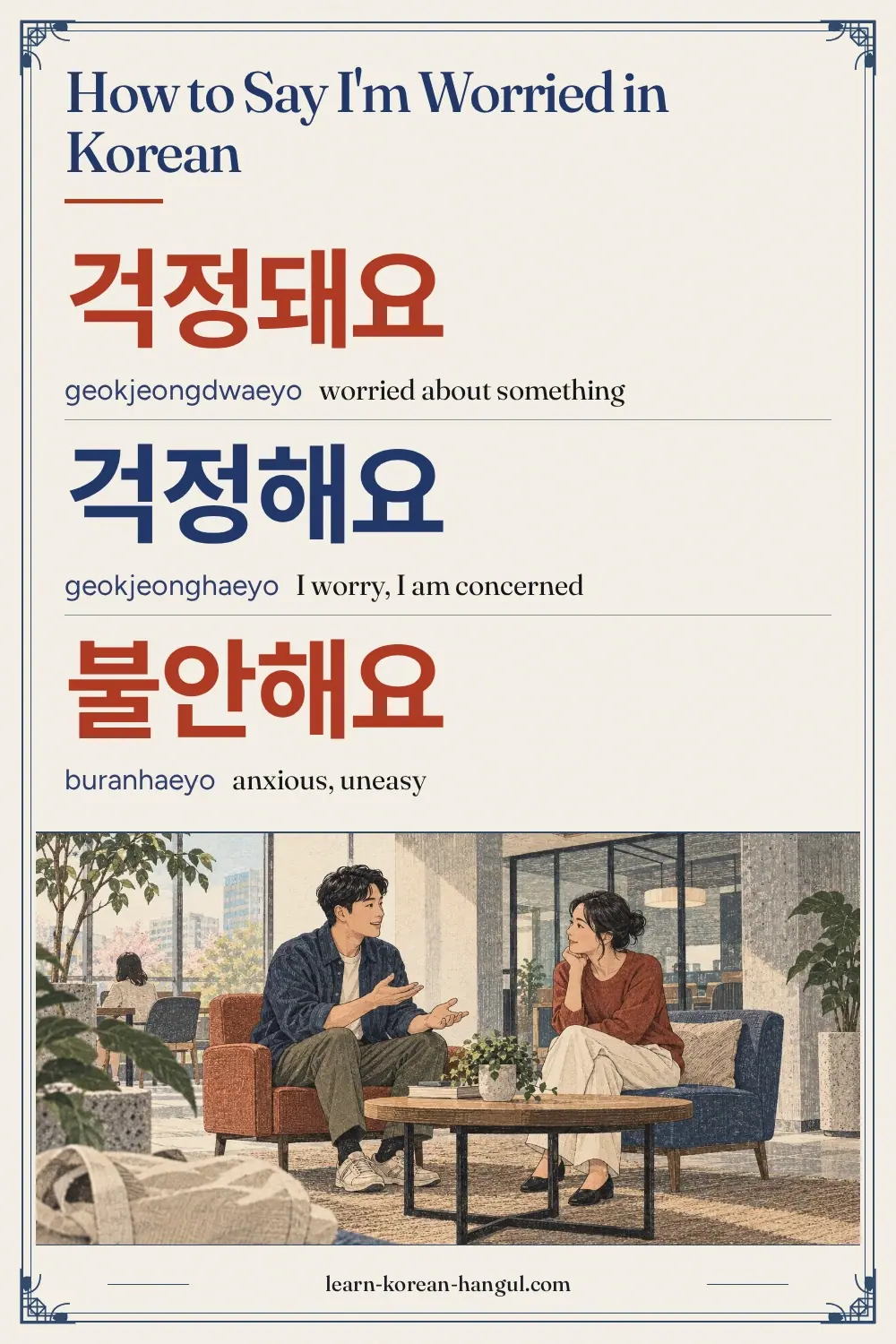
걱정돼요
걱정돼요
What you'll learn
- Say I'm worried with 걱정돼요, 걱정됩니다 or 걱정돼, depending on the listener.
- Name the cause of the worry and ask others if they are worried.
- Tell 걱정돼요 apart from 걱정해요, 걱정이에요 and 불안해요.
- Spell 돼요 correctly and pronounce 걱정 as [걱쩡].
Before you start: you only need to read Hangul. When you want to comfort someone, learn don't worry in Korean. Time: about 10 minutes. Audio plays only when you press a button.
How Do You Say I'm Worried in Korean?
The standard way to say I'm worried in Korean is 걱정돼요. The noun 걱정 means worry or concern. The verb 되다 means "to become", so literally the sentence is "worry becomes". Korean prefers this wording for feelings you cannot control. Korean usually drops "I", so 걱정돼요 alone is a full sentence, and you can put the cause in front of it with the particle 이/가.
| Situation | Best form | Romanization | Why |
|---|---|---|---|
| Telling a colleague or teacher | 걱정돼요 | geokjeongdwaeyo | Polite, natural |
| Telling a close friend | 걱정돼 | geokjeongdwae | Casual |
| A formal statement | 걱정됩니다 | geokjeongdoemnida | Formal |
| Naming the cause | 시험이 걱정돼요 | siheomi geokjeongdwaeyo | Cause + feeling |
| Describing a worry | 걱정이에요 | geokjeongieyo | It is a worry |
The next section sorts the forms by level.
What Are the Formal, Polite and Casual Ways to Say I'm Worried?
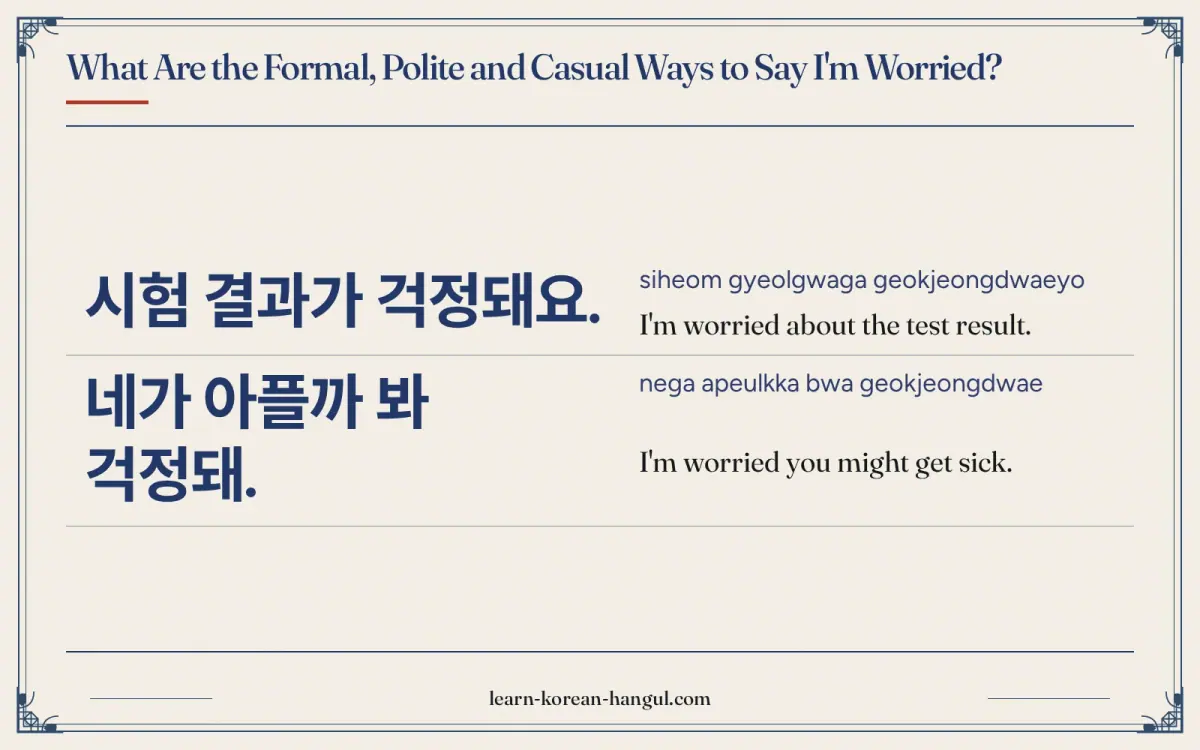
The forms follow the Korean speech levels, explained in the guide to Korean speech levels. The stem 걱정되- stays the same, and only the ending changes.
Polite: 걱정돼요 (geokjeongdwaeyo)
Polite · 해요체걱정돼요 is the form to learn first. It suits colleagues, teachers and strangers. It is soft and honest without being dramatic. The cause usually comes first.
시험 결과가 걱정돼요.
siheom gyeolgwaga geokjeongdwaeyo
I'm worried about the test result.
The particle 가 marks 결과 (result) as the thing that causes the worry. Korean often uses 이/가 with feelings in this way.
Casual: 걱정돼 (geokjeongdwae)
Casual · 반말걱정돼 drops the polite 요. Use it with close friends, siblings and children. It often carries the pattern -ㄹ까 봐 (-lkka bwa), which means "in case" or "I fear that".
네가 아플까 봐 걱정돼.
nega apeulkka bwa geokjeongdwae
I'm worried you might get sick.
The stem of 아프다 drops its ㅡ before an ending that starts with a vowel and keeps it here before ㄹ, so 아플까 is correct.
Formal: 걱정됩니다 (geokjeongdoemnida)
Formal · 합쇼체걱정됩니다 is the formal form. It appears in news, speeches and business writing, as in 안전이 걱정됩니다 (safety is a concern). It is pronounced [걱쩡됨니다]. Here the stem 되- stays 되, because the ending -ㅂ니다 does not start with a vowel.
Describing: 걱정이에요 (geokjeongieyo)
Polite · 해요체걱정이에요 means "it is a worry" or "I'm worried". It is a statement about the situation, as in 요즘 건강이 걱정이에요 (lately my health is a worry). It sounds more settled than 걱정돼요, which feels like a worry that has just come up.
Active: 걱정해요 (geokjeonghaeyo)
Polite · 해요체걱정해요 uses 하다 (to do), so it says you are actively worrying. Parents and friends use it about other people. The honorific form 걱정하세요 describes what an older person does.
제가 늦으면 부모님이 걱정하세요.
jega neujeumyeon bumonimi geokjeonghaseyo
If I am late, my parents worry.
The honorific -세요 shows respect for 부모님 (parents). Now the pronunciation.
How Do You Pronounce 걱정돼요?
걱정돼요 is pronounced [걱쩡돼요], geok-jeong-dwae-yo, in four syllables. The only surprise is the tense ㅈ in 걱정.
- 걱 (geok): a short "guhk" that stops in the throat.
- 정 (jeong): spoken tense, like "jjung", with no puff of air.
- 돼 (dwae): "dweh".
- 요 (yo): "yo".
Sound Changes to Listen For
These changes follow the National Institute of Korean Language standard pronunciation rules (표준 발음법):
- Tense after ㄱ. 걱정 is [걱쩡]: the ㄱ at the end of 걱 makes the ㅈ tense (Article 23). See Korean tensification.
- ㅂ before ㄴ becomes ㅁ. 걱정됩니다 is [걱쩡됨니다] (Article 18). See Korean nasalization.
- No liaison for ㅇ. In 걱정이에요, the final ㅇ of 정 stays in place and does not move to 이, so it is [걱쩡이에요].
Revised Romanization writes geokjeong and does not show the tensing, because the tensing comes from a sound change. With the sound clear, here is how to spell it.
Why Is It 돼요 and Not 되요?
The stem 되- ends in the vowel ㅚ. Before the ending -어요, it contracts: 되 + 어요 → 돼요. So 돼 is short for 되어. The spelling 되요 is a common mistake, even among Koreans.
- Quick test. Replace the word with 하다. If 해요 fits, write 돼요, as in 걱정해요 / 걱정돼요.
- Before a consonant. The stem stays 되: 걱정되고 (and worried), 걱정됩니다.
- Common pairs. 안 돼요 (it's not allowed), 잘돼요 (it goes well; 잘되다 is one word), 준비돼요 (it gets ready).
The past tense follows the same logic: 걱정됐어요 (geokjeongdwaesseoyo) means "I was worried", pronounced [걱쩡돼써요].
When Should You Use 걱정돼요, and When Should You Not?
Use 걱정돼요 to share a real concern, to ask for help, or to show care. Do not use it for a small matter, because Korean listeners will take it seriously.
Situations Where It Fits
- Before an exam or an interview. 내일 면접이 걱정돼요. (I'm worried about tomorrow's interview.)
- Caring about someone. 요즘 힘들어 보여서 걱정돼요. (You've seemed to be having a hard time lately, so I'm worried.)
- Work. 일정이 늦어질까 봐 걱정돼요. (I'm worried the schedule will slip.)
Situations to Avoid
- Light chat. For a tiny concern, say 좀 신경 쓰여요 (jom singyeong sseuyeoyo, it bothers me a little).
- Bad news to an elder. Sound calm first, then explain.
- As a command. To tell someone not to worry, use 걱정하지 마세요, not 걱정돼요.
Two short conversations show how it sounds.
What Does I'm Worried Sound Like in a Real Conversation?
In real life, the line is followed by comfort or an offer of help.
Friends before an Interview
Minsu
왜 그래? 무슨 일 있어?
wae geurae? museun il isseo
What's wrong? Is something up?
Hana
내일 면접이야. 너무 걱정돼.
naeil myeonjeobiya. neomu geokjeongdwae
I have an interview tomorrow. I'm so worried.
Minsu
잘할 거야. 걱정하지 마.
jalhal geoya. geokjeonghaji ma
You'll do well. Don't worry.
What to notice: 잘할 거야 is pronounced [잘할꺼야], and Minsu uses the negative command -지 마 to comfort Hana.
Colleagues before a Presentation
Senior
발표 준비는 잘돼요?
balpyo junbineun jaldwaeyo
Is the presentation preparation going well?
Junior
사실 좀 걱정돼요. 자료가 아직 부족해요.
sasil jom geokjeongdwaeyo. jaryoga ajik bujokaeyo
Honestly, I'm a bit worried. The material is still lacking.
Senior
같이 봐 줄게요.
gachi bwa julgeyo
I'll look at it with you.
What to notice: the junior says 사실 (honestly) and 좀 (a bit) to soften the worry. The offer 봐 줄게요 is pronounced [봐줄께요], and 부족해요 is pronounced [부조캐요].
How Is 걱정돼요 Different from 불안해요 and 긴장돼요?
English "worried" covers several feelings. Korean separates them.
| Korean | Romanization | Meaning | Use it when |
|---|---|---|---|
| 걱정돼요 | geokjeongdwaeyo | worried about something | You can name the cause |
| 걱정이에요 | geokjeongieyo | it is a worry | Describing a lasting concern |
| 걱정해요 | geokjeonghaeyo | I worry, I am concerned | Worrying about someone |
| 불안해요 | buranhaeyo | anxious, uneasy | A vague, heavy feeling |
| 긴장돼요 | ginjangdwaeyo | nervous, tense | Before a test or a stage |
The word 불안 (buran) has no clear cause, while 걱정 usually points to one. For the feeling before a performance, see I'm nervous in Korean.
What Should You Know about the Culture behind I'm Worried?
In Korean, worry is often an act of care. Saying 걱정돼요 to a friend or a family member tells them that they matter to you. Parents show love by asking if you ate and slept well, and the short phone call 걱정돼서 전화했어요 (I called because I was worried) is a common, warm line.
- Care, not weakness. Telling someone you worry about them is a kindness, not a criticism.
- Comfort pattern. The usual answer is 걱정하지 마세요, followed by a reason to feel calm, such as 괜찮을 거예요 (it will be fine).
- Carrying it alone. Some people avoid saying they are worried at work. 좀 걱정이 돼서요 (I'm a bit worried, so...) is a soft way to raise a problem.
An expert tip: adding 좀 (jom, a bit) or 조금 (jogeum, a little) before the verb, as in 좀 걱정돼요, makes the line modest and easier for a boss to hear.
What Mistakes Do Learners Make with I'm Worried in Korean?
Most mistakes come from spelling and from the choice between 되다 and 하다.
| Mistake | Why it is a problem | Fix |
|---|---|---|
| 걱정되요 | The contraction of 되어 is 돼 | Say 걱정돼요 |
| [걱정돼요] with a soft ㅈ | The ㅈ should be tense | Say [걱쩡돼요] |
| 걱정 해요 spaced | 걱정하다 is written as one word | Write 걱정해요 |
| 걱정돼요 to tell someone not to worry | That says you are worried | Say 걱정하지 마세요 |
| 걱정하세요 for yourself | The honorific is for others | Say 걱정돼요 |
| 걱정이 돼요 vs 걱정돼요 | Both are correct | Pick either |
Learners also assume 걱정돼요 is always the right choice. Sometimes 걱정이에요 or 걱정이 많아요 (I have many worries) fits better, especially when the worry has lasted a long time.
How Do You Ask Someone If They Are Worried?
You can turn the same words into a question by raising your voice at the end. To a friend, say 걱정돼? (geokjeongdwae?). To a colleague, say 걱정돼요? (geokjeongdwaeyo?). To an older person, use the honorific 걱정되시죠? (geokjeongdoesijyo?), which means "you must be worried, right?". To invite someone to talk, ask 무슨 걱정 있어요? (museun geokjeong isseoyo?), "is something worrying you?". Here 무슨 means "some", so it is a yes-or-no question and usually ends with a rise; said with the stress on 무슨 and a falling end, it asks "What are you worried about?".
| Listener | Question | Romanization |
|---|---|---|
| Close friend | 걱정돼? | geokjeongdwae |
| Colleague | 걱정돼요? | geokjeongdwaeyo |
| Elder or customer | 걱정되시죠? | geokjeongdoesijyo |
Is It the Same as I Am Worried, Worried or I Worry?
Yes, with small differences. The short answers below cover the other searches folded into this page.
- I am worried in Korean: 걱정돼요 or the formal 걱정됩니다.
- Worried in Korean: 걱정되는 (geokjeongdoeneun) before a noun, as in 걱정되는 일 (a worrying matter).
- I worry in Korean: 걱정해요 for the act of worrying.
- I'm so worried in Korean: 너무 걱정돼요 or 정말 걱정돼요.
- I'm worried about you in Korean: 네가 걱정돼 to a friend. Politely, use the person's name or title instead of a word for "you", as in 지민 씨가 걱정돼요.
Now practise aloud.
Practice: Say It Aloud
Play the slow clip of 걱정돼요 three times and keep the ㅈ tense. Then choose a phrase. Answers follow.
- You tell your teacher politely that you are worried about the exam.
- You tell a close friend that you are worried about her.
- You comfort a friend.
- How do you write the past tense, "I was worried", in the polite style?
Answers
- 시험이 걱정돼요.
- 네가 걱정돼.
- 걱정하지 마.
- 걱정됐어요.
The phrase flashcards drill these lines with audio.
Related Phrases to Learn Next
A worry leads to comfort and to care.
- Don't worry in Korean: 걱정하지 마세요 to reassure.
- I'm nervous in Korean: 긴장돼요 before a big moment.
- Take care in Korean: a warm line to say when you worry about someone.
This guide belongs to the Korean feelings phrases collection. What this page does not cover: fear words, panic and mental-health vocabulary. Remember that 걱정돼요 is the safe polite form, spell it with 돼, say the ㅈ tense, and you can say i'm worried in Korean naturally.
Frequently Asked Questions
How do you say I'm worried in Korean?
Say 걱정돼요 (geokjeongdwaeyo) in polite speech, 걱정돼 (geokjeongdwae) to a close friend and 걱정됩니다 (geokjeongdoemnida) in formal speech. The word 걱정 means worry, and 되다 means to become, so the phrase says worry is arising in you. Add the cause before it, such as 시험이 걱정돼요 (I'm worried about the test).
What is the difference between 걱정돼요 and 걱정해요?
걱정돼요 says a worry has come up in you and you cannot help it, so it fits your own feelings about a test or a situation. 걱정해요 (geokjeonghaeyo) says you actively worry, and it is common for people who worry about others, as in 엄마가 걱정해요 (Mom is worried). Both are correct, but the first sounds more personal.
Why is it 걱정돼요 and not 걱정되요?
The stem 되- plus the ending -어요 contracts to 돼요, because 돼 is short for 되어. The spelling 되요 is a very common mistake. A simple test: if 해요 fits in the same place, as in 걱정해요, write 돼요. If 하 fits, as in 걱정하다, write 되. The same rule gives 안 돼요 (it's not allowed).
How do I say don't worry in Korean?
Say 걱정하지 마세요 (geokjeonghaji maseyo) or the shorter 걱정 마세요 in polite speech, and 걱정하지 마 or 걱정 마 to a friend. The honorific -세요 is used for the person you comfort. Add 괜찮을 거예요 (it will be fine) to sound kind. The negative command uses 마, not 안.
How do I ask someone if they are worried in Korean?
Ask 걱정돼요? (geokjeongdwaeyo?) with a rising tone, or 걱정돼? to a friend. To show respect, say 걱정되시죠? (geokjeongdoesijyo?), which means you must be worried, right. You can also ask 무슨 걱정 있어요? (is something worrying you?). It is a gentle way to invite someone to talk.
What mistakes do learners make with I'm worried in Korean?
Learners write 걱정되요, say [걱정] with a soft ㅈ instead of [걱쩡], or use 걱정이에요 for every worry. Another slip is using 저는 걱정해요 for a feeling that simply comes up, which can sound like you are choosing to worry. Use 걱정돼요 for your own worry and 걱정하다 for worrying about someone.