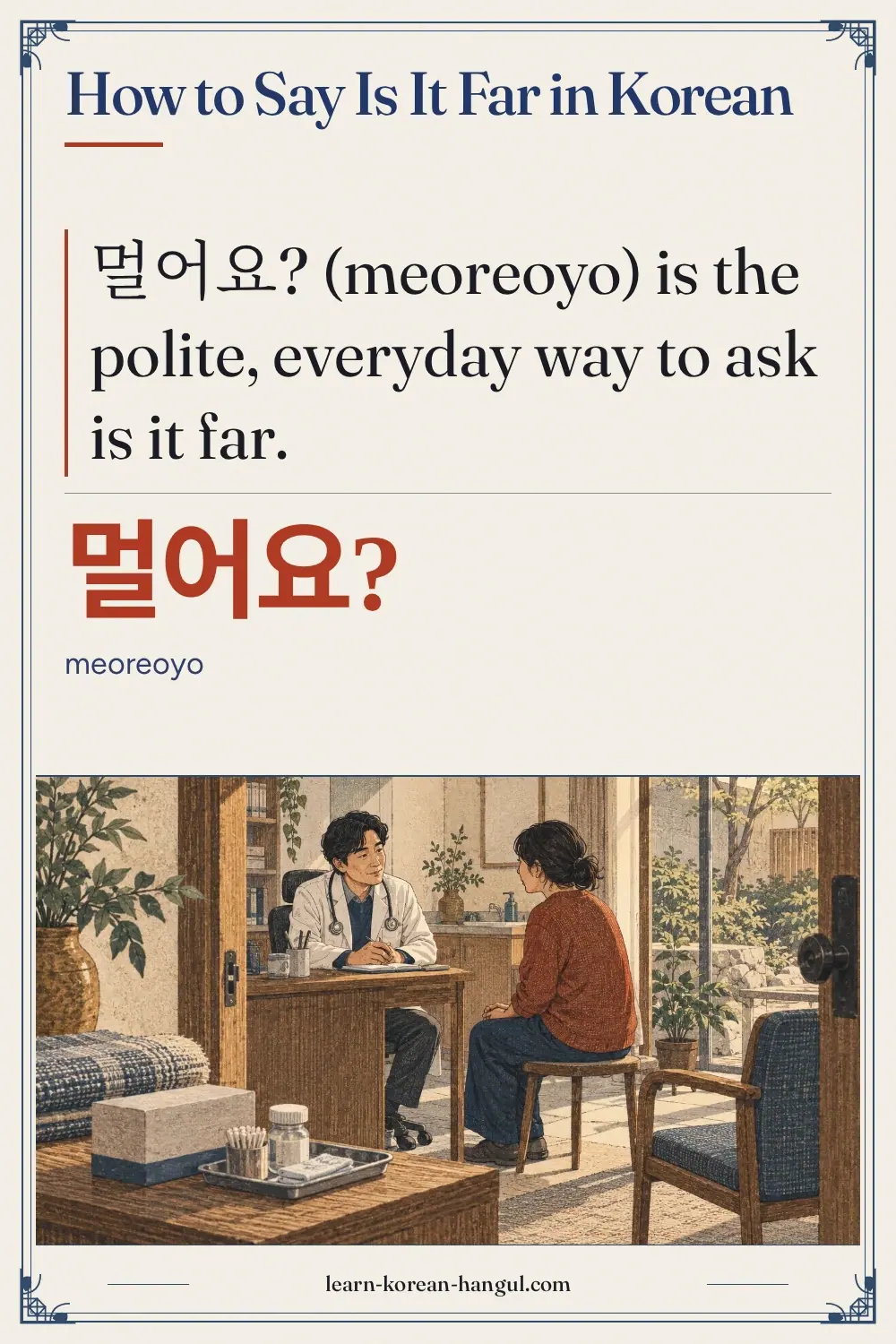
멀어요?
멀어요?
What you'll learn
- Ask is it far with 멀어요?, 멉니까? or 멀어?, depending on the listener.
- Ask how far, whether you can walk and how long it takes.
- Answer with 멀어요, 가까워요 or a time such as 걸어서 십 분.
- Understand why 멀다 becomes 멉니다 and 머세요.
Before you start: you only need to read Hangul. When you know the distance, learn how do I get to in Korean. Time: about 10 minutes. Audio plays only when you press a button.
How Do You Say Is It Far in Korean?
The standard way to say is it far in Korean is 멀어요? The dictionary form is 멀다, a describing word meaning "to be far". Korean drops "it" when the topic is clear, so 멀어요? alone is a full question. Put the place first when you need to be specific, as in 여기서 멀어요? ("is it far from here?").
| Situation | Best form | Romanization | Why |
|---|---|---|---|
| Asking a stranger or a clerk | 멀어요? | meoreoyo | Polite, natural |
| Asking a close friend | 멀어? | meoreo | Casual |
| A formal announcement or desk | 멉니까? | meomnikka | Formal |
| Asking how far | 얼마나 멀어요? | eolmana meoreoyo | How far |
| Asking about walking | 걸어서 갈 수 있어요? | georeoseo gal su isseoyo | Can I walk |
The ending changes with the listener, while the stem 멀- stays the same. The next section sorts the forms by level.
What Are the Formal, Polite and Casual Ways to Say Is It Far?
The forms follow the Korean speech levels, explained in the guide to Korean speech levels. The stem stays, and the ending changes.
Polite: 멀어요? (meoreoyo)
Polite · 해요체멀어요? is the form to learn first. It suits strangers, shop staff, taxi drivers and colleagues. Add the place and the starting point to make it clear.
서울역에서 호텔까지 멀어요?
Seoullyeogeseo hotelkkaji meoreoyo
Is the hotel far from Seoul Station?
The particle 에서 means "from" and 까지 means "to" or "as far as". In 서울역에서, the ㄹ of 서울 meets 역 and the sound is [서울려게서]: a ㄴ sound is inserted and then it becomes ㄹ.
Casual: 멀어? (meoreo)
Casual · 반말멀어? drops the polite 요. Use it with close friends, siblings and children. Without the 요, a rising voice still marks it as a question.
Formal: 멉니까? (meomnikka)
Formal · 합쇼체멉니까? is the formal question form. It appears at information desks, in announcements and in news-style speech. It is pronounced [멈니까]. In daily life you will use 멀어요? far more often.
Answers: 멀어요, 안 멀어요, 가까워요
Polite · 해요체You will also need to understand the answers. 멀어요 means it is far, 안 멀어요 (an meoreoyo) means it is not far, and 가까워요 means it is near. Many people give the time instead of the word.
아니요, 안 멀어요. 걸어서 십 분쯤 걸려요.
aniyo, an meoreoyo. georeoseo sip bunjjeum geollyeoyo
No, it's not far. It takes about ten minutes on foot.
The word 쯤 (jjeum) means "about", and 걸리다 (geollida) means "to take" for time. The sound of 십 분 is [십뿐], with a tense ㅂ.
Why Does 멀다 Become 멉니다 and 머세요?
멀다 is a describing word whose stem ends in ㄹ. In Korean, this ㄹ disappears before the sounds ㄴ, ㅂ and ㅅ, and before the honorific 시. This is called ㄹ-dropping (ㄹ 탈락). Before 어, 지 or other plain endings, the ㄹ stays.
| Ending | Form | Romanization | Meaning |
|---|---|---|---|
| polite | 멀어요 | meoreoyo | it is far |
| formal | 멉니다 | meomnida | it is far (formal) |
| honorific | 머세요 | meoseyo | it is far (respectful) |
| modifier | 먼 곳 | meon got | a far place |
| negative | 멀지 않아요 | meolji anayo | it is not far |
| past | 멀었어요 | meoreosseoyo | it was far |
The modifier 먼 (meon) goes before a noun: 먼 길 (meon gil, a long way). The word 머세요 is rare for distance, because honorifics are for people, not places. It appears when the subject is a person's home or workplace.
How Do You Pronounce 멀어요?
멀어요 is pronounced [머러요], meo-reo-yo, in three syllables. The ㄹ at the end of 멀 moves to the next syllable, a pattern called liaison (연음), so it sounds like 머러요 even though you write 멀어요.
- 멀 (meol): "muh" with relaxed, unrounded lips.
- 어 (eo): "uh", and it takes the ㄹ sound.
- 요 (yo): "yo".
Sound Changes to Listen For
These changes follow the National Institute of Korean Language standard pronunciation rules (표준 발음법):
- Liaison. A final consonant moves to a vowel-initial syllable, so 멀어요 is [머러요] (Article 13).
- ㅂ before ㄴ becomes ㅁ. 멉니까 is [멈니까] (Article 18).
- Tense after -(으)ㄹ. In 갈 수 있어요, the ㅅ after the ending -ㄹ is tense: [갈쑤]. See Korean tensification (Article 27).
- Tense after ㅂ. 십 분 is [십뿐] (Article 23).
The vowel in 멀 is ㅓ. It is not rounded, so keep your lips relaxed and avoid the ㅗ sound. Now you can say it, so let us see how to ask well.
How Do You Ask How Far and How Long?
멀어요? is only the start. These questions get you the information you need.
| You want to know | Korean | Romanization |
|---|---|---|
| How far it is | 얼마나 멀어요? | eolmana meoreoyo |
| How long it takes on foot | 걸어서 얼마나 걸려요? | georeoseo eolmana geollyeoyo |
| If you can walk there | 걸어서 갈 수 있어요? | georeoseo gal su isseoyo |
| If it is near | 가까워요? | gakkawoyo |
| If it is still far | 아직 멀었어요? | ajik meoreosseoyo |
Yes-or-no questions such as 가까워요? rise at the end. Wh-questions such as 얼마나 멀어요? carry the stress on 얼마나 and do not end with a sharp rise, because the question word already marks them as questions.
걸어서 갈 수 있어요?
georeoseo gal su isseoyo
Can I go on foot?
The verb 걷다 (to walk) becomes 걸어서 before a vowel (걷 → 걸). The question 아직 멀었어요? is used in a car or on a hike and means "are we still far?".
When Should You Use 멀어요?, and When Should You Not?
Use 멀어요? when you plan a route, choose a restaurant or decide between walking and a taxi. Do not use it in place of a time question when you care about time.
Situations Where It Fits
- At a hotel. 공항까지 멀어요? (Is the airport far?)
- Choosing a restaurant. 그 식당 멀어? (Is that restaurant far?)
- Hiking. 정상까지 아직 멀었어요? (Is the summit still far?)
Situations to Avoid
- When you mean a long time. Say 오래 걸려요? (does it take long?).
- As a complaint. A tired 너무 멀어요 can sound like criticism of the host.
- Without a place. Name the place so the listener knows what you mean.
Two short conversations show how it sounds.
What Does Is It Far Sound Like in a Real Conversation?
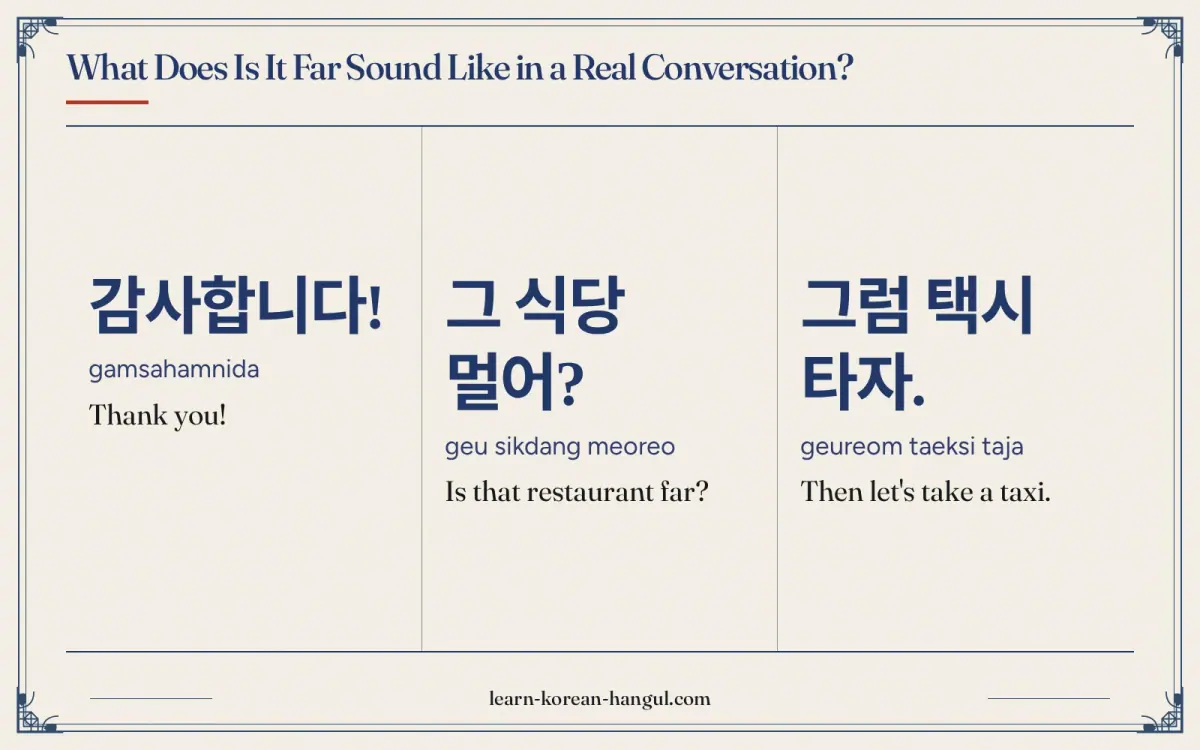
In real life, the line is followed by a time and a thank-you.
Asking a Passer-By
Traveler
실례합니다. 경복궁은 여기서 멀어요?
sillyehamnida. gyeongbokgungeun yeogiseo meoreoyo
Excuse me. Is Gyeongbokgung far from here?
Passer-By
아니요, 안 멀어요. 걸어서 십 분쯤 걸려요.
aniyo, an meoreoyo. georeoseo sip bunjjeum geollyeoyo
No, it's not far. It takes about ten minutes on foot.
Traveler
감사합니다!
gamsahamnida
Thank you!
What to notice: the traveler opens with 실례합니다 (excuse me), and the answer gives a time, not a distance.
Friends Choosing Transport
Jisu
그 식당 멀어?
geu sikdang meoreo
Is that restaurant far?
Minho
좀 멀어. 버스로 이십 분 걸려.
jom meoreo. beoseuro isip bun geollyeo
A bit far. It takes twenty minutes by bus.
Jisu
그럼 택시 타자.
geureom taeksi taja
Then let's take a taxi.
What to notice: the casual 멀어 comes with 좀 (a bit), and the suggestion 타자 (let's ride) uses the casual -자 ending.
What Should You Know about the Culture behind Is It Far?
Koreans usually describe distance in time. A friend will say 걸어서 오 분 (five minutes on foot) or 지하철로 삼십 분 (thirty minutes by subway), and kilometers appear mostly for driving or hiking. Map apps display walking time, written 도보 (dobo, on foot), and Naver Map and KakaoMap are widely used for it.
- Subway-based thinking. People measure a place by its nearest station, such as 역에서 가까워요 (it's close to the station).
- Short answers. A short answer such as 가까워요 is often all you will hear, so ask for a time if you need one.
- Politeness. If the answer is far, people may offer to call a taxi or show you the route.
An expert tip: 거리 (geori) means distance, and 걸어갈 수 있는 거리 (georeogal su inneun geori) means walking distance. Use it as in 걸어갈 수 있는 거리예요 (it's within walking distance).
What Mistakes Do Learners Make with Is It Far in Korean?
Most mistakes come from writing the sounds and from mixing up distance and time.
| Mistake | Why it is a problem | Fix |
|---|---|---|
| 머러요 | That is the sound, not the spelling | Write 멀어요 |
| 멀어요 for a long time | Means far, not long | Say 오래 걸려요 |
| 멀습니다 | The ㄹ must drop before ㅂ | Say 멉니다 |
| A sharp rise on 얼마나 멀어요 | The question word already marks the question | Let the pitch fall |
| 먼어요 | ㄹ is not dropped before 어 | Say 멀어요 |
| 길어요 for far | 길다 means long in length | Say 멀어요 |
Learners also mix 멀다 with 크다 (to be big). A place can be 커요 (big) and still be 가까워요 (near).
How Do You Ask Someone If a Place Is Far?
You can turn the same words into a question by raising your voice at the end. To a friend, say 멀어? (meoreo?). To a clerk or a stranger, say 멀어요? (meoreoyo?). In a formal setting, use 멉니까? (meomnikka?). You rarely need an honorific, because distance describes a place, not a person. If the place belongs to someone you respect, such as a teacher's home, say 선생님 댁은 먼가요? (seonsaengnim daegeun meongayo?), which is gentle and indirect.
| Listener | Question | Romanization |
|---|---|---|
| Close friend | 멀어? | meoreo |
| Stranger or clerk | 멀어요? | meoreoyo |
| Formal desk | 멉니까? | meomnikka |
Is It the Same as Far, near or How Long Does It Take?
Close, but each folded query has its own wording. The short answers below cover the other searches folded into this page.
- Far in Korean: 멀어요, or 멀리 (meolli) for the adverb, as in 멀리 가요 (go far away).
- Near in Korean: 가까워요, or 근처 (geuncheo, nearby).
- How far in Korean: 얼마나 멀어요?
- How long does it take in Korean: 얼마나 걸려요? (eolmana geollyeoyo)
- Walking distance in Korean: 걸어갈 수 있는 거리 (georeogal su inneun geori).
Now practise aloud.
Practice: Say It Aloud
Play the slow clip of 멀어요? three times and keep the ㄹ light. Then choose a phrase. Answers follow.
- You ask a hotel clerk politely if the station is far.
- You ask a friend if a cafe is far.
- You ask how far the airport is.
- How do you say "it takes ten minutes on foot"?
Answers
- 역은 멀어요?
- 그 카페 멀어?
- 공항까지 얼마나 멀어요?
- 걸어서 십 분 걸려요.
The phrase flashcards drill these lines with audio.
Related Phrases to Learn Next
Once you know the distance, you need a route and a ride.
- How do I get to in Korean: the pattern for asking the way.
- Take me to the airport in Korean: what to tell a taxi driver.
This guide belongs to the Korean directions phrases collection. What this page does not cover: public transport tickets, street addresses and fares. Remember that 멀어요? is the safe polite question, answers usually come as minutes and the ㄹ links to the next syllable, so you can say is it far in Korean naturally.
Frequently Asked Questions
How do you say is it far in Korean?
Say 멀어요? (meoreoyo) in polite speech, 멀어? (meoreo) to a close friend and 멉니까? (meomnikka) in formal speech. Raise your voice at the end because it is a yes-or-no question. To ask about a place, add it in front: 여기서 멀어요? means is it far from here.
How do I ask how far something is in Korean?
Say 얼마나 멀어요? (eolmana meoreoyo). The word 얼마나 means how much or how long, and because it is a wh-question it ends with a fall or a rise-fall rather than a sharp rise. People often answer with time, such as 걸어서 십 분쯤 걸려요 (it takes about ten minutes on foot), not with a distance in kilometers.
How do I say it's far or it's near in Korean?
Say 멀어요 (meoreoyo) for far and 가까워요 (gakkawoyo) for near. Add 아주 or 많이 for very far, as in 아주 멀어요. To say not far, use 안 멀어요 (an meoreoyo) or 멀지 않아요 (meolji anayo), and to say close by, use 근처예요 (geuncheoyeyo).
How do I ask if I can walk there in Korean?
Say 걸어서 갈 수 있어요? (georeoseo gal su isseoyo). The pattern 걸어서 means on foot, and -(으)ㄹ 수 있어요 means can. The phrase 갈 수 is pronounced [갈쑤]. You can also ask 걸어서 얼마나 걸려요? (how long does it take on foot) to get a time instead of a yes or no.
Why does 멀다 become 멉니다 and 머세요?
멀다 ends in ㄹ, and Korean drops that ㄹ before the sounds ㄴ, ㅂ, ㅅ and the honorific 시. So 멀 + -ㅂ니다 becomes 멉니다, and 멀 + 세요 becomes 머세요. Before 어 and a plain consonant the ㄹ stays, as in 멀어요 and 멀지 않아요. This pattern is called ㄹ-dropping.
What mistakes do learners make with is it far in Korean?
Learners write 머러요 as they hear it, use 멀어요 to mean takes a long time, or end 얼마나 멀어요 with a sharp rise. The word for a long time is 오래 걸려요 (orae geollyeoyo). Also, 멀어요? asks about distance, not about being late. Write the base spelling 멀어요 and say it with liaison.