공항에 가 주세요
공항에 가 주세요
What you'll learn
- Say 공항에 가 주세요, 인천공항으로 가 주세요 and 공항까지 가 주세요 and choose the one that fits.
- Pronounce the seven syllables of 공항에 가 주세요 with a clear "ng" and a plain 주세요.
- Name a terminal and ask a hotel to call a taxi.
- Avoid the wrong particle, as in 공항을 가 주세요.
Before you start: if you still need to find a taxi, see where is the taxi stand in Korean. Time: about 12 minutes. Audio plays only when you press a button.
How Do You Say Take Me to the Airport in Korean?
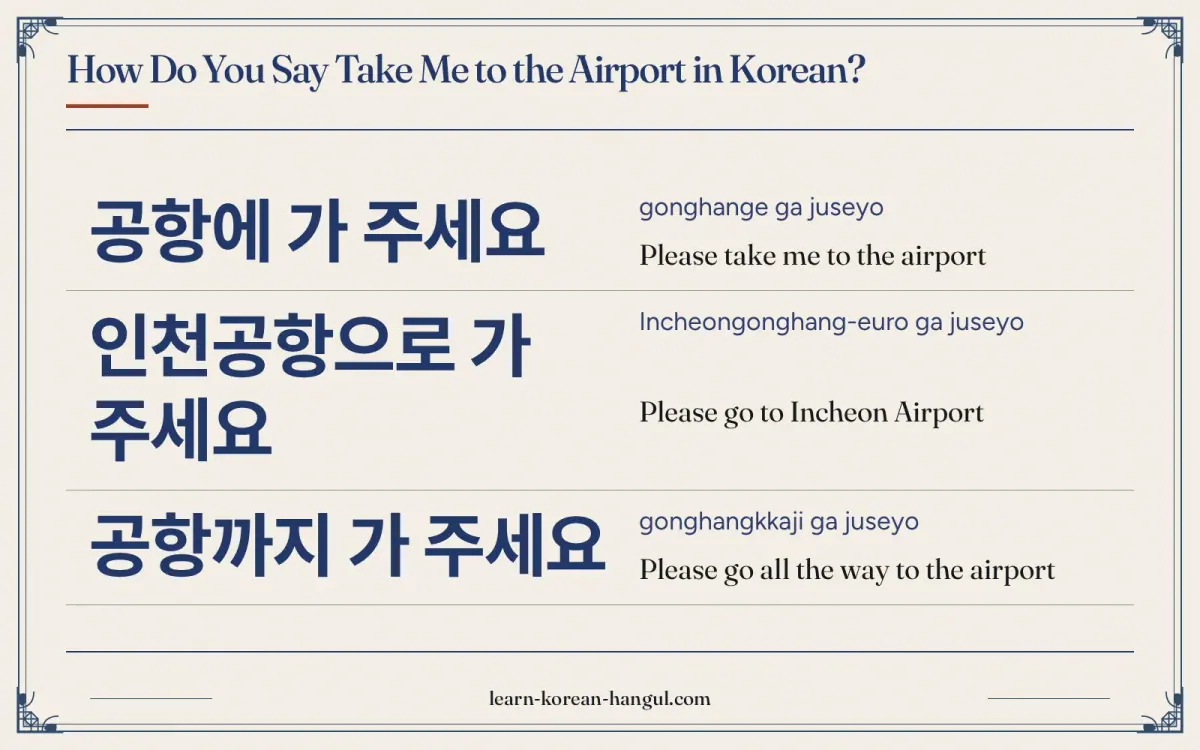
The standard way to say take me to the airport in Korean is 공항에 가 주세요. The noun 공항 means "airport", and 에 marks the place you are going. The verb 가다 is "to go". The ending -아/어 주세요 means "please do this for me", so the sentence literally says "please go to the airport for me". In a taxi, that is exactly the request.
| Korean | Romanization | Meaning | Where you hear it |
|---|---|---|---|
| 공항에 가 주세요 | gonghange ga juseyo | Please take me to the airport | Taxi, any driver |
| 인천공항으로 가 주세요 | Incheongonghang-euro ga juseyo | Please go to Incheon Airport | Taxi, when you want to be specific |
| 공항까지 가 주세요 | gonghangkkaji ga juseyo | Please go all the way to the airport | Taxi, long trips |
| 공항으로 부탁드립니다 | gonghang-euro butakdeurimnida | To the airport, please (formal) | Hotels, car services |
| 공항에 데려다주세요 | gonghange deryeodajuseyo | Please take me to the airport (with a person) | Family, friends, a colleague |
| 공항에 데려다줘 | gonghange deryeodajwo | Take me to the airport (casual) | Close friends only |
Revised Romanization (the South Korean government standard of 2000) is only a reading aid here. Learn the Hangul first. The next section shows how the forms differ.
What Are the Polite and Casual Ways to Say Take Me to the Airport?
Take me to the airport in Korean has polite, formal and casual choices. The verb of going stays the same in the middle, and the ending and the particle change.
Polite: 공항에 가 주세요 (gonghange ga juseyo)
Polite · 해요체공항에 가 주세요 is the safe default. It works with any driver. The shorter 공항이요 ("the airport, please") is also common once you are in the car. The verb 가다 becomes 가 before 주세요, because 가 + 아 merges into one sound.
Polite: 인천공항으로 가 주세요 (Incheongonghang-euro ga juseyo)
Polite · 해요체으로 marks a direction, so 인천공항으로 가 주세요 means "head to Incheon Airport". Use it when your city has more than one airport. For a terminal, add the number first: 제2터미널로 가 주세요 (je-i teomineollo ga juseyo).
인천공항으로 가 주세요.
Incheongonghang-euro ga juseyo
Please go to Incheon Airport.
Polite: 공항까지 가 주세요 (gonghangkkaji ga juseyo)
Polite · 해요체까지 means "as far as" or "until". 공항까지 가 주세요 asks the driver to go all the way, which is useful when you are far away or want to confirm the destination.
제2터미널로 가 주세요.
je-i teomineollo ga juseyo
Please go to Terminal 2.
Formal: 공항으로 부탁드립니다 (gonghang-euro butakdeurimnida)
Formal · 합쇼체부탁드립니다 is the formal, humble way to ask. It suits a hotel desk or a chauffeur service. In a normal taxi, 가 주세요 is enough.
With a Person: 공항에 데려다주세요 (gonghange deryeodajuseyo)
Polite · 해요체데려다주다 means "to take someone to a place". It describes a person who accompanies you or gives you a ride, so it fits family and colleagues better than a taxi driver. Say it as [공항에 데려다주세요].
Casual: 공항에 데려다줘 (gonghange deryeodajwo)
Casual · 반말With a friend, drop the polite ending and say 공항에 데려다줘. Never use this with a driver or a stranger. The next section covers the sound.
How Do You Pronounce 공항에 가 주세요?
공항에 가 주세요 is pronounced [공항에 가 주세요], in seven syllables: gong-hang-e ga ju-se-yo. The sounds to master are the nasal "ng" and a smooth join into 에.
- 공 (gong): a plain g, the vowel ㅗ, and the "ng" of ㅇ.
- 항 (hang): a light h, ㅏ, and "ng" again.
- 에 (e): a plain vowel, joined smoothly to 항.
- 가 (ga): a plain g and ㅏ.
- 주 (ju): a plain j and a rounded u.
- 세 (se): s plus ㅔ.
- 요 (yo): a short, light ending.
Sound Changes to Listen For
- Nasal ㅇ. The final ㅇ in 공 and 항 is "ng", as in "sing". Do not pronounce it as a separate "g".
- Smooth join in 항에. The ㅇ stays as "ng" and 에 follows, so it sounds like [공항에]. Do not add a "g" sound.
- Tense [까] in 공항까지. The ㄲ of 까지 is a tense sound. Hold the tongue still and release it sharply: [공항까지].
- Tense [뜨] in 부탁드립니다. The ㄱ batchim in 탁 tenses the ㄷ of 드: [부탁뜨림니다]. The 립니다 ending also turns the ㅂ into [ㅁ].
- Tense [씨] in 몇 시. In 몇 시에, the ㅅ is tense: [멷씨에].
- No tensing in 주세요. The ㅈ stays plain after 가, so say [주세요], not "jjuseyo".
- No rising pitch in a request. A request ends calmly. A sharp rise would turn it into a question.
Say the three syllables 공항에 as one smooth shape and you will sound natural. Next, when does each form fit?
When Should You Use 공항에 가 주세요, and When Should You Not?
Use 공항에 가 주세요 when a driver or a driver service is taking you. Use 데려다주세요 when a person is going with you or giving you a ride. The choice depends on who is driving, not on how far the trip is.
Situations Where It Fits
- A taxi on the street. Get in, say 안녕하세요, then name the place.
- A hotel desk. Ask the staff to call a car: 공항까지 택시 좀 불러 주세요.
- A booked car. Say 공항으로 부탁드립니다 to a pre-booked driver.
Situations to Avoid
- 공항에 데려다줘 with a driver. The casual form sounds rude.
- 공항을 가 주세요. The place you travel to takes 에 or 으로, not 을.
- 가요 as a request. 가요 means "I go" or "we go", so it describes you instead of asking the driver.
Three short scenes show the forms in use.
What Does Take Me to the Airport Sound Like in a Real Conversation?
Travel requests are short. Listen for the ending of each sentence.
In a Taxi
Guest
인천공항으로 가 주세요.
Incheongonghang-euro ga juseyo
Please go to Incheon Airport.
Driver
네, 몇 터미널이에요?
ne, myeot teomineorieyo
Yes, which terminal?
Guest
2터미널이요.
i teomineoriyo
Terminal 2, please.
What to notice: The driver's question is a wh-question, so it does not need a sharp rise. 터미널이에요 sounds like [터미너리에요], because the ㄹ moves to the next syllable. The guest answers with the short 이요.
At a Hotel Desk
Guest
공항까지 택시 좀 불러 주세요.
gonghangkkaji taeksi jom bulleo juseyo
Please call a taxi to the airport.
Staff
네, 바로 불러 드릴게요.
ne, baro bulleo deurilgeyo
Yes, I'll call one right away.
What to notice: 택시 sounds like [택씨], and 불러 드릴게요 sounds like [불러 드릴께요]. 좀 softens the request. The hotel staff use the humble 드리다.
Asking a Friend for a Ride
Ji-Ho
내일 아침에 공항에 데려다줄 수 있어?
naeil achime gonghange deryeodajul su isseo
Can you take me to the airport tomorrow morning?
Su-Bin
응, 몇 시에 가면 돼?
eung, myeot sie gamyeon dwae
Sure, what time should we go?
What to notice: Both lines drop 요, because the friends are close. 줄 수 있어 sounds like [줄쑤 이써], with a tense [쑤]. The question 몇 시에 가면 돼? asks "what time would it work to go?".
What Should You Know about the Culture behind Take Me to the Airport?
These are general patterns, not rules.
- Other ways to go. Many travellers also use the airport bus (공항버스, gonghangbeoseu) or the airport railroad (공항철도, gonghangcheoldo), which are usually cheaper than a taxi and avoid traffic.
- Say or show. If your pronunciation is not clear, show the airport name in Hangul on your phone. Drivers read 인천공항 faster than they hear it.
- Terminal first. Large airports have more than one terminal, so know the terminal for your airline before you leave.
- Ask about the fare. To ask the cost before or after the ride, see how much is the fare in Korean.
An expert tip: In 가 주세요, the verb 주다 ("to give") does a different job than in "give me a book". It marks that the action is done as a favour for you. That is why 가 주세요 can mean "go for me" and 데려다주세요 means "take me". Once that idea is clear, forms such as 기다려 주세요 ("please wait") and 도와주세요 ("please help") are easy to guess. For how endings carry politeness, see Korean speech levels.
What Mistakes Do Learners Make with Take Me to the Airport in Korean?
Most errors come from the wrong particle or the wrong verb form.
| Mistake | Why it is a problem | Fix |
|---|---|---|
| Saying 공항을 가 주세요 | 을 marks an object, not a destination | Say 공항에 or 공항으로 |
| Saying 공항에 가요 as a request | It means "I go to the airport" | Say 공항에 가 주세요 |
| Using 데려다줘 with a driver | The casual form sounds rude | Use 가 주세요 |
| Saying only 공항 with no ending | It is a noun and can sound abrupt | Add 이요 or 에 가 주세요 |
| Not naming the airport | The Seoul area has two main airports | Say 인천공항 or 김포공항 |
Learners often translate "take me" word for word and reach for 데리고 가다. In a taxi, the natural request names the place and asks the driver to go: 가 주세요.
Is It the Same as to the Airport or Go to the Airport?
Yes. Each English phrase is covered by the forms above, with a small difference in tone.
- To the airport in Korean: 공항으로 (to the airport, as a direction) or the short 공항이요 in a taxi.
- Go to airport in Korean: 공항에 가요 for a statement ("I go to the airport"), and 공항에 가 주세요 for a request.
- Airport in Korean: the noun is 공항. For the word on its own, see airport in korean.
- How long does it take: 공항까지 얼마나 걸려요? (gonghangkkaji eolmana geollyeoyo) asks how long it takes to reach the airport.
Practice: Say It Aloud
Play the slow clip and repeat 공항에 가 주세요 three times. Then choose the best request for each scene. Answers follow.
- You are in a taxi and want Incheon Airport.
- You need Terminal 2.
- You ask a hotel to call a taxi.
- A friend is driving you to the airport tomorrow.
Answers
- 인천공항으로 가 주세요.
- 제2터미널로 가 주세요.
- 공항까지 택시 좀 불러 주세요.
- 내일 공항에 데려다줘.
The phrase flashcards drill these requests with audio.
Related Phrases to Learn Next
Asking for the airport leads to other travel phrases.
- stop here please in Korean: tell the driver where to pull over.
- how much is the fare in Korean: ask the cost of the ride.
- check in in Korean: the next step at the airport.
This guide belongs to the korean airport phrases collection. What this page does not cover: airport train tickets, luggage rules and ride-hailing app menus. Learn 공항에 가 주세요 and the name of your airport, and you can say take me to the airport in Korean to any driver.
Frequently Asked Questions
How do you say take me to the airport in Korean?
Say 공항에 가 주세요 (gonghange ga juseyo) to a taxi driver. Name the airport for clarity: 인천공항으로 가 주세요. With a friend who is giving you a ride, say 공항에 데려다줘. The verb 가다 means "to go", and 주세요 makes it a polite request.
How do you pronounce 공항에 가 주세요?
It has seven syllables: gong-hang-e ga ju-se-yo. The ㅇ at the end of 공 and 항 is a nasal "ng". The ㅎ of 항 is a light h after the "ng" of 공, and it can weaken in fast speech. The ㅈ of 주세요 stays plain. Revised Romanization writes gonghange ga juseyo.
What is the difference between 에 and 으로 in this phrase?
에 marks the place you are going, so 공항에 가 주세요 means "go to the airport". 으로 marks a direction or route, so 공항으로 가 주세요 means "head toward the airport". Both work with a taxi driver, and the meaning is nearly the same.
Is 공항에 가 주세요 formal or casual?
It is polite. The ending 주세요 is a respectful request that suits drivers, hotel staff and strangers. The formal version is 공항으로 부탁드립니다. With a friend who is driving you, drop the polite ending and say 공항에 데려다줘.
What is the most common mistake with take me to the airport in Korean?
Using the object particle, as in 공항을 가 주세요. The place you travel to takes 에 or 으로, not 을. Another mistake is using 가요 alone, which means "I go" or "we go", and so does not ask the driver to take you.