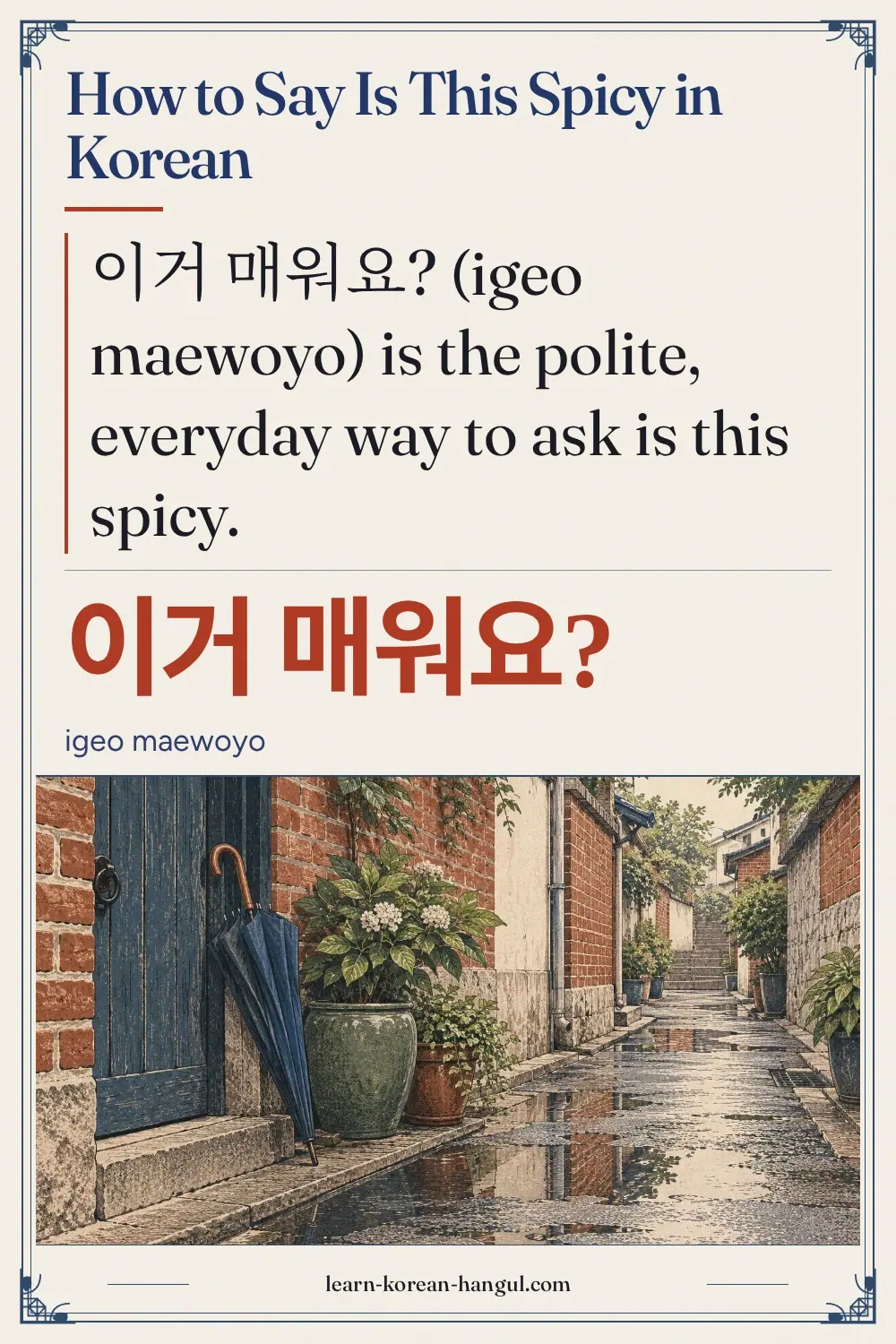
이거 매워요?
이거 매워요?
What you'll learn
- Ask is this spicy with 이거 매워요?, 이거 맵습니까? or 이거 매워?, depending on the listener.
- Ask how spicy and understand the answers.
- Understand why 맵다 becomes 매워요.
- Tell 매워요 apart from 뜨거워요 and 더워요.
Before you start: you only need to read Hangul. When you want to ask for a milder dish, learn not spicy please in Korean. Time: about 10 minutes. Audio plays only when you press a button.
How Do You Say Is This Spicy in Korean?
The standard way to say is this spicy in Korean is 이거 매워요? The word 이거 (igeo) is a spoken form of 이것 and means "this thing". The word 매워요 (maewoyo) is the polite form of 맵다. Korean drops extra words, so you do not need to say "it is". Point to the dish, say 이거 매워요?, and you have asked a full question.
| Situation | Best form | Romanization | Why |
|---|---|---|---|
| Asking a server or owner | 이거 매워요? | igeo maewoyo | Polite, natural |
| Asking a close friend | 이거 매워? | igeo maewo | Casual |
| A formal restaurant or desk | 이거 맵습니까? | igeo maepseumnikka | Formal |
| Asking how spicy | 얼마나 매워요? | eolmana maewoyo | How spicy |
| Asking if it is very spicy | 많이 매워요? | mani maewoyo | Very spicy |
The ending changes with the listener, while the stem stays the same. The next section sorts the forms by level.
What Are the Formal, Polite and Casual Ways to Say Is This Spicy?
The forms follow the Korean speech levels, explained in the guide to Korean speech levels. The stem 맵- and its changed form 매우- are the same across levels, and only the ending changes.
Polite: 이거 매워요? (igeo maewoyo)
Polite · 해요체이거 매워요? is the form to learn first. It suits servers, market sellers, colleagues and new friends. Raise your voice at the end, because it is a yes-or-no question.
이 떡볶이는 별로 안 매워요.
i tteokbokkineun byeollo an maewoyo
This tteokbokki isn't very spicy.
The phrase 별로 안 (byeollo an) means "not very". The word 떡볶이 is pronounced [떡뽀끼].
Casual: 이거 매워? (igeo maewo)
Casual · 반말이거 매워? drops the polite 요. Use it with close friends, siblings and children.
Formal: 이거 맵습니까? (igeo maepseumnikka)
Formal · 합쇼체이거 맵습니까? is the formal question form. It appears at a banquet or in announcements. It is pronounced [이거 맵씀니까]. In daily life you will use 이거 매워요? far more often.
Answers: 조금 매워요, 아주 매워요, 안 매워요
Polite · 해요체The answers use the same word with a degree. 조금 매워요 (jogeum maewoyo) means a little spicy, 아주 매워요 (aju maewoyo) means very spicy, and 안 매워요 (an maewoyo) means not spicy. The past tense, 매웠어요 (maewosseoyo), means it was spicy.
저는 매운 음식을 잘 못 먹어요.
jeoneun maeun eumsigeul jal mot meogeoyo
I can't eat spicy food well.
The form 매운 (maeun) is the version of 맵다 that goes before a noun, as in 매운 음식 (spicy food). Now the grammar rule behind these forms.
Why Does 맵다 Become 매워요?
맵다 is a ㅂ-irregular describing word. When an ending that begins with a vowel follows, the ㅂ at the end of the stem changes to 우 and joins the ending: 맵 + 어요 → 매우 + 어요 → 매워요. Before a consonant, the ㅂ stays.
| Form | Korean | Romanization |
|---|---|---|
| polite | 매워요 | maewoyo |
| past | 매웠어요 | maewosseoyo |
| before a noun | 매운 | maeun |
| formal | 맵습니다 | maepseumnida |
| negative | 맵지 않아요 | maepji anayo |
| because | 매워서 | maewoseo |
The same change appears in 덥다 → 더워요 (hot weather) and 뜨겁다 → 뜨거워요 (hot to touch). A few ㅂ words are regular, such as 좁다 (narrow) → 좁아요. For the sound, see the next section.
How Do You Pronounce 이거 매워요?
이거 매워요 is pronounced [이거 매워요], i-geo mae-wo-yo, in five syllables. Each syllable is clear, and the vowel in 거 is ㅓ, which is unrounded.
- 이 (i): "ee".
- 거 (geo): "guh", with relaxed lips.
- 매 (mae): "meh".
- 워 (wo): "wuh", with rounded lips.
- 요 (yo): "yo".
Sound Changes to Listen For
These changes follow the National Institute of Korean Language standard pronunciation rules (표준 발음법):
- Tense after ㅂ. In 맵습니까, the ㅅ after ㅂ is tense: [맵씀]. See Korean tensification (Article 23).
- ㅂ before ㄴ becomes ㅁ. 맵습니까 is [맵씀니까] (Article 18). See Korean nasalization.
- Tense after ㄱ. 떡볶이 is [떡뽀끼]: the final ㄱ makes the next ㅂ tense, and the ㄲ of 볶 moves forward (Articles 13 and 23).
Revised Romanization writes maepseumnikka and tteokbokki as they are spelled and does not show tensing that comes from a neighbouring sound. With the sound clear, here is how to ask for more detail.
How Do You Ask How Spicy a Dish Is?
이거 매워요? answers with yes or no. These questions get you a degree.
| You want to know | Korean | Romanization |
|---|---|---|
| How spicy it is | 얼마나 매워요? | eolmana maewoyo |
| If it is very spicy | 많이 매워요? | mani maewoyo |
| If there is a milder choice | 안 매운 거 있어요? | an maeun geo isseoyo |
| If they eat spicy food | 매운 거 잘 드세요? | maeun geo jal deuseyo |
| If it can be made milder | 안 맵게 해 줄 수 있어요? | an maepge hae jul su isseoyo |
The question 얼마나 매워요? is a wh-question, so the stress falls on 얼마나 and the tone ends with a fall or a rise-fall rather than a sharp rise. The honorific verb 드세요 in 매운 거 잘 드세요? is used for an older guest, because it shows respect to the person who eats.
When Should You Use 이거 매워요?, and When Should You Not?
Use 이거 매워요? at the moment you order, or before you take a bite from a shared dish. Do not use it to criticise a dish after you have been served.
Situations Where It Fits
- Ordering. 이거 매워요? 안 매운 거 있어요? (Is this spicy? Is there something not spicy?)
- Street food. 이 떡볶이 매워요? (Is this tteokbokki spicy?)
- A friend's house. 이거 매워? 나 매운 거 못 먹어. (Is this spicy? I can't eat spicy food.)
Situations to Avoid
- After the food arrives, as a complaint. 너무 매워요 can sound rude to a cook. Say 저한테는 좀 매워요 (it's a bit spicy for me).
- When you want a different dish. Say 다른 거 있어요? (is there something else?).
- With 안 매워요? for a neutral question. This asks "isn't it spicy?", which is a leading question.
Two short conversations show how it sounds.
What Does Is This Spicy Sound Like in a Real Conversation?
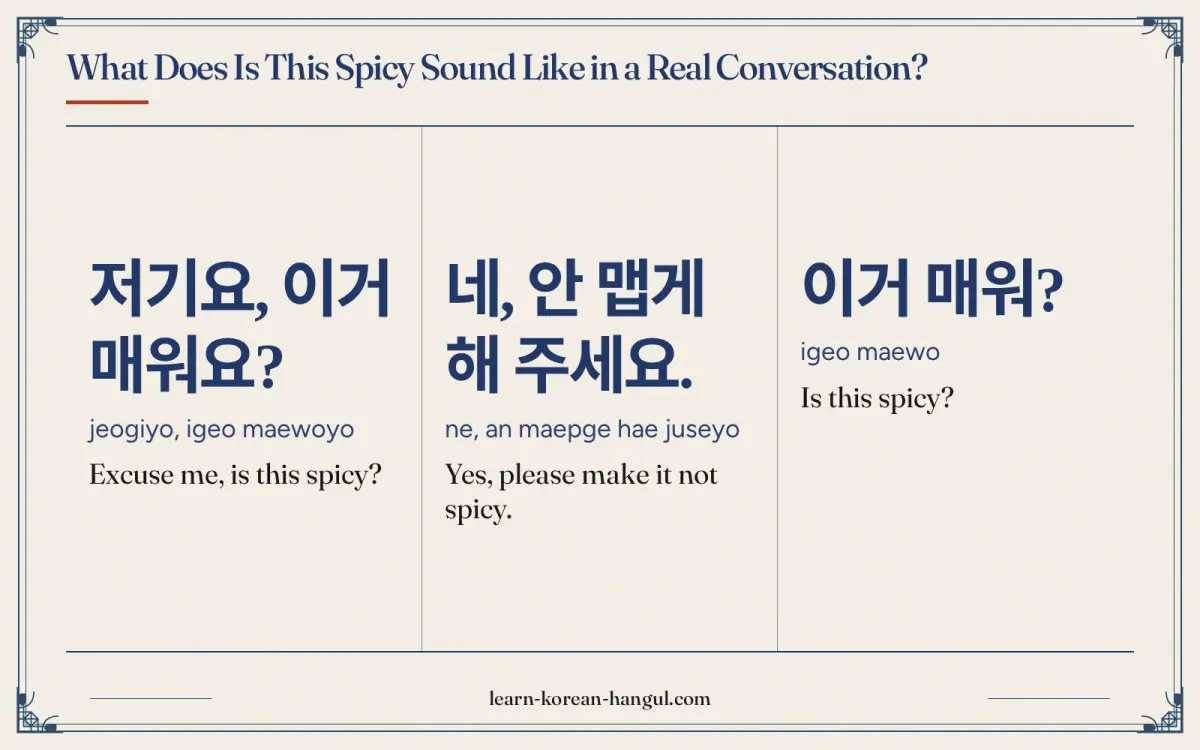
In real life, the question leads to an offer to adjust the dish.
Asking a Server
Guest
저기요, 이거 매워요?
jeogiyo, igeo maewoyo
Excuse me, is this spicy?
Server
조금 매워요. 안 맵게 해 드릴까요?
jogeum maewoyo. an maepge hae deurilkkayo
It's a little spicy. Shall I make it not spicy?
Guest
네, 안 맵게 해 주세요.
ne, an maepge hae juseyo
Yes, please make it not spicy.
What to notice: the guest calls the server with 저기요. The server offers with 해 드릴까요, a humble offer, and the guest answers with the request pattern 해 주세요.
Friends Trying a New Dish
Yuna
이거 먹어 봤어? 진짜 맛있어.
igeo meogeo bwasseo? jinjja masisseo
Have you tried this? It's really good.
Tom
이거 매워?
igeo maewo
Is this spicy?
Yuna
별로 안 매워. 먹어 봐.
byeollo an maewo. meogeo bwa
Not very spicy. Try it.
What to notice: friends use the casual 매워 and the pattern 먹어 봐 (try eating it). The word 진짜 is pronounced [진짜] with a tense ㅉ in its spelling.
What Should You Know about the Culture behind Is This Spicy?
Spicy food is common in Korean cooking. The heat usually comes from 고춧가루 (gochutgaru, chili flakes) and 고추장 (gochujang, chili paste). Not every dish is spicy, though. 불고기, 갈비 and 삼계탕 are usually mild, while kimchi stew and tteokbokki are known for heat.
- Different kinds of hot. 얼큰하다 (eolkeunhada) describes a spicy, hearty soup, a taste many people love on a cold day.
- Spice levels. Some restaurants and instant noodles use levels, such as 순한 맛 (sunhan mat, mild) and 매운맛 (maeunmat, spicy).
- Teasing. A person who cannot eat spicy food may be teased as a 맵찔이 (maepjjiri), a playful slang word, so use it only with friends.
- Asking is normal. Staff are used to foreign guests asking 이거 매워요?, and they will often tell you honestly.
An expert tip: when someone says 안 매워요, check the listener's taste. A person who loves spicy food may call a hot dish 안 매워요, so ask 저한테도 안 매울까요? (will it also be mild for me?).
What Mistakes Do Learners Make with Is This Spicy in Korean?
Most mistakes come from the ㅂ-irregular change and from the word for hot.
| Mistake | Why it is a problem | Fix |
|---|---|---|
| 맵어요 | The ㅂ changes to 우 before 어 | Say 매워요 |
| 맵워요 | The ㅂ is not kept | Say 매워요 |
| [맵습니까] as written | The ㅅ is tense and the ㅂ of 습 becomes ㅁ | Say [맵씀니까] |
| 뜨거워요 for spicy | Means hot to touch | Say 매워요 |
| 이거 안 매워요? for a neutral question | Means "isn't it spicy?" | Say 이거 매워요? |
| 이거 맵어? to a friend | Wrong stem change | Say 이거 매워? |
Learners also use 맛있어요 (it's tasty) as an answer to a spice question. Say it after you know the dish suits you, as in 맵지만 맛있어요 (it's spicy, but tasty).
How Do You Ask Someone If They Like Spicy Food?
You can turn the same words into a question by raising your voice at the end. To a friend, say 매운 거 좋아해? (maeun geo joahae?). To a colleague, say 매운 거 좋아해요? (maeun geo joahaeyo?). To an older person, use 매운 음식 좋아하세요? (maeun eumsik joahaseyo?), which is respectful. The word 좋아해요 is pronounced [조아해요], because the final ㅎ of 좋 is silent before a vowel. A kind follow-up is 못 드시는 거 있으세요? (mot deusineun geo isseuseyo?), which means "is there anything you can't eat?".
| Listener | Question | Romanization |
|---|---|---|
| Close friend | 매운 거 좋아해? | maeun geo joahae |
| Colleague | 매운 거 좋아해요? | maeun geo joahaeyo |
| Elder | 매운 음식 좋아하세요? | maeun eumsik joahaseyo |
Is It the Same as Is It Spicy, Spicy or How Spicy?
Yes. The short answers below cover the other searches folded into this page.
- Is it spicy in Korean: 이거 매워요? or just 매워요?
- Spicy in Korean: 매워요 (maewoyo), or 매운 (maeun) before a noun.
- How spicy in Korean: 얼마나 매워요?
- Very spicy in Korean: 아주 매워요 or 너무 매워요.
- Not spicy in Korean: 안 매워요 or 맵지 않아요.
Now practise aloud.
Practice: Say It Aloud
Play the slow clip of 이거 매워요? three times and keep the ㅓ unrounded. Then choose a phrase. Answers follow.
- You ask a server politely if a dish is spicy.
- You ask a close friend if a dish is spicy.
- You say the dish is very spicy.
- You ask a server to make it not spicy.
Answers
- 이거 매워요?
- 이거 매워?
- 아주 매워요.
- 안 맵게 해 주세요.
The phrase flashcards drill these lines with audio.
Related Phrases to Learn Next
A spice question leads to a request and to praise.
- Not spicy please in Korean: the request for a milder dish.
- Delicious in Korean: 맛있어요 once you have tried it.
- I'd like to order in Korean: the full ordering pattern.
This guide belongs to the Korean restaurant phrases collection. What this page does not cover: the full list of dishes, allergy words and table manners. Remember to point and say 이거 매워요?, change 맵 to 매워 before a vowel, and ask for 얼마나 for a degree, and you can say is this spicy in Korean with confidence.
Frequently Asked Questions
How do you say is this spicy in Korean?
Say 이거 매워요? (igeo maewoyo) in polite speech, 이거 매워? (igeo maewo) to a close friend and 이거 맵습니까? (igeo maepseumnikka) in formal speech. Raise your voice at the end because it is a yes-or-no question. The word 이거 means this thing, so point to the dish while you ask.
How do I ask how spicy something is in Korean?
Say 얼마나 매워요? (eolmana maewoyo) or 많이 매워요? (mani maewoyo, is it very spicy). The first is a wh-question, so its tone does not climb sharply at the end. Typical answers are 조금 매워요 (a little spicy), 아주 매워요 (very spicy) and 안 매워요 (not spicy).
Why is it 매워요 and not 맵어요?
맵다 is a ㅂ-irregular describing word. When an ending that begins with a vowel follows, the final ㅂ changes to 우 and merges with the ending, so 맵 + 어요 becomes 매워요. The same happens in 더워요 (hot weather) and 쉬워요 (easy). Before a consonant the ㅂ stays, giving 맵습니다 and 맵지 않아요.
How do I say I can't eat spicy food in Korean?
Say 저는 매운 음식을 잘 못 먹어요 (jeoneun maeun eumsigeul jal mot meogeoyo), which means I can't eat spicy food well. For a request, say 안 맵게 해 주세요 (an maepge hae juseyo, please make it not spicy). Staff will usually adjust the dish, but some foods, such as kimchi stew, may stay spicy.
What is the difference between 매워요, 뜨거워요 and 더워요?
All three can be hot in English. 매워요 (maewoyo) means spicy hot, 뜨거워요 (tteugeowoyo) means hot to touch, like soup or tea, and 더워요 (deowoyo) means hot weather or feeling hot. Saying 뜨거워요 about a chili dish would mean its temperature is high, not that it burns your tongue.
What mistakes do learners make with is this spicy in Korean?
Learners say 맵어요, forget the ㅂ-irregular change, or pronounce 맵습니다 as written instead of [맵씀니다]. Another slip is asking 이거 안 매워요?, which means isn't this spicy, and can sound like you expect it to be spicy. Use 이거 매워요? for a neutral question.