
제발
제발
What you'll learn
- Understand what 제발 means and how strong it is.
- Pair 제발 with polite, casual and formal endings.
- Use 제발 좀, 제발요 and 제발 한 번만.
- Tell 제발 apart from 주세요, 부디 and 재발.
Before you start: you only need to read Hangul. For ordinary polite requests, learn please in Korean too. Time: about 10 minutes. Audio plays only when you press a button.
What Does Jebal Mean in Korean?
제발 (jebal) means "please", but it is much stronger than the please in "please pass the salt". It means "I beg you" or "I really hope so". Because it is an adverb, it sits in front of the verb or at the start of the sentence, and it has no politeness of its own. The ending of the sentence tells the listener how polite you are.
| Situation | Best form | Romanization | Why |
|---|---|---|---|
| Pleading with a colleague or stranger | 제발 도와주세요 | jebal dowajuseyo | Polite |
| Pleading with a close friend | 제발 도와줘 | jebal dowajwo | Casual |
| A formal request | 제발 부탁드립니다 | jebal butakdeurimnida | Formal |
| Short soft plea | 제발요 | jebaryo | Polite plea |
| Frustrated demand | 제발 좀 | jebal jom | For goodness sake |
The next section sorts the forms by level.
What Are the Formal, Polite and Casual Ways to Use Jebal?
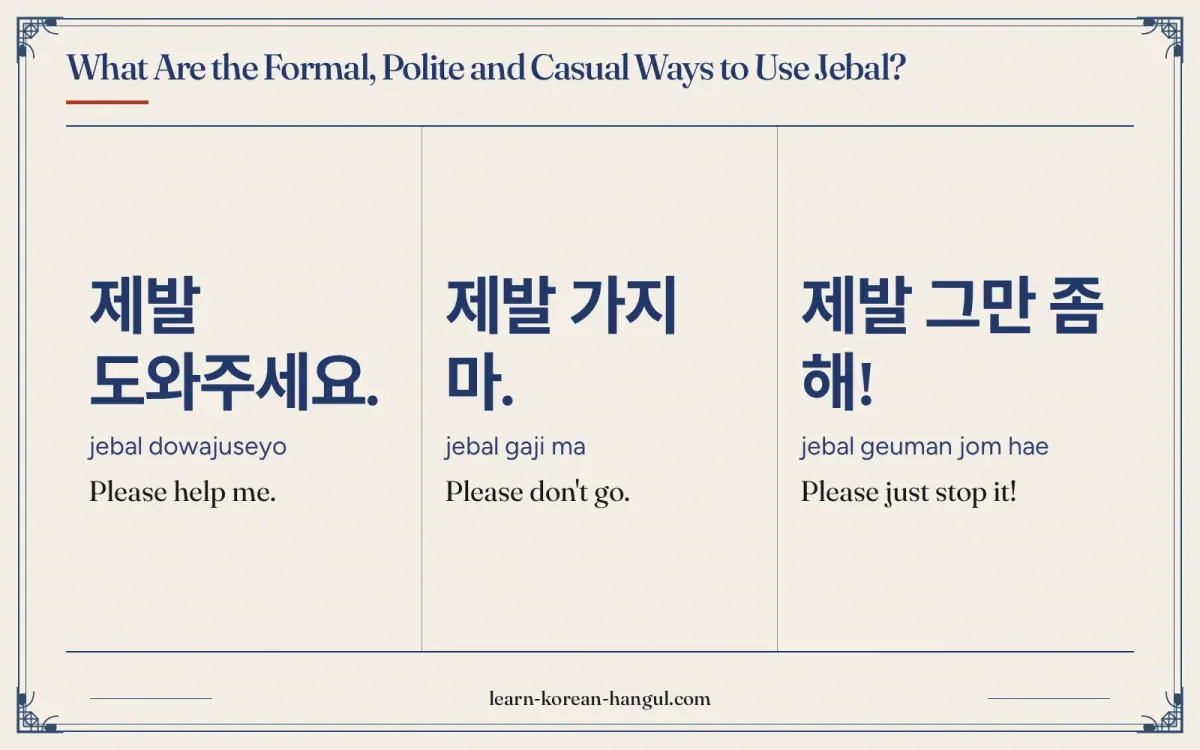
The forms follow the Korean speech levels, explained in the guide to Korean speech levels. 제발 stays the same, and the ending changes.
Polite: 제발 도와주세요 (jebal dowajuseyo)
Polite · 해요체제발 도와주세요 is the form to learn first. It suits strangers, colleagues and anyone you must respect. The verb 도와주다 (to help) gives 도와주세요, a polite request. If you want a plain request without the plea, remove 제발.
제발 도와주세요.
jebal dowajuseyo
Please help me.
In an emergency, shorter words work better. See help in Korean.
Casual: 제발 도와줘 (jebal dowajwo)
Casual · 반말제발 도와줘 drops the polite ending. Use it with close friends, siblings and partners. The casual form is very common in dramas, where it is paired with 가지 마 (don't go).
제발 가지 마.
jebal gaji ma
Please don't go.
The ending 지 마 is the casual form of "don't". The polite form is 가지 마세요.
Formal: 제발 부탁드립니다 (jebal butakdeurimnida)
Formal · 합쇼체제발 부탁드립니다 is the formal form. The verb 부탁드리다 is the humble form of "ask a favor". It fits a serious request to a boss, a customer or an official. It is pronounced [제발 부탁뜨림니다]. A softer polite version is 제발 부탁드려요.
Frustrated: 제발 좀 (jebal jom)
Casual · 반말제발 좀 means "for goodness sake" or "will you please". The word 좀 (a bit) usually softens a request, but with 제발 it shows impatience. It is common with friends and family.
제발 그만 좀 해!
jebal geuman jom hae
Please just stop it!
Use this with care. The speaker is asking for the other person to stop, so it works with a sibling and not with a teacher. Now the pronunciation.
How Do You Pronounce 제발?
제발 is pronounced [제발], je-bal, in two syllables. It sounds just as it is written.
- 제 (je): "jeh", with an unaspirated, light ㅈ.
- 발 (bal): "bahl", with a soft ㅂ and a light ㄹ at the end.
Sound Changes to Listen For
These changes follow the National Institute of Korean Language standard pronunciation rules (표준 발음법):
- Tense after ㄱ. 부탁드립니다 is [부탁뜨림니다]: the ㄱ in 탁 makes the ㄷ of 드 tense (Article 23). See Korean tensification.
- ㅂ before ㄴ becomes ㅁ. The 립니다 part is [림니다] (Article 18). See Korean nasalization.
- The particle 요 after ㄹ. In careful speech the ㄹ of 발 links to 요, [제바료]. In common speech 제발요 is often said [제발료], with a light ㄴ sound before 요 that turns into ㄹ.
Revised Romanization writes jebaryo for 제발요, with no added sound before 요, and does not show the tensing in 부탁드립니다, because it comes from a sound change. With the sound clear, here is when to use the word.
How Do You Add Emotion with Jebal?
You can change the feeling by adding small words. These are the patterns you will hear most.
| Pattern | Korean | Romanization | Meaning |
|---|---|---|---|
| Just this once | 제발 한 번만 | jebal han beonman | please, just once |
| Softer plea | 제발요 | jebaryo | please, I'm asking |
| With a wish | 제발 ~았으면 좋겠어요 | jebal -asseumyeon jokesseoyo | I really hope that... |
| After the sentence | 도와주세요, 제발 | dowajuseyo, jebal | please, please help |
The wish pattern -았/었으면 좋겠다 means "I wish that" or "I hope that". It is pronounced with an aspirated ㅋ, [조케써요], so Revised Romanization shows jokesseoyo.
제발 비가 안 왔으면 좋겠어요.
jebal biga an wasseumyeon jokesseoyo
I really hope it does not rain.
Here 왔으면 is pronounced [와쓰면]. Notice that 제발 can sit in front of a hope as well as in front of a request.
When Should You Use 제발, and When Should You Not?
Use 제발 when the situation is serious or emotional, and when you truly want the listener to act. Do not use it as a general please.
Situations Where It Fits
- Emotional scenes. 제발 가지 마. (Please don't go.)
- A real need. 제발 도와주세요. 길을 잃었어요. (Please help me. I'm lost.)
- Strong hope. 제발 합격하게 해 주세요. (Please let me pass.)
- Frustration with friends. 제발 좀 조용히 해. (Please just be quiet.)
Situations to Avoid
- Ordering food. Say 물 주세요, not 제발 물 주세요.
- A small favor from a colleague. Say 부탁드려요 (I'd like to ask you).
- A formal email. Use 부탁드립니다 without 제발, unless the matter is urgent.
Two short conversations show how it sounds.
What Does Jebal Sound Like in a Real Conversation?
In real life, the word appears at moments of high feeling.
A Drama Farewell
She
제발 가지 마.
jebal gaji ma
Please don't go.
He
미안해. 이미 정했어.
mianhae. imi jeonghaesseo
I'm sorry. I've already decided.
She
제발… 한 번만 생각해 줘.
jebal... han beonman saenggakae jwo
Please... think about it just once.
What to notice: the casual 가지 마 and 생각해 줘 show an intimate relationship. The word 생각해 is pronounced [생가캐], with an aspirated ㅋ.
Asking for Help at Work
Junior
부장님, 제발 한 번만 도와주세요. 마감이 내일이에요.
bujangnim, jebal han beonman dowajuseyo. magami naeirieyo
Sir, please help me just this once. The deadline is tomorrow.
Manager
알았어요. 뭐부터 할까요?
arasseoyo. mwobuteo halkkayo
All right. What shall we start with?
What to notice: the junior uses the title 부장님 and the polite ending, so 제발 adds urgency without being rude. The manager's 할까요 is pronounced [할까요] with a tense ㄲ in its spelling.
What Should You Know about the Culture behind Jebal?
Dramas and songs use 제발 a lot, because they put strong feelings in short phrases. A learner who watches a K-drama will notice it in farewell scenes and in arguments. In everyday life, Koreans use it more lightly, often as an exasperated 제발 좀 with friends.
- Strong, not rude. 제발 shows need, not disrespect, as long as the ending is polite.
- Drama effect. Repeating it, as in 제발, 제발, makes a scene feel urgent.
- Humour. Friends use 제발 jokingly, such as 제발 숙제 좀 끝나게 해 주세요 (please let the homework end), to be dramatic.
An expert tip: when you want to sound warmer in a formal email, 부디 (budi) is a graceful word. It is often used in 부디 건강하세요 (please take care of your health) and is more formal than 제발.
What Mistakes Do Learners Make with Jebal in Korean?
Most mistakes come from treating 제발 as a polite please.
| Mistake | Why it is a problem | Fix |
|---|---|---|
| 제발 주세요 in a shop | Too dramatic for an ordinary request | Say 주세요 |
| 제발 줘 to anyone but a close friend | The casual ending sounds blunt | Say 제발 주세요 |
| 재발 for please | 재발 means recurrence | Write 제발 |
| 제발 to an elder with a casual ending | The ending decides politeness | Say 제발 도와주세요 |
| Too many 제발 in one sentence | Sounds theatrical | Use it once |
| 제발 as a greeting | It is a plea | Use 안녕하세요 |
The pair 제발 and 재발 is a common spelling trap. The word 재발 (jaebal) means that something comes back, such as an illness, as in 병이 재발했어요 (the illness has come back). Check the first vowel: 제 has ㅔ, and 재 has ㅐ.
How Do You Ask Someone to Do Something Nicely?
You can turn a plea into a polite request by choosing the right ending. To a friend, say 제발 도와줄래? (jebal dowajullae?), which means "will you help me?". To a colleague, say 도와주실래요? (dowajusillaeyo?), which uses the honorific -시-. To a boss, use 도와주실 수 있으세요? (dowajusil su isseuseyo?), which means "could you help me?". A plain polite request without a plea is 도와주세요. These questions rise at the end because they are yes-or-no questions.
| Listener | Request | Romanization |
|---|---|---|
| Close friend | 제발 도와줘 | jebal dowajwo |
| Colleague | 제발 도와주세요 | jebal dowajuseyo |
| Boss or customer | 제발 부탁드립니다 | jebal butakdeurimnida |
Is It the Same as Please, Beg or I'm Begging You?
Close, but each folded query has its own wording. The short answers below cover the other searches folded into this page.
- Please jebal in Korean: use 제발 only for a strong plea; use 주세요 for a normal please.
- Beg in Korean: 빌다 (bilda) is the verb to beg, and 애원하다 (aewonhada) is a stronger, formal word.
- I'm begging you in Korean: 제발 부탁이에요 (jebal butagieyo) or 이렇게 빌게요 (ireoke bilgeyo).
- Jebal meaning: please, I beg you, or I really hope.
Now practise aloud.
Practice: Say It Aloud
Play the slow clip of 제발 three times and keep the ㅈ light. Then choose a phrase. Answers follow.
- You beg a stranger for help.
- You plead with a close friend not to leave.
- You make a formal request to a manager.
- How do you say "for goodness sake, stop"?
Answers
- 제발 도와주세요.
- 제발 가지 마.
- 제발 부탁드립니다.
- 제발 그만 좀 해.
The phrase flashcards drill these lines with audio.
Related Phrases to Learn Next
A strong plea leads to the plain request and to emergency words.
- Please in Korean: 주세요 and 부탁드려요 for everyday requests.
- Help in Korean: 도와주세요 and 살려 주세요 when it is urgent.
- Forgive me in Korean: the next step when you plead after a mistake.
This guide belongs to the K-drama Korean phrases collection. What this page does not cover: song lyrics, prayer wording and the full list of request endings. Remember that 제발 is a strong please, the ending sets the politeness, and 주세요 is still the everyday word, and you can say jebal in Korean naturally.
Frequently Asked Questions
What does jebal mean in Korean?
제발 (jebal) means please, but in the strong sense of I beg you. It adds urgency or emotion to a request, such as 제발 도와주세요 (please help me) or 제발 가지 마 (please don't go). It is an adverb, so it does not make the sentence polite on its own. The ending of the verb decides the level.
Is jebal the same as please in Korean?
Not exactly. For an ordinary polite request, Korean uses 주세요 (juseyo) or 부탁드려요 (butakdeuryeoyo), as in 물 주세요 (water, please). 제발 is for pleading or strong hope. If you use 제발 while ordering coffee, it sounds dramatic. Use it when something matters to you a great deal.
How do I use jebal politely in Korean?
Combine 제발 with a polite or formal ending. Say 제발 도와주세요 (jebal dowajuseyo) in polite speech, and 제발 부탁드립니다 (jebal butakdeurimnida) in formal speech. To a close friend, say 제발 도와줘. You may also add 요 to make 제발요 (jebaryo), a short, soft plea, which is common in spoken Korean.
What does jebal jom mean in Korean?
제발 좀 (jebal jom) means for goodness sake or will you please. The word 좀 softens a request, but with 제발 it shows frustration, as in 제발 좀 조용히 해 (please just be quiet). Use it with friends and family, and be careful with colleagues or elders, because it can sound annoyed.
What is the difference between 제발 and 부디?
Both express a strong wish. 제발 (jebal) is spoken and pleading, used in daily talk and drama. 부디 (budi) is more formal and literary and often wishes someone well, as in 부디 건강하세요 (please take care of your health). Use 제발 when you beg for something and 부디 when you hope for it in a formal, kind way.
What mistakes do learners make with jebal in Korean?
Learners mix up 제발 with 재발 (jaebal), which means a recurrence, and they use 제발 for every polite request. Another slip is thinking 제발 is a polite word on its own. A request such as 제발 줘 sounds blunt unless the listener is a close friend; use 주세요. Keep 제발 for pleading, and keep 주세요 for ordering and asking.