How Do You Say Forgive Me in Korean?
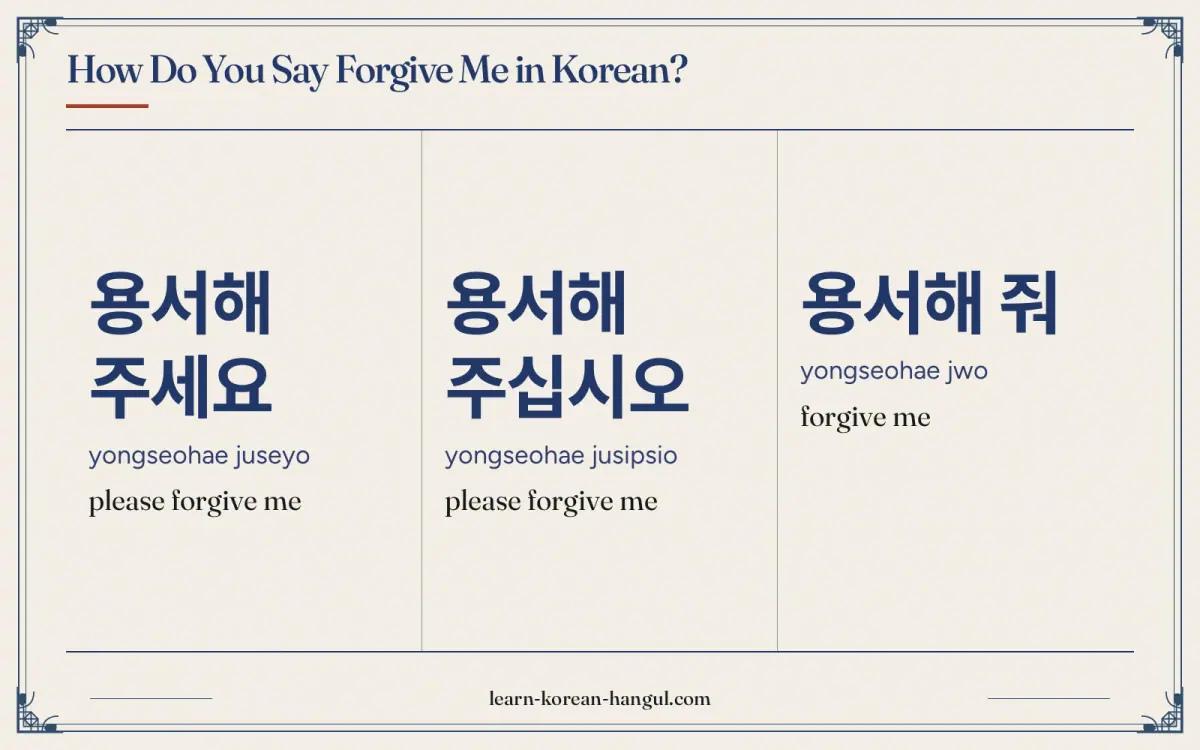
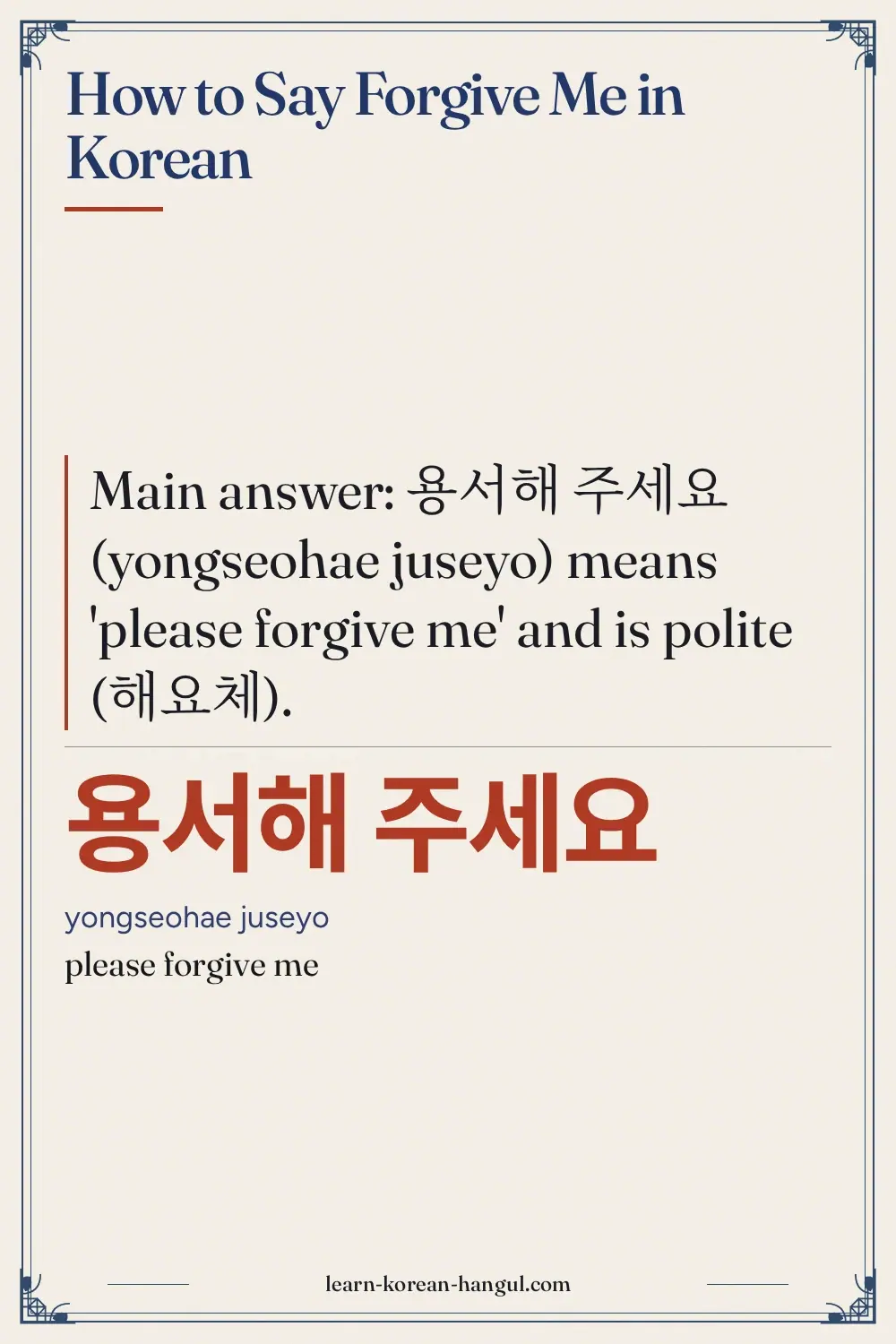
The standard polite way to say forgive me in Korean is 용서해 주세요 (yongseohae juseyo). The phrase has three parts: 용서해 (yongseohae, from the verb 용서하다, "to forgive"), 주 (ju, from 주다, "to give," here meaning "do it for me") and 세요 (seyo, the polite request ending). Together they ask the listener to do the favour of forgiving.
Four forms cover most situations.
| Korean | Revised Romanization | Meaning | Register |
|---|---|---|---|
| 용서해 주세요 | yongseohae juseyo | please forgive me | polite (해요체) |
| 용서해 주십시오 | yongseohae jusipsio | please forgive me | formal (합쇼체) |
| 용서해 줘 | yongseohae jwo | forgive me | casual (해체) |
| 한 번만 봐주세요 | han beonman bwajuseyo | please let it go just this once | polite, asks for leniency |
Revised Romanization (the South Korean government standard of 2000) is a reading aid only. The Hangul is the real spelling. The next section explains how the forms differ by listener.
What Are the Formal, Polite and Casual Ways to Say Forgive Me?
Korean apologies follow the usual levels, and the Korean speech levels explain how the endings change. For "forgive me," the level depends on who was hurt and how serious the mistake was. A serious mistake with a senior person calls for the polite or formal form, and the casual form belongs to close friends.
Polite: 용서해 주세요 (yongseohae juseyo)
용서해 주세요 means "please forgive me" and is the form to learn first. It suits a teacher, a coworker, a neighbour or an older relative, after a real mistake. The speaker usually adds a short bow.
Example: 정말 죄송합니다. 용서해 주세요. (jeongmal joesonghamnida. yongseohae juseyo.) "I am truly sorry. Please forgive me."
Formal: 용서해 주십시오 (yongseohae jusipsio)
용서해 주십시오 means "please forgive me" in the formal style (합쇼체). It appears in formal letters, in public apologies and in drama scenes. The ending -십시오 is the formal request ending, and the phrase sounds solemn.
Example: 모든 잘못은 제게 있습니다. 용서해 주십시오. (modeun jalmoseun jege itseumnida. yongseohae jusipsio.) "All the fault is mine. Please forgive me."
Casual: 용서해 줘 (yongseohae jwo)
용서해 줘 means "forgive me" with no 요, which makes it casual. Close friends and partners hear it after a real argument. The phrase is heavy, so using it for a small slip sounds dramatic.
Example: 내가 잘못했어. 용서해 줘. (naega jalmotaesseo. yongseohae jwo.) "It was my fault. Forgive me."
Polite: 한 번만 봐주세요 (han beonman bwajuseyo)
한 번만 봐주세요 means "please let it go just this once." The verb 봐주다 (bwajuda) means "to overlook, to cut someone some slack," and 한 번만 (han beonman) means "only one time." The phrase asks for leniency instead of full forgiveness, so it fits a late fee, a missed deadline or a first mistake.
Example: 한 번만 봐주세요. 다시는 안 그럴게요. (han beonman bwajuseyo. dasineun an geureolgeyo.) "Please let it go just this once. I won't do it again."
Choosing a Form by Listener
The table gives one clear choice per situation.
| Situation | Best choice | Why |
|---|---|---|
| Serious mistake, senior person | 용서해 주세요 | polite and sincere |
| Public apology, formal letter | 용서해 주십시오 | formal and solemn |
| Small mistake, any listener | 죄송합니다 | lighter than 용서 |
| First slip, asking leniency | 한 번만 봐주세요 | asks for a pass |
| Real argument with a close friend | 용서해 줘 | casual and heavy |
Once the choice is clear, the next step is to hear the words.
How Do You Pronounce 용서해 주세요?
용서해 주세요 is pronounced [용서해 주세요], roughly "yong-seo-hae ju-se-yo," with six syllables in two word groups. Play the slow clip, then the normal clip, and repeat each one aloud.
| Word | Spelled | Spoken | Revised Romanization |
|---|---|---|---|
| 용서해 | 용-서-해 | [용서해] | yongseohae |
| 주세요 | 주-세-요 | [주세요] | juseyo |
What Sound Changes Happen in the Forgive-Me Phrases?
The polite phrase has no big spelling change. The final ㅇ of 용 stays a nasal "ng" sound and does not link to the next syllable, because 서 starts with the consonant ㅅ. Say "yong" with the back of the tongue raised, then "seo" as a new syllable, with no extra vowel between them.
The formal form has one change. In 주십시오, the ㅂ of 십 and the ㅅ of 시 meet, and the Standard Pronunciation Rules (표준 발음법) of the National Institute of Korean Language (국립국어원) make the ㅅ tense, so the form sounds like [주십씨오]. Many learners expect 십시오 to change to [심시오] because ㅂ becomes ㅁ before ㄴ or ㅁ. That change is nasalization, and it does not apply here because ㅅ is not a nasal sound. The page on nasalization shows the cases where it does apply.
With the sounds clear, the next question is when to use the heavy phrase.
When Should You Use 용서해 주세요, and When Should You Not?
Use 용서해 주세요 after a real mistake, when the other person was hurt or inconvenienced in a serious way. 한 번만 봐주세요 asks for leniency instead, and it fits smaller situations, such as a late payment or a missed appointment. For everyday slips, use sorry in Korean, which is lighter and more common.
Situations Where 용서해 주세요 Fits
- A serious mistake at work. Say 용서해 주세요 to a manager after a real error, with a bow.
- A broken promise to a family member. The phrase shows you take the mistake seriously.
- A formal apology letter. Use 용서해 주십시오 as a closing line.
Situations to Avoid with 용서해 줘
- A small slip. Using 용서해 줘 as a casual sorry for small things sounds dramatic. For a stepped-on foot, say 미안해 or 미안해요 (mianhaeyo).
- A stranger in a crowd. Use 죄송합니다 or 실례했습니다 (sillyehaetseumnida), not a plea for forgiveness.
- An elder, in the casual form. Dropping the 요 is rude to a senior person.
If unsure, choose the lighter apology first. The dialogues below show how real apologies sound.
What Does Forgive Me Sound Like in a Real Conversation?
Read each dialogue, play the clip, and say one role aloud.
Dialogue 1: A serious apology at work
- A: 정말 죄송합니다. 용서해 주세요. (jeongmal joesonghamnida. yongseohae juseyo.) "I am truly sorry. Please forgive me."
- B: 괜찮아요. 다음에는 조심하세요. (gwaenchanayo. daeumeneun josimhaseyo.) "It's all right. Be careful next time."
정말 죄송합니다. 용서해 주세요. 괜찮아요. 다음에는 조심하세요.
Dialogue 2: Two friends after a small argument
- A: 한 번만 봐줘. (han beonman bwajwo.) "Cut me some slack, just this once."
- B: 알았어, 이번만이야. (arasseo, ibeonmaniya.) "Okay, only this time."
한 번만 봐줘. 알았어, 이번만이야.
In Dialogue 1, the speaker opens with 죄송합니다 and then adds 용서해 주세요, which raises the apology a step. The reply 괜찮아요 (gwaenchanayo, "it's all right") closes it. The guide to it's okay in Korean shows more answers. In Dialogue 2, both friends use the casual 봐줘 and 알았어. Behind the words lies a cultural idea.
What Should You Know about the Culture behind Forgive Me?
The phrase is heavy and used in serious apologies, in dramas and in formal letters. Korean apologies often carry the idea of 사과 (sagwa, "apology") that is shown by action as well as words: a deep bow, a quiet voice and a promise to do better. The word 용서 (yongseo, "forgiveness") puts the decision in the other person's hands, which is why it feels weighty.
Because the phrase asks the other person to forgive, it can feel like pressure when used lightly. Many speakers prefer 죄송합니다 (joesonghamnida) or 미안해요 (mianhaeyo) for ordinary regret, and keep 용서 for moments when a relationship is at stake. Learners who watch Korean dramas hear 용서해 줘 often, and the drama setting makes it sound more common than it is in daily life. That gap leads to some typical mistakes.
What Mistakes Do Learners Make with Forgive Me in Korean?
The most common mistake is using 용서해 줘 as a casual sorry for small things, which sounds dramatic. Five mistakes appear again and again:
- Using 용서해 줘 for a small slip. Fix: say 미안해 or 미안해요.
- Using 용서해 줘 with an elder. Fix: use 용서해 주세요.
- Writing 용서 해 주세요. 용서하다 is one verb, so 용서해 takes no space inside it. Fix: write 용서해 주세요.
- Mixing up nasalization. Saying [주심시오] instead of [주십씨오]. Fix: remember that ㅅ is not a nasal.
- Asking forgiveness before saying sorry. Fix: open with 죄송합니다, then ask for 용서.
All five come from translating "forgive me" without its weight. A few related searches ask the same thing in other words, so they are answered next.
Short Answers on Forgive Me Please and Pardon
Three searches lead to this page, so each gets a short answer.
- Forgive me please in Korean: The word "please" is already inside 주세요, so 용서해 주세요 covers it.
- Please forgive me in Korean: The same phrase, 용서해 주세요, is the answer.
- Pardon in Korean: For "pardon me" in the sense of "I did not catch that," use 네? (ne?) or 다시 말해 주세요 (dasi malhae juseyo). For "pardon me" as an apology, use 죄송합니다.
The related pages I'm very sorry in Korean and sorry in Korean cover lighter apologies. After the answers, the last step is practice.
Related Phrases to Learn Next
Three pages follow the same layout and pair well with this one:
- Sorry in Korean: the everyday apology.
- I'm very sorry in Korean: a stronger apology without a request for forgiveness.
- It's okay in Korean: how to answer an apology.
The complete list sits in the polite Korean phrases cluster.
Practice: Say It Aloud
Spend five minutes on this routine.
- Play the slow clip of 용서해 주세요 and repeat it three times.
- Say 죄송합니다, then 용서해 주세요, as one two-step apology.
- Say 한 번만 봐주세요 and 한 번만 봐줘, and name the listener for each.
- Hide the Romanization with the toggle and read the four forms from Hangul only.
- Drill the cluster with the phrase flashcards.
When the phrase comes out with a steady, quiet tone, you can say forgive me in Korean when the moment really calls for it.
Frequently Asked Questions
The answers below add details about how to say forgive me in Korean beyond the sections above.
What is the difference between 용서해 주세요 and 죄송합니다?
죄송합니다 means "I am sorry" and fits both small and large mistakes. 용서해 주세요 means "please forgive me" and asks the other person to decide, so it is heavier and fits serious mistakes. Many speakers say 죄송합니다 first and add 용서해 주세요 only when the mistake is real.
What is the difference between 용서해 주세요 and 용서해 주십시오?
Both mean "please forgive me." 용서해 주세요 is polite (해요체) and fits a teacher, a manager or a neighbour. 용서해 주십시오 is formal (합쇼체) and fits formal letters, public statements and drama scenes. The formal form sounds solemn when spoken in daily life.
Is 용서해 주세요 formal or casual?
용서해 주세요 is polite, in the 해요체 style, between formal and casual. The formal version is 용서해 주십시오, and the casual version is 용서해 줘. Choose the ending by the person you are asking and by how serious the mistake is.
Can I use 용서해 주세요 with friends, elders and strangers?
With elders and managers, 용서해 주세요 is the right level for a serious mistake. With friends, the casual 용서해 줘 fits only after a real argument. With strangers, 죄송합니다 is usually enough, because a plea for forgiveness is too heavy for a small bump.
How do I reply when someone says 용서해 주세요?
To accept, say 괜찮아요 (gwaenchanayo, "it's all right") or 용서할게요 (yongseohalgeyo, "I forgive you"). To soften the moment, add 다음에는 조심하세요 ("be careful next time"). With a friend, 괜찮아 (gwaenchana) or 알았어 (arasseo) is enough, and a smile helps the moment pass quickly.
What is the most common mistake with forgive me in Korean?
Learners use 용서해 줘 as a casual sorry for small things, which sounds dramatic, as if a friendship were at stake. Use 미안해요 or 죄송합니다 for everyday slips, and keep 용서해 주세요 for mistakes that really hurt or inconvenienced someone.