
주세요
주세요
What you'll learn
- Ask for any object with noun + 주세요.
- Ask for any action with verb + -아/어 주세요, such as 도와주세요 (please help me).
- Choose between 주세요, 부탁합니다 and 제발 for a shop, a formal request and a desperate plea.
- Pronounce 부탁합니다 as [부타캄니다].
Before you start: you need to read Hangul. Knowing thank you in Korean helps, because most requests end with thanks. Time: about 14 minutes. Audio plays only when you press a button.
How Do You Say Please in Korean?
The everyday way to say please in Korean is 주세요, added to the end of a request. 주세요 comes from 주다 (to give) with the honorific polite ending -세요, so it means "please give". It works in two patterns.
| Pattern | Example | Romanization | Meaning |
|---|---|---|---|
| Noun + 주세요 | 물 주세요 | mul juseyo | Water, please |
| Noun + 좀 주세요 | 영수증 좀 주세요 | yeongsujeung jom juseyo | The receipt, please (softer) |
| Verb + -아/어 주세요 | 도와주세요 | dowajuseyo | Please help me |
| Verb + -아/어 주세요 | 천천히 말해 주세요 | cheoncheonhi malhae juseyo | Please speak slowly |
Building the action pattern takes three steps:
- Take the verb stem: 말하다 (to speak) gives 말하-.
- Add -아/어/해: 말하- becomes 말해.
- Add 주세요: 말해 주세요, "please speak (for me)".
The verb 주다 here means "for my benefit", which is why the pattern sounds like a request rather than an order. The next section sets out the main forms by politeness.
What Are the Formal, Polite and Casual Ways to Say Please?
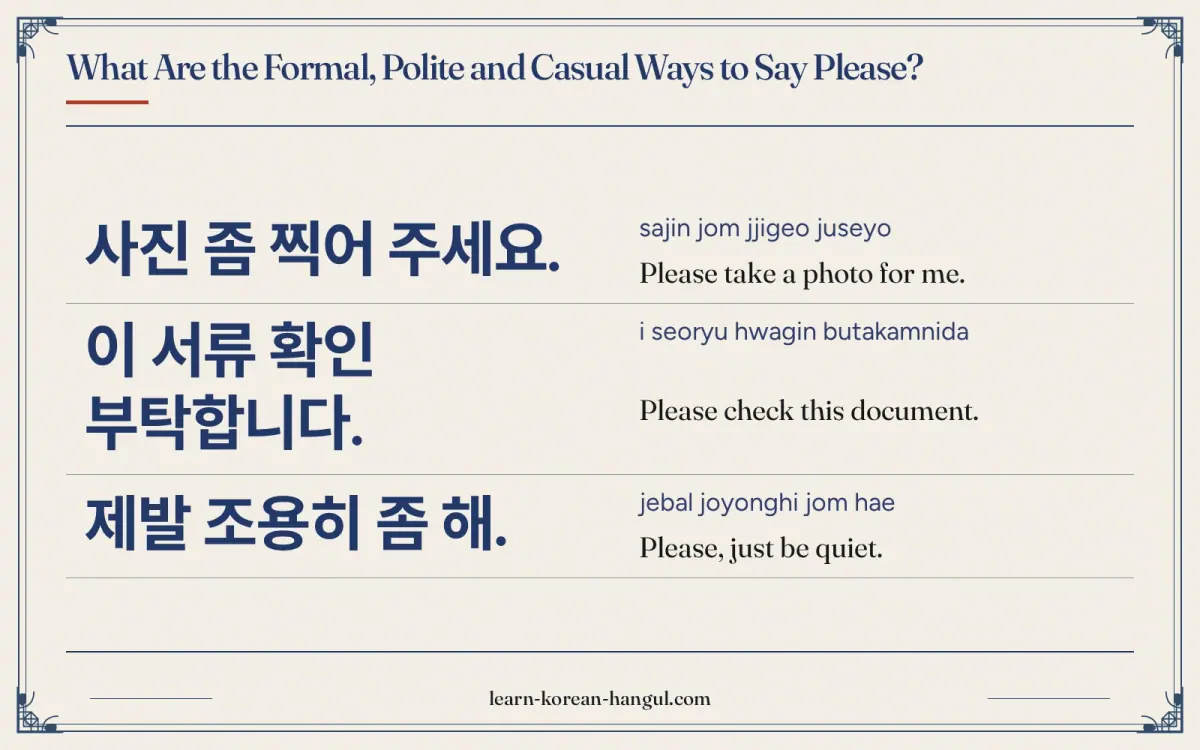
Please follows the Korean speech levels, the endings that change with the listener, explained in the guide to Korean speech levels. With strangers and staff, the polite -세요 form is standard.
Polite: 주세요 (juseyo)
Polite · 해요체주세요 is the request you will use most: in cafés, shops, taxis and markets. It is polite on its own, and adding 좀 (a little) before it makes it softer and more natural.
아이스 아메리카노 한 잔 주세요.
aiseu amerikano han jan juseyo
One iced Americano, please.
For an even gentler tone, ask a question: 주시겠어요? (would you give me?), as in 포장해 주시겠어요? (could you wrap it to go?).
Polite: 해 주세요 (hae juseyo)
Polite · 해요체해 주세요 is the action version: "please do it (for me)". Any verb can go in front, in its -아/어 form. In a taxi, 여기서 세워 주세요 means "please stop here".
사진 좀 찍어 주세요.
sajin jom jjigeo juseyo
Please take a photo for me.
Formal: 부탁합니다 (butakamnida)
Formal · 합쇼체부탁합니다 means "I ask this of you" or "I'm counting on you". It follows a request to stress that it is a favour, especially at work. The polite 부탁해요 and the humble 부탁드립니다 are common variants.
이 서류 확인 부탁합니다.
i seoryu hwagin butakamnida
Please check this document.
The set phrase 잘 부탁드립니다 is said when you start working or studying with someone, roughly "I look forward to working with you".
Casual: 제발 (jebal)
Casual · 반말제발 is an emotional please, "please, I beg you". It adds urgency to a request and is used when you are desperate, frustrated or joking. It is not a register of its own: 제발 can sit before a polite ending, but the tone stays emotional.
제발 조용히 좀 해.
jebal joyonghi jom hae
Please, just be quiet.
With friends, the casual versions of the patterns drop -세요: 물 줘 (water, please) and 도와줘 (help me). Pronouncing the main forms is next.
How Do You Pronounce 주세요?
주세요 is pronounced as written, [주세요], juseyo, in three even syllables: ju-se-yo, with no strong stress.
- 주 (ju): a soft j, between English "j" and "ch" but without a puff of air, then "oo".
- 세 (se): "seh".
- 요 (yo): short and level; do not stretch it into "yoh-oo".
Sound Changes to Listen For
Two of the forms on this page change in speech, following the National Institute of Korean Language Standard Pronunciation rules (표준 발음법):
- 부탁합니다 is [부타캄니다]. The ㄱ at the end of 탁 meets the ㅎ of 합 and they merge into ㅋ, a change called aspiration, explained in Korean aspiration rules. Then ㅂ before ㄴ becomes ㅁ. Revised Romanization follows the sound, butakamnida, although many learner materials write butakhamnida.
- 부탁해요 is [부타캐요]. The same ㄱ + ㅎ merge gives ㅋ.
- 주십시오 is [주십씨오]. In the formal command form, the ㅂ of 십 tenses the next ㅅ.
With the sounds in place, the next question is when each request form fits.
When Should You Use 주세요, and When Should You Not?
Use 주세요 for everyday requests to staff, strangers and anyone you speak politely to. Avoid it only with close friends, where 줘 is natural, and in very formal writing, where 주십시오 or 부탁드립니다 fit better.
Situations Where It Fits
- Ordering food or drinks. 김밥 하나 주세요 (one gimbap, please).
- Asking for directions or help. 길 좀 알려 주세요 (please tell me the way).
- Taxis. 서울역으로 가 주세요 (to Seoul Station, please).
- Emergencies. 도와주세요 (help me), covered in more detail in help in Korean.
Situations to Avoid
- Close friends. 주세요 sounds distant; use 줘 or 해 줘.
- Formal written requests. Use 부탁드립니다 or -아/어 주시기 바랍니다 in work emails and notices.
- Shop requests with 제발. It sounds like begging; 주세요 is enough.
- Elders with 줘. The casual form is too blunt; use 주세요 or 주시겠어요?
The dialogues below show requests in typical everyday settings.
What Does Please Sound Like in a Real Conversation?
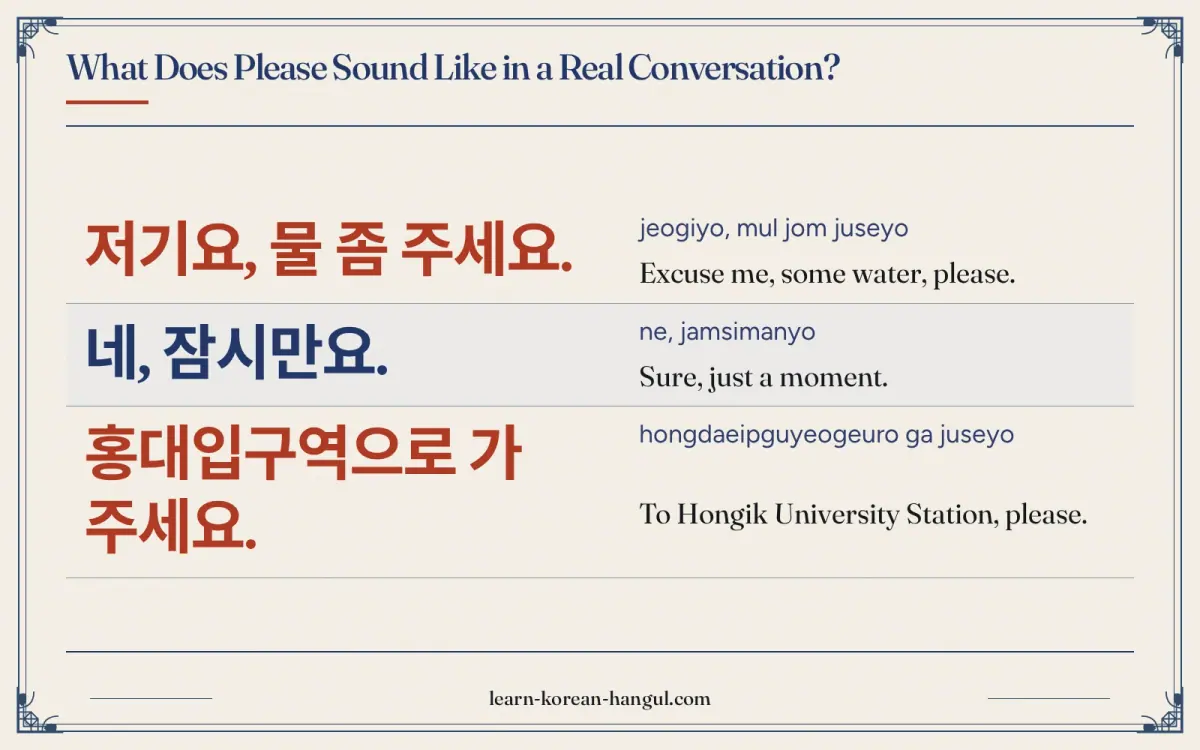
A Korean request is usually short and ends in 주세요 or a related form, often followed by thanks. Listen for 좀 and the question form.
Asking for Water
Customer
저기요, 물 좀 주세요.
jeogiyo, mul jom juseyo
Excuse me, some water, please.
Server
네, 잠시만요.
ne, jamsimanyo
Sure, just a moment.
What to notice: 저기요 gets attention, then 물 좀 주세요 makes the request. The full scene is on water please in Korean, and calling staff is explained in excuse me in Korean.
In a Taxi
Passenger
홍대입구역으로 가 주세요.
hongdaeipguyeogeuro ga juseyo
To Hongik University Station, please.
Driver
네.
ne
Okay.
Passenger
여기서 세워 주세요. 감사합니다.
yeogiseo sewo juseyo. gamsahamnida
Please stop here. Thank you.
What to notice: 가 주세요 and 세워 주세요 are both verb + -아/어 주세요.
Asking a Colleague for a Favour
Hyejin
이 보고서 한번 봐 주실 수 있어요?
i bogoseo hanbeon bwa jusil su isseoyo?
Could you take a look at this report?
Colleague
네, 오후에 볼게요.
ne, ohue bolgeyo
Sure, I'll look this afternoon.
Hyejin
감사합니다. 부탁해요.
gamsahamnida. butakaeyo
Thank you. I appreciate it.
What to notice: the question form 봐 주실 수 있어요? (could you look for me?) is softer than a direct request. That preference for indirect requests is part of the culture of asking.
What Should You Know about the Culture behind Please?
Korean politeness in requests comes from the verb ending, not from an extra word, so a Korean request without "please" is not rude.
- Endings carry politeness. 물 주세요 is already as polite as "Could I have some water, please?"
- 좀 softens. Adding 좀 (literally "a little") makes a request lighter and is extremely common in speech.
- Questions soften further. 해 주실 수 있어요? (could you do it for me?) is gentler than 해 주세요.
- Thanks closes. Most requests end with 감사합니다 after the favour.
An expert insight: learners often translate "please" word for word and reach for 제발 because dictionaries list it first. In daily life, 제발 is the please of a desperate parent or a sports fan watching a penalty, not of a café order. The mistakes below follow from this kind of literal translation.
What Mistakes Do Learners Make with Please in Korean?
Most please mistakes come from looking for a single word instead of using the request ending.
| Mistake | Why it is a problem | Fix |
|---|---|---|
| Using 제발 in shops: 제발 커피 주세요 | Sounds like begging | Say 커피 주세요 |
| Saying 줘 to staff or elders | Casual ending | Say 주세요 |
| Using a bare verb stem + 주세요: 말하 주세요 | Missing the -아/어 form | Say 말해 주세요 |
| Mixing -세요 and -아/어 주세요 meanings | 가세요 means "go", 가 주세요 means "go (for me)" | Use 가 주세요 in a taxi |
| Pronouncing 부탁합니다 with k + h | ㄱ + ㅎ merge into ㅋ | Say [부타캄니다] |
Learners often assume 주세요 sounds bossy because it looks like an order. Actually, the -시- and -요 inside 주세요 make it a polite request, which is why every Korean uses it with shop staff all day.
Is 주세요 the Same as a Formal Please?
Partly. The formal version of please in Korean is 주십시오 or, in writing, 부탁드립니다; 주세요 is the everyday polite form. The answers below cover the other searches folded into this page.
- Please formal in Korean: 주십시오, 주시겠어요?, or 부탁드립니다.
- Please casual in Korean: 줘 or 해 줘 with friends.
- Please give me in Korean: noun + 주세요, as in 이거 주세요 (this one, please).
- Please help in Korean: 도와주세요.
- Please in Korean juseyo: yes, 주세요 (juseyo) is the most common please ending.
- Pls in Korean: in texts, friends write 제발 or ㅈㅂ (an abbreviation of 제발) for a playful plea.
Now practise building requests aloud.
Practice: Say It Aloud
Play the slow clip of 주세요, repeat it three times, then 도와주세요 and 부탁합니다. Then make a request for each situation. Answers follow.
- Ask a server for the menu (메뉴).
- Ask a stranger to speak more slowly (천천히 말하다).
- Ask a taxi driver to go to the airport (공항).
- End a work email asking a colleague to check a file.
Answers
- 메뉴 좀 주세요.
- 천천히 말해 주세요.
- 공항으로 가 주세요.
- 확인 부탁드립니다.
The phrase flashcards drill request patterns with audio.
Related Phrases to Learn Next
Please is half of a polite exchange; the other phrases complete it.
- Thank you in Korean: 감사합니다 after the request is done.
- Excuse me in Korean: 저기요 and 여기요 to get attention first.
- Help in Korean: 도와주세요 for urgent situations.
This guide belongs to the polite Korean phrases collection. What this page does not cover: the full grammar of -아/어 주다 and formal written requests, which belong to the grammar lessons. Put 주세요 after what you want, add 좀 when you want to soften it, and you can say please in Korean in any shop or office.
Frequently Asked Questions
Is 주세요 rude because it sounds like a command?
No. 주세요 contains the honorific -시- and the polite -요, so it is a polite request, not a bare command. Saying 커피 주세요 to a barista is normal and courteous. To sound even softer, add 좀 before it, as in 커피 좀 주세요, or use the question form 주시겠어요?
How do you say yes please in Korean?
Say 네, 주세요 (ne, juseyo), yes, please give it to me, when offered something like a bag or a refill. For an action, say 네, 부탁해요 (yes, I'd appreciate it). A simple 네, 감사합니다 (yes, thank you) also accepts an offer politely and is very common in shops.
What does 잘 부탁드립니다 mean?
잘 부탁드립니다 (jal butakdeurimnida) is a set phrase said when you start working, studying or living with someone. It means roughly please treat me well or I look forward to working with you. Korean uses it at first meetings in offices and classes, often after giving your name and bowing.
What is the difference between 앉으세요 and 앉아 주세요?
앉으세요 is a polite instruction, please sit, often an invitation from a host. 앉아 주세요 asks the listener to sit as a favour to you, for example when a photographer needs everyone seated. Both are polite. The -세요 form focuses on the listener's comfort; the -아/어 주세요 form focuses on your request.
How do you say please in Korean in a text message?
Text requests use the same endings: 사진 보내 주세요 (please send the photo) or, to friends, 사진 보내 줘. Young people sometimes add ㅠㅠ (crying eyes) or 제발 for a playful begging tone. In work messages, 부탁드립니다 (I respectfully ask) at the end of the request is common and polite.