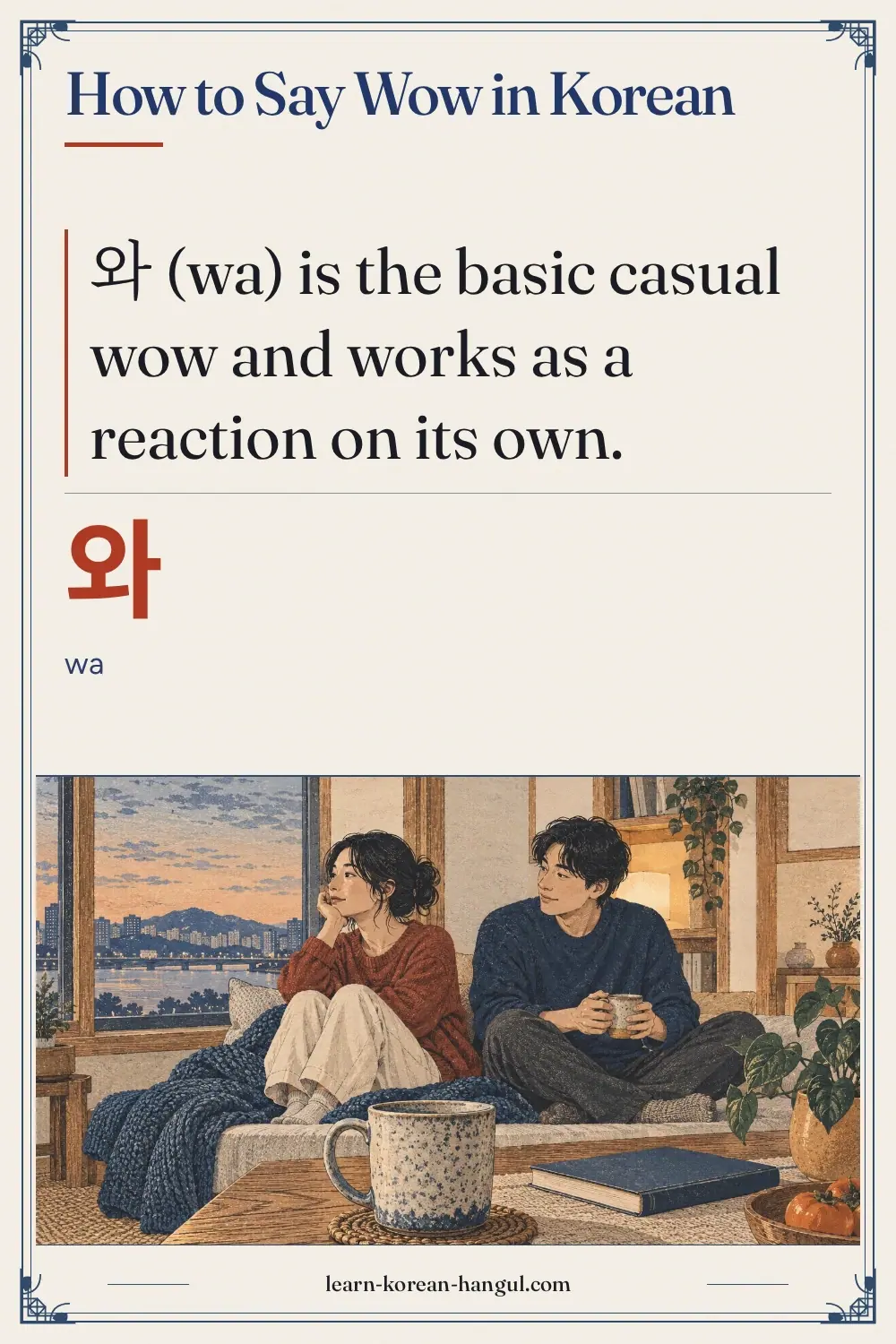
와
와
What you'll learn
- Say wow with 와, 우와, 대박 and 놀랍네요 and know how excited each one sounds.
- Choose a reaction for a friend, a boss and a stranger.
- Say 대박이다 as [대바기다] and 놀랍네요 as [놀람네요].
- Avoid slang with elders and cheerful reactions to sad news.
Before you start: knowing hello in Korean helps, because reactions follow greetings in small talk. Time: about 12 minutes. Audio plays only when you press a button.
How Do You Say Wow in Korean?
The basic answer is 와, but Korean has several wows that differ in excitement and politeness. Think of them as a short ladder: calm and casual at the bottom, polite at the top.
| Form | Romanization | Feeling | Best listener |
|---|---|---|---|
| 와 | wa | Wow, impressed | Friends, family, yourself |
| 우와 | uwa | Wow, very excited | Friends, children |
| 대박 | daebak | Awesome, unbelievable (slang) | Friends and peers |
| 놀랍네요 | nollamneyo | That's amazing (polite) | Seniors, strangers, coworkers |
Wow is an interjection (감탄사), a word that carries a feeling and needs no verb. 와 and 우와 are sounds of surprise, so they have no formal or polite versions. For formal situations, Korean uses a full sentence such as 놀랍네요 or 대단하네요 ("that's impressive"). The next section shows each form in use.
What Are the Polite and Casual Ways to Say Wow?
Korean marks the listener with speech levels, explained in the guide to Korean speech levels. Wow sounds are casual by nature, so polite speech adds a sentence ending, and the choice of word does the rest.
Casual: 와 (wa)
Casual · 반말와 reacts to something good or surprising: tasty food, a nice view, a big number. It is short, and you can stretch it for effect. Add the polite -요 to a following sentence if the listener is older.
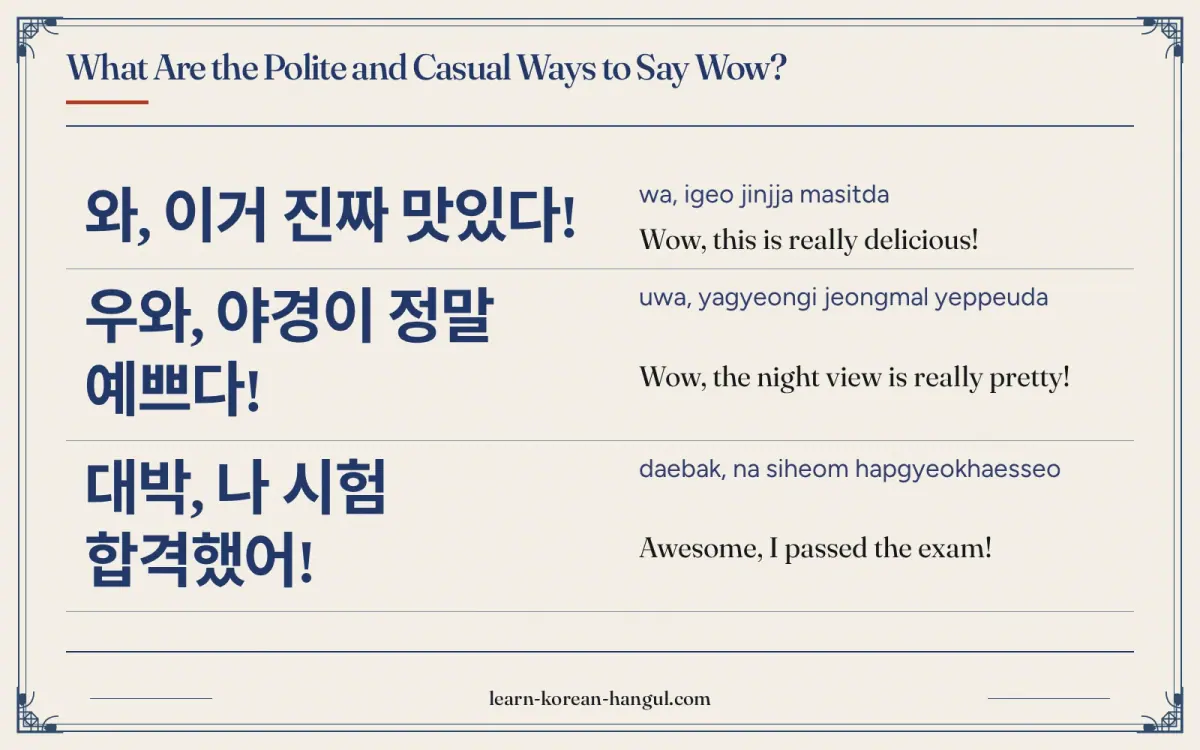
와, 이거 진짜 맛있다!
wa, igeo jinjja masitda
Wow, this is really delicious!
Casual: 우와 (uwa)
Casual · 반말우와 is 와 with extra feeling. It is common when you are amazed by something beautiful or huge, and it often comes with a rising tone.
우와, 야경이 정말 예쁘다!
uwa, yagyeongi jeongmal yeppeuda
Wow, the night view is really pretty!
Casual: 대박 (daebak)
Casual · 반말대박 is slang for "awesome", "amazing" or "no way". It reacts to news and has more punch than 와. Use it with friends and classmates, but not with a boss or an elder.
대박, 나 시험 합격했어!
daebak, na siheom hapgyeokhaesseo
Awesome, I passed the exam!
Polite: 놀랍네요 (nollamneyo)
Polite · 해요체놀랍네요 comes from 놀랍다, "to be surprising". The ending -네요 shows that you have just noticed something, and -요 keeps it polite. Use it with coworkers, teachers and people you have just met.
정말 놀랍네요. 어떻게 만드셨어요?
jeongmal nollamneyo. eotteoke mandeusyeosseoyo?
That's really amazing. How did you make it?
Polite Replacements for a Senior
With a boss or an elder, 정말요? (jeongmaryo?, "really?") and 대단하네요 (daedanhaneyo, "that's impressive") replace 와 and 대박. They sound respectful and show that you are listening.
정말요? 대단하네요.
jeongmaryo? daedanhaneyo
Really? That's impressive.
Choosing the form is easier once you can hear the sounds, so pronunciation comes next.
How Do You Pronounce 와?
와 is a short [와], pronounced "wah", and it takes one beat. The vowel ㅘ glides from ㅗ to ㅏ in one syllable, and the silent ㅇ in front means there is no consonant before it.
- 와 (wa): round your lips for "w" and open into "ah".
- 우와 (u-wa): two beats, "oo" then "wah".
- 대박 (dae-bak): "deh" and "bahk"; the final ㄱ is held without a puff of air.
- 놀랍네요 (nol-lam-ne-yo): four beats, said smoothly as [놀람네요].
Sound Changes to Listen For
Two small changes shape these reactions:
- Liaison on 대박이다. The final ㄱ of 대박 moves onto the silent ㅇ of 이다, giving [대바기다] ("it's awesome"). The same linking is described in the liaison rules.
- Nasalization in 놀랍네요. The ㅂ in 랍 sits before ㄴ, so it is said as ㅁ: [놀람네요]. See ㅂ-to-ㅁ nasalization. The ㄹ at the end of 놀 and the ㄹ at the start of 랍 join into one long l, written ll in Revised Romanization.
After the sound comes the judgment about when each wow is safe.
When Should You Use 와, and When Should You Not?
Use 와 and 우와 when you are impressed by something good, and use 대박 when the news is big and the listener is a friend. Avoid all three with elders in formal settings, and avoid them for sad news.
Situations Where It Fits
- Food and sights. 와 and 우와 suit a great meal, a view or a gift.
- Good news from friends. 대박 matches a friend's promotion, exam pass or surprise.
- Talking to yourself. A quiet 와 at a good price is natural and harmless.
Situations to Avoid
- Slang with elders. 대박 sounds too casual for a boss, a teacher or a parent of a friend.
- Cheerful wow for sad news. 우와 after a funeral announcement sounds careless.
- Wow for a serious achievement told by a senior. Use 대단하네요 instead.
Short exchanges show the same rules at work.
What Does Wow Sound Like in a Real Conversation?
Three short exchanges cover a friend, a boss and a shared view. Listen for the reaction in the first line of each reply.
A Friend Passes an Exam
Minji
나 시험 합격했어!
na siheom hapgyeokhaesseo
I passed the exam!
Sujin
와, 대박! 축하해!
wa, daebak! chukahae
Wow, awesome! Congratulations!
What to notice: Sujin stacks 와 and 대박 for extra feeling, then adds 축하해 (congratulations), which is also casual.
Good News from a Team Leader
Team Leader
오늘 계약이 성사됐어요.
oneul gyeyagi seongsadwaesseoyo
The contract was concluded today.
You
정말요? 대단하네요. 축하드립니다.
jeongmaryo? daedanhaneyo. chukadeurimnida
Really? That's impressive. Congratulations.
What to notice: 축하드립니다 is the humble "congratulations" for a senior, which keeps the whole reply respectful.
Looking at the Night View
Friend
저기 봐. 야경이 정말 예쁘다.
jeogi bwa. yagyeongi jeongmal yeppeuda
Look over there. The night view is really pretty.
You
우와, 진짜 예쁘다!
uwa, jinjja yeppeuda
Wow, it's really pretty!
What to notice: 진짜 is the casual "really". For the question form, see really in Korean. Behind these reactions sit some habits of Korean speech.
What Should You Know about the Culture behind Wow?
Short spoken reactions are a normal part of Korean conversation, and the words carry social signals.
- 대박 started as a "jackpot" word. It is commonly explained as a big hit or windfall, and the exact origin is debated. People wish a new shop or product 대박 나세요 (daebak naseyo), "I hope it's a big hit", as a good-luck wish.
- 대박 can also be bad. Among friends, 대박 reacts to shocking things, such as losing a wallet, so tone and face carry the meaning.
- Listening is shown aloud. Short sounds such as 와 and 정말요? tell a speaker that you are following the story.
- Seniors get fuller replies. A bare 대박 can feel like you are not taking the speaker seriously.
An expert insight: the spelling 와 is also a particle meaning "and" or "with" after a vowel, as in 친구와 (with a friend). Context separates them, since the interjection stands alone with a comma or an exclamation.
What Mistakes Do Learners Make with Wow in Korean?
Most mistakes come from using one wow for every listener or every mood.
| Mistake | Why it is a problem | Fix |
|---|---|---|
| 대박 to a boss or elder | It is slang | Say 정말요? or 대단하네요 |
| 우와 after sad news | It sounds cheerful | Stay quiet, or say 힘드시겠어요 |
| Writing "wow" as 와우 for everything | 와우 is a borrowed word and sounds playful | Use 와 or 우와 |
| Saying 놀랍네요 to a close friend | It sounds stiff | Say 와 or 대박 |
| Stretching 와 with a flat tone | It sounds bored | Use rising pitch and a smile |
Learners often assume 대박 is the standard word for wow because it is popular on social media. Actually, 대박 is slang, while 와 is the neutral base, and the fix is to start with 와 whenever you are unsure.
Is "Wow Korean" the Same as Wow in Korean?
Yes, the search "wow korean" asks for the Korean way to say wow, and this page answers it.
- Wow korean: 와 for a simple reaction, 우와 for a bigger one.
- Wow in Korean, polite: 놀랍네요 or 대단하네요.
- Wow in Korean, slang: 대박.
Now practise matching each reaction to a listener.
Practice: Say It Aloud
Play the slow clip of 와 three times and repeat it. Then choose a reaction for each situation. Answers follow.
- Your friend shows a photo of a huge cake.
- Your boss says the company won a contract.
- You see a rainbow alone.
- A coworker tells you that she speaks four languages.
Answers: 1. 우와 or 대박. 2. 정말요? 대단하네요. 3. 와. 4. 놀랍네요 or 대단하네요.
Drill these with the phrase flashcards.
Related Phrases to Learn Next
- Daebak in Korean: the slang in depth, and how it compares with wow.
- Really in Korean: 진짜 and 정말 to keep a conversation going.
- Omg in Korean: stronger reactions of surprise.
This guide belongs to the common responses and fillers collection. What this page does not cover: other slang reactions and text-message spellings. Start with 와, add 대박 for friends and 놀랍네요 for seniors, and you can say wow in Korean to anyone.
Frequently Asked Questions
What is the difference between 와 and 우와?
Both are casual wows. 와 is short and calm, while 우와 is longer and shows stronger delight, often with a rising tone. Use 와 for ordinary good news and 우와 for something beautiful, huge or surprising. Neither is polite, so add a polite sentence when you speak to an elder.
Is 와 formal or casual?
It is casual. 와 is an interjection, so it has no formal ending. You can still say it to a polite listener if you follow it with a polite sentence, such as 와, 정말 맛있어요. For a fully respectful reaction, use 놀랍네요 or 대단하네요 instead of a bare 와.
Can I use 와 with friends, elders and strangers?
With friends, yes. With a stranger, a quiet 와 about food or a view is fine, but a polite sentence is safer. With elders, add -요 or use 정말요? and 대단하네요. Keep 대박 for friends and people your own age.
Is 대박 rude?
It is not rude with friends, but it is slang. Teachers, bosses and older relatives may find it too casual, and it can sound careless if the news is serious. If you are unsure, say 정말요? or 대단하네요 and you will not offend anyone.
What is the most common mistake with wow in Korean?
Using 대박 or 우와 in the wrong setting. Both are casual and cheerful, so they clash with a respectful conversation or with sad news. Match the reaction to the listener: 와 for friends, 정말요? and 대단하네요 for seniors, and silence or a quiet word for bad news.