
정말요?
정말요?
What you'll learn
- Say 정말요? and 진짜요? with the rising pitch that makes them reactions.
- Choose between 정말요?, 진짜요?, 진짜? and 그래요? for a senior, a peer and a friend.
- Explain why 정말이에요? sounds more doubtful than 정말요?.
- Use 정말 and 진짜 as the adverb "really" in sentences such as 정말 맛있어요.
Before you start: knowing hello in Korean helps, because every form here uses the same polite and casual endings. Time: about 12 minutes. Audio plays only when you press a button.
How Do You Say Really in Korean?
The standard way to say really in Korean is 정말요?, made of 정말 (jeongmal, really, truly) plus the polite particle 요 (yo). A rising pitch on the last syllable turns it into a surprised reaction, much like "Really?" in English. The same word 정말 also works as an adverb inside sentences, as in 정말 좋아요 (it is really good).
| Form | Romanization | Register | Say it to |
|---|---|---|---|
| 정말요? | jeongmaryo | Polite (해요체) | Coworkers, teachers, strangers, seniors |
| 진짜요? | jinjjayo | Polite, friendly | Peers, and seniors you know well |
| 진짜? | jinjja | Casual (해체) | Close friends, siblings |
| 그래요? | geuraeyo | Polite (해요체) | Anyone; softer and more neutral |
| 정말이에요? | jeongmarieyo | Polite (해요체) | Anyone, when you really want confirmation |
Five reactions share one meaning but differ in warmth and distance, so the next section pairs each with a listener.
What Are the Polite and Casual Ways to Say Really?
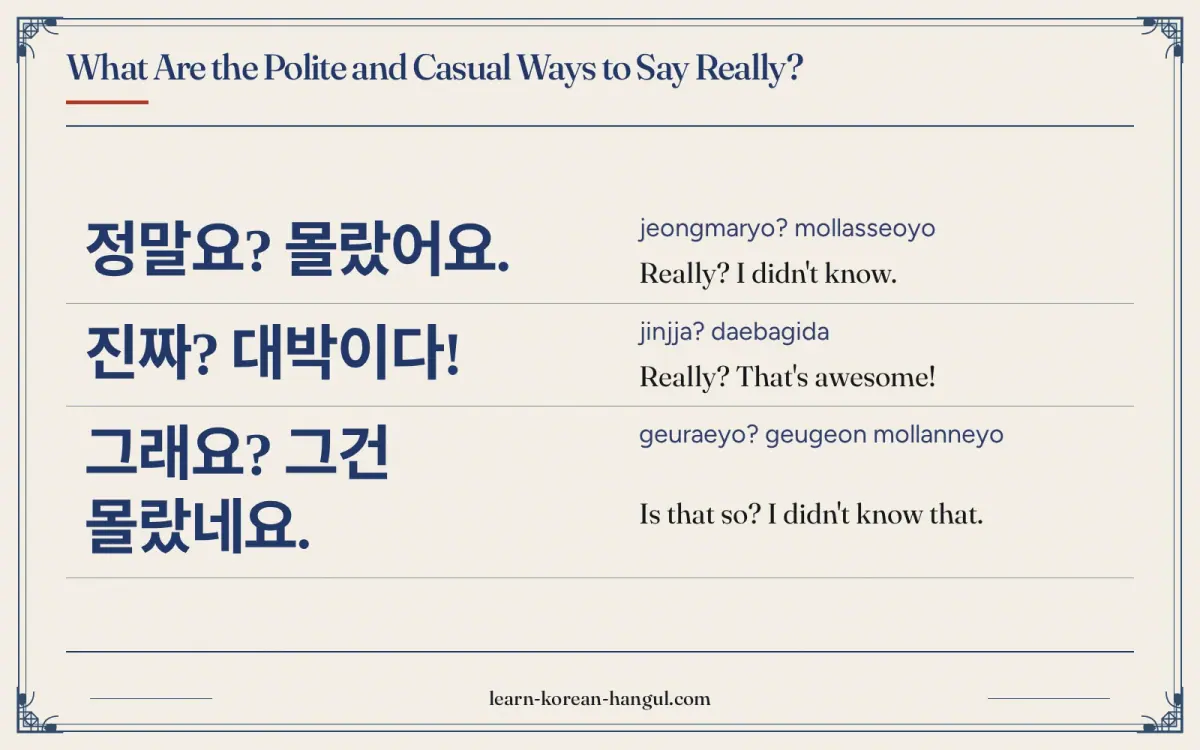
Really follows the Korean speech levels, explained in the guide to Korean speech levels. The word changes in two ways: the ending (요 or none) and the choice between 정말 and 진짜.
Polite: 정말요? (jeongmaryo)
Polite · 해요체정말요? is the neutral polite reaction. It fits a coworker, a teacher, a shop assistant and a stranger, and it is the safest choice with seniors. 정말 is slightly more neutral and polished than 진짜.
정말요? 몰랐어요.
jeongmaryo? mollasseoyo
Really? I didn't know.
Polite: 진짜요? (jinjjayo)
Polite · 해요체진짜요? is polite but warmer and more everyday. People use it with peers, juniors and seniors they know well. It adds a little more excitement than 정말요?, so keep it away from stiff formal meetings.
진짜요? 저도 거기 가 봤어요.
jinjjayo? jeodo geogi ga bwasseoyo
Really? I've been there too.
Casual: 진짜? (jinjja)
Casual · 반말진짜? drops the 요, so it is casual. Use it with close friends, siblings and people your age who already speak casually to you. Friends often stretch it, as in 진~짜?, to show strong surprise.
진짜? 대박이다!
jinjja? daebagida
Really? That's awesome!
Polite: 그래요? (geuraeyo)
Polite · 해요체그래요? means "is that so?" or "oh, really?". It is calmer than 정말요?, because it receives news without expressing much surprise. It suits information, such as opening hours or directions, and it is ideal when you want to sound interested but unhurried.
그래요? 그건 몰랐네요.
geuraeyo? geugeon mollanneyo
Is that so? I didn't know that.
Polite: 정말이에요? (jeongmarieyo)
Polite · 해요체정말이에요? literally asks "is it true?" (정말 plus 이에요, "is"). It checks the facts rather than reacting, so it can sound doubtful. Use it when you really want confirmation, for example after unexpected bad news or a surprising price.
정말이에요? 확실해요?
jeongmarieyo? hwaksilhaeyo
Is it true? Are you sure?
All five can be said correctly only with the right pitch and sounds, which are covered next.
How Do You Pronounce 정말요?
정말요 is pronounced [정말료], jeongmaryo, in three syllables, and the question mark means the last syllable rises. Many speakers add an l-like sound before 요, which is why the common romanization has two l letters.
- 정 (jeong): a soft j, then "uh" (ㅓ), ending in the "ng" of "sing".
- 말 (mal): "mahl", with the tongue touching the roof of the mouth for ㄹ.
- 요 (yo): "yoh", often heard as "lyo" after ㄹ, with the pitch rising.
Sound Changes to Listen For
Four details from the National Institute of Korean Language Standard Pronunciation Rules (표준 발음법) and natural speech matter here.
- The extra l sound in 정말요. After 말, many speakers say 요 as [료], so 정말요 is heard as [정말료]. This is common speech rather than a spelling rule, and the spelling stays 정말요.
- Liaison in 정말이에요. The ㄹ of 말 moves to the empty syllable 이, so 정말이에요 is [정마리에요]. The rule is explained in Korean liaison.
- The tense ㅉ in 진짜. ㅉ is a tense consonant letter: say it with a tight throat and no puff of air. The sound-change rule that makes plain consonants tense is covered in Korean tensification.
- Rising pitch. Pitch rises on the last syllable for a reaction. Without it, 정말요 can sound like a flat statement or like sarcasm.
With the sounds covered, the next question is when each form is safe to use.
When Should You Use 정말요?, and When Should You Not?
Use 정말요? or 진짜요? to react with surprise in conversation, 진짜? with close friends, and 그래요? when you want a calm response. 진짜 is friendlier among peers, while 정말 is the safer neutral choice with seniors.
Situations Where It Fits
- Good news from a coworker. 정말요? 축하해요! (Really? Congratulations!)
- A friend's big story. 진짜? 그래서 어떻게 됐어? (Really? So what happened?)
- Facts you did not know. 그래요? 고마워요. (Is that so? Thank you.)
- A listener's encouragement. Short reactions such as 정말요? and 그래요? signal that you are following the story.
Situations to Avoid
- A formal meeting with a boss. 진짜 is too casual. Use 정말요? or the formal 그렇습니까? (geureoseumnikka, is that so?).
- A plain reaction with 정말이에요? It asks for confirmation and can sound as if you doubt the speaker.
- A stranger, with 진짜?. The missing 요 sounds rude.
- Serious bad news. Reactions such as 진짜? can sound light-hearted. Use 아, 그래요? in a low voice, or say 정말 안타까워요 (that is really sad).
The short scenes below show each type of reaction in conversation.
What Does Really Sound Like in a Real Conversation?
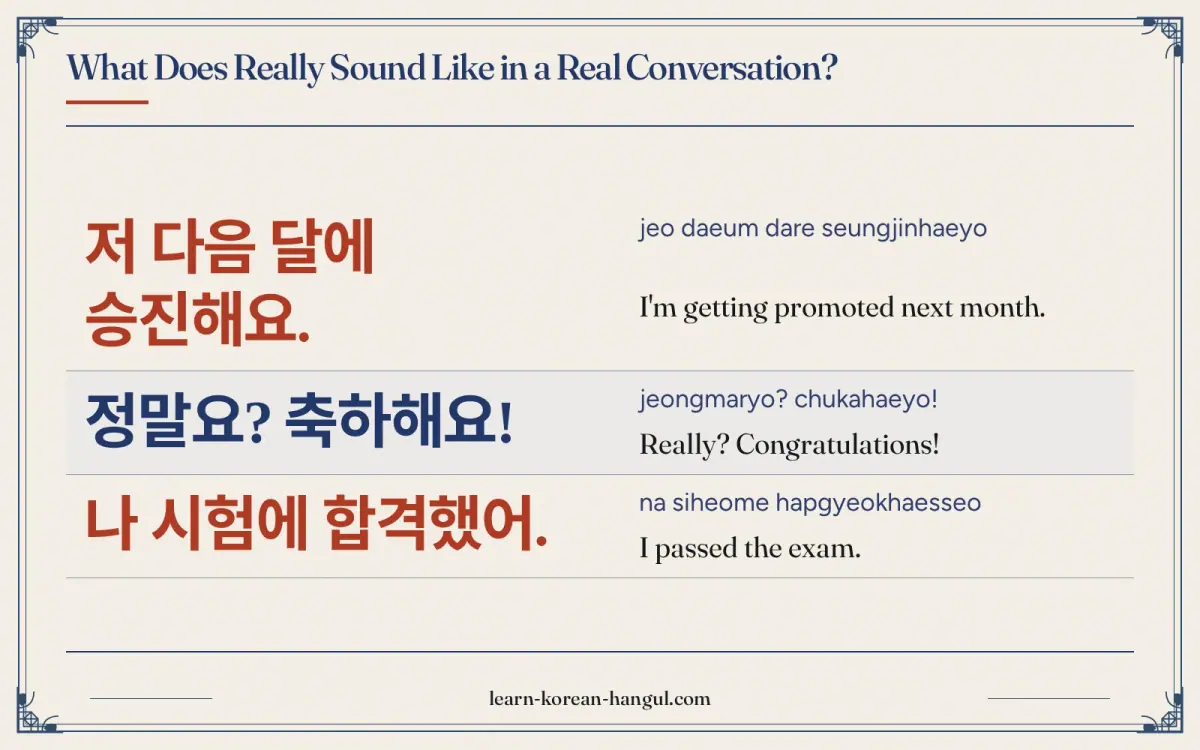
A Korean reaction is usually one or two words, followed by a congratulation or a question. Notice how each speaker keeps the same politeness level throughout.
News from a Coworker
Coworker
저 다음 달에 승진해요.
jeo daeum dare seungjinhaeyo
I'm getting promoted next month.
You
정말요? 축하해요!
jeongmaryo? chukahaeyo!
Really? Congratulations!
What to notice: 정말요? is the neutral polite reaction, and 축하해요 (congratulations) follows at once.
Good News between Friends
Minho
나 시험에 합격했어.
na siheome hapgyeokhaesseo
I passed the exam.
Jiu
진짜? 대박! 축하해!
jinjja? daebak! chukahae!
Really? Awesome! Congratulations!
What to notice: casual 진짜? needs no 요, and 대박 (awesome) adds excitement.
A Tip from a Neighbour
Neighbour
이 식당은 월요일에 문을 닫아요.
i sikdangeun woryoire muneul dadayo
This restaurant closes on Mondays.
You
그래요? 몰랐어요. 고마워요.
geuraeyo? mollasseoyo. gomawoyo
Is that so? I didn't know. Thank you.
What to notice: 그래요? receives information calmly. The cultural role of such short reactions comes next.
What Should You Know about the Culture behind Really?
Korean listeners react often and out loud, so short reaction words carry as much social meaning as the news itself.
- Constant reactions. Korean conversation includes frequent short responses such as 네, 아, 그래요? and 정말요?, called 맞장구 (matjanggu, chiming in), which show you are listening.
- Reactions, not questions. With rising intonation these words do not ask for proof; the speaker usually keeps talking. Pausing for a real answer would feel odd.
- Calm versus excited. 그래요? is the calmest, 정말요? shows more surprise, and 진짜요? is the most excited of the polite forms.
- 真 means real. 진짜 (眞짜) also means "the real thing", opposite 가짜 (fake). 진짜 가방 means a genuine bag.
An expert insight: learners often over-use 정말이에요? because it matches the English "is that true?". In real conversation, 정말요? and 그래요? are the normal reactions, and 정말이에요? is kept for moments when you really need to check a fact. The common mistakes below show the other typical slips.
What Mistakes Do Learners Make with Really in Korean?
Most mistakes with really come from using the wrong level of surprise or the wrong politeness level.
| Mistake | Why it is a problem | Fix |
|---|---|---|
| Saying 정말이에요? to react to news | It asks "is it true?" and can sound doubtful | Use 정말요? or 그래요? |
| Using 진짜 with a boss in a formal meeting | Too casual for the setting | Use 정말요? or 그렇습니까? |
| Dropping 요: 정말? to a senior | The casual form sounds rude | Add 요: 정말요? |
| Using falling pitch on 정말요 | It sounds flat or sarcastic | Raise the pitch on 요 |
| Treating 진짜 only as "really?" | 진짜 also means "genuine", opposite 가짜 (fake) | Use 진짜예요 for "it is genuine" |
Learners often assume that 정말요? and 정말이에요? are interchangeable. Actually, 정말요? reacts, while 정말이에요? asks for verification, so the second one can feel like a challenge to the speaker. Use 정말요? by default.
Is It the Same as Really Formal?
The short answers below cover the other ways people search for this phrase.
- Really formal in Korean: 정말입니까? (jeongmarimnikka), said [정마림니까], is formal; you mainly hear it in interviews and news.
- Is that true in Korean: 정말이에요? or 사실이에요? (sasirieyo, is it a fact?).
- For real in Korean: 진짜로? (jinjjaro) or 진짜야? (jinjjaya) among friends.
- Seriously in Korean: 진심이에요? (jinsimieyo, are you serious?) or 진짜요?.
- Realy in Korean: a common misspelling of "really"; the answer is the same, 정말요?.
- Really as an adverb: 정말 좋아요 (it is really good) and 진짜 맛있어요 (it is really delicious); see also jinjja in Korean.
The next section turns these forms into a short practice routine.
Practice: Say It Aloud
Play the slow clip of 정말요? and repeat it three times with rising pitch, then try 진짜? and 그래요?. Then choose the reaction for each case. Answers follow.
- A coworker says she is moving to Busan. React politely.
- Your close friend says he won a prize. React casually.
- A neighbour tells you the shop is closed on Mondays. React calmly.
- Which is safer with your boss, 진짜 or 정말요?
Answers
- 정말요? 부산으로 가요?
- 진짜? 대박! 축하해!
- 그래요? 몰랐어요.
- 정말요?, because 진짜 without 요 is casual.
The phrase flashcards drill the five reactions with audio.
Related Phrases to Learn Next
Really sits beside other reaction words you use in a conversation.
- Jinjja in Korean: the full story of 진짜 as a reaction and an intensifier.
- Wow in Korean: 와 and 우와 for pure amazement.
- I see in Korean: 그렇군요 for calm understanding.
- No way in Korean: 말도 안 돼요 for disbelief.
This guide belongs to the Korean filler words collection. What this page does not cover: slang reactions, long surprised exclamations and written reactions in chat. Use 정말요? with seniors, 진짜? with friends, and 그래요? when you want to stay calm, and you can say really in Korean at the right level.
Frequently Asked Questions
What is the difference between 정말요? and 진짜요?
Both mean "really?" and both are polite. 정말요? is neutral and safe with seniors, coworkers and strangers. 진짜요? is warmer and more everyday, so it fits peers and people you know well. In a stiff formal meeting, 정말요? is better. The casual 진짜? is only for close friends.
Is 정말요? formal or casual?
정말요? is polite, in the 해요체 style. It is neither the stiff formal register nor the casual one. The formal version is 정말입니까?, mostly heard in interviews, and the casual version is 정말? or 진짜?. In everyday life the polite 정말요? is the best default.
Can I use 정말요? with friends, elders and strangers?
Yes with elders and strangers, because it is polite and neutral. With close friends it is fine but a little formal, and they will usually say 진짜? instead. Do not use casual 진짜? or 정말? with elders or strangers, since dropping the 요 sounds rude. Rising pitch makes it a reaction.
Why does 정말요 sound like jeongmaryo?
Many speakers add an l-like sound before 요 after the final ㄹ of 정말, so the word is heard as [정말료]. The spelling does not change. The common romanization jeongmaryo reflects that sound. If you say [정말요] without the extra l, people will still understand you.
How do you say really as in really good?
Put 정말 or 진짜 before the adjective or verb. 정말 좋아요 means "it is really good" and 진짜 맛있어요 means "it is really delicious". 진짜 is a little more casual and emphatic. For polite writing and speech with seniors, 정말 is the safer adverb. No question intonation is needed.