농담이에요
농담이에요
What you'll learn
- Say just kidding with 농담이에요, 농담입니다 or 농담이야, depending on the listener.
- Say I was joking, I'm not joking and you're kidding, right.
- Tell 농담 apart from 장난 and 거짓말.
- Pronounce 농담이에요 as [농다미에요] and 거짓말 as [거진말].
Before you start: you only need to read Hangul. If your joke hurts someone, learn sorry in Korean. Time: about 10 minutes. Audio plays only when you press a button.
How Do You Say Just Kidding in Korean?
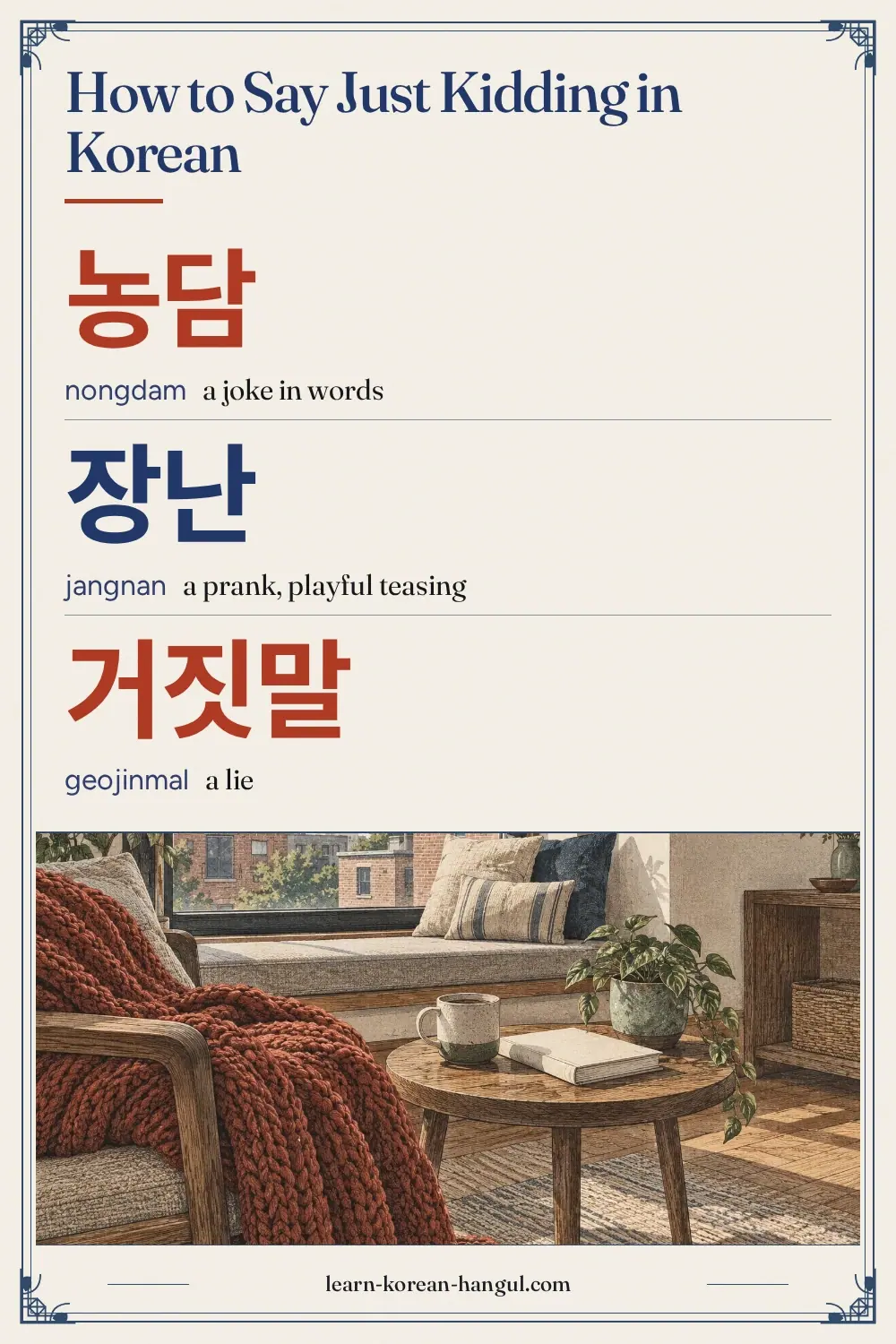
The standard way to say just kidding in Korean is 농담이에요. The noun 농담 (nongdam) means a joke or a humorous remark. The ending 이에요 is the polite form of "to be", used after a consonant. Together, 농담이에요 means "it's a joke". Korean drops "I" and "it", so these three syllables are a complete sentence.
| Situation | Best form | Romanization | Why |
|---|---|---|---|
| Telling a colleague or a new friend | 농담이에요 | nongdamieyo | Polite, natural |
| Telling a close friend | 농담이야 | nongdamiya | Casual |
| A formal setting | 농담입니다 | nongdamimnida | Formal |
| Saying you were joking | 농담이었어요 | nongdamieosseoyo | Past |
| Saying it was just play | 장난이에요 | jangnanieyo | Playful |
The ending changes with the listener, while 농담 stays the same. The next section sorts the forms by level.
What Are the Formal, Polite and Casual Ways to Say Just Kidding?
The forms follow the Korean speech levels, explained in the guide to Korean speech levels. Each level is a different form of 이다 (to be).
Polite: 농담이에요 (nongdamieyo)
Polite · 해요체농담이에요 is the form to learn first. It suits colleagues, classmates, neighbors and anyone you do not know well. Say it with a light voice and a smile so the joke is clear.
아까 한 말은 농담이에요. 화내지 마세요.
akka han mareun nongdamieyo. hwanaeji maseyo
What I said earlier was a joke. Don't be angry.
The command 화내지 마세요 (hwanaeji maseyo) is "please don't get angry". It uses the verb 화내다 (to get angry) with the negative command 지 마세요.
Casual: 농담이야 (nongdamiya)
Casual · 반말농담이야 drops the polite ending. Use it with close friends, siblings and classmates. Repeating the word, as in 농담이야, 농담, is a common way to end a prank.
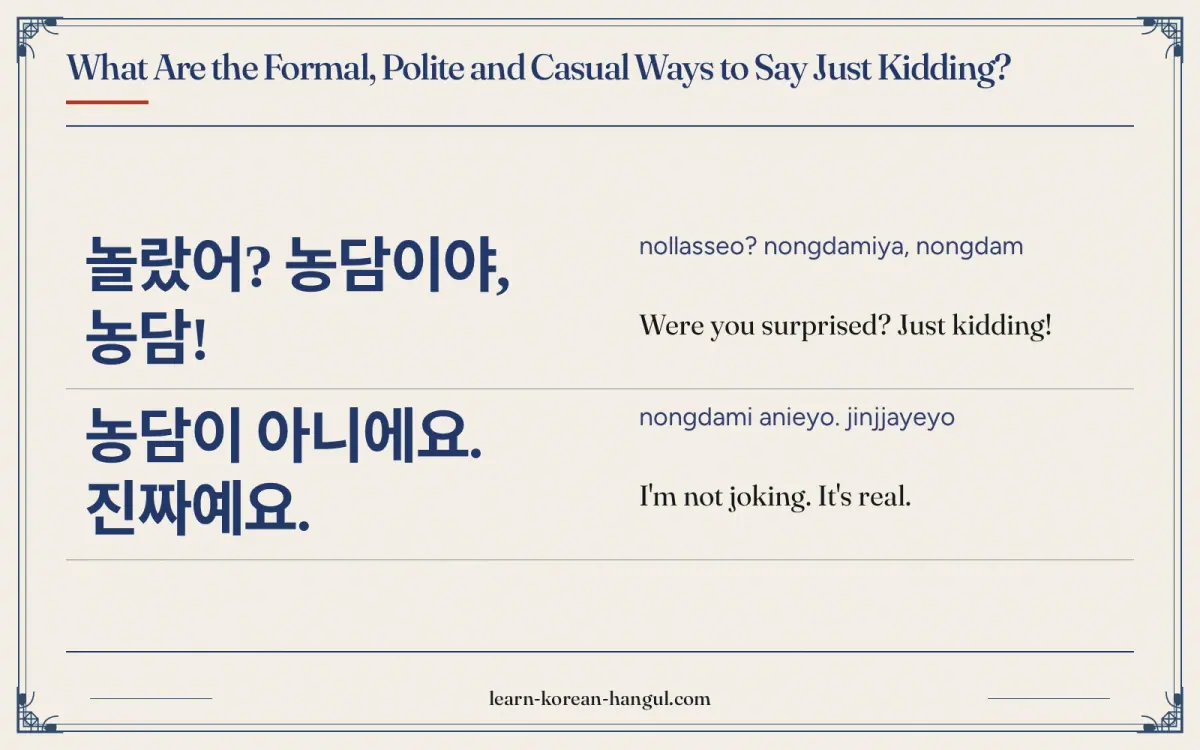
놀랐어? 농담이야, 농담!
nollasseo? nongdamiya, nongdam
Were you surprised? Just kidding!
Formal: 농담입니다 (nongdamimnida)
Formal · 합쇼체농담입니다 is the formal form. It appears when a presenter jokes in a speech or an announcer corrects a mistake. It is pronounced [농다밈니다]. In daily life you will use 농담이에요 far more often.
Past: 농담이었어요 (nongdamieosseoyo)
Polite · 해요체농담이었어요 means "it was a joke". Use it when someone took you seriously afterward, as in 아까 그건 농담이었어요 (that earlier thing was a joke). It is pronounced [농다미어써요].
Playful: 장난이에요 (jangnanieyo)
Polite · 해요체장난이에요 means "I was just playing". The word 장난 (jangnan) covers pranks, teasing and silly play. It fits a joke that is an action, not a sentence, such as hiding a friend's keys.
Denying: 농담이 아니에요 (nongdami anieyo)
Polite · 해요체농담이 아니에요 means "it is not a joke". The word 아니에요 is the negative of 이에요. Add 진짜예요 (it's real) when you want the listener to believe you.
농담이 아니에요. 진짜예요.
nongdami anieyo. jinjjayeyo
I'm not joking. It's real.
Now the pronunciation.
How Do You Pronounce 농담이에요?
농담이에요 is pronounced [농다미에요], nong-da-mi-e-yo, in five syllables. The final ㅁ of 담 moves to the next syllable, so you say "da-mi" instead of "dam-i". This is called liaison (연음).
- 농 (nong): "nohng", with the soft "ng" at the end.
- 담 (dam): "dah", with the ㅁ moving on.
- 이 (i): "mee", carrying the moved ㅁ.
- 에요 (eyo): "eh-yo".
Sound Changes to Listen For
These changes follow the National Institute of Korean Language standard pronunciation rules (표준 발음법):
- Liaison. 농담이에요 is [농다미에요] and 농담입니다 is [농다밈니다] (Article 13).
- ㅂ before ㄴ becomes ㅁ. The 입니다 part is [임니다] (Article 18). See Korean nasalization.
- Final ㅅ before ㅁ. 거짓말 (a lie) is [거진말]: the ㅅ is said as ㄷ and then as ㄴ before ㅁ (Articles 9 and 18).
The vowel in 농 is ㅗ, with rounded lips, and the vowel in 어 of 이었어요 is ㅓ, which is unrounded. With the sound clear, here is how to use the phrase.
When Should You Use 농담이에요, and When Should You Not?
Use 농담이에요 right after a joke or a prank, or when a listener looks worried. It is a way to take back a statement that was never serious.
Situations Where It Fits
- After a prank. 복권 당첨됐다는 건 농담이에요. (The lottery win was a joke.)
- When a listener takes you seriously. 아, 농담이에요! (Oh, I'm kidding!)
- Lightening the mood. 농담이에요, 걱정 마세요. (Just kidding, don't worry.)
Situations to Avoid
- After an insult. Saying 농담이에요 does not cancel a hurtful remark. Say 미안해요 (I'm sorry) instead.
- With elders you do not know. Keep jokes mild, and use 농담이에요 only if the first joke was light.
- At a serious moment. At a funeral or in a meeting about money, do not joke.
Two short conversations show how it sounds.
What Does Just Kidding Sound Like in a Real Conversation?
In real life, the line comes with a laugh or a small teasing remark.
Friends and a Joke
Minji
나 어제 복권 당첨됐어!
na eoje bokgwon dangcheomdwaesseo
I won the lottery yesterday!
Jihun
진짜? 대박!
jinjja? daebak
Really? Amazing!
Minji
아니, 농담이야.
ani, nongdamiya
No, just kidding.
Jihun
야! 깜짝 놀랐잖아.
ya! kkamjjak nollatjana
Hey! You really surprised me.
What to notice: the casual 농담이야 comes right after the surprise. The pattern -잖아 (you know, as you can see) often follows a joke like this.
A Joke at the Office
Senior
오늘 회의는 밤 열두 시까지예요.
oneul hoeuineun bam yeoldu sikkajiyeyo
Today's meeting goes until midnight.
Junior
네? 정말요?
ne? jeongmaryo
What? Really?
Senior
하하, 농담이에요. 한 시간이면 끝나요.
haha, nongdamieyo. han siganimyeon kkeunnayo
Ha ha, just kidding. It will end in an hour.
What to notice: the senior uses the polite 농담이에요 with a colleague, and the junior's 정말요 (jeongmaryo) is often said [정말료] in common speech, with a light ㄴ sound before 요 that turns into ㄹ. The sound of 끝나요 is [끈나요].
How Is 농담 Different from 장난 and 거짓말?
English "kidding" covers several ideas. Korean separates them.
| Korean | Romanization | Meaning | Use it when |
|---|---|---|---|
| 농담 | nongdam | a joke in words | A funny or false remark |
| 장난 | jangnan | a prank, playful teasing | An action or playful behavior |
| 거짓말 | geojinmal | a lie | You meant to deceive |
| 설마 | seolma | no way, surely not | You are doubting something |
| 놀리다 | nollida | to tease | You make fun of someone |
The verb 놀리다 (to tease) gives 놀리는 거예요 (nollineun geoyeyo), "I'm teasing you". Teasing is warmer when the other person knows you mean well. If someone says 농담이에요 and the topic was serious, the better word may be 거짓말, a lie. For doubt, see no way in Korean.
What Should You Know about the Culture behind Just Kidding?
Humor in Korean depends on the relationship. Friends of the same age tease each other quickly, while joking with a senior is done more carefully. The idea of 눈치 (nunchi), reading the mood, decides whether a joke lands.
- Age and rank. A junior may joke lightly with a senior, but should avoid teasing about looks, age or money.
- Mood first. Wait for a relaxed moment, then say the joke with a smile.
- April Fools' Day. 만우절 (manujeol) is April 1, when people play pranks. A prank is often ended with 거짓말이야! (it's a lie!) or 농담이야.
- Online. In chat, a joke often ends with ㅋㅋ (keukeu, laughter), which works like a smile.
An expert tip: 정말요? (really?) is the usual reply to a surprising line. A speaker who then says 농담이에요 closes the loop and shows that the surprise was planned.
What Mistakes Do Learners Make with Just Kidding in Korean?
Most mistakes come from the ending and from the relationship.
| Mistake | Why it is a problem | Fix |
|---|---|---|
| 농담예요 | A consonant ending takes 이에요 | Say 농담이에요 |
| [농담이에요] pronounced word by word | The ㅁ links to the next syllable | Say [농다미에요] |
| 농담이야 to a boss | Too casual | Say 농담이에요 |
| 농담해요 for just kidding | Describes the act of joking, not a quick take-back | Say 농담이에요 |
| 농담 아니에요 for just kidding | Means the opposite | Say 농담이에요 |
| [거짓말] pronounced as written | The ㅅ turns into ㄴ | Say [거진말] |
Learners also treat 농담이에요 as an apology. It is not. If your joke hurt someone, follow it with 미안해요, as in 농담이었어요. 미안해요.
How Do You Ask Someone If They Are Kidding?
You can turn the same words into a question by raising your voice at the end. To a friend, say 농담이야? (nongdamiya?) or 농담이지? (nongdamiji?), which means "you're kidding, right?". To a colleague, say 농담이죠? (nongdamijyo?). To an older person, use the honorific 농담이시죠? (nongdamisijyo?). These are yes-or-no questions, so they rise at the end. The phrase 장난해요? (jangnanhaeyo?) also means "are you kidding me?", but it often sounds irritated, so avoid it with someone you respect.
| Listener | Question | Romanization |
|---|---|---|
| Close friend | 농담이야? | nongdamiya |
| Colleague | 농담이죠? | nongdamijyo |
| Elder or customer | 농담이시죠? | nongdamisijyo |
Is It the Same as Kidding, Joking or I'm Joking?
Yes. The short answers below cover the other searches folded into this page.
- Kidding in Korean: 농담 for the noun, and 농담이에요 as the sentence.
- Joking in Korean: 농담하다 (nongdamhada, to joke), as in 농담하지 마세요 (don't joke).
- I'm joking in Korean: 농담이에요 or 농담하는 거예요 (I'm making a joke).
- Just joking in Korean: 그냥 농담이에요 (geunyang nongdamieyo).
Now practise aloud.
Practice: Say It Aloud
Play the slow clip of 농담이에요 three times and let the ㅁ link to 이. Then choose a phrase. Answers follow.
- You tell a colleague politely that you were joking.
- You tell a close friend, "Just kidding!"
- You say "I'm not joking" to a friend.
- You ask a colleague, "You're kidding, right?"
Answers
- 농담이었어요.
- 농담이야!
- 농담 아니야.
- 농담이죠?
The phrase flashcards drill these lines with audio.
Related Phrases to Learn Next
A joke often leads to an apology or a doubtful reply.
- Sorry in Korean: 미안해요 when a joke goes too far.
- Really in Korean: 정말요? as the usual reply to a surprise.
- No way in Korean: 설마 when you doubt a story.
This guide belongs to the Korean common responses collection. What this page does not cover: slang jokes, wordplay and puns. Remember that 농담이에요 is the safe polite form, the ㅁ links to 이, and the mood decides everything, and you can say just kidding in Korean naturally.
Frequently Asked Questions
How do you say just kidding in Korean?
Say 농담이에요 (nongdamieyo) in polite speech, 농담이야 (nongdamiya) to a close friend and 농담입니다 (nongdamimnida) in formal speech. The word 농담 means a joke, and the ending 이에요 means it is. Say it right after the joke, ideally with a smile, so the listener knows you were not serious.
How do I say I'm joking or I was joking in Korean?
Say 농담이에요 for I'm joking and 농담이었어요 (nongdamieosseoyo) for I was joking. To a friend, say 농담이야 and 농담이었어. You can also say 그냥 농담이에요 (geunyang nongdamieyo), just a joke. The past form is pronounced [농다미어써요] and is useful when someone took you seriously.
What is the difference between 농담 and 장난?
농담 (nongdam) is a joke made with words, such as a funny line or a false statement. 장난 (jangnan) is playful behavior, such as teasing, a prank or horseplay. You can say 장난이에요 to mean I was just playing around. Both can end a joke, but 농담 fits words and 장난 fits actions.
How do I say I'm not joking in Korean?
Say 농담 아니에요 (nongdam anieyo) or 농담이 아니에요 (nongdami anieyo) in polite speech, and 농담 아니야 to a friend. Add 진짜예요 (jinjjayeyo, it's real) to be clear. The pattern 아니에요 is the negative of 이에요, so it means it is not a joke.
How do I ask are you kidding in Korean?
Ask 농담이죠? (nongdamijyo?) or 농담이야? (nongdamiya?) to a friend, which means you're kidding, right. To an older person, use 농담이시죠? (nongdamisijyo?). The phrase 장난해요? (jangnanhaeyo?) also means are you kidding me, but it often sounds irritated, so avoid it with someone you respect.
What mistakes do learners make with just kidding in Korean?
Learners write 농담예요 instead of 농담이에요, because 농담 ends in a consonant. They also use the casual 농담이야 with older people, or pronounce it as written, [농담이에요], instead of [농다미에요]. Another slip is joking about age, family or money with someone new, which can feel rude even when you say 농담이에요 afterward.