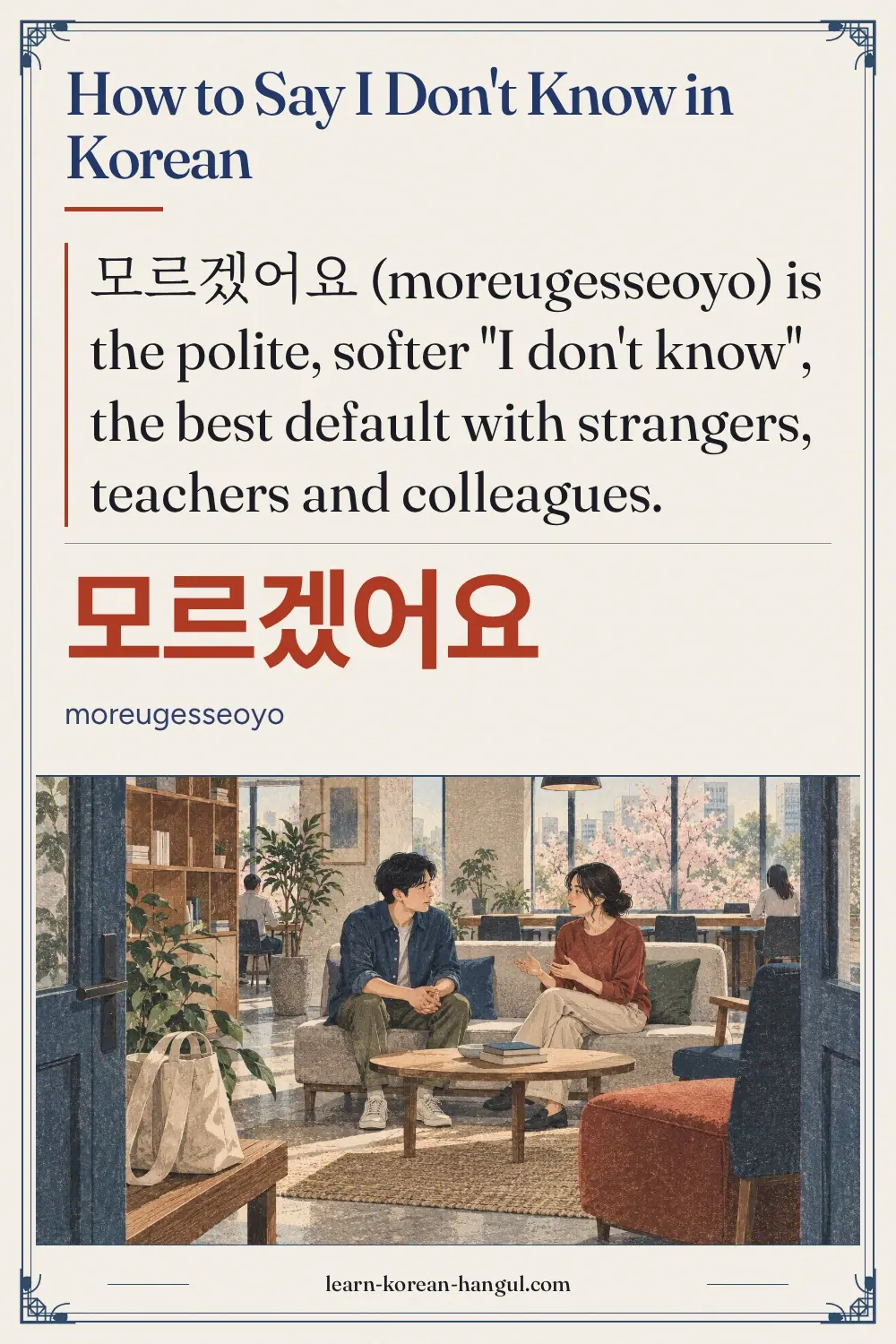
모르겠어요
모르겠어요
What you'll learn
- Say 모르겠어요 aloud as [모르게써요], and 몰라요 with a long ll.
- Choose between 모르겠어요, 몰라요, 잘 모르겠어요 and 몰라 for a stranger, a teacher and a friend.
- Explain why Korean says 몰라요, not 안 알아요.
- Soften "I don't know" so it never sounds dismissive.
Before you start: you need to read Hangul; romanization is shown as an aid and can be hidden. Time: about 9 minutes.
How Do You Say I Don't Know in Korean?
The safest way to say I don't know in Korean is 모르겠어요, from the verb 모르다, "to not know". Korean has a whole verb for not knowing, and its endings change with the listener.
| Form | Romanization | Register | Say it to |
|---|---|---|---|
| 모르겠어요 | moreugesseoyo | Polite, soft | Strangers, teachers, colleagues |
| 잘 모르겠어요 | jal moreugesseoyo | Polite, softest | Anyone, when you are unsure |
| 몰라요 | mollayo | Polite, flat | Acquaintances, for plain facts |
| 몰라 | molla | Casual (반말) | Close friends, siblings, children |
| 모르겠습니다 | moreugetseumnida | Formal | Bosses, interviews, class |
The -겠- in 모르겠어요 adds a feeling of "I can't tell", which makes the answer modest. The next section shows each form in a sentence.
What Are the Formal, Polite and Casual Ways to Say I Don't Know?
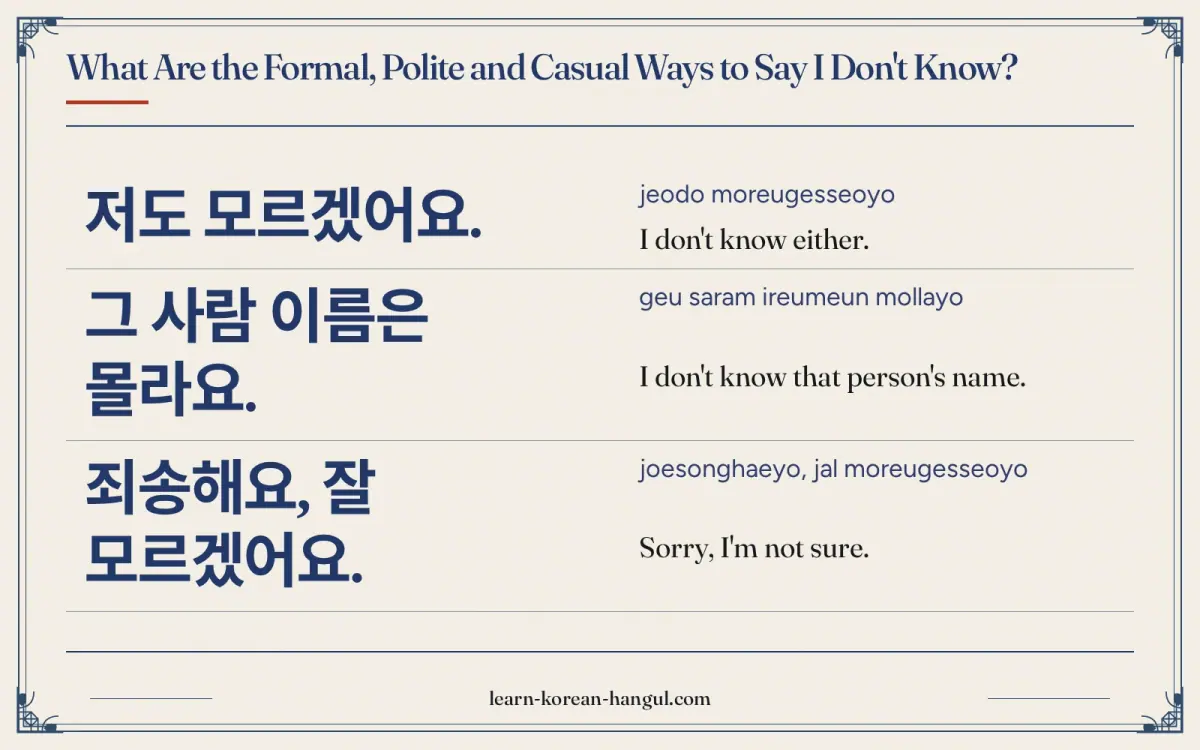
I don't know follows the Korean speech levels, the endings that change with the listener's age, status and closeness, explained in the guide to Korean speech levels. The meaning stays the same while the ending shifts.
Polite: 모르겠어요 (moreugesseoyo)
Polite · 해요체모르겠어요 is the best everyday choice. It sounds as if you have thought about the question and cannot find the answer, which is polite. Use it with shop staff, classmates, teachers and coworkers.
저도 모르겠어요.
jeodo moreugesseoyo
I don't know either.
Polite: 몰라요 (mollayo)
Polite · 해요체몰라요 comes from 모르다 + -아요. Because 모르다 is a 르-irregular verb, 모르 + 아요 becomes 몰라요, with a double ㄹ. It is polite in form, but it states a plain fact, such as not knowing a name, and in some tones it sounds uninterested.
그 사람 이름은 몰라요.
geu saram ireumeun mollayo
I don't know that person's name.
Polite: 잘 모르겠어요 (jal moreugesseoyo)
Polite · 해요체잘 means "well", so 잘 모르겠어요 is literally "I don't know well", close to "I'm not sure". It is the gentlest form and the one Koreans use most when a stranger asks for directions.
죄송해요, 잘 모르겠어요.
joesonghaeyo, jal moreugesseoyo
Sorry, I'm not sure.
Casual: 몰라 (molla)
Casual · 반말몰라 is the casual "dunno" for close friends and younger people. Tone matters: a light 몰라 is friendly, but a sharp 몰라 can mean "I don't care" or "leave me alone".
나도 몰라.
nado molla
I don't know either.
All four forms say you do not know. The main forms change sound in ways worth practising, so pronunciation comes next.
How Do You Pronounce 모르겠어요?
모르겠어요 is pronounced [모르게써요], mo-reu-ge-sseo-yo, in five syllables. The ㅆ at the bottom of 겠 moves onto the next syllable, so you hear a tense "ss" at the start of 써.
- 모 (mo): "mo", lips rounded.
- 르 (reu): a light tap for ㄹ and the unrounded vowel ㅡ.
- 게 (ge): "geh".
- 써 (sseo): a tense, hissing ss and an open "uh".
- 요 (yo): "yo", with a gentle fall.
Sound Changes to Listen For
Three changes shape the forms of I don't know:
- Liaison of ㅆ. In 모르겠어요, ㅆ links to the silent ㅇ of 어, giving [모르게써요].
- Double ㄹ in 몰라요. The 르-irregular rule creates ㄹㄹ, said as a long, clear l: [몰라요], not "mo-ra-yo".
- Tensing and nasalization in 모르겠습니다. ㅆ is said like [ㄷ] before ㅅ, which makes ㅅ tense, and ㅂ becomes ㅁ before ㄴ: [모르겓씀니다]. The tensing rule is explained in Korean tensification.
Revised Romanization, the official system for writing Korean in Latin letters, gives moreugesseoyo and mollayo. It does not show every sound change, so treat it as a guide. Choosing the right form for the moment matters even more, as the next section shows.
When Should You Say 모르겠어요, and When Should You Not?
Use 모르겠어요 or 잘 모르겠어요 with anyone you speak politely to. Use 몰라 only with close friends, and avoid a bare 몰라요 with elders and bosses, where it can sound like you are brushing them off.
Situations Where It Fits
- A stranger asks for directions. 죄송한데 잘 모르겠어요.
- A teacher asks a question in class. 잘 모르겠습니다.
- A colleague asks about a schedule. 모르겠어요, 확인해 볼게요 (I don't know; I'll check).
Situations to Avoid
- A bare 몰라요 to your boss. Add a softener or offer to find out.
- 몰라 to an older stranger. The casual form sounds rude.
- 안 알아요 anywhere. Use 몰라요 or 모르겠어요.
These choices are easier to feel in real exchanges, so here are three.
What Does I Don't Know Sound Like in a Real Conversation?
A Korean "I don't know" often comes with an apology or an offer to help. Listen for the softeners around it.
A Stranger Asks for Directions
Stranger
저기요, 서울역이 어디예요?
jeogiyo, seoullyeogi eodiyeyo?
Excuse me, where is Seoul Station?
You
죄송한데 잘 모르겠어요.
joesonghande jal moreugesseoyo
I'm sorry, but I'm not sure.
What to notice: the apology 죄송한데 makes "I don't know" kind.
A Teacher Checks a Word
Teacher
이 단어 뜻 알아요?
i daneo tteut arayo?
Do you know what this word means?
Student
아니요, 모르겠어요.
aniyo, moreugesseoyo
No, I don't know.
What to notice: the teacher asks with 알아요?, and the student answers with 모르다, not 안 알아요.
Friends Looking for Someone
Minsu
지수 어디 갔어?
jisu eodi gasseo?
Where did Jisu go?
Sua
몰라. 아까 나갔어.
molla. akka nagasseo
Dunno. She went out a while ago.
What to notice: friends use casual 몰라 and add the little they do know. That habit of softening links to culture.
What Should You Know about the Culture behind I Don't Know?
Koreans tend to soften "I don't know", because a flat answer can sound unhelpful or cold. The extra words show that you care about the question.
- Apologise first. 죄송한데요 or 미안한데 before the answer is common.
- Offer a next step. 확인해 볼게요 (I'll check) or 물어볼게요 (I'll ask) turns "I don't know" into help.
- Modesty with -겠-. 모르겠어요 sounds less final than 몰라요, which suits talk with seniors.
- The sulky 몰라. In dramas, a character saying 몰라 and turning away is sulking, not uninformed.
An expert insight: learners often assume 몰라요 is simply the short version of 모르겠어요. Actually, they carry different attitudes: 몰라요 reports a fact, while 모르겠어요 shows you tried. That is why Koreans answer a teacher with 잘 모르겠습니다, not 몰라요. The common mistakes below come from this.
What Mistakes Do Learners Make with I Don't Know in Korean?
Most I don't know mistakes come from English grammar, from tone, or from pronunciation.
| Mistake | Why it is a problem | Fix |
|---|---|---|
| Saying 안 알아요 | 알다 has its own opposite, 모르다 | Say 몰라요 or 모르겠어요 |
| A bare 몰라요 to a boss | Sounds dismissive | Say 잘 모르겠어요, 확인해 볼게요 |
| 몰라 to an older stranger | Casual form | Say 잘 모르겠어요 |
| Saying "mo-ra-yo" | Misses the double ㄹ | Say [몰라요] with a long l |
| A plain s in 겠어 | ㅆ is tense | Say [게써] |
Learners often think the casual 몰라 is neutral. Actually, its tone swings widely, from a cheerful "no idea" to an annoyed "whatever", so with new friends a polite 잘 모르겠어요 is safer.
Other Ways People Search for I Don't Know in Korean
People search for I don't know in Korean in several forms. The short answers below cover each one.
- Dont know / i dont know / i do not know in Korean: all the same phrase, 모르겠어요 or 몰라요.
- Idk in Korean: 몰라 among friends, or ㅁㄹ in texts.
- No idea in Korean: 전혀 모르겠어요 (I have no idea at all).
- I don't know romanized: moreugesseoyo, following the Revised Romanization of Korean; romanization is an aid, not the real spelling.
- I don't understand: a different phrase, 이해가 안 돼요, covered in I don't understand in Korean.
Reading the forms is one thing; producing them on cue is another, so practise now.
Practice: Say It Aloud
Play the slow clip of 모르겠어요, repeat it three times, then try 몰라요 and 잘 모르겠어요. Then choose a form for each situation. Answers follow.
- An older stranger asks you where the bus stop is, and you do not know.
- Your best friend asks what time the movie starts.
- Your manager asks for a number you need to look up.
Answers
- 죄송한데 잘 모르겠어요.
- 몰라. 찾아볼게 (Dunno. I'll look it up).
- 지금은 잘 모르겠습니다. 확인해 보겠습니다 (I'm not sure right now. I'll check).
Drill these forms with the phrase flashcards, which include audio for each one.
Related Phrases to Learn Next
I don't know sits among the phrases that keep a conversation going when you are unsure.
- I know in Korean: 알아요 and 알겠어요, the other side of 모르다; learn it next.
- I don't understand in Korean: 이해가 안 돼요, for when you heard but did not follow.
- Maybe in Korean: 아마 and 글쎄요, for answers between yes and no.
- Sorry in Korean: 죄송해요, the softener that often comes first.
This guide belongs to the Korean conversation collection. What this page does not cover: the full grammar of -겠- and other 르-irregular verbs. Reach for 잘 모르겠어요 with anyone you respect, keep 몰라 for friends, and you can say I don't know in Korean without sounding rude.
Frequently Asked Questions
What is the difference between 모르겠어요 and 몰라요?
Both mean I don't know and both are polite. 모르겠어요 adds -겠-, which softens the answer to something like "I can't say" or "I'm not sure", so it sounds modest. 몰라요 states a plain fact and can sound blunt or uninterested. With teachers, bosses and strangers, choose 모르겠어요 or 잘 모르겠어요.
Why is it not 안 알아요?
Because Korean has a separate verb for not knowing. 알다 means to know, and its opposite is 모르다, to not know. So "I know" is 알아요 and "I don't know" is 몰라요 or 모르겠어요. 안 알아요 is grammatical-looking but wrong, and Koreans will notice it at once.
How do you say idk in Korean texting?
Friends type 몰라, or the shorter ㅁㄹ, the first consonants of 몰라. Cute versions such as 몰라용 or 몰랑 appear between close friends. These are casual, so in a message to a teacher or colleague write 잘 모르겠어요 or 잘 모르겠습니다 instead. Adding 확인해 볼게요 (I'll check) sounds helpful.
How do you say I don't know to a teacher?
Say 잘 모르겠습니다 in class or 잘 모르겠어요 in a relaxed lesson. Add a softener such as 죄송한데 (I'm sorry, but) if you need to. Avoid 몰라요 on its own, because it can sound like you are not trying. You can also ask 다시 설명해 주시겠어요? (Could you explain again?).
What is the most common mistake with I don't know in Korean?
The most common mistake is saying 몰라요 bluntly to an elder or a boss, which can sound like you are brushing them off. Use 잘 모르겠어요. The second is building the phrase from English as 안 알아요. A third is pronouncing 겠어 with a plain s; it is [게써] with a tense ㅆ.