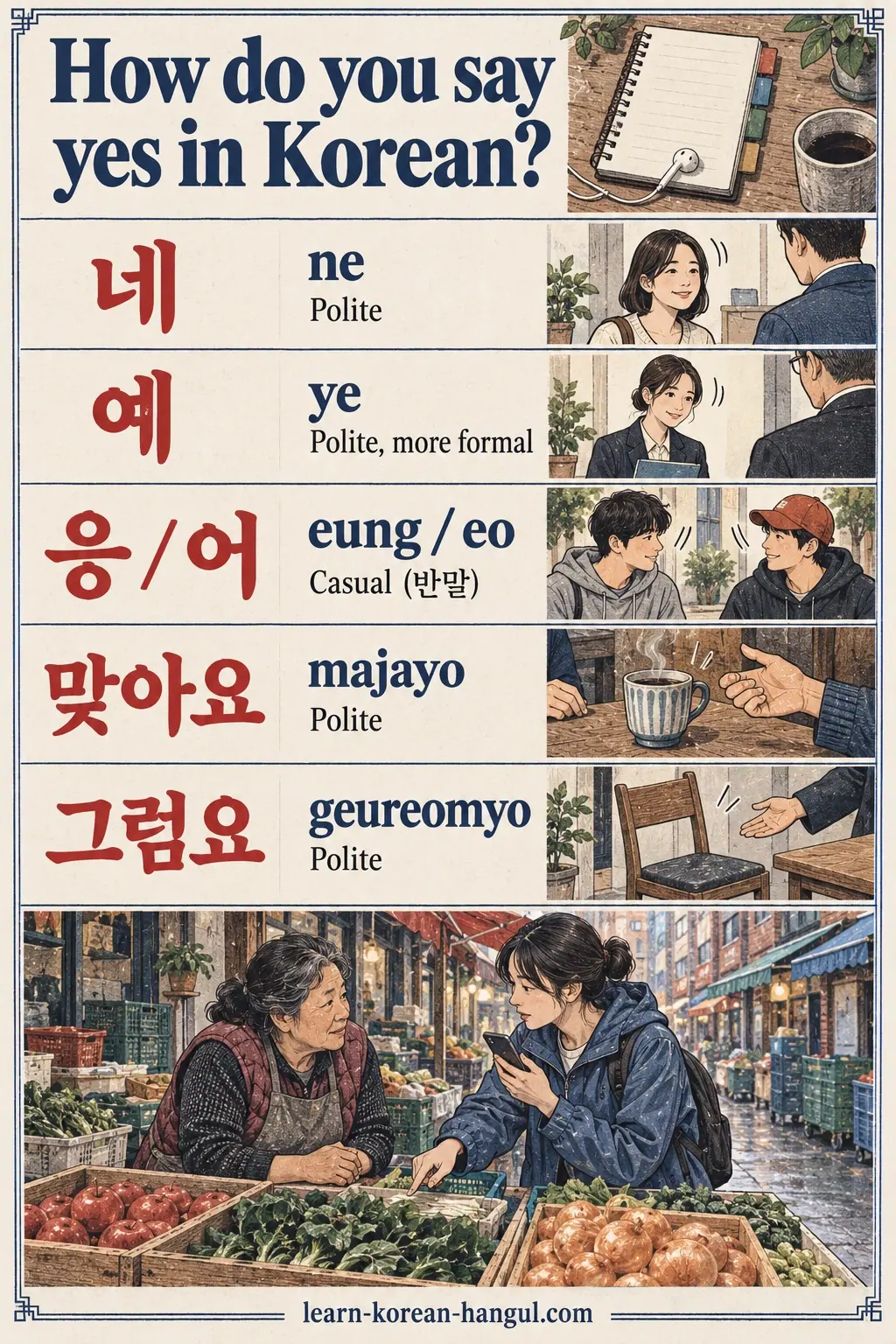
네
네
What you'll learn
- Say 네 aloud with a clear [e] vowel and a falling tone, and tell it apart from the rising 네? (pardon?).
- Choose between 네, 예, 응, 맞아요 and 그럼요 for a stranger, a senior and a friend.
- Answer negative questions such as 안 먹었어요? the Korean way.
- Recognise 네 as a listening signal, not always as agreement.
Before you start: you need to read Hangul; romanization is shown as an aid and can be hidden. Time: about 10 minutes. Audio plays only when you press a button.
How Do You Say Yes in Korean?
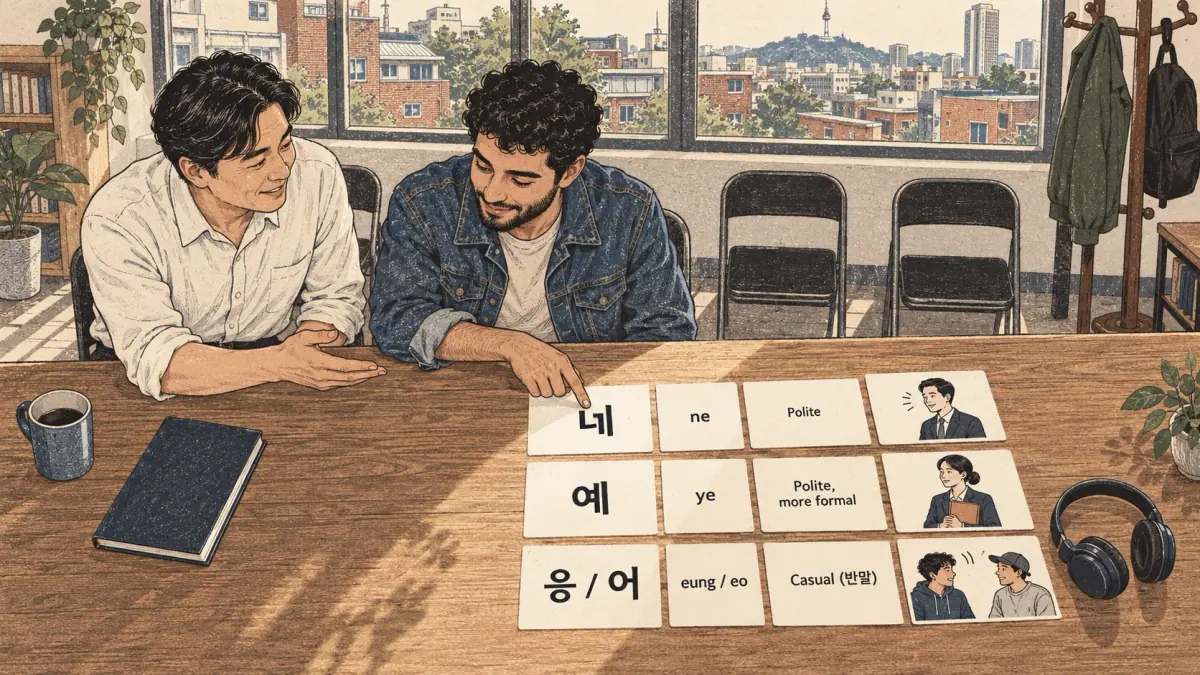
The safest way to say yes in Korean is 네, because it is polite enough for anyone you meet and never sounds rude. Korean has several words for yes, and the right one depends on how close you are to the listener.
| Form | Romanization | Register | Say it to |
|---|---|---|---|
| 네 | ne | Polite | Anyone: staff, strangers, teachers, colleagues |
| 예 | ye | Polite, more formal | Bosses, elders, interviews, the army |
| 응 / 어 | eung / eo | Casual (반말) | Close friends, siblings, partners, children |
| 맞아요 | majayo | Polite | Anyone, when you mean "that's right" |
| 그럼요 | geureomyo | Polite | Anyone, when you mean "of course" |
네 and 예 are single words that do not change their ending. 맞아요 and 그럼요 are full answers that carry the polite ending -요, and dropping -요 makes them casual: 맞아 and 그럼. The next section shows each form in a sentence.
What Are the Formal, Polite and Casual Ways to Say Yes?

Yes in Korean follows the Korean speech levels, the sets of endings and words that change with the listener's age, status and closeness, explained in the guide to Korean speech levels. The meaning stays "yes" while the word shifts.
Polite: 네 (ne)
Polite · 해요체네 is the yes you hear all day in Korea: at the till, on the phone, in class and at work. It goes with polite -요 sentences and with formal -ㅂ니다 sentences, so it fits almost every adult conversation.
네, 알겠어요.
ne, algesseoyo
Yes, got it.
Add a short reply after 네 and you sound fluent at once: 네, 좋아요 (yes, sounds good) or 네, 맞아요 (yes, that's right).
Formal: 예 (ye)
Formal · 합쇼체예 has the same meaning as 네 and is equally standard, but it sounds crisper and more deferential. You hear it in job interviews, in the army, from staff answering a manager, and from younger people speaking to grandparents. It pairs naturally with the formal -ㅂ니다 ending.
예, 맞습니다.
ye, matseumnida
Yes, that is correct.
Casual: 응 (eung)
Casual · 반말응 is the casual yeah, said to close friends, younger siblings, partners and children. Many speakers also use a quick 어 (eo) in the same way. Both belong to 반말, casual speech, so never use them with someone you should speak politely to.
응, 갈게.
eung, galge
Yeah, I'll come.
Polite: 맞아요 (majayo)
Polite · 해요체맞아요 means "that's right" and comes from the verb 맞다, to be correct. Use it when someone checks a fact: your name, your order, a time. 네 answers the question, and 맞아요 confirms the detail, so Koreans often say both: 네, 맞아요.
맞아요, 저도 그렇게 생각해요.
majayo, jeodo geureoke saenggakhaeyo
That's right, I think so too.
Polite: 그럼요 (geureomyo)
Polite · 해요체그럼요 means "of course" or "sure". It is warmer than 네 and shows you are happy to agree, for example when someone asks if they can sit down or borrow a pen. In everyday speech an extra [ㄴ] sound is usually added before 요, so it is heard as [그럼뇨].
그럼요, 앉으세요.
geureomyo, anjeuseyo
Of course, please sit down.
All five forms say yes. Saying 네 itself with the right vowel and tone is the next step.
How Do You Pronounce 네?

네 is pronounced [ne], close to the English "neh" in a short, clipped way. Start with the tongue behind the upper teeth for ㄴ (n), then open into ㅔ, a vowel like the e in "bed". Do not glide into "nay".
- ㄴ (n): the same n as in "no".
- ㅔ (e): the e in "bed", short and steady.
- Tone: let the pitch fall slightly at the end for a plain yes.
Sound Changes to Listen For
네 is a single syllable, so it has no sound change inside the word. The challenges come from vowels and intonation:
- 네 and 내 sound alike. The standard pronunciation rules (Article 4) still list ㅐ and ㅔ as two vowels, but most Seoul speakers today pronounce them the same. So 네 (yes) and 내 (my) can sound identical, and context tells them apart.
- Rising 네? means "pardon?". When the pitch goes up, 네? asks the speaker to repeat or shows surprise. Listen to the contrast below.
- 예 starts with a y glide. 예 is [je], "yeh". In fast speech it can shorten until it sounds close to 네, so listen for the context.
- 응 ends in ng. 응 is [ɯŋ]: the vowel ㅡ (lips relaxed, not rounded) and then the ng of "sing", with the back of the tongue raised.
Revised Romanization, the official system for writing Korean in Latin letters, gives ne, ye and eung. These spellings guide the sound, but the Hangul is the real form. Choosing the right word for the listener matters even more, as the next section shows.
When Should You Use 네, and When Should You Not?

Use 네 with anyone you speak politely to: strangers, staff, teachers, colleagues and elders. Switch to 응 only with close friends or younger people, and choose 예 when a setting is formal and hierarchical.
Situations Where It Fits
- Answering a call or your name. Koreans answer the phone with 네 or 여보세요, and a teacher calling the register hears 네.
- Confirming an order. "One coffee?" gets 네, or 네, 맞아요.
- Taking instructions at work. 네, 알겠습니다 (yes, understood) is the standard reply to a manager.
- Listening to someone speak. A soft 네, 네 shows you are following.
Situations to Avoid
- 응 or 어 to a teacher, boss or older stranger. Casual forms skip the respect they expect.
- 네 to close friends all the time. It is not wrong, but it can sound cold or sarcastic between friends.
- 네 when you mean "I agree". A string of 네 may only mean "I'm listening". Say 맞아요 or 좋아요 to show real agreement.
These choices are easier to feel in real exchanges, so here are three.
What Does Yes Sound Like in a Real Conversation?

A Korean yes is often short, and it is usually followed by a second phrase that adds the detail. Listen to how each speaker builds on the yes.
Confirming an Order at a Café
Barista
아메리카노 한 잔 맞으세요?
amerikano han jan majeuseyo?
One Americano, is that right?
Customer
네, 맞아요.
ne, majayo
Yes, that's right.
What to notice: the barista checks with 맞으세요?, and the customer answers with 네 plus 맞아요. You will hear 맞으세요? in many cafés, although strict grammar guides call honorific -시- on an order, rather than a person, excessive.
A Manager Checks on a Report
Manager
회의 자료 준비됐어요?
hoeui jaryo junbidwaesseoyo?
Are the meeting documents ready?
Jimin
예, 준비됐습니다.
ye, junbidwaetseumnida
Yes, they are ready.
What to notice: Jimin uses the formal 예 and the formal ending -습니다 to a manager.
Two Friends Make Plans
Minsu
내일 영화 볼래?
naeil yeonghwa bollae?
Want to see a movie tomorrow?
Sua
응, 좋아.
eung, joa
Yeah, sounds good.
What to notice: friends use casual 응 and the casual 좋아, with no -요. The way Koreans use yes in conversation also has a cultural side.
What Should You Know about the Culture behind Yes?

네 in Korean does more work than "yes" in English. It answers questions, but it also signals attention, politeness and readiness, so a Korean 네 is not always agreement.
- 네 as a listening signal. While you talk, a Korean listener may say 네, 네 or nod. This backchannel (맞장구) means "I'm following", not "I accept your offer".
- Answering when called. When a teacher, parent or boss calls your name, the polite reply is 네, meaning "Yes, I'm here".
- Yes agrees with the question. To 안 추워요? (Aren't you cold?), 네 means "Right, I'm not cold." This logic is explained in the page on answering yes or no questions in Korean.
- Indirect no. A polite 네… with a pause, followed by 그런데 (but), often leads into a refusal.
An expert insight: learners often assume a Korean colleague who says 네 many times during a meeting has agreed to a plan. Actually, those 네 often just mean "I hear you", because backchannel 네 is part of polite listening. Ask a direct follow-up, such as 괜찮으세요? (Is that all right with you?), before you count it as agreement. The common mistakes below come from this and from speech level.
What Mistakes Do Learners Make with Yes in Korean?
Most yes mistakes come from English answer logic, from intonation, or from the wrong speech level.
| Mistake | Why it is a problem | Fix |
|---|---|---|
| Answering 아니요 to 안 먹었어요? when you did not eat | Korean yes agrees with the question | Say 네, 안 먹었어요 |
| Saying 응 to a teacher, boss or older stranger | Casual 반말 form | Use 네 or 예 |
| Rising pitch on a plain yes | 네? sounds like "pardon?" | Let the pitch fall: 네. |
| Reading 네 as agreement in a meeting | It may only mean "I'm listening" | Ask a follow-up question |
| Pronouncing 네 as "nay" | Adds a glide Korean does not have | Keep ㅔ short and steady |
Learners often assume 예 is old-fashioned or wrong because textbooks teach 네 first. Actually, 예 is standard and very much alive in formal and hierarchical settings, so it is worth recognising even if you rarely say it.
Other Ways People Search for Yes in Korean
People search for yes in Korean in many forms. The short answers below cover each one.
- Yes formal in Korean: 예 is the most formal; 네 is polite and always safe.
- Yes casual in Korean: 응 or 어, for close friends and younger people.
- Yes romanized in Korean: ne for 네, ye for 예 and eung for 응, following the Revised Romanization of Korean; romanization is an aid, not the real spelling.
- Yes in South Korean: 네 is the everyday word, and the Standard Korean Language Dictionary (표준국어대사전) lists both 네 and 예 as standard.
- Yeah in Korean: 응 or 어 with friends; 네 with everyone else.
- Yep in Korean: 넵 (nep) in polite chats and 응 or ㅇㅇ among friends.
- Yes "ne" in Korean: yes, 네 is romanized ne, and it does not mean "no", even though it sounds a little like the English "nay".
For the other side of these questions, the page on yes no questions in Korean shows how to ask them. Reading the forms is one thing; producing them on cue is another, so practise now.
Practice: Say It Aloud
Play the slow clip of 네, repeat it three times with a falling tone, then try 예, 응 and 맞아요. Then choose a form for each situation. Answers follow.
- A clerk asks if you want a bag, and you do.
- Your younger brother asks if you are hungry, and you are.
- A colleague asks, 안 바빠요? (You're not busy?), and you are not busy.
- Your manager asks if the report is finished, and it is.
Answers
- 네, or 네, 주세요 (yes, please).
- 응, or 어, 배고파 (yeah, I'm hungry).
- 네, 안 바빠요, because 네 agrees with "you're not busy".
- 예, 다 했습니다, or 네, 다 했습니다 (yes, it's done).
Drill 네 and the related phrases with the phrase flashcards, which include audio for each form.
Related Phrases to Learn Next
Yes is one of the short responses that keep a Korean conversation moving.
- No in Korean: 아니요 and 아니에요, the natural partner of 네; once 네 feels natural, move on to it.
- Okay in Korean: 좋아요 and 알겠어요, often heard in the same conversation as 네.
- Of course in Korean: 물론이죠 and 당연하죠, stronger than 그럼요.
- I understand in Korean: 알겠어요 and 이해했어요, the answer that often follows 네.
This guide belongs to the Korean filler words and responses collection. What this page does not cover: the full grammar of negative questions, regional dialect forms and the many interjections of agreement such as 그렇죠. Start with 네, switch to 응 with close friends, and you can say yes in Korean to anyone.
Frequently Asked Questions
What is the difference between 네 and 예?
네 and 예 mean the same thing and are both standard Korean. 예 sounds more formal and deferential, so you hear it in offices, the army, interviews and from people speaking to elders. 네 is softer and is the everyday choice. Either one is polite, so neither will offend a stranger.
Is 네 formal or casual?
네 is polite, not casual. It sits at the same level as the -요 endings, so it suits strangers, staff, teachers and colleagues. It is also used next to formal -ㅂ니다 sentences, as in 네, 알겠습니다. Between close friends, 네 can sound distant, and 응 or 어 is more natural.
Can I use 네 with friends, elders and strangers?
Yes with elders and strangers, where 네 is the safest choice. With close friends of your age, 네 sounds a little stiff, so friends say 응 or 어. With very senior people in a formal setting, 예 adds a touch more respect. When you are unsure of the relationship, choose 네.
How do you say yes in Korean when texting?
In polite texts, 네 or the brisk 넵 (nep) is common, and 네네 sounds eager. Among friends, people type 응, 웅 (a cute spelling) or just ㅇㅇ, the first consonants of 응응. 넵 is popular in workplace chats, but ㅇㅇ to a boss or teacher would sound rude.
How do you write yes in Hangul?
Yes is written 네 in Hangul, one block made of the consonant ㄴ and the vowel ㅔ. The formal 예 is the silent ㅇ plus ㅖ. Casual 응 is ㅇ on top, ㅡ in the middle and ㅇ again as the final sound, which is pronounced ng. Each one is a single syllable block.
What is the most common mistake with yes in Korean?
The most common mistake is answering negative questions with English logic. To 안 먹었어요? (You didn't eat?), Koreans answer 네, 안 먹었어요 if they did not eat, because 네 agrees with the question. The second mistake is saying 응 to a teacher or an older stranger.