아니에요
아니에요
What you'll learn
- Say 아니에요, 신경 쓰지 마세요, 됐어요 and 괜찮아요, and know how each one feels to the listener.
- Choose the right "never mind" for an apology, a thank-you and an offer.
- Pronounce 됐어요 as [돼써요] and 괜찮아요 as [괜차나요].
- Avoid using 됐어요 with a boss or an elder.
Before you start: the forms below depend on the listener, so a quick look at Korean speech levels helps. Time: about 10 minutes. Audio plays only when you press a button.
How Do You Say Never Mind in Korean?
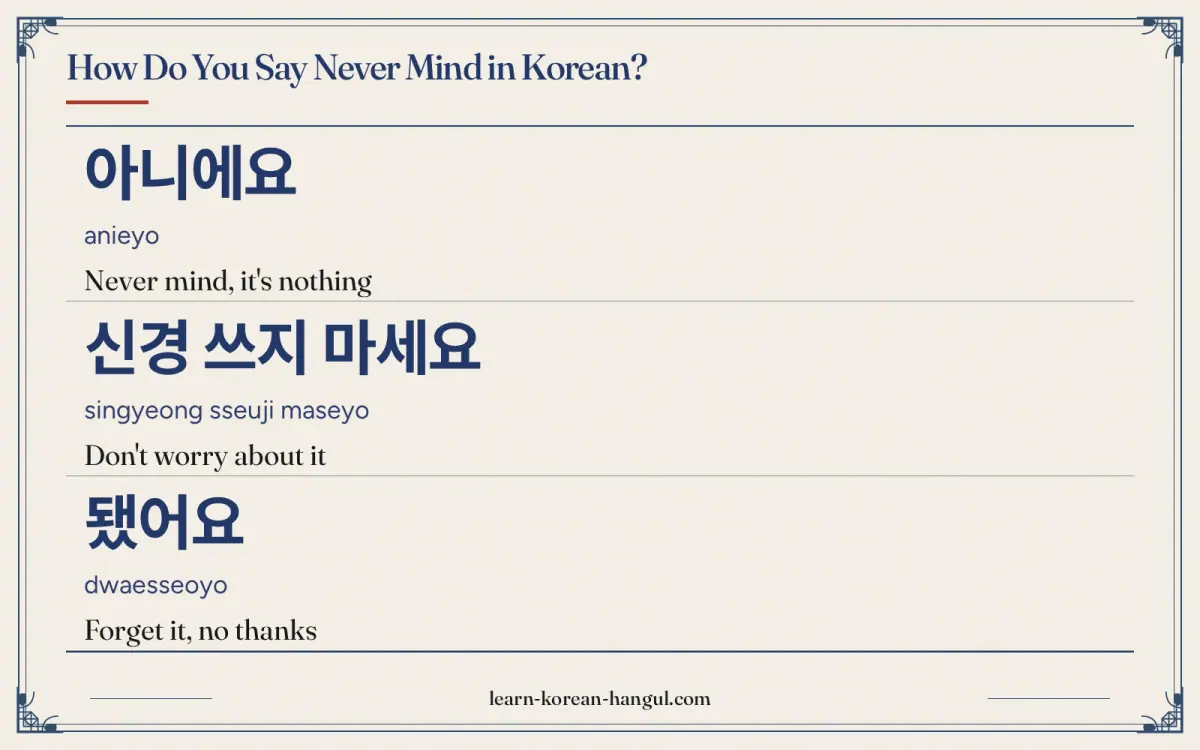
The most common answer is 아니에요. It is the polite form of 아니다 ("to be not"), so literally it means "it is not". Because the topic is dropped when you say it, it also works as "it's nothing" or "don't mention it". The English words "never mind", "forget it" and "don't mind" each match a different Korean phrase.
| Korean | Romanization | Meaning | Style |
|---|---|---|---|
| 아니에요 | anieyo | Never mind, it's nothing | Polite |
| 신경 쓰지 마세요 | singyeong sseuji maseyo | Don't worry about it | Polite |
| 됐어요 | dwaesseoyo | Forget it, no thanks | Polite, curt |
| 괜찮아요 | gwaenchanayo | It's fine | Polite |
Revised Romanization (the South Korean government standard of 2000) is only a reading aid. Learn the Hangul first. The next section goes through each phrase and when to use it.
What Are the Polite Ways to Say Never Mind?
All four phrases below take the polite -요 ending. They differ in how warm, how firm and how final they sound.
Polite: 아니에요 (anieyo)
Polite · 해요체Use 아니에요 to drop what you were saying: "oh, never mind". Add 아무것도 (amugeotdo, "nothing") for a stronger "it's really nothing". It is also the humble reply to thanks, a compliment or an apology: the speaker says "it's nothing" and plays down their own effort.
아니에요. 아무것도 아니에요.
anieyo. amugeotdo anieyo
No. It is nothing.
Polite: 신경 쓰지 마세요 (singyeong sseuji maseyo)
Polite · 해요체신경 means "nerves, attention", and 쓰다 here means "to use", so the phrase literally says "don't use your attention on it". It is the most direct way to say "don't worry about it". It is a polite instruction, so it fits an apology or a small mistake.
신경 쓰지 마세요. 괜찮아요.
singyeong sseuji maseyo. gwaenchanayo
Don't worry about it. It's fine.
Polite: 됐어요 (dwaesseoyo)
Polite · 해요체됐어요 is the past form of 되다 ("to become, to be done"), so it says "it's done" and by extension "that's enough" or "forget it". It is also the usual way to refuse an offer: "No thanks". It is short and firm. With a smile it is fine among peers, but the tone can sound dismissive.
됐어요. 저는 안 먹을게요.
dwaesseoyo. jeoneun an meogeulgeyo
No thanks. I won't eat.
Polite: 괜찮아요 (gwaenchanayo)
Polite · 해요체괜찮아요 means "it's fine" or "I'm okay". It is the warmest of the four. After someone apologises, 괜찮아요 forgives them. It also declines an offer gently, which is why context matters. The page on it's okay in Korean covers it in detail.
Casual Forms
With friends, drop the -요: 아니야 (aniya, "no, never mind"), 신경 쓰지 마 (singyeong sseuji ma), 됐어 (dwaesseo) and 괜찮아 (gwaenchana). These are casual, so use them with friends your own age and with younger people only.
Casual · 반말아니야, 신경 쓰지 마.
aniya, singyeong sseuji ma
No, never mind.
The phrases are short, but the sounds hide some changes, as the next section shows.
How Do You Pronounce 아니에요?
아니에요 has four syllables: 아 (a), 니 (ni), 에 (e) and 요 (yo). It is read as written: [아니에요]. Many speakers say the 에요 part quickly, so the 에 sounds like a short "e" and the phrase runs together as "a-ni-e-yo".
- 아: an open "ah".
- 니: "ni", with a light ㄴ.
- 에: "eh". Most Seoul speakers say ㅔ and ㅐ the same way.
- 요: "yo", short.
Sound Changes to Listen For
- 됐어요 → [돼써요]. The final ㅆ of 됐 links to 어, and it sounds like a tense "ss". Revised Romanization writes dwaesseoyo.
- 괜찮아요 → [괜차나요]. The ㅎ in 찮 is silent before a vowel, so 괜찮아요 sounds like 괜차나요. RR writes gwaenchanayo.
- 아무것도 → [아무걷또]. The final ㅅ of 것 sounds like ㄷ, and it makes the next ㄷ tense. RR writes amugeotdo and does not show the tensing.
- 쓰지. The ㅆ is tense and the vowel ㅡ is unrounded: keep your lips flat, not round.
| Spelling | Sound |
|---|---|
| 아니에요 | [아니에요] |
| 됐어요 | [돼써요] |
| 괜찮아요 | [괜차나요] |
| 아무것도 | [아무걷또] |
Once you can say these words, the main question is when each one is safe.
When Should You Use 아니에요, and When Should You Not?
Use 아니에요 to drop a topic or to reply modestly. Use 괜찮아요 to forgive, and keep 됐어요 for peers.
Situations Where It Fits
- You started to say something and changed your mind. 아니에요, 아무것도 아니에요.
- Someone thanks you. 아니에요 shows that you did not do anything special.
- Someone apologises for a small thing. 괜찮아요 or 신경 쓰지 마세요 puts them at ease.
- You refuse an offer among friends. 됐어 or 됐어요 is quick and clear.
Situations to Avoid
- An elder or a boss offers something. 됐어요 may sound dismissive. Say 괜찮습니다 or 아니에요, 괜찮아요 instead.
- Someone asks a yes/no question about a fact. 아니에요 here means "no, it isn't", not "never mind".
- A serious apology. A short 됐어요 can sound like you do not accept it. Say 괜찮아요 with a warmer voice.
- Writing. In formal writing, use 신경 쓰지 않으셔도 됩니다 ("you do not need to worry").
Three short dialogues show the phrases in action.
What Does Never Mind Sound Like in a Real Conversation?
The first dialogue is at work, the second replies to thanks, and the third is among friends.
Never Mind, It Was Nothing
Colleague
아까 무슨 말을 하려고 하셨어요?
akka museun mareul haryeogo hasyeosseoyo
What were you going to say earlier?
You
아니에요. 아무것도 아니에요.
anieyo. amugeotdo anieyo
No. It's nothing.
What to notice: the colleague's question has the wh-word 무슨 ("what kind of"), so it does not need a sharp rise at the end. The answer uses 아니에요 twice to close the topic.
Replying to Thanks
Hye-Jin
도와줘서 고마워요.
dowajwoseo gomawoyo
Thank you for helping.
Sung-Min
아니에요, 괜찮아요.
anieyo, gwaenchanayo
It's nothing, don't mention it.
What to notice: 아니에요 does not say "no" to the thanks. It plays down the effort, and 괜찮아요 adds warmth.
Offering More Food
Friend
더 먹을래?
deo meogeullae
Do you want more?
You
됐어, 배불러.
dwaesseo, baebulleo
No thanks, I'm full.
What to notice: 먹을래 is the casual "do you want to eat?", pronounced [머글래]. 배불러 is "I'm full" in the casual style. Among friends 됐어 is natural, and the culture behind these replies is next.
What Should You Know about the Culture behind Never Mind?
Korean speakers often use modest replies to keep relationships smooth.
- Playing things down. After a thank-you or a compliment, 아니에요 means "I did nothing special". Refusing praise is a polite habit, not a real denial.
- One word, two meanings. 아니에요 also means "no, it isn't". A listener uses the tone and the situation to choose. After a thank-you it is "it's nothing"; after "Is this yours?" it is "no".
- Refusing gently. 괜찮아요 can mean "I'm fine" or "no thanks", and people use it to decline offers softly. 됐어요 is a firmer decline.
- Spelling. The correct spelling is 아니에요. The form 아니예요 is non-standard. The contracted form 아녜요 is also correct in speech and writing.
An expert insight: the phrase works because Korean often leaves out the topic and relies on context. When a Korean speaker says only 아니에요, the listener fills in what was not said. The same habit leads to the mistakes below.
What Mistakes Do Learners Make with Never Mind in Korean?
Most mistakes come from tone and from using one phrase for every situation.
| Mistake | Why it is a problem | Fix |
|---|---|---|
| Using 됐어요 to a boss or elder | It can sound dismissive | Say 아니에요 or 괜찮아요 |
| Writing 아니예요 | Not the standard spelling | Write 아니에요 or 아녜요 |
| Saying 됐어요 for a thank-you reply | It says "forget it", not "you're welcome" | Say 아니에요 |
| Answering a yes/no question with 아니에요 when you mean never mind | The listener hears "no" | Add 아무것도 |
| Pronouncing 괜찮아요 with a sounded ㅎ | The ㅎ is silent: [괜차나요] | Link ㄴ and 아 |
Learners often think "never mind" has one translation. In practice, English "never mind" hides several different meanings, which the next section sorts out.
Is It the Same as Nevermind?
The spelling changes, but the answer does not. "Nevermind", "forget it" and "don't mind" all map to the phrases above.
- Nevermind in Korean: 아니에요, 아무것도 아니에요.
- Forget it in Korean: 됐어요 for a curt "forget it", or 잊어 주세요 (ijeo juseyo, "please forget it") for a softer request.
- Don't mind in Korean: 신경 쓰지 마세요.
- It's fine: 괜찮아요.
- No problem: see no problem in Korean.
Now practise choosing among them.
Practice: Say It Aloud
Play the slow clip and repeat 아니에요 three times, then link the sounds in 괜찮아요. Choose the best phrase for each situation. Answers follow.
- You start a sentence and decide not to finish.
- A colleague apologises for a small mistake.
- A friend offers more food and you are full.
- A colleague thanks you for helping.
Answers
- 아니에요, 아무것도 아니에요.
- 괜찮아요. 신경 쓰지 마세요.
- 됐어, 배불러.
- 아니에요, 괜찮아요.
The phrase flashcards drill common replies with audio.
Related Phrases to Learn Next
Never mind connects to apologies and thanks.
- It's okay in Korean: the full range of 괜찮아요.
- No problem in Korean: another way to answer thanks.
- Sorry in Korean: the other side of the exchange.
This guide belongs to the Korean filler words collection. What this page does not cover: longer expressions for forgiveness, and written Korean for formal emails. Choose the phrase that matches the mood, and you can say never mind in Korean in a way that fits.
Frequently Asked Questions
How do you say never mind in Korean?
Say 아니에요 (anieyo), or 아무것도 아니에요 ("it's nothing"). To tell someone not to worry, say 신경 쓰지 마세요. To forgive an apology, say 괜찮아요. With friends, drop the -요: 아니야, 괜찮아.
How do you pronounce 아니에요?
Say a-ni-e-yo, four syllables, [아니에요]. The ㅔ in 에 is a short "eh", and many speakers say the last two syllables quickly. Link the sounds smoothly. Play the slow clip and repeat after it.
What is the difference between 아니에요 and 신경 쓰지 마세요?
아니에요 drops a topic or modestly answers thanks: "it's nothing". 신경 쓰지 마세요 is an instruction: "don't worry about it". Use the first for yourself and the second to comfort someone else.
Can I use 아니에요 with friends, elders and strangers?
Yes. 아니에요 is polite, so it works with elders, colleagues and strangers. With close friends, use 아니야. Be careful with 됐어요: it works with peers, but it can sound dismissive to an elder or a boss.
What is the most common mistake with never mind in Korean?
The most common mistake is using 됐어요 with someone senior, where it can sound rude. The second is the spelling 아니예요. The correct spelling is 아니에요, and the short form is 아녜요.