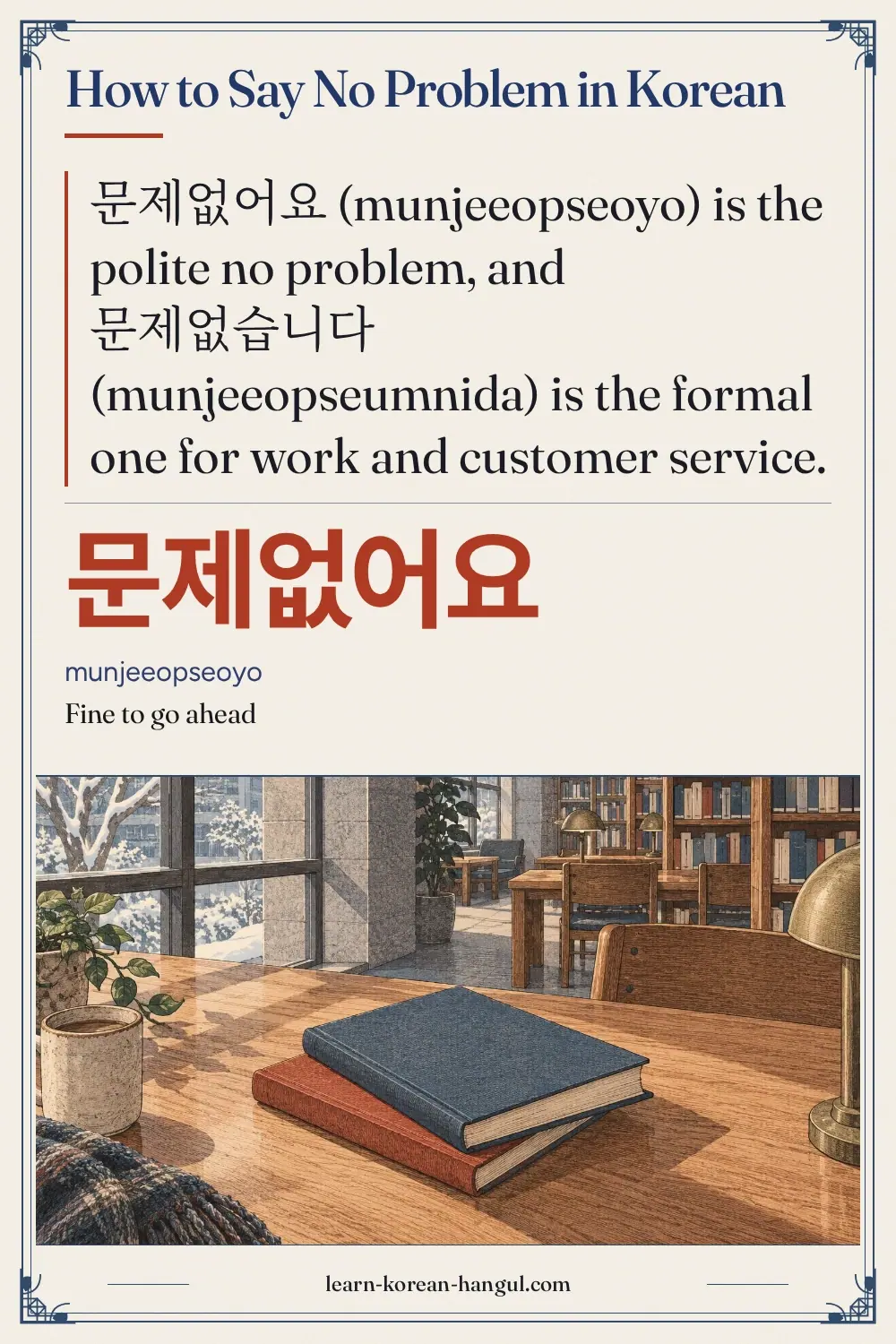
문제없어요
문제없어요
What you'll learn
- Pick the right no problem for three jobs: agreeing, forgiving and replying to thanks.
- Say 문제없어요 as [문제업써요] and 괜찮아요 as [괜차나요].
- Switch between formal, polite and casual forms.
- Spot when 괜찮아요 means no thank you.
Before you start: knowing sorry in Korean helps, because many no-problem answers reply to an apology. Time: about 10 minutes. Audio plays only when you press a button.
Key facts
- 문제없어요 means nothing stands in the way of a plan, while 괜찮아요 means it is fine or no worries after a small mistake.
- 괜찮아요 can also mean no thank you when someone offers you something.
How Do You Say No Problem in Korean?
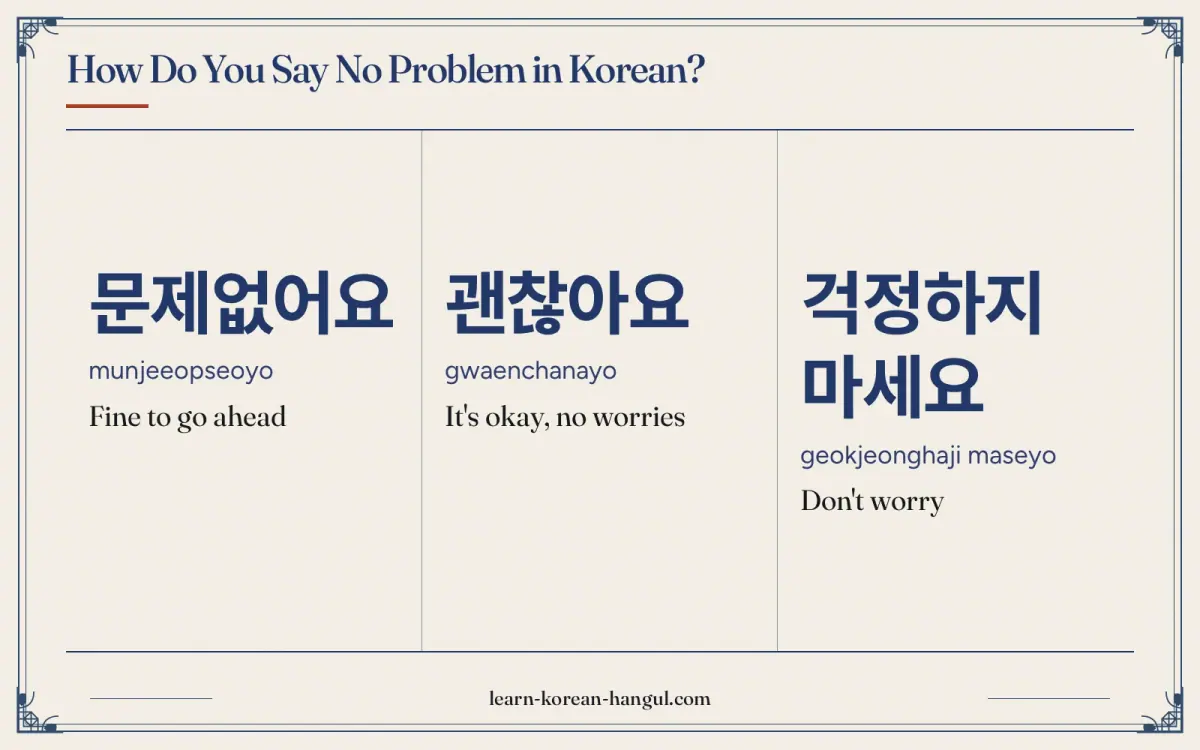
The standard way to say no problem in Korean is 문제없어요, which literally means "there is no problem". It fits when someone asks whether a plan, request or change is acceptable, and the answer is yes.
| English meaning | Situation | Korean | Romanization |
|---|---|---|---|
| Fine to go ahead | Someone asks to change a plan | 문제없어요 | munjeeopseoyo |
| It's okay, no worries | Someone apologises for a small mistake | 괜찮아요 | gwaenchanayo |
| Don't worry | Someone looks anxious | 걱정하지 마세요 | geokjeonghaji maseyo |
| It's nothing | Someone thanks you | 아니에요 | anieyo |
문제 means "problem", and 없어요 is the polite form of 없다, "there is not". The verb 없다 also appears in 맛없어요 (not tasty), so the pattern is useful beyond this phrase. Now the forms by listener.
What Are the Formal, Polite and Casual Ways to Say No Problem?
Korean changes the sentence ending to match the listener, a system called speech levels. The guide to Korean speech levels explains them, and this page uses three: formal (합쇼체), polite (해요체) and casual (해체).
Formal: 문제없습니다 (munjeeopseumnida)
Formal · 합쇼체문제없습니다 is what staff, managers and professionals say to confirm that a request can be done. It is respectful and businesslike, and it suits customers, clients and bosses.
네, 문제없습니다. 내일까지 보내 드리겠습니다.
ne, munjeeopseumnida. naeilkkaji bonae deurigetseumnida
Yes, no problem. I will send it by tomorrow.
Polite: 문제없어요 (munjeeopseoyo)
Polite · 해요체문제없어요 is the everyday polite form for coworkers, classmates and people you meet for the first time. It agrees to a plan without sounding stiff.
문제없어요. 같이 가요.
munjeeopseoyo. gachi gayo
No problem. Let's go together.
Polite: 괜찮아요 (gwaenchanayo)
Polite · 해요체괜찮아요 means "it's fine" and is the phrase for waving off a small mistake: a spilled drink, a late arrival, a bump on the street. It describes your feeling about the situation, while 문제없어요 describes whether the situation works.
괜찮아요. 신경 쓰지 마세요.
gwaenchanayo. singyeong sseuji maseyo
It's fine. Don't worry about it.
Polite: 걱정하지 마세요 (geokjeonghaji maseyo)
Polite · 해요체걱정하지 마세요 means "please don't worry" and is used to calm someone down. It fits after a mistake, before an exam or when someone is nervous about a plan.
걱정하지 마세요.
geokjeonghaji maseyo
Don't worry.
Casual: 문제없어 and 걱정 마
Casual · 반말With friends, drop the -요: 문제없어 (munjeeopseo) means no problem, and 걱정 마 (geokjeong ma) means don't worry. The casual 괜찮아 (gwaenchana) also works.
문제없어. 걱정 마.
munjeeopseo. geokjeong ma
No problem. Don't worry.
Use the formal form with seniors and customers, the polite form with most people and the casual form with close friends. The sounds of these phrases hide two surprises.
How Do You Pronounce 문제없어요?
문제없어요 is pronounced [문제업써요], not "mun-je-eop-seo-yo", because the ㅂ of the double ending ㅄ in 없 stays as a closing sound while the ㅅ moves to the next syllable and becomes tense. Say it in four beats.
- 문 (mun): "moon".
- 제 (je): "jeh", light and short.
- 업 (eop): the ㅂ closes the sound, no puff of air.
- 써요 (sseo-yo): a strong, tense s, then "yo".
Sound Changes to Listen For
Two rules affect these phrases.
- Double batchim and liaison. The batchim ㅄ in 없 is two consonants. When a vowel follows, the second one (ㅅ) moves onto the next syllable and becomes tense, giving [업써요]. See Korean liaison.
- Silent ㅎ. In 괜찮아요, the ㅎ of the final ㄶ is not pronounced before a vowel (Article 12), and the ㄴ links forward, so the phrase is [괜차나요]. These follow the National Institute of Korean Language Standard Pronunciation rules (표준 발음법).
With the sounds clear, the harder skill is picking the right phrase for the moment.
When Should You Use 문제없어요, and When Should You Not?
Use 문제없어요 when you agree that a plan, request or situation works. Do not use it as a reply to thank you or as a general apology response, because Korean has better phrases for those moments.
Situations Where It Fits
- Agreeing to a change. "Can we move the meeting?" Answer 네, 문제없어요.
- Confirming a request. Staff say 네, 문제없습니다 when they can do what a customer asks.
- Confirming your own work. 문제없어요 means "everything is working".
- Reassuring a friend. 문제없어 means "I've got it".
Situations to Avoid
- After a thank you. Say 아니에요 or 천만에요 (you're welcome) instead. See you're welcome in Korean.
- After a sincere apology. Say 괜찮아요. It deals with the feeling, not the plan.
- After a serious mistake. 문제없어요 may sound as though you do not care.
Real exchanges make the three jobs easier to remember.
What Does No Problem Sound Like in a Real Conversation?
No problem in Korean usually answers a question, so the sentence before it matters as much as the phrase itself.
Moving a Meeting
Colleague
회의 시간을 바꿔도 될까요?
hoeui siganeul bakkwodo doelkkayo?
May we change the meeting time?
You
네, 문제없습니다.
ne, munjeeopseumnida
Yes, no problem.
What to notice: the formal 문제없습니다 fits a work request. A colleague you know well could get the polite 문제없어요 instead.
A Spilled Coffee
Customer
죄송해요, 커피를 쏟았어요.
joesonghaeyo, keopireul ssodasseoyo
I'm sorry, I spilled my coffee.
Staff
괜찮아요. 걱정하지 마세요.
gwaenchanayo. geokjeonghaji maseyo
It's fine. Don't worry.
What to notice: 괜찮아요 answers the apology, and 걱정하지 마세요 adds comfort. The apology side of this exchange is covered in sorry in Korean.
Thanks between Friends
Minsu
도와줘서 고마워.
dowajwoseo gomawo
Thanks for helping.
Jia
아니야, 문제없어.
aniya, munjeeopseo
It's nothing, no problem.
What to notice: between friends, 아니야 (it's nothing) does the main work, and the casual 문제없어 after it is fine among friends, even though it would sound businesslike after a polite thank you. The next step after small talk like this is it's okay in Korean. These choices reflect how Koreans handle thanks and apologies.
What Should You Know about the Culture behind No Problem?
Korean replies to thanks and apologies lean toward modesty, so a direct "no problem" is less common than in English.
- Modest replies. To thank-yous, people often say 아니에요 ("it's not anything") or 별거 아니에요 ("it's nothing special"), which downplays the favour.
- 괜찮아요 is flexible. It can mean "it's fine", "I'm fine", "no, thank you" or "never mind". A waiter who asks "more rice?" and hears 괜찮아요 will usually understand "no thanks". The phrases for a clear refusal are on the no thank you page.
- Formal confirmation at work. Service staff say 문제없습니다 to confirm that a request is possible, and managers may ask 문제없나요? to check a plan.
An expert insight: learners often use 괜찮아요 for everything, including saying yes to an offer. If you want to accept, add 네 or 좋아요, because 괜찮아요 alone can be read as a refusal. The table below collects other common mistakes.
What Mistakes Do Learners Make with No Problem in Korean?
Most mistakes come from translating the English phrase word for word into one Korean phrase.
| Mistake | Why it is a problem | Fix |
|---|---|---|
| 문제없어요 after a thank you | Sounds like a shop confirming an order | Say 아니에요 or 천만에요 |
| 괜찮아요 to accept an offer | Often heard as "no thanks" | Say 네, 좋아요 |
| 문제없어 to a boss | Casual ending is rude | Say 문제없습니다 |
| Reading 없어요 as "eop-seo-yo" | The tense sound is missing | Say [업써요] |
| 문제없어요 after a serious mistake | Sounds as if you do not care | Say 괜찮아요, then comfort the person |
Learners often assume 문제없어요 is the translation of "no problem" in every case. Actually, it matches the "fine to go ahead" meaning only, and the other English meanings use 괜찮아요 and 아니에요.
Is It the Same as No Worries, No Biggie or No Problem Formal?
Not exactly. Each English search below maps to a different Korean phrase.
- No worries in Korean: 괜찮아요, or 걱정하지 마세요 when you want to reassure someone.
- No problem formal in Korean: 문제없습니다.
- No biggie in Korean: 별거 아니에요 (polite) or 별거 아니야 (casual), meaning "it's nothing special".
- Don't worry: 걱정하지 마세요, covered in depth in don't worry in Korean.
The pattern repeats across the page: formal 습니다, polite 요, casual with no ending. Time to practise.
Practice: Say It Aloud
Play the slow clip of 문제없어요 three times, then say it as [문제업써요]. Choose the phrase for each situation. Answers follow.
- A client asks if you can deliver on Friday and you can.
- A stranger bumps you and apologises.
- A friend thanks you for lending a pen.
- Your teammate is nervous about a talk.
Answers
- 네, 문제없습니다.
- 괜찮아요.
- 아니야 (or 아니야, 문제없어).
- 걱정하지 마세요 (or 걱정 마 to a close friend).
The phrase flashcards drill all of these with audio.
Related Phrases to Learn Next
No problem leads straight into thanks, apologies and reassurance, so these are the natural next phrases.
- It's okay in Korean: 괜찮아요 in more detail, including the no thanks meaning.
- You're welcome in Korean: 천만에요 and the modest 아니에요.
- Sorry in Korean: 죄송합니다 and 미안해요.
This guide belongs to the polite Korean phrases collection. What this page does not cover: business Korean in depth and the full range of refusals, which have their own lessons. Choose 문제없어요 for plans, 괜찮아요 for small mistakes and 아니에요 after thanks, and you can say no problem in Korean in every situation.
Frequently Asked Questions
Does 괜찮아요 mean no problem or no thank you?
It can mean both. After an apology, 괜찮아요 means it's fine, no problem. After an offer such as more rice, it means no thanks, I'm fine. Listen to what came before it, and add a smile or a nod for yes. For a clear refusal, say 괜찮습니다 or the phrases on the no thank you page.
How do I say no problem when someone thanks me in Korean?
Say 아니에요 (it's nothing) or 천만에요 (you're welcome) instead of 문제없어요. Koreans often answer thanks with a modest 아니에요 or 별거 아니에요 (it's nothing special). Using 문제없어요 right after a thank you can sound like a shop confirming a booking.
How do I say no worries in Korean?
The closest everyday phrase is 괜찮아요, said after a small mistake or apology. To tell someone not to be anxious, say 걱정하지 마세요 (polite) or 걱정 마 (casual). 문제없어요 is slightly more practical, meaning there is nothing wrong with the plan or task.
What is the casual way to say no problem to a friend?
Drop the -요: 문제없어 (munjeeopseo) means no problem, and 괜찮아 (gwaenchana) means it's fine. For no big deal, say 별거 아니야. Add 걱정 마 (don't worry) to calm a friend. Do not use these casual forms with teachers, bosses or older strangers.
Can I say 문제없어요 to my boss?
Yes, 문제없어요 is polite, and 문제없습니다 is the better choice for a boss, a client or a customer, because the formal ending shows more respect. Use it when confirming a plan, as in 네, 문제없습니다 (yes, no problem). Avoid the casual 문제없어 at work.