어떡해
어떡해
What you'll learn
- Use 어떡해 and 어떡해요 as a reaction of worry or sympathy.
- Tell 어떡해 apart from 어떻게 ("how").
- Pronounce [어떠캐] and [어떠케] and spell both correctly.
- Pick a gentler form such as 어쩌죠 for elders.
Before you start: you should read Hangul and know that 요 makes a sentence polite. The pages on help in Korean and how in Korean are good partners. Time: about 12 minutes. Audio plays only when you press a button.
Key facts
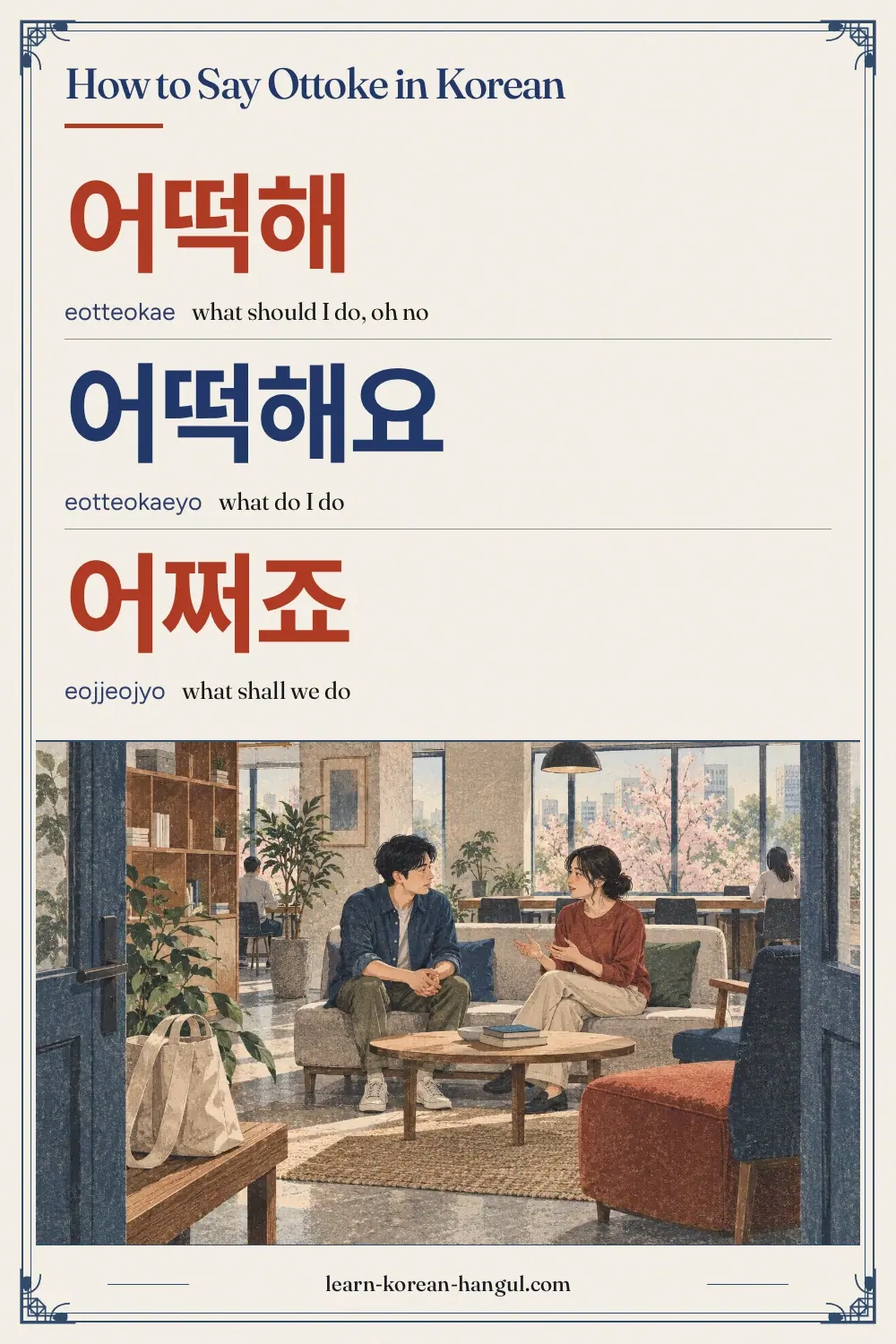
- 어떡해 (eotteokae) means "what should I do?" or "oh no!".
- 어떡해요 (eotteokaeyo) is polite, and 어쩌죠 (eojjeojyo) is gentler still.
- 어떻게 (eotteoke) means "how" and needs more words after it.
- The spelling 어떻해 is a common mistake.
- Both words sound almost the same: [어떠캐] and [어떠케].
How Do You Say Ottoke in Korean?
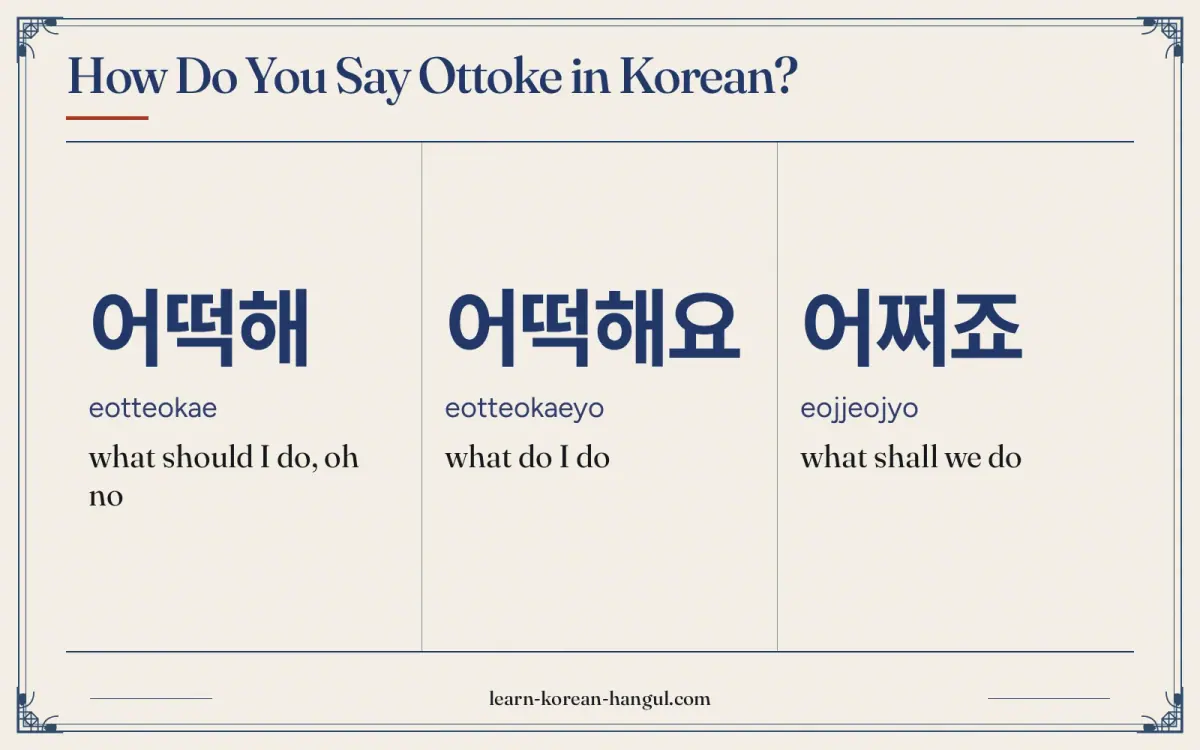
The word is 어떡해. It began as a short form of 어떻게 해 (eotteoke hae), which literally means "do how?" or "what shall I do?". Over time the short form became its own reaction, so Koreans say it when something has gone wrong and they feel stuck. English speakers write it "ottoke" or "otokke", but the standard Revised Romanization is eotteokae.
| Korean | Romanization | Meaning | Style |
|---|---|---|---|
| 어떡해 | eotteokae | what should I do, oh no | casual |
| 어떡해요 | eotteokaeyo | what do I do | polite |
| 어쩌죠 | eojjeojyo | what shall we do | polite, gentle |
| 어떻게 | eotteoke | how | neutral adverb |
| 어떻게 해요 | eotteoke haeyo | what do I do, how do I do it | polite |
| 어떡하지 | eotteokaji | what should I do (to myself) | casual, thinking aloud |
Two forms look alike, but they do different jobs. 어떡해 is a complete reaction: it can end a sentence and needs nothing after it. 어떻게 means "how" and sits before a verb, as in 어떻게 가요? (eotteoke gayo, "how do I get there?"). The long phrase 어떻게 해요? asks a real question, and a listener will answer with advice. The short 어떡해 usually asks nothing.
What Are the Polite and Casual Ways to Say Ottoke?
The choice depends on who listens and how serious the problem is. The guide to Korean speech levels explains casual and polite endings in full.
Casual: 어떡해 (eotteokae)
Casual · 반말This is the form to learn first. Say it when you forget something, when a friend has a problem or when you hear sad news. It carries emotion, so your voice usually rises and tightens.
어떡해! 지갑을 잃어버렸어.
eotteokae! jigabeul ireobeoryeosseo
Oh no! I lost my wallet.
Casual, Thinking Aloud: 어떡하지 (eotteokaji)
Casual · 반말어떡하지 adds the ending -지, which sounds like a question to yourself or a friend: "what should I do?". It is pronounced [어떠카지].
Polite: 어떡해요 (eotteokaeyo)
Polite · 해요체어떡해요 adds 요. Use it with elders, teachers, coworkers and strangers. In a panic, a polite listener still hears the worry.
Polite and Gentle: 어쩌죠 (eojjeojyo)
Polite · 해요체어쩌죠 comes from 어쩌다 (eojjeoda, "to do how") and the soft ending -죠. It sounds calmer than 어떡해요 and works when you are worried but want to stay composed. For example, a clerk says 어쩌죠? when something is out of stock.
Polite Question: 어떻게 해요? (eotteoke haeyo)
Polite · 해요체This is the real question "what do I do?" or "how do I do it?". It expects an answer, and like other wh-questions it usually ends with a fall or rise-fall, not a sharp rise.
Neutral: 어떻게 (eotteoke)
Polite · 해요체어떻게 is the adverb "how". It does not end a sentence.
이거 어떻게 먹어요?
igeo eotteoke meogeoyo
How do I eat this?
The sounds explain why the two words are so often confused.
How Do You Pronounce 어떡해?
어떡해 has three syllables, spoken eo-tteo-kae. The first vowel ㅓ is unrounded, so keep your lips spread and relaxed. The ㄸ is a tense consonant: press your tongue to the ridge behind your upper teeth and release it without a puff of air.
Sound Changes to Listen For
- 어떡해 is [어떠캐]. The final ㄱ of 떡 meets the ㅎ of 해, and together they make an aspirated ㅋ (Standard Pronunciation Article 12). Revised Romanization shows this as eotteokae. In RR, the h of such a predicate is not written when the aspirated sound is shown by the letter k.
- 어떻게 is [어떠케]. Here the ㅎ comes first and the ㄱ follows, so the same ㅋ appears. Revised Romanization writes eotteoke.
- 어떡해요 is [어떠캐요]. The 요 adds no change.
Since most Seoul speakers pronounce ㅐ and ㅔ the same, [어떠캐] and [어떠케] sound almost identical in fast speech. The standard rules still list ㅐ and ㅔ as two vowels, and the spelling is what keeps the words apart. This is why the written forms need care. The page on Korean tensification explains tense sounds like ㄸ in more detail.
When Should You Use 어떡해, and When Should You Not?
Use 어떡해 when you feel stuck or when you share a friend's trouble. It is more about feeling than about asking for advice. A friend who hears 어떡해 will comfort you before they offer a plan.
Situations Where It Fits
- A mistake. You miss a bus, break a phone or lose a key.
- Sympathy. A friend tells you sad news, and you say 어떡해, which means "oh no, I feel for you".
- Panic about a deadline. You think aloud: 어떡하지?
- Drama scenes. Characters say 어떡해 to show fear or heartbreak.
Situations to Avoid
- Formal writing or speeches. Use 어떻게 해야 할지 모르겠습니다 ("I do not know what to do").
- With a senior who has not heard the bad news. Begin with 죄송한데 (joesonghande, "I am sorry, but") and use 어떡해요.
- When you want real advice. Use the question 어떻게 해요? so the listener knows to answer.
- Light jokes about serious loss. The word signals worry, so do not use it as a joke about someone's pain.
What Does Ottoke Sound Like in a Real Conversation?
In real talk, 어떡해 comes at the peak of a problem, often twice in a row: 어떡해, 어떡해! Listen for the tight, rising voice on the first dialogue and the calmer polite forms in the second.
A Lost Wallet
Minji
지갑을 잃어버렸어.
jigabeul ireobeoryeosseo
I lost my wallet.
Jihun
어떡해! 경찰서에 가 보자.
eotteokae! gyeongchalseoe ga boja
Oh no! Let's go to the police station.
What to notice: 잃어버렸어 is pronounced [이러버려써], because the ㅎ is silent before a vowel. The friend answers 어떡해 first, then offers a plan, which is the usual order.
A Missed Flight
Traveler
비행기를 놓쳤어요. 어떡해요?
bihaenggireul nochyeosseoyo. eotteokaeyo
I missed my flight. What do I do?
Staff
어쩌죠? 다음 비행기를 알아볼게요.
eojjeojyo? daeum bihaenggireul alabolgeyo
What shall we do? I will look at the next flight.
What to notice: the traveler uses the polite 어떡해요, and the staff member uses the calmer 어쩌죠. 알아볼게요 is pronounced [아라볼께요]. Both questions are open "what" questions, so the pitch does not rise sharply at the end.
A Bad Exam
Sujin
시험 망쳤어. 어떡해?
siheom mangchyeosseo. eotteokae
I messed up the exam. What do I do?
Haneul
괜찮아, 다음에 잘 보면 돼.
gwaenchana, daeume jal bomyeon dwae
It's okay, you can do well next time.
What to notice: the sad question 어떡해? is really a plea for comfort. 괜찮아 is [괜차나], the comforting answer, and 잘 보면 돼 means "you just need to do well (next time)".
What Should You Know about the Culture behind Ottoke?
어떡해 is one of the best-known Korean expressions of feeling, and it shows how Korean talk values sharing emotion. Friends respond to a worried 어떡해 with comfort first, and with solutions only after that.
- It is not always a question. Many speakers do not expect an answer. They want a kind reaction.
- Sympathy counts. Saying 어떡해 about a friend's loss shows that you feel it with them.
- It is common in songs and dramas. The word appears in lyrics and dialogue, so learners hear it often.
- Repetition shows panic. 어떡해, 어떡해 is a real state of alarm.
- Elders prefer polite forms. Even in worry, use 어떡해요 or 어쩌죠 with seniors.
An expert insight: the word is a compact whole sentence. Think of it as "what-do-I-do!", and you will not try to attach a noun to it.
What Mistakes Do Learners Make with Ottoke in Korean?
Most mistakes come from the spelling and from mixing the two words.
| Mistake | Why it is a problem | Fix |
|---|---|---|
| Writing 어떻해 | It mixes 어떡해 and 어떻게 | Write 어떡해 |
| Writing 어떡게 | It also mixes the two | Write 어떻게 for "how" |
| 어떻게 for a panicked "oh no" | 어떻게 means "how" | Say 어떡해 |
| 어떡해 to a senior | It is casual | Say 어떡해요 or 어쩌죠 |
| Romanizing as "otokke" and dropping the aspirated sound | The word has [어떠캐] | Write eotteokae |
The spelling mistake is common among Korean speakers too, since both words sound alike. A simple tip is to ask: is the word a whole reaction, or does it modify a verb? If it stands alone, use 어떡해.
Is It the Same as Eotteokae?
They are the same word in different spellings. The related searches map to this page like this.
- Eotteokae in Korean: the Revised Romanization of 어떡해.
- Eotteoke in Korean: the Revised Romanization of 어떻게, the word for "how".
- Otokke in Korean: an informal spelling of 어떡해 that drops the aspiration.
- How in Korean: 어떻게 for "how". The page on how in Korean covers the vocabulary word.
- What should I do in Korean: 어떻게 해야 해요? (eotteoke haeya haeyo) for a real question, or 어떡해 for the feeling.
Related Phrases to Learn Next
Reaction phrases belong together, so learn this set:
- Help in Korean: 도와주세요, when you need real help.
- OMG in Korean: 어머 and 세상에, for surprise.
- Don't worry in Korean: 걱정 마세요, the comfort that answers 어떡해.
This guide belongs to the K-drama phrases collection. What this page does not cover: the grammar of the contraction 어떻게 해 → 어떡해, and the full list of -지 endings, which have their own lessons. Use 어떡해 for feelings and 어떻게 for how, and you can say ottoke in Korean with the right spelling.
Practice: Say It Aloud
Play the slow clip of 어떡해 and repeat it three times, then 어떡해요 and 어떻게. Then pick the right word. Answers follow.
- You miss your bus and say it to yourself.
- A friend tells you she failed a test.
- You ask a stranger how to use a ticket machine.
- You tell your teacher you lost your homework.
Answers
- 어떡해!
- 어떡해, 괜찮아?
- 이거 어떻게 해요?
- 숙제를 잃어버렸어요. 어떡해요?
The phrase flashcards drill these reactions with audio.
Frequently Asked Questions
How do you say ottoke in Korean?
Write 어떡해 and romanize it eotteokae. It means "what should I do?" or "oh no!" and shows worry. With friends say 어떡해, and with elders say 어떡해요 or 어쩌죠. The common English spelling "ottoke" or "otokke" comes from how the word sounds to English ears and is not the standard form.
How do you pronounce 어떡해?
It sounds like [어떠캐]. The final ㄱ in 어떡 joins the ㅎ of 해 and makes an aspirated ㅋ sound. The ㄸ is tense, so press your tongue firmly without a puff of air. Revised Romanization shows the aspiration as eotteokae, so the h is not written.
What is the difference between 어떡해 and 어떡해요?
어떡해 is casual, so it fits friends, siblings and your own thoughts. 어떡해요 adds the polite 요 and fits elders, coworkers and strangers. Both express worry. When the situation is serious and the listener is senior, many speakers switch to 어쩌죠 or 어떻게 하죠, which sound calmer.
Is 어떡해 formal or casual?
어떡해 is casual. It has no politeness ending, so it fits people you speak casually to. For a polite version add 요, which gives 어떡해요. There is no very formal single word for it, so formal speech uses a full phrase such as 어떻게 해야 할지 모르겠습니다, "I do not know what to do".
Can I use 어떡해 with friends, elders and strangers?
Use it freely with friends and family. With elders and strangers use 어떡해요, which is polite. In a real emergency, any listener will understand a panicked 어떡해, but you should still follow it with a polite request such as 도와주세요 if you need help from someone older.
What is the most common mistake with ottoke in Korean?
The most common mistake is the spelling 어떻해, which mixes up 어떡해 and 어떻게. Remember that 어떡해 is a complete reaction, while 어떻게 is "how" and needs more words after it. A second mistake is saying 어떻게 when you want the panicked "oh no".