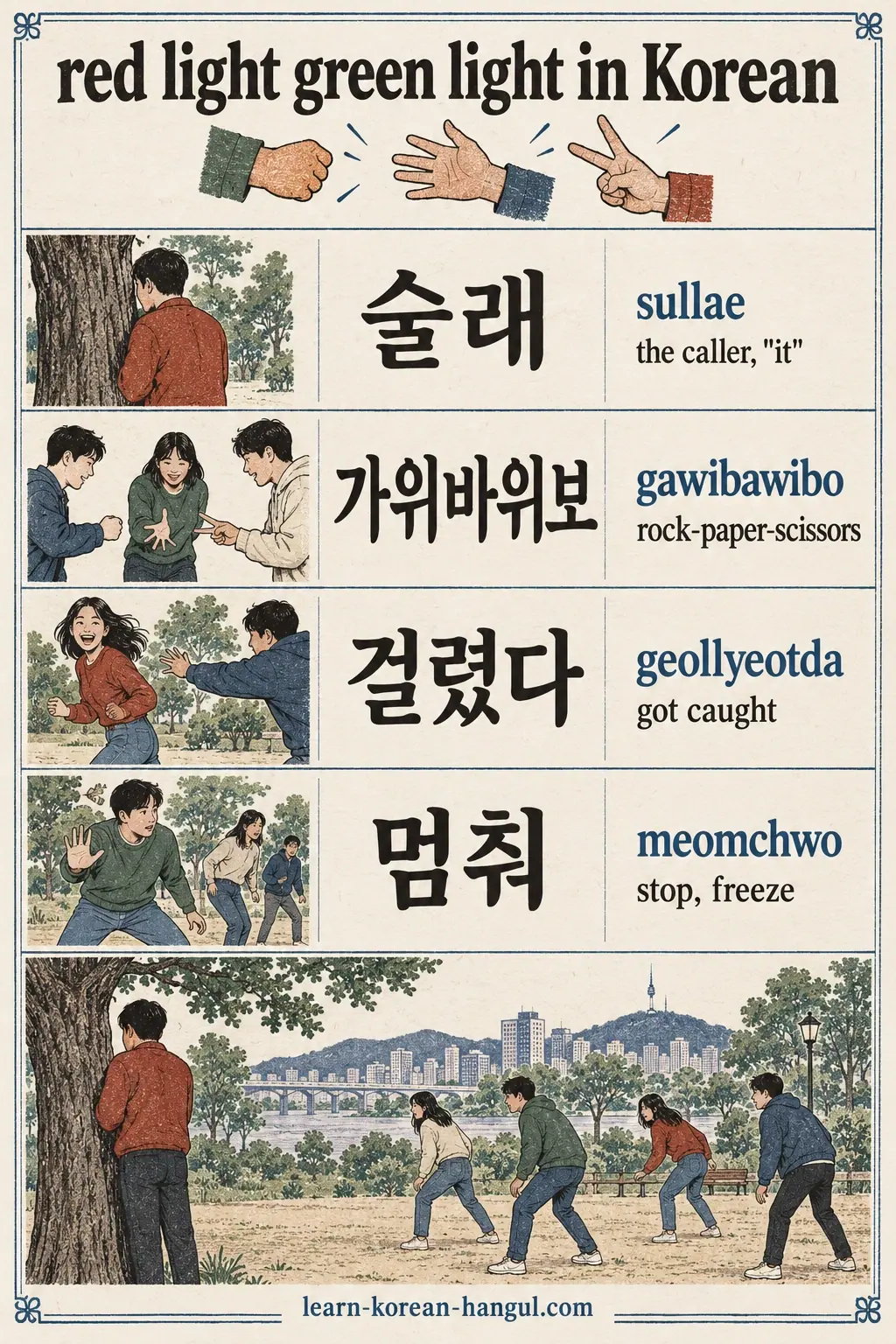
무궁화 꽃이 피었습니다
무궁화 꽃이 피었습니다
What you'll learn
- Say 무궁화 꽃이 피었습니다 aloud as [무궁화 꼬치 피얻씀니다] at a steady beat.
- Explain why the Korean game is named after a flower and not after traffic lights.
- Tell the formal chant 무궁화 꽃이 피었습니다 apart from the casual tag call 얼음 땡.
- Use 빨간불 and 파란불 correctly when you mean real traffic lights.
Before you start: knowing hello in Korean helps, because the chant uses the same formal ending as a greeting. Time: about 12 minutes. Audio plays only when you press a button.
How Do You Say Red Light Green Light in Korean?
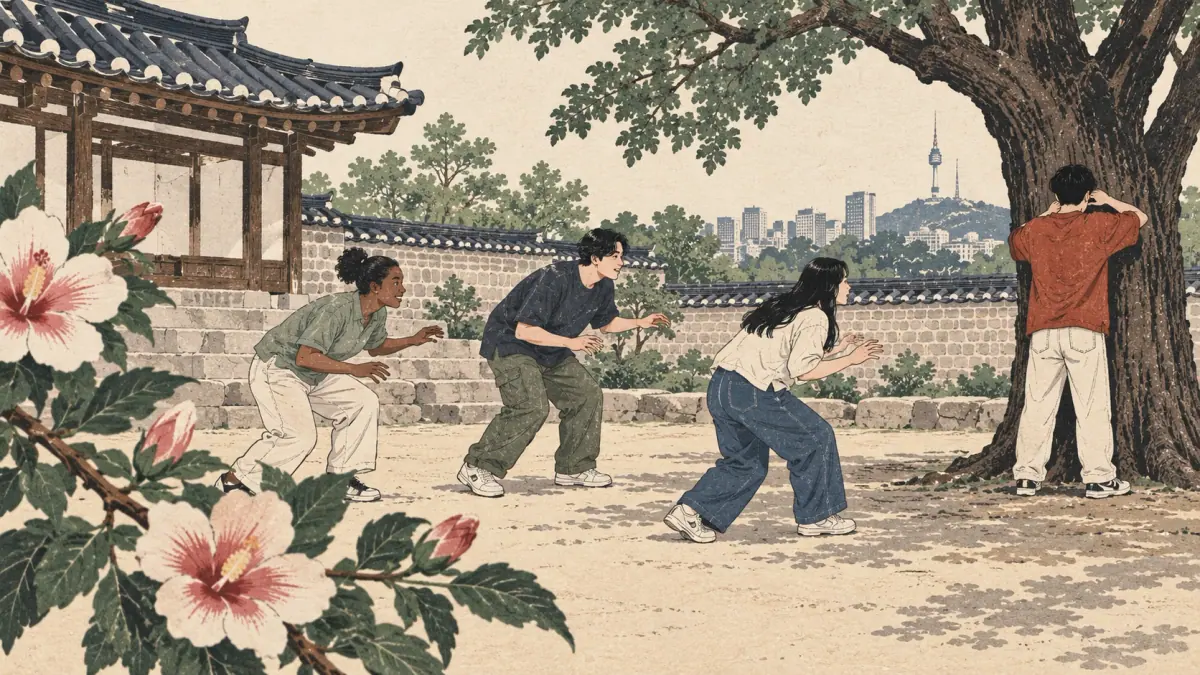
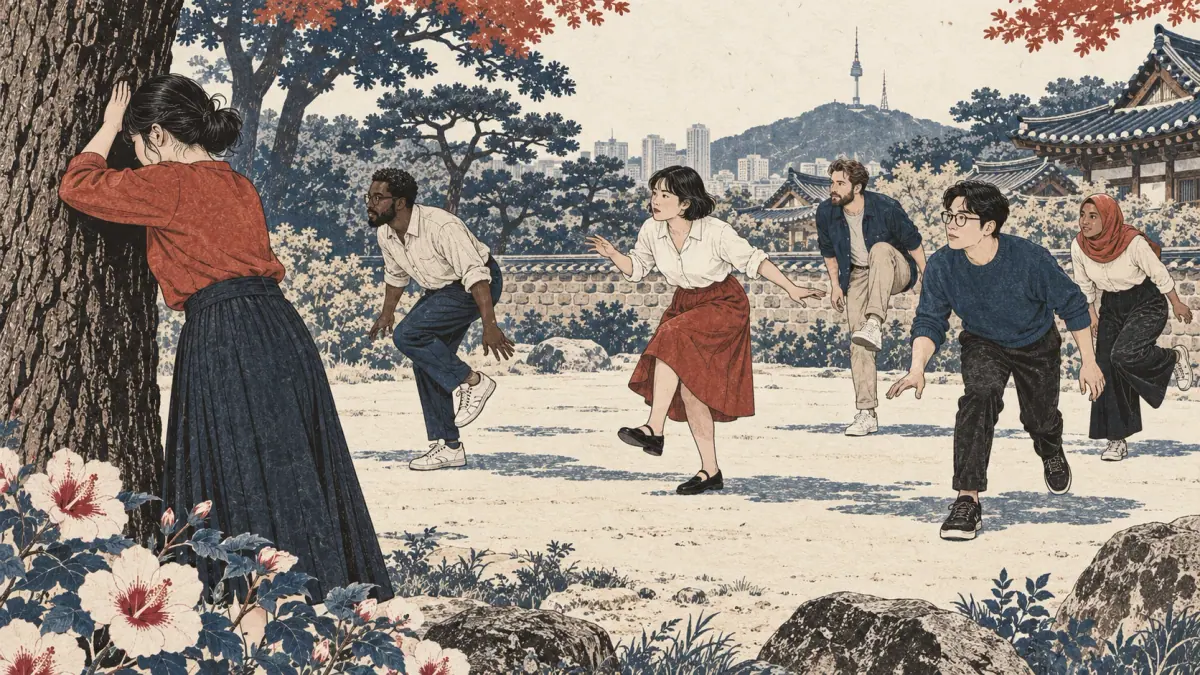
The Korean game that English speakers call red light green light is played with the line 무궁화 꽃이 피었습니다. The caller (술래, sullae) faces away and chants it, while the other players creep forward and freeze when the caller turns around. It is named after the mugunghwa (무궁화), a hibiscus known in English as the rose of Sharon and treated as Korea's national flower.
| Form | Romanization | Register | Who says it |
|---|---|---|---|
| 무궁화 꽃이 피었습니다 | mugunghwa kkochi pieotseumnida | Formal (합쇼체), chanted | The caller in the game |
| 얼음 땡 | eoreum ttaeng | Casual, game call | Children playing the tag game |
| 빨간불 / 파란불 | ppalganbul / paranbul | Neutral, everyday | Anyone talking about real traffic lights |
The chant and the tag call are both game words, so the next section explains what each one does and who says it.
What Are the Formal and Casual Ways to Say Red Light Green Light?
The chant uses the formal ending -ㅂ니다 of the Korean speech levels, explained in the guide to Korean speech levels. Children use it as a fixed rhyme, not as a way of addressing a senior. The tag call 얼음 땡 is casual play language.
Formal: 무궁화 꽃이 피었습니다 (mugunghwa kkochi pieotseumnida)
Formal · 합쇼체무궁화 꽃이 피었습니다 is made of 무궁화 (the hibiscus), 꽃이 (the flower, as subject), and 피었습니다 (has bloomed, the formal past of 피다, to bloom). The formal -습니다 ending gives the chant a ceremonial sound, and the past tense reports that the flower "has bloomed". The caller repeats it until the final syllable and then turns around.
무궁화 꽃이 피었습니다. 무궁화 꽃이 피었습니다.
mugunghwa kkochi pieotseumnida. mugunghwa kkochi pieotseumnida
The hibiscus flower has bloomed. The hibiscus flower has bloomed.
Casual: 얼음 땡 (eoreum ttaeng)
Casual · 반말얼음 땡 belongs to a related Korean tag game. 얼음 (eoreum) means ice: a player about to be tagged shouts it and freezes in place, which protects them from being caught. 땡 (ttaeng) is a "ding" sound that frees the frozen player when a teammate touches them. It is casual, short and shouted, so use it only when you are playing.
얼음! 땡!
eoreum! ttaeng!
Freeze! Unfreeze!
Both calls are fun but have narrow uses. How to say the chant clearly is the next question.
How Do You Pronounce 무궁화 꽃이 피었습니다?
무궁화 꽃이 피었습니다 is pronounced [무궁화 꼬치 피얻씀니다], mugunghwa kkochi pieotseumnida, in ten syllables. Children chant one syllable per beat. Practise slowly first and keep the beat even.
- 무 (mu): "moo".
- 궁 (gung): "goong", ending in the "ng" of "sing".
- 화 (hwa): "hwah", with a light h after the ng sound.
- 꼬 (kko): the tense ㄲ of 꽃, said tight with no puff of air.
- 치 (chi): the ㅊ of 꽃 moves to the next syllable and joins 이.
- 피 (pi): "pee" with a small puff of air.
- 얻 (eot): the vowel of 었 with a short, unreleased [t] ending.
- 씀 (sseum): tense s and an m ending.
- 니 (ni): "nee".
- 다 (da): a soft d and "ah".
Sound Changes to Listen For
Four sound changes from the National Institute of Korean Language Standard Pronunciation Rules (표준 발음법) explain the gap between spelling and sound.
- Liaison in 꽃이. The final ㅊ moves to the vowel 이, so 꽃이 is [꼬치].
- A final ㅆ becomes [ㄷ]. In 었, the final ㅆ is said as [ㄷ] when a consonant follows, so 피었습니다 starts as [피얻].
- Tensification of ㅅ. After that [ㄷ], the ㅅ of 습 becomes tense, so 습 is said [씀]. The rule is explained in Korean tensification.
- Nasalization of ㅂ. ㅂ before ㄴ becomes ㅁ, so 습니다 is [씀니다]. The rule is explained in ㅂ-to-ㅁ nasalization.
[피얻씀니다] is the standard form. In everyday speech the [ㄷ] is often absorbed, giving [피어씀니다], and both are understood. Next comes when the chant fits.
When Should You Use 무궁화 꽃이 피었습니다, and When Should You Not?
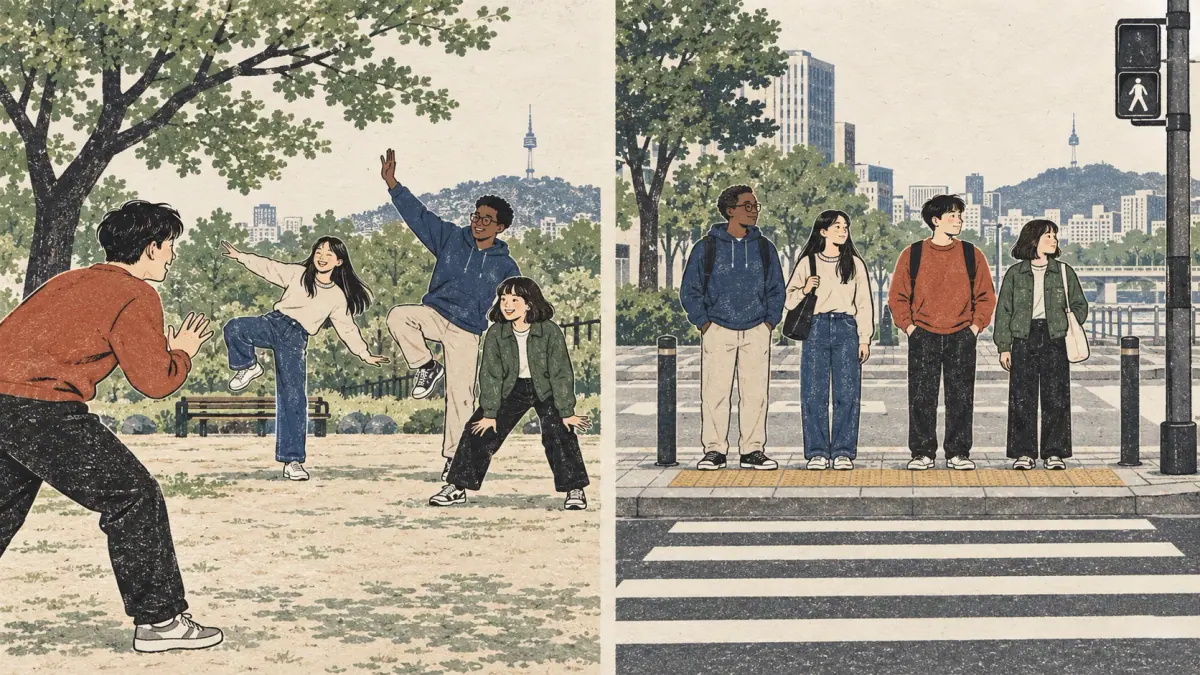
Use 무궁화 꽃이 피었습니다 only when you are playing the game, talking about the game or joking about Squid Game. It is a fixed chant, not a way to address a person in daily life.
Situations Where It Fits
- Playing the game. The caller chants 무궁화 꽃이 피었습니다 while the others move.
- Talking about the show. 무궁화 꽃이 피었습니다 is the line fans quote from the first game of Squid Game.
- A tag game with younger children. 얼음 땡 works as the call.
- A joke on a crowded street. Friends sometimes stop mid-step and chant it for fun.
Situations to Avoid
- A real traffic light. Say 빨간불이에요 (it is a red light), not the chant.
- Describing a bloomed flower. The chant is a set line; use 꽃이 피었어요 (the flower has bloomed) instead.
- A solemn setting. The line is playful, and the formal ending does not make it respectful speech.
- An older stranger. Chanting at someone you do not know can confuse or annoy them.
The short scenes below show the chant, the show and the traffic light in conversation.
How Do You Play Red Light Green Light in Korean?
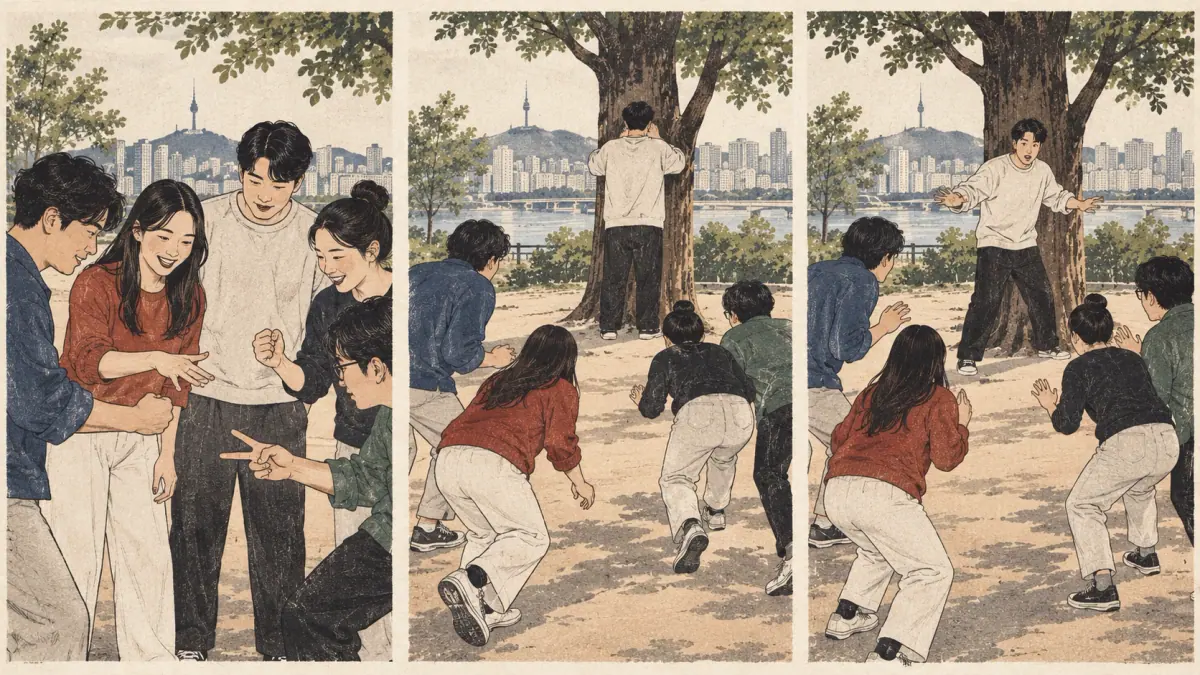
The common Korean version has five steps, and each step has a Korean word you can use. Rules vary between families, schools and regions, so treat the steps below as the usual version.
- Choose the caller. Players pick the 술래 (sullae, the "it" player), often by 가위바위보 (gawibawibo, rock-paper-scissors).
- Line up. The caller stands facing a wall or a tree, and the others wait at a start line.
- Chant and creep. The caller chants 무궁화 꽃이 피었습니다 while the others move forward.
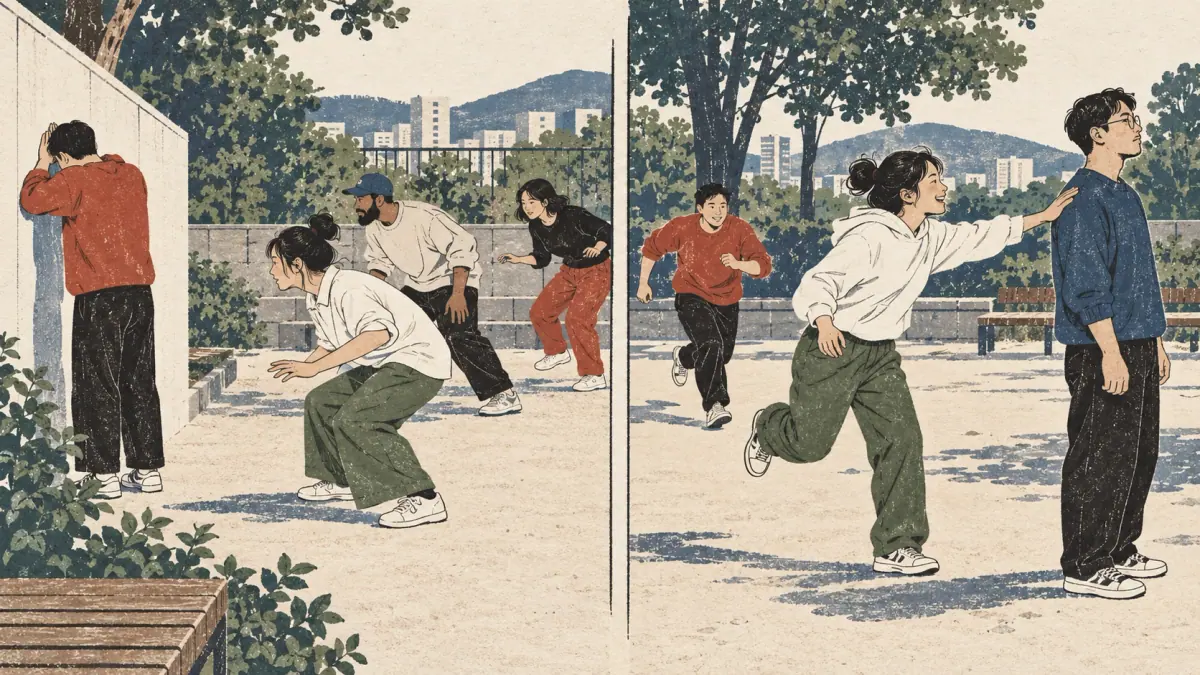
- Turn and check. On the last syllable the caller turns around, and anyone still moving is caught: 걸렸다 (geollyeotda, got caught).
- Reach and tag. The first player to touch the caller wins the round.
| Word | Romanization | Meaning | Audio |
|---|---|---|---|
| 술래 | sullae | the caller, "it" | |
| 가위바위보 | gawibawibo | rock-paper-scissors | |
| 걸렸다 | geollyeotda | got caught | |
| 멈춰 | meomchwo | stop, freeze |
The chant is the signal of the game, so the next question is how the English name differs from the Korean one.
Traffic Light Words in Korean
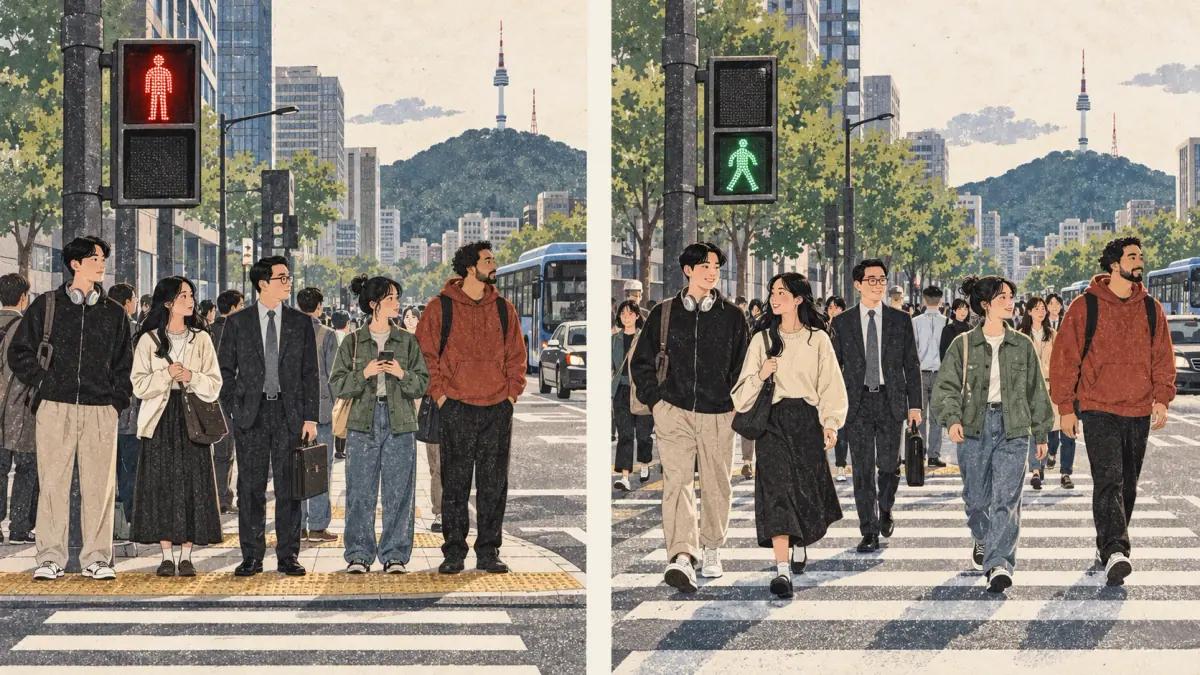
The English name red light, green light comes from road signals, but the Korean game is named after a flower. Real traffic lights are 신호등 (sinhodeung, traffic light). A red signal is 빨간불 (ppalganbul), and a green signal is usually 초록불 (chorokbul) or 파란불 (paranbul, "blue light"), because Korean uses 파랗다 for both blue and green shades in this word. Do not use these words as the name of the game.
| Signal | Korean | Romanization |
|---|---|---|
| Red | 빨간불 | ppalganbul |
| Green (common) | 파란불 | paranbul |
| Green (also used) | 초록불 | chorokbul |
| Traffic light | 신호등 | sinhodeung |
Next, the chant and the road words in real conversations.
What Does Red Light Green Light Sound Like in a Real Conversation?
The chant is part of a short play exchange, and the traffic-light words come up in a very different one. Notice that the two vocabularies never mix.
On the Playground
Child A
이번엔 누가 술래야?
ibeonen nuga sullaeya?
Who is it this time?
Child B
내가 할게. 무궁화 꽃이 피었습니다!
naega halge. mugunghwa kkochi pieotseumnida!
I'll do it. The hibiscus flower has bloomed!
Child A
아, 걸렸다!
a, geollyeotda!
Oh, I got caught!
What to notice: the children speak casually, and only the chant itself uses the formal ending.
Talking about the Show
Ara
이 장면 알아?
i jangmyeon ara?
Do you know this scene?
Ben
응, 무궁화 꽃이 피었습니다 나오는 장면이잖아.
eung, mugunghwa kkochi pieotseumnida naoneun jangmyeonijana
Yes, it's the scene with the hibiscus line, isn't it?
What to notice: casual speech with a quoted chant inside it. For the show's own title see squid game in Korean.
At a Crossing
Traveller
건너도 돼요?
geonneodo dwaeyo?
May I cross?
Local
아직 빨간불이에요. 파란불이 되면 건너요.
ajik ppalganburieyo. paranburi doemyeon geonneoyo
It's still red. Cross when it turns green.
What to notice: the real traffic-light words are 빨간불 and 파란불. Cultural background for the game comes next.
What Should You Know about the Culture behind Red Light Green Light?
The Korean game is older than its English name suggests, and its call is a small piece of national symbolism.
- A flower of eternity. 무궁화 is written 無窮花 in Hanja, "endless flower", and it is treated as Korea's national flower by custom rather than by law.
- One syllable per beat. The caller chants all ten syllables evenly and may speed up to turn around quickly, which makes the last syllables the tensest part of the game.
- Squid Game. The 2021 Netflix series opens its deadly games with this call from a giant doll, which made the line famous worldwide.
- A game for everyone. Korean children learn it at school, in the playground and at family gatherings, with local rule variations.
An expert insight: learners often try to translate "red light, green light" word by word. The better approach is to learn the chant as one rhythmic unit and to treat 빨간불 and 파란불 as separate road vocabulary. The common mistakes below follow from mixing these up.
What Mistakes Do Learners Make with Red Light Green Light in Korean?
Most mistakes come from translating the English name instead of learning the Korean chant.
| Mistake | Why it is a problem | Fix |
|---|---|---|
| Calling the game 빨간불 초록불 | That is a literal translation, not the game's name | Say 무궁화 꽃이 피었습니다 |
| Saying 피었어요 in the chant | The traditional call uses the formal -습니다 | Use 피었습니다 |
| Reading 꽃이 as [꼬시] or [꽃이] | ㅊ links to 이 and is said [꼬치] | Say [꼬치] |
| Pronouncing 습 with a b: "seup-ni-da" | ㅂ becomes ㅁ before ㄴ | Say [씀니다] |
| Using the chant in daily conversation | It is a game line, not a general phrase | Use it for the game or the show only |
Learners often assume that the Korean game has a "red light" and a "green light" word. Actually, the chant is the signal: moving is allowed while the caller chants and forbidden when the caller turns. The word 피었습니다 is past tense, "has bloomed", not a command.
Is It the Same as Squid Game?
The short answers below cover the other ways people search for this phrase.
- Squid game in Korean: the show title is 오징어 게임 (ojingeo geim); the full answer is on the page for squid game in Korean.
- Red light green light Korean: the game call is 무궁화 꽃이 피었습니다.
- Mugunghwa in Korean: 무궁화 (mugunghwa) is the hibiscus, rose of Sharon, and the first word of the call.
- Related tag call: 얼음 땡 is a different game, played by freezing and touching.
The next section turns these facts into a short practice routine.
Practice: Say It Aloud
Play the slow clip of 무궁화 꽃이 피었습니다 and chant it three times at a steady beat, one syllable at a time. Then answer the questions. Answers follow.
- How many syllables does the chant have?
- How do you pronounce 꽃이?
- You are caught while moving. What do you say?
- What do Koreans often call a green pedestrian signal?
Answers
- Ten: 무-궁-화-꽃-이-피-었-습-니-다.
- [꼬치].
- 걸렸다!
- 파란불 (or 초록불).
The phrase flashcards drill the chant and related game words with audio.
Related Phrases to Learn Next
The chant sits beside other phrases you hear in Korean dramas and shows.
- Fighting in Korean: the cheer 화이팅 used for support.
- Daebak in Korean: the slang for "awesome".
- OMG in Korean: how to react with shock.
- Squid game in Korean: the title 오징어 게임.
This guide belongs to the K-drama phrases collection. What this page does not cover: every regional version of the game, the show's plot and other drama lines. Learn the ten-syllable chant, keep 빨간불 and 파란불 for roads, and you can say red light green light in Korean the way children actually play it.
Frequently Asked Questions
What does 무궁화 꽃이 피었습니다 literally mean?
It means "the hibiscus flower has bloomed". 무궁화 is the hibiscus, known in English as the rose of Sharon and used as the national flower. 꽃이 is "the flower" as a subject, and 피었습니다 is the formal past of 피다, "to bloom". The sentence has no meaning in the game other than being the chant.
Is 무궁화 꽃이 피었습니다 formal or casual?
Grammatically it is formal, because it ends in -습니다 of the 합쇼체 style. In practice it is a fixed children's chant, so it sounds playful rather than respectful. The casual 얼음 땡 is a different game call. For real conversation with an older person, use 안녕하세요 or a polite sentence, not the chant.
Can I use 무궁화 꽃이 피었습니다 with friends, elders and strangers?
With friends, yes, mainly when playing or joking about the show. With elders or strangers, avoid it unless you are in a game together, because it is a chant and not a greeting. It can confuse people who do not expect it. Use the polite everyday forms from the speech-level guide.
What is the difference between 무궁화 꽃이 피었습니다 and 얼음 땡?
They are calls for different games. 무궁화 꽃이 피었습니다 is chanted by the caller while others move and freeze. 얼음 땡 belongs to a tag game: 얼음 means freeze and 땡 means a frozen player is freed. Both are children's game language, and neither is used as ordinary conversation.
How do you say red light and green light at a traffic signal in Korean?
Red is 빨간불 (ppalganbul), and green is 파란불 (paranbul) or 초록불 (chorokbul). The traffic light itself is 신호등 (sinhodeung). To say you must wait, use 아직 빨간불이에요 (it is still red). These words describe roads only; they are not the name of the children's game or the chant.