
선배
선배
What you'll learn
- Say 선배 and 선배님 aloud with the open ㅓ vowel.
- Choose between 선배, 선배님, 후배 and 동기 to describe anyone in your school or workplace.
- Explain why a younger person can be your 선배.
- Avoid sibling terms and bare names with seniors.
Before you start: you need to read Hangul; romanization is shown as an aid and can be hidden. Time: about 9 minutes. Audio plays only when you press a button.
What Does Sunbae Mean in Korean?
Sunbae means "senior" in Korean, in the sense of someone ahead of you in the same group. 선배 is a Sino-Korean word, built from Chinese characters (先輩, "earlier generation"), and it belongs to a set of three.
| Word | Romanization | Hanja | Meaning |
|---|---|---|---|
| 선배 | seonbae | 先輩 | Entered before you |
| 동기 | donggi | 同期 | Entered at the same time |
| 후배 | hubae | 後輩 | Entered after you |
These three words map every relationship in a school, club, team or company. The full word entry is in senior in Korean, and family words are in Korean family members. The next section shows each word in a sentence.
Which Forms of Sunbae Should You Know?
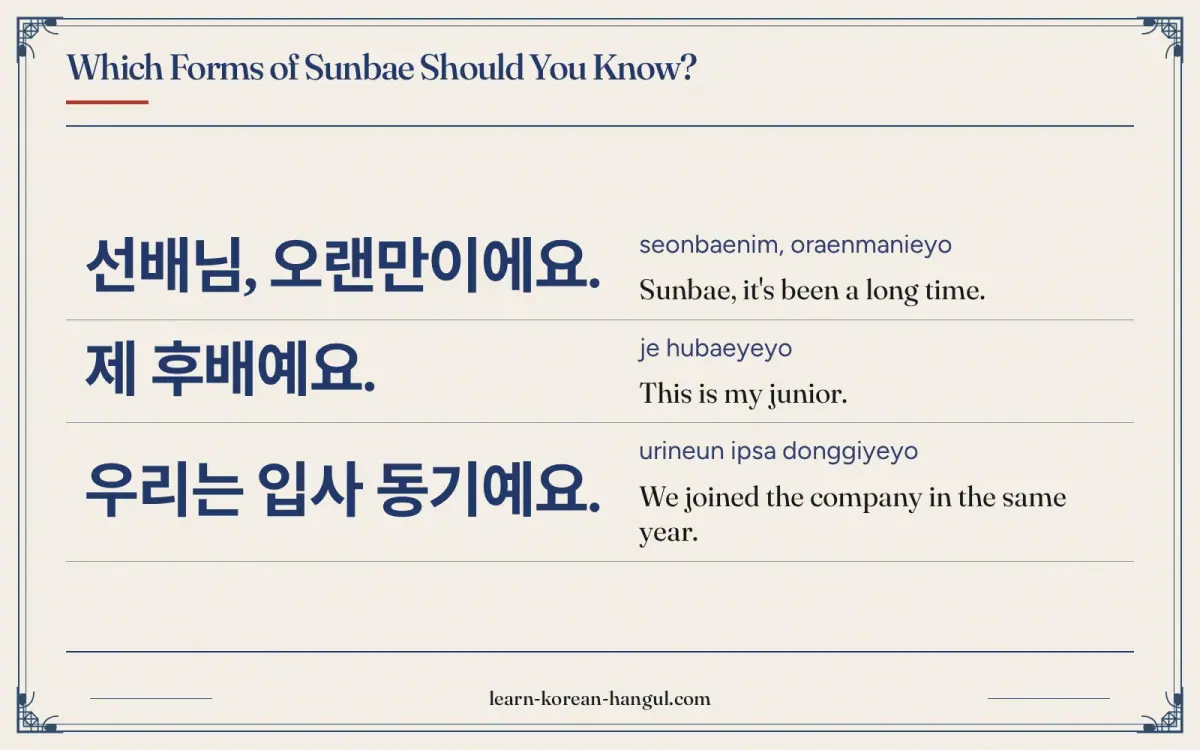
선배 is a noun, so it does not change with the listener. The honorific suffix -님 adds respect, and the sentence after it follows the Korean speech levels.
Everyday: 선배 (seonbae)
Polite · 해요체선배 is how students and club members address a senior they know. It is often used with polite -요 sentences, and it can follow a name: 민지 선배.
선배, 이거 좀 알려 주세요.
seonbae, igeo jom allyeo juseyo
Sunbae, could you show me this?
Polite: 선배님 (seonbaenim)
Formal · 합쇼체선배님 adds -님, the same suffix as in 선생님 (teacher). New members use it at first, and in sports teams, the army and the entertainment industry, juniors often keep it for years. Actors, for example, call senior actors 선배님 on set and in interviews.
선배님, 오랜만이에요.
seonbaenim, oraenmanieyo
Sunbae, it's been a long time.
Everyday: 후배 (hubae)
Polite · 해요체후배 is the junior. Seniors rarely call a junior 후배 to their face; they use the junior's name. The word is used to describe someone: "this is my junior".
제 후배예요.
je hubaeyeyo
This is my junior.
Everyday: 동기 (donggi)
Polite · 해요체동기 means someone who started at the same time: 입사 동기 (hired in the same year), 대학 동기 (started university together). 동기 usually speak casually with each other, whatever their ages.
우리는 입사 동기예요.
urineun ipsa donggiyeyo
We joined the company in the same year.
The words are set. Saying 선배 with the right vowel is the next step.
How Do You Pronounce 선배?
선배 is pronounced [선배], seonbae, in two syllables. The first vowel is ㅓ, an open "uh", and the second is ㅐ, like the e in "bed".
- 선 (seon): s, an open "uh", then n.
- 배 (bae): a soft b and "eh".
- 선배님 adds 님 (nim), with the lips closing for m.
Sound Changes to Listen For
선배 has no sound change, but the vowels trip up many learners:
- ㅓ, not "u". The fan spelling sunbae suggests "sun", but ㅓ is open and unrounded, closer to "sawn" without rounding.
- ㅐ and ㅔ. The standard pronunciation rules (Article 4) still list ㅐ and ㅔ as two vowels, but most Seoul speakers today pronounce them the same, so 배 sounds like "beh".
- Soft ㅂ after ㄴ. Between voiced sounds, ㅂ in 배 sounds close to an English b, not a p.
Revised Romanization, the official system for writing Korean in Latin letters, writes ㅓ as eo, giving seonbae. Fans often write sunbae and hoobae. Knowing whom to call 선배 matters more than the spelling, as the next section shows.
When Should You Call Someone Sunbae, and When Should You Not?
Call someone 선배 or 선배님 when they joined your school, club or field before you. In offices that use job titles, use the title instead, and never use 선배 for someone who joined after you.
Situations Where It Fits
- University and clubs. Older students and club members are 선배.
- Sports teams and the entertainment industry. 선배님 for anyone who debuted or joined earlier.
- Old schoolmates at work. Colleagues from the same university often keep calling each other 선배.
Situations to Avoid
- Offices that use job titles. Say 대리님, 과장님 or 팀장님.
- Someone who joined after you. Use their name; they are your 후배.
- A 동기. Use their name, even if they are older.
These choices are easier to feel in real exchanges, so here are three.
How Is Sunbae Used in Real Conversations?
선배 usually opens a sentence, and the junior keeps polite endings. Listen for who speaks casually and who does not.
A Club Junior Checks the Meeting Time
Junior
선배, 이번 주 모임 몇 시예요?
seonbae, ibeon ju moim myeot siyeyo?
Sunbae, what time is this week's meeting?
Senior
여섯 시야. 늦지 마.
yeoseot siya. neutji ma
Six. Don't be late.
What to notice: the junior uses -요, and the senior answers casually.
A New Actor Greets a Senior Actor
New Actor
선배님, 잘 부탁드립니다.
seonbaenim, jal butakdeurimnida
Sunbae, I look forward to working with you.
Senior Actor
그래요, 같이 열심히 해 봐요.
geuraeyo, gachi yeolsimhi hae bwayo
Sure, let's work hard together.
What to notice: 선배님 plus the formal -ㅂ니다 is the standard greeting on a first meeting.
A Senior Pays for Lunch
Senior
오늘은 내가 살게.
oneureun naega salge
Lunch is on me today.
Junior
감사합니다, 선배. 잘 먹겠습니다.
gamsahamnida, seonbae. jal meokgetseumnida
Thank you, sunbae. I'll enjoy the meal.
What to notice: paying for juniors is part of being a 선배, and the junior thanks with 잘 먹겠습니다. That habit belongs to a wider culture of seniority.
What Should You Know about the Culture behind Sunbae?
The 선후배 relationship, seniors and juniors, shapes school, club and work life in Korea. It brings respect from juniors and responsibility from seniors.
- Entry date beats age. A younger 선배 still outranks an older 후배 in the group, which can make speech choices delicate.
- Seniors pay. A 선배 often treats juniors to meals or coffee, and juniors may later do the same for their own 후배.
- Mentoring. 선배 pass on notes, advice and contacts.
- Dramas. School and office dramas often build romance on 선배 and 후배 roles.
An expert insight: learners often treat 선배 as an age word, like 형 or 언니. Actually, it is a position in a group, so it ignores age and gender. That makes it the neutral choice when a sibling term would sound too personal. The common mistakes below come from mixing the two systems.
What Mistakes Do Learners Make with Sunbae in Korean?
Most sunbae mistakes come from age, from closeness, or from the workplace.
| Mistake | Why it is a problem | Fix |
|---|---|---|
| Calling an office senior 형 or 언니 | Too personal | Say 선배님 or a job title |
| Calling a 선배 by first name only | Ignores seniority | Say 민지 선배 |
| Deciding 선배 by age | Entry date decides | Ask when they joined |
| Calling a 동기 "선배" | You started at the same time | Use their name |
| Saying "sun-bay" | ㅓ is open, ㅐ is short | Say [선배] |
Learners often assume the casual 선배 is rude. Actually, between students who know each other, 선배 with polite -요 sentences is normal; 선배님 is only needed when the setting is formal or the relationship is new.
Other Ways People Search for Sunbae in Korean
People search for sunbae in Korean in a few forms. The short answers below cover each one.
- Sunbae meaning: a senior in your school, club, company or field.
- Sunbaenim in Korean: 선배님, the respectful form.
- Hoobae in Korean: 후배 (hubae), the junior.
- Sunbae romanized: seonbae, following the Revised Romanization of Korean; romanization is an aid, not the real spelling.
- Younger sibling or junior friend: 동생, covered in dongsaeng in Korean.
Reading the rules is one thing; producing the right word on cue is another, so practise now.
Practice: Say It Aloud
Play the slow clip of 선배, repeat it three times, then try 선배님. Then choose a term for each situation. Answers follow.
- You meet a third-year student in your university club for the first time.
- You introduce a student who joined your club a year after you.
- You talk about a colleague who was hired the same year as you.
Answers
- 선배님, 안녕하세요.
- 제 후배예요.
- 입사 동기예요.
Drill 선배 and related terms with the phrase flashcards, which include audio.
Related Terms to Learn Next
선배 is one of the address terms Koreans use inside groups.
- Oppa in Korean: 오빠, a woman's word for an older man she is close to; learn it next.
- Unnie in Korean: 언니, a woman's word for an older woman.
- Dongsaeng in Korean: 동생, for younger siblings and younger friends.
This guide belongs to the Korean terms of address collection. What this page does not cover: full company title ladders and military ranks. Start with 선배님, follow the group's habit, and you will use sunbae in Korean with the right respect.
Frequently Asked Questions
What is the difference between 선배 and 선배님?
Both mean senior. 선배 is the everyday term between students and club members who know each other. 선배님 adds the honorific -님, so it sounds more respectful and formal. Newcomers usually start with 선배님, and juniors in sports teams, the entertainment industry and the army tend to keep using it even after years.
Can a younger person be your sunbae?
Yes. Seniority comes from when someone entered the school, club or company, not from age. A 26-year-old new employee may have a 24-year-old 선배 who joined two years earlier. In that case the junior still calls the younger person 선배, and both sides often keep polite speech with each other.
What is the opposite of sunbae?
The opposite of 선배 is 후배 (hubae), the junior, someone who entered after you. People who entered at the same time are 동기 (donggi), such as 입사 동기 (colleagues hired in the same year) or 대학 동기 (classmates who started university together). A 선배 introduces a junior as 제 후배예요.
Can I call a coworker sunbae?
Sometimes. In many offices, colleagues use job titles such as 대리님 or 과장님 instead. 선배 or 선배님 is common in newsrooms, schools, hospitals, sports teams and the entertainment industry, and between colleagues from the same university. Follow what your colleagues use, and when you are unsure, a job title is safer.
What is the most common mistake with sunbae in Korean?
The most common mistake is using sibling terms such as 형, 언니 or 오빠 for workplace seniors, which sounds too personal; 선배님 or a title is neutral. The second is calling a 선배 by first name alone. A third is assuming age decides seniority, when entry date does.