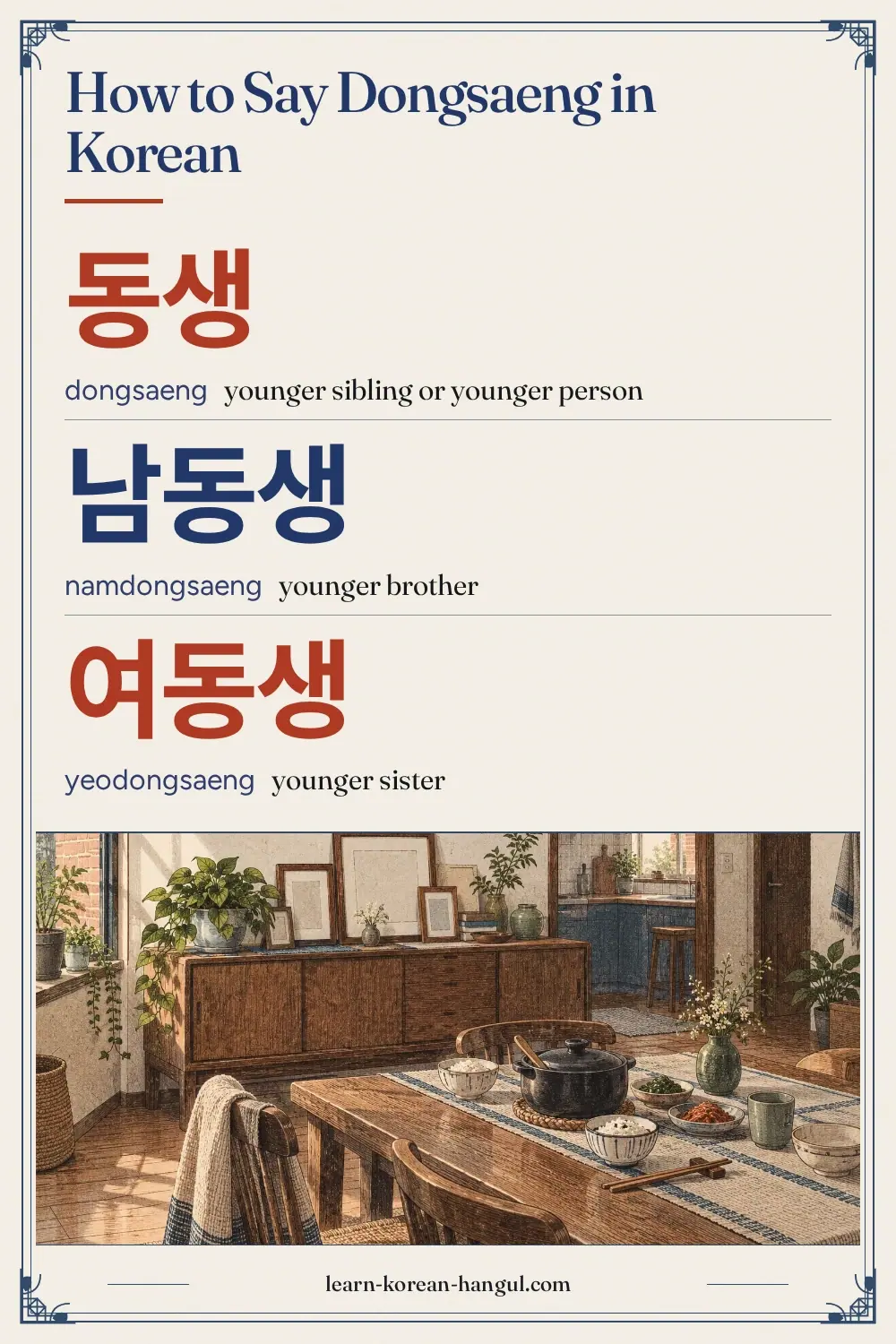
동생
동생
What you'll learn
- Say younger sibling, younger brother and younger sister with 동생, 남동생 and 여동생.
- Use 동생 for a younger friend, and know when it is too familiar.
- Talk about someone else's younger sibling politely with 동생분.
- Pronounce 동생 with a clear final ㅇ.
Before you start: you need to read Hangul. Knowing oppa in Korean helps, because oppa, unnie and noona are the words a younger person uses back. Time: about 13 minutes. Audio plays only when you press a button.
How Do You Say Dongsaeng in Korean?
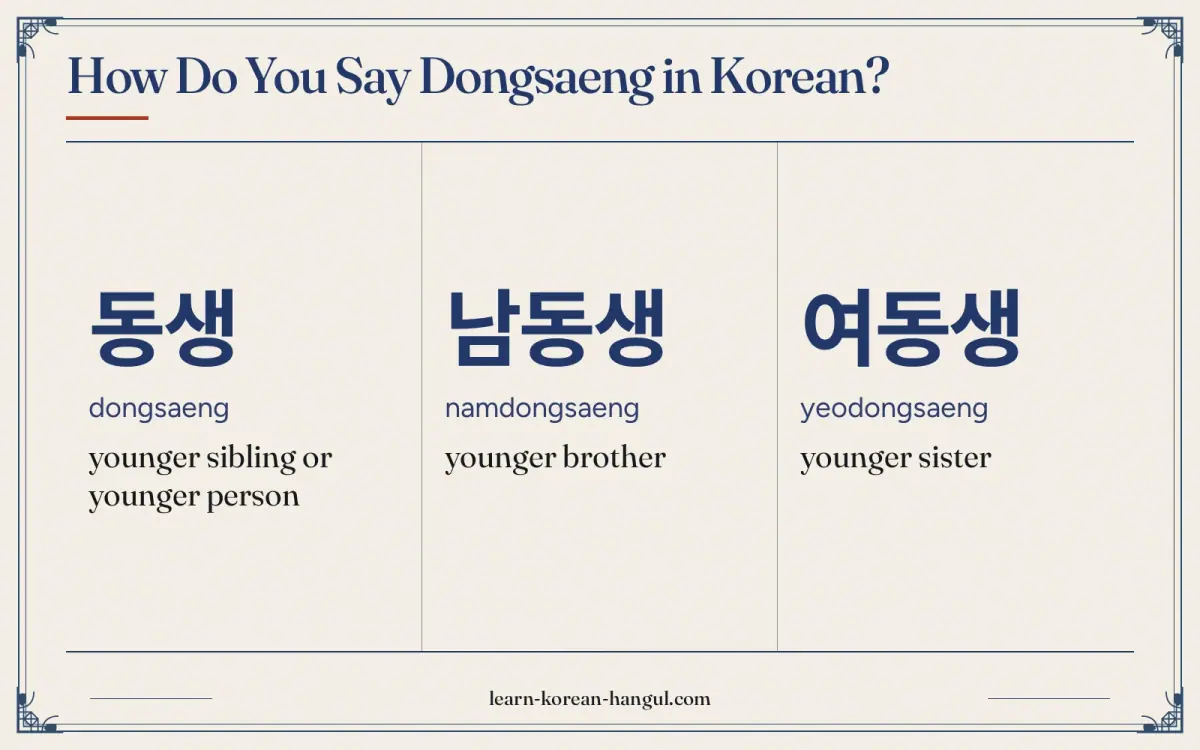
The everyday way to say dongsaeng in Korean is 동생, which means "younger sibling" in general. It does not show gender, so a speaker adds 남 (nam, "male") or 여 (yeo, "female") when the sex matters. The word comes from Sino-Korean roots, and it is built to rank people by age.
| Korean | Romanization | Meaning | When to use it |
|---|---|---|---|
| 동생 | dongsaeng | younger sibling or younger person | general word |
| 남동생 | namdongsaeng | younger brother | when you need to say "brother" |
| 여동생 | yeodongsaeng | younger sister | when you need to say "sister" |
| 친동생 | chindongsaeng | younger sibling by blood | to separate from a "younger friend" |
| 동생분 | dongsaengbun | someone else's younger sibling | polite and respectful |
| 막내 | mangnae | youngest child | the youngest in a family |
Building the words takes two steps:
- Start with 동생 (younger sibling).
- Put 남 or 여 in front: 남 + 동생 gives 남동생, and 여 + 동생 gives 여동생.
Korean also has older-sibling words that depend on the speaker's sex, which the guides on oppa in Korean and unnie in Korean explain. The next section sets out how 동생 changes with the listener.
What Are the Common Ways to Say Dongsaeng?
The word 동생 itself does not change with politeness, but how you use it does. The guide to Korean speech levels explains the endings. In short: add 제 ("my", humble) and a polite ending when you talk to someone you do not know, and use 내 ("my", plain) and casual endings with friends.
Everyday: 동생 (dongsaeng)
동생 is the general word. In a polite sentence it appears as 제 동생 (je dongsaeng, "my younger sibling"), where 제 is the humble form of "my". Use it when you do not need to say the sex.
제 동생은 고등학생이에요.
je dongsaengeun godeunghaksaengieyo
My younger sibling is a high school student.
Everyday: 남동생 (namdongsaeng)
남동생 says "younger brother" clearly. Add a number to say how many, as in 한 명 (han myeong, "one person").
남동생이 한 명 있어요.
namdongsaengi han myeong isseoyo
I have one younger brother.
Everyday: 여동생 (yeodongsaeng)
여동생 says "younger sister". The same patterns apply, with 여 in place of 남.
여동생이랑 같이 살아요.
yeodongsaengirang gachi sarayo
I live with my younger sister.
Address: 동생 for a Younger Friend
An older person can call a younger friend 동생, usually in a casual style. It shows closeness, like an older relative. The younger person answers with a word such as 형, 오빠, 누나 or 언니, depending on their own and the speaker's sex.
동생, 밥 먹었어?
dongsaeng, bap meogeosseo
Hey, have you eaten?
Polite Reference: 동생분 (dongsaengbun)
To ask about someone else's younger sibling, add the honorific 분 (bun, "person"), as in 동생분은 몇 살이세요? ("how old is your younger sibling?").
Pronunciation comes next, and it is straightforward.
How Do You Pronounce 동생?
동생 is pronounced [동생], dongsaeng in Revised Romanization, in two syllables: dong-saeng. Each syllable ends in the nasal sound ㅇ, said like the "ng" in English "sing".
- 동 (dong): a clear "do" followed by "ng", with the tongue back and no extra vowel.
- 생 (saeng): "sae" followed by "ng". The vowel ㅐ sounds like the "e" in "bed".
The standard pronunciation rules (Article 4) still list ㅐ and ㅔ as two vowels, but most Seoul speakers today pronounce them the same.
Sound Changes to Listen For
동생 has no strong sound change, as the National Institute of Korean Language Standard Pronunciation rules (표준 발음법) list no change for ㅇ followed by ㅅ. Two compound forms need only a small note:
- 남동생 is [남동생]. The ㅁ at the end of 남 stays clear and does not link, because the next syllable begins with ㄷ.
- 여동생 is [여동생]. The vowel 여 simply flows into 동.
The only thing to watch is the ending ㅇ: keep it closed, and do not add a vowel to say "dongsaengi". When a particle follows, nothing moves: 동생이 is [동생이], because a final ㅇ never shifts into the next syllable, and 여동생이랑 is [여동생이랑]. With the sounds in place, the next question is when to use the word.
When Should You Use 동생, and When Should You Not?
Use 동생 for a younger sibling or a younger person you are close to, and avoid it for peers, strangers and anyone older. The lists below show where it fits and where it does not.
Situations Where It Fits
- Talking about your own family. 제 동생 is the normal polite way to introduce a younger sibling.
- An older friend speaking to a younger friend. 동생 is warm, when the friendship is close.
- An older coworker or club member. Some people call a trusted junior 동생 outside work.
- Telling a story. 동생이 말했어요 ("my younger sibling said") sets the scene.
Situations to Avoid
- A same-age friend. Calling a same-age friend 동생 implies they are younger and may offend.
- A stranger. Using the word for someone you do not know sounds condescending.
- An older person. Younger people never use 동생 upward. Use 형, 오빠, 누나, 언니 or a title.
- A formal workplace. Use the person's name and title, such as 김 대리님.
The dialogues below show the word in everyday settings.
What Does Dongsaeng Sound Like in a Real Conversation?
A dongsaeng conversation is usually about family or about who is older. Listen for the sibling words in the first dialogue and the age check in the second.
Asking about Siblings
Minho
형제자매가 있어요?
hyeongjejamaega isseoyo
Do you have brothers or sisters?
Hana
네, 남동생이 한 명 있어요.
ne, namdongsaengi han myeong isseoyo
Yes, I have one younger brother.
Minho
몇 살이에요?
myeot sarieyo
How old is he?
Hana
스무 살이에요. 대학생이에요.
seumu sarieyo. daehaksaengieyo
He is twenty. He is a university student.
What to notice: 형제자매 (hyeongjejamae) means "brothers and sisters" in general, and 몇 살이에요? asks the age. The answer uses native Korean numbers, as in how to say age in Korean.
Finding out Who Is Older
Jiho
몇 년생이에요?
myeot nyeonsaengieyo
What year were you born?
Suyeon
2001년생이에요.
icheon-illyeonsaengieyo
I was born in 2001.
Jiho
그럼 제 동생이네요. 말 편하게 해도 돼요?
geureom je dongsaengineyo. mal pyeonhage haedo dwaeyo
Then you are younger than me. May I speak casually?
What to notice: 몇 년생이에요? asks the birth year and is the usual way to find out who is older. 말 편하게 해도 돼요? asks for permission to speak casually. The older person decides the switch to 반말.
An Older Friend Calling a Younger One
Seokjin
동생, 오늘 시간 있어?
dongsaeng, oneul sigan isseo
Hey, are you free today?
Younghoon
네, 형. 왜요?
ne, hyeong. waeyo
Yes, older brother. Why?
Seokjin
같이 저녁 먹자.
gachi jeonyeok meokja
Let us have dinner together.
What to notice: an older friend uses 동생 as an address, and the younger person replies with 형, which a younger man uses for an older man. A younger woman would say 오빠 or 언니 depending on the speaker. See sunbae in Korean for the school and work version.
What Should You Know about the Culture behind Dongsaeng?
In Korean culture, age ranks relationships, and 동생 is the word that marks the younger side. An older sibling or friend uses it with affection, and a younger person is expected to use respectful terms back.
- Age decides the words. Korean has four words for an older sibling, chosen by the speaker's sex and the sibling's (형, 누나, 오빠, 언니), but a single word, 동생, for a younger sibling. The system gives the older speaker the choice of how warm to be.
- Birth year matters more than birthday. People ask 몇 년생이에요? to decide who is 형, 오빠, 누나, 언니 or 동생. The guide to Korean terms of address collects these words.
- Closeness can turn a friend into a dongsaeng. An older friend calls a younger friend 동생 as a sign of trust. It does not need a blood tie.
- It goes only one way. The younger person must not call the older person 동생.
An expert insight: learners often reach for 동생 as the only word for any younger person, but Korean also uses the person's name and 씨 for a polite address. The mistakes below follow from over-using the family word.
What Mistakes Do Learners Make with Dongsaeng in Korean?
Most mistakes come from using a family word in a place where a name would be safer. The table collects the five most common ones.
| Mistake | Why it is a problem | Fix |
|---|---|---|
| Calling a same-age friend 동생 | It implies they are younger | Use the name, or 친구 |
| Calling a stranger 동생 | It sounds condescending | Use 저기요 or a title |
| Using 동생 for an older person | It reverses the age order | Use 형, 오빠, 누나, 언니 |
| Saying 내 동생 to a teacher | 내 is plain "my" | Say 제 동생 |
| Forgetting 남 or 여 when the sex matters | 동생 does not show it | Say 남동생 or 여동생 |
Learners often assume that 동생 means only a blood sibling. Actually the word also covers a younger friend or junior, which is why Korean has 친동생 to show that the person is a real sibling.
Is It the Same as the Dongsaeng Meaning, Younger Brother or Younger Sister?
Mostly, yes: 동생 is the general word, and 남동생 and 여동생 are the sex-specific forms. The list gives the answer to each related search folded into this page.
- Dongsaeng meaning in Korean: "younger sibling" or "younger person", with no sex marked.
- Younger sibling in Korean: 동생. The page on younger sibling in Korean covers the vocabulary entry.
- Younger brother in Korean: 남동생. See younger brother in Korean.
- Younger sister in Korean: 여동생. See younger sister in Korean.
Now practise the phrases aloud.
Practice: Say It Aloud
Play the slow clip of 동생 and repeat it three times, then say 남동생 and 여동생. Then choose the right word for each situation. Answers follow.
- Tell a teacher that you have one younger brother.
- Ask a new friend if they have a younger sibling.
- Call a younger friend you know well.
- Ask a coworker, politely, how old their younger sibling is.
Answers
- 남동생이 한 명 있어요.
- 동생 있어요?
- 동생, 잘 지냈어?
- 동생분은 몇 살이세요?
The phrase flashcards drill family words with audio.
Related Phrases to Learn Next
Dongsaeng is one half of a pair; the older-sibling words complete it.
- Oppa in Korean: the word a younger woman uses for an older brother or male friend.
- Unnie in Korean: the word a younger woman uses for an older sister.
- Sunbae in Korean: the word for a senior at school or work.
- Korean family members: the full set of family words.
This guide belongs to the Korean terms of address collection. What this page does not cover: the full set of older-sibling words and the rules for workplace titles, which belong to other lessons. Use 동생 for a younger sibling, 남동생 or 여동생 when the sex matters, and you can say dongsaeng in Korean with the right closeness.
Frequently Asked Questions
What is the difference between 동생 and 남동생?
동생 means "younger sibling" and does not show sex, so it covers a younger brother, a younger sister or even a younger friend. 남동생 specifies "younger brother" by adding 남 (male). Use 동생 when sex does not matter or is already clear, and use 남동생 or 여동생 when you want to be exact, such as in an introduction.
Can I use 동생 with friends, elders and strangers?
Use it with younger friends you know well, in a casual style. Do not use it with elders or older friends, because the word goes only downward in age. With strangers it sounds condescending, so use a name or 저기요. When you talk about your own younger sibling in polite speech, 제 동생 is always safe.
How do I talk about someone else's younger sibling politely?
Add the honorific 분 and say 동생분 (dongsaengbun), as in 동생분은 어디에 사세요? ("where does your younger sibling live?"). Use polite endings with -시-. Do not say 제 동생 for someone else's sibling, because 제 means "my". For a friend of the same age, 친구 동생 is also acceptable.
How do I ask if someone has a younger sibling?
Ask 동생 있어요? (dongsaeng isseoyo) for "do you have a younger sibling?", or 남동생이나 여동생 있어요? to ask about a brother or sister. For brothers and sisters in general, 형제자매가 있어요? is more complete. Keep the polite 요 style. A follow-up such as 몇 살이에요? continues the chat.
How do I say older brother and older sister in Korean?
The words depend on the speaker's sex. A man says 형 (hyeong) for an older brother and 누나 (nuna) for an older sister. A woman says 오빠 (oppa) for an older brother and 언니 (unnie) for an older sister. These are the words a 동생 uses back, and each has its own guide on this site.