포장해 주세요
포장해 주세요
What you'll learn
- Say 포장해 주세요, 포장이요 and 가져갈게요 and pick the one that fits the moment.
- Pronounce 포장해 주세요, including the tense [께] in 가져갈게요.
- Ask for leftovers to be packed and for a gift to be wrapped.
- Avoid confusing the verb 싸다 "to wrap" with the adjective 싸다 "to be cheap".
Before you start: if you have not ordered yet, see i'd like to order in Korean. Time: about 12 minutes. Audio plays only when you press a button.
How Do You Say to Go Please in Korean?
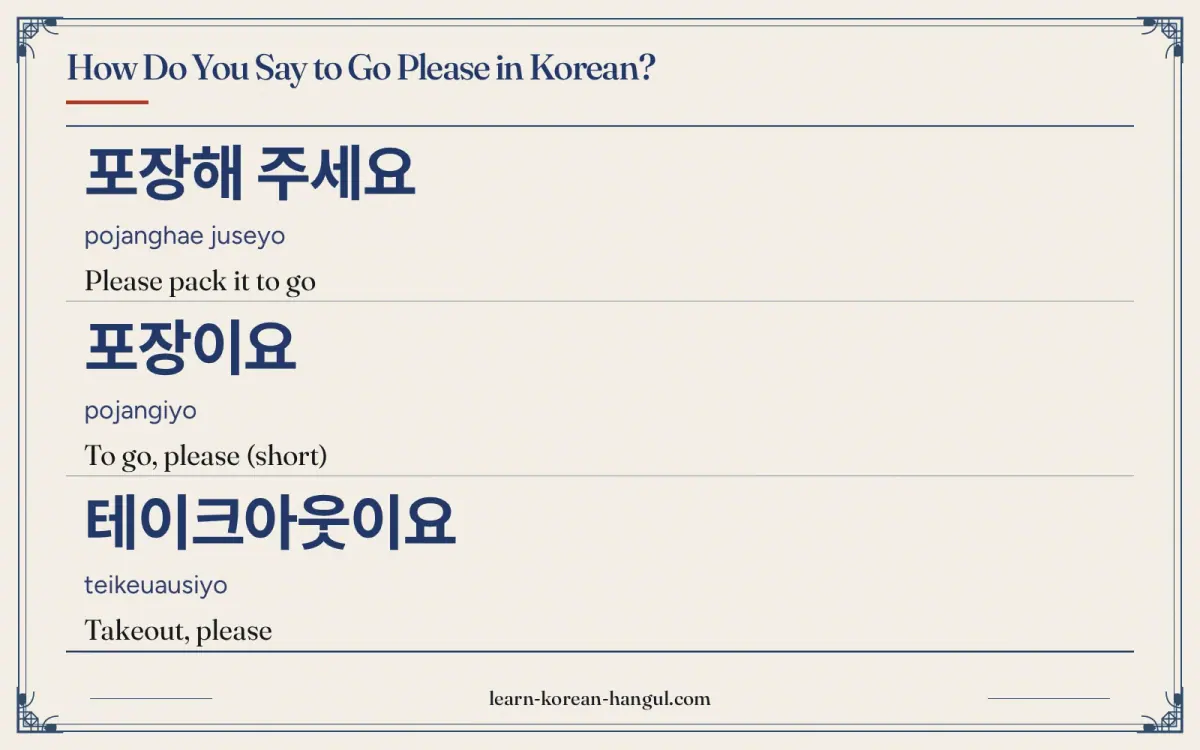
The standard way to say to go please in Korean is 포장해 주세요. The noun 포장 comes from Chinese characters meaning "pack" and "dress". Adding 하다 makes the verb 포장하다, "to pack" or "to wrap". The ending -아/어 주세요 turns a verb into a polite request. Together, the sentence asks the staff to put your food in a bag or box.
| Korean | Romanization | Meaning | Where you hear it |
|---|---|---|---|
| 포장해 주세요 | pojanghae juseyo | Please pack it to go | Any restaurant |
| 포장이요 | pojangiyo | To go, please (short) | At a counter, answering a question |
| 테이크아웃이요 | teikeuausiyo | Takeout, please | Cafes, chain shops |
| 가져갈게요 | gajyeogalgeyo | I will take it with me | When the food is ready |
| 싸 주세요 | ssa juseyo | Please wrap it up | Leftovers at a table |
| 포장 부탁드립니다 | pojang butakdeurimnida | Takeout, please (formal) | Hotels, formal places |
Revised Romanization (the South Korean government standard of 2000) is only a reading aid here. Learn the Hangul first. Next, the register ladder.
What Are the Polite and Casual Ways to Say to Go Please?
To go please in Korean has polite, short and casual choices. You can name the dish first, give a short answer, or announce that you will carry it away.
Polite: 포장해 주세요 (pojanghae juseyo)
Polite · 해요체포장해 주세요 is the safe default. Say the dish first, then the quantity, then 포장해 주세요. The word order is "dish, number, request".
김치찌개 하나 포장해 주세요.
gimchijjigae hana pojanghae juseyo
One kimchi stew to go, please.
Short Answer: 포장이요 (pojangiyo)
Polite · 해요체When the staff ask 여기서 드세요, 포장이세요? ("eating here, or to go?"), the natural answer is 포장이요. The ending 이요 is the short polite copula, so it means "it's to go". After a consonant like ㅇ in 포장, 이요 is read straight through: [포장이요].
아이스 아메리카노 한 잔, 포장이요.
aiseu amerikano han jan, pojangiyo
One iced americano, to go.
Promise: 가져갈게요 (gajyeogalgeyo)
Polite · 해요체가져갈게요 means "I will take it with me". The ending -(으)ㄹ게요 is a decision about your own action. In writing it is 가져, but it is pronounced [가저]. The full word sounds like [가저갈께요].
Leftovers: 싸 주세요 (ssa juseyo)
Polite · 해요체싸다 as a verb means "to wrap". 남은 거 싸 주세요 means "please wrap the rest". The adjective 싸다 ("to be cheap") has the same spelling and the same polite form 싸요, so the context decides. When you hold food and point at it, nobody will think you mean "cheap".
Formal: 포장 부탁드립니다 (pojang butakdeurimnida)
Formal · 합쇼체부탁드립니다 is the formal, humble way to ask. It suits hotels and formal dinners. In daily life, 포장해 주세요 is enough.
Casual: 포장해 줘 (pojanghae jwo)
Casual · 반말With a close friend or sibling, you might say 포장해 줘 or 싸 줘. Do not use these with staff. Now, the sound.
How Do You Pronounce 포장해 주세요?
포장해 주세요 is pronounced [포장해 주세요], in six syllables: po-jang-hae ju-se-yo. There is no big sound change, so the work is in the vowels and the nasal ㅇ.
- 포 (po): an aspirated p, which is a stronger puff of air than ㅂ, and a rounded o.
- 장 (jang): a plain j, the vowel ㅏ, and the "ng" of ㅇ.
- 해 (hae): a light h and ㅐ. After ㅇ, the h can nearly disappear.
- 주 (ju): a plain j and a rounded u.
- 세 (se): s plus ㅔ.
- 요 (yo): a short, light ending.
Sound Changes to Listen For
- Aspirated ㅍ in 포. Say 포 with a clear puff of air. A plain ㅂ would make it sound like "bo-jang".
- ㅈ stays plain. In 장 and 주, the ㅈ is not tense, so avoid "jjang".
- Tense [께] in 가져갈게요. After the -(으)ㄹ ending, the ㄱ of 게 is tense: [가저갈께요]. The Revised Romanization still writes gajyeogalgeyo because it does not show tensing caused by a neighbouring sound. See Korean tensification.
- Tense [뜨] in 부탁드립니다. The ㄱ batchim in 탁 tenses the ㄷ of 드: [부탁뜨림니다].
- Tense [꼬] in 먹고. In 여기서 먹고 가요 (yeogiseo meokgo gayo, "I'll eat here"), the ㄱ of 고 is tense after the final ㄱ of 먹: [먹꼬].
- Liaison. 남은 음식 sounds like [나믄 음식], because the ㅁ moves to the next syllable.
- No rising pitch in a request. A request ends calmly. A sharp rise would turn it into a question.
Listen for the clear puff on 포 and a calm ending. Next, when does each form fit?
When Should You Use 포장해 주세요, and When Should You Not?
Use 포장해 주세요 when you want food or drink to take away, or leftovers wrapped. Use the short 포장이요 when the staff have just asked. The choice depends on what the staff said before, not on the dish.
Situations Where It Fits
- Ordering to go. 불고기 포장해 주세요 works in almost any restaurant.
- Answering a question. 포장이세요? is a question from staff. Answer 포장이요.
- At the end of the meal. Point at the table and say 남은 거 싸 주세요.
Situations to Avoid
- 포장해 줘 with staff. Even a young cashier deserves the polite form.
- Asking at a self-service buffet. In buffets, staff may not allow packing, so check first.
- 포장해요 as a request. That form means "I pack" or "let's pack", not "please pack it".
Three short scenes show the forms in use.
What Does to Go Please Sound Like in a Real Restaurant?
Takeout requests are short. Listen for the ending of each sentence.
Asking at a Restaurant
Guest
이거 포장돼요?
igeo pojangdwaeyo
Can I get this to go?
Staff
네, 포장해 드릴게요.
ne, pojanghae deurilgeyo
Yes, I'll pack it for you.
What to notice: 포장돼요? is a yes-or-no question and ends with a gentle rise. The staff answer 드릴게요 [드릴께요] uses the humble 드리다 with the -ㄹ게요 promise.
Ordering at a Counter
Staff
여기서 드세요, 포장이세요?
yeogiseo deuseyo, pojangiseyo
Eating here, or to go?
Guest
포장이요.
pojangiyo
To go, please.
What to notice: The staff use the honorific 드세요 and 이세요. The guest answers with the short 포장이요, which is polite without a verb.
Taking Leftovers Home
Guest
남은 음식 포장해 주실 수 있어요?
nameun eumsik pojanghae jusil su isseoyo
Could you pack the leftover food?
Staff
네, 잠시만 기다려 주세요.
ne, jamsiman gidaryeo juseyo
Yes, please wait a moment.
What to notice: 주실 수 있어요 sounds like [주실쑤 이써요], with a tense [쑤]. The staff reply uses 잠시만 기다려 주세요. For more waiting phrases, see wait a moment in Korean.
What Should You Know about the Culture behind to Go Please?
These are general habits, not rules.
- Takeout is easy. Many restaurants and street food shops sell food to take away, and delivery (배달) is also widespread.
- Leftovers. Packing leftover main dishes is common at many casual restaurants. Shared side dishes (반찬) are often not packed, but you can ask.
- Pay first or after. In a counter shop you often order and pay first. In a sit-down place, the bill please in Korean comes at the end.
- More than one. To order another portion, see one more please in Korean.
An expert tip: 포장 has several meanings. It is "packing" for takeout and "wrapping" for a gift, and it is also part of 포장마차 (pojangmacha), the street food tent. The 포장 in 포장마차 is written with different Chinese characters and means a cloth cover, not takeout. A word that looks the same can have separate roots, so check the context. For how endings carry politeness, see Korean speech levels.
What Mistakes Do Learners Make with to Go Please in Korean?
Most errors come from the wrong verb or the wrong register.
| Mistake | Why it is a problem | Fix |
|---|---|---|
| Saying 포장해요 to ask | It means "I pack" or "let's pack" | Say 포장해 주세요 |
| Saying 포장 alone | It is a noun, so it can sound abrupt | Add 이요 or 해 주세요 |
| Using 싸 주세요 for "cheaper" | 싸다 "to wrap" is not "to be cheap" | Ask for a discount with 깎아 주세요 (kkakka juseyo) |
| Using 포장해 줘 with staff | The casual form sounds rude | Use 포장해 주세요 |
| Writing 가저갈게요 because it sounds that way | The spelling keeps ㅕ and only the sound is [가저] | Write 가져갈게요 |
Learners often translate "to go" word for word and reach for 가다. In Korean, the order is about the food, so you ask for packing with the noun 포장.
Is It the Same as Takeaway, Take out or Pack It?
Yes. Each English phrase is covered by the forms above, with a small difference in tone.
- Takeaway in Korean: 포장 is the general word, and 포장이요 is the short order. For the noun on its own, see takeout in korean.
- Take out in Korean: 테이크아웃이요 is the loanword, mostly used in cafes.
- To go in Korean: 포장해 주세요 or 포장이요.
- Pack it in Korean: 싸 주세요 for leftovers, and 포장해 주세요 for a fresh order.
Practice: Say It Aloud
Play the slow clip and repeat 포장해 주세요 three times. Then choose the best request for each scene. Answers follow.
- A cashier asks whether you are eating in, and you want to take it away.
- You want one tteokbokki to go.
- You have leftover food on the table.
- You want to say "I'll take it with me".
Answers
- 포장이요.
- 떡볶이 하나 포장해 주세요.
- 남은 거 싸 주세요.
- 가져갈게요.
The phrase flashcards drill these requests with audio.
Related Phrases to Learn Next
Once you can ask for takeout, these pages finish the order.
- i'd like to order in Korean: place the order before you ask for the bag.
- the bill please in Korean: pay after the meal.
- one more please in Korean: add another portion.
This guide belongs to the korean restaurant phrases collection. What this page does not cover: delivery apps, packaging complaints and food-safety questions. Learn 포장해 주세요 and 포장이요, and you can say to go please in Korean anywhere.
Frequently Asked Questions
How do you say to go please in Korean?
Say 포장해 주세요 (pojanghae juseyo) for "please pack it to go". When ordering, you can name the dish first: 김치찌개 하나 포장해 주세요. If the staff ask whether you are eating in, the short answer is 포장이요. In a cafe, 테이크아웃이요 also works.
How do you pronounce 포장해 주세요?
It has six syllables: po-jang-hae ju-se-yo. The ㅇ at the end of 장 is a nasal "ng". The ㅎ in 해 is light and can almost disappear after ㅇ. The ㅈ of 주세요 stays plain, with no tense sound. Revised Romanization writes pojanghae juseyo.
What is the difference between 포장 and 테이크아웃?
Both mean food to take away. 포장 is the Korean word and is used everywhere, including restaurants. 테이크아웃 is the English loanword, which is most common in cafes and chain shops. Staff understand both, so choose 포장 when you are unsure.
Is 포장해 주세요 formal or casual?
It is polite. The ending 주세요 is a respectful request that suits waiters and cashiers. The formal version is 포장 부탁드립니다. The short 포장이요 is also polite and is the most natural answer to a question. Casual forms such as 포장해 줘 only fit friends.
How do you ask to take leftovers home in Korean?
Say 남은 음식 포장해 주세요 (nameun eumsik pojanghae juseyo) or the more casual 남은 거 싸 주세요. At many restaurants this is fine. Some places, such as buffets, may say no, and shared side dishes are often not packed. Asking politely is always acceptable.