하나 더 주세요
하나 더 주세요
What you'll learn
- Say 하나 더 주세요 aloud and ask a server for another portion or drink.
- Choose between 하나 더 주세요, 반찬 더 주세요, 한 번 더 주세요 and 추가해 주세요.
- Explain why items take native numbers such as 하나 and 두 개, not 일 and 이.
- Tell apart "one more portion" (하나 더) and "one more time" (한 번 더).
Before you start: knowing hello in Korean helps, because servers greet you first. Time: about 12 minutes. Audio plays only when you press a button.
How Do You Say One More Please in Korean?
The standard way to say one more please in Korean is 하나 더 주세요, made of 하나 (hana, one), 더 (deo, more) and 주세요 (juseyo, please give me). Say the item first if the server might not know what you mean, as in 김치찌개 하나 더 주세요. If you just need "more", the short version 더 주세요 (deo juseyo) works too.
| Form | Romanization | Register | Say it to |
|---|---|---|---|
| 하나 더 주세요 | hana deo juseyo | Polite (해요체) | Servers and café staff, for one more portion or drink |
| 반찬 더 주세요 | banchan deo juseyo | Polite (해요체) | Restaurant staff, for side-dish refills |
| 한 번 더 주세요 | han beon deo juseyo | Polite (해요체) | Anyone, for one more try or repeat |
| 추가해 주세요 | chugahae juseyo | Polite (해요체) | Staff, for added extras that may cost money |
All four phrases are polite and end in 주세요, so the choice depends on what you want more of. The next section takes each one in turn.
What Are the Polite Ways to Say One More Please?
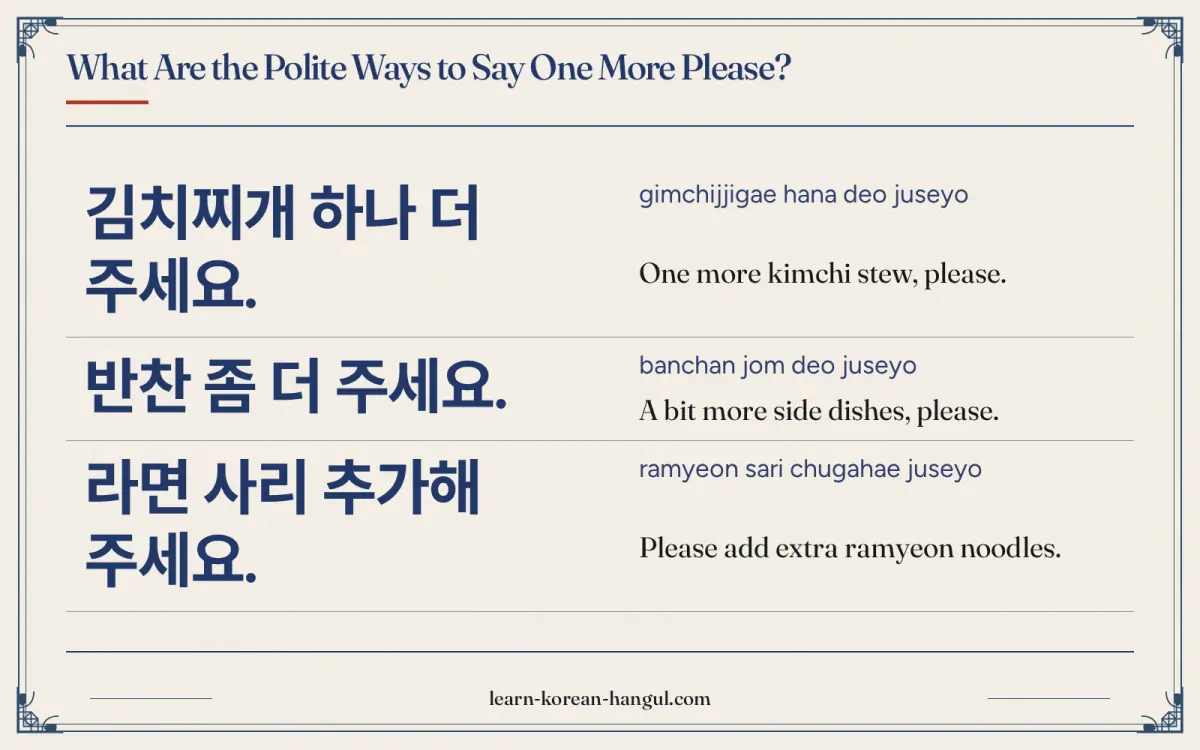
One more please follows the Korean speech levels, explained in the guide to Korean speech levels. In a restaurant you will almost always use the polite style, so the choices below are about the thing you are asking for, not about politeness.
Polite: 하나 더 주세요 (hana deo juseyo)
Polite · 해요체하나 더 주세요 asks for one more of the same dish or drink. 하나 is a native number that stands alone, so you can add the item before it. For two or three, change the count: 둘 더 (dul deo) or 두 개 더 (du gae deo), 세 개 더 (se gae deo).
김치찌개 하나 더 주세요.
gimchijjigae hana deo juseyo
One more kimchi stew, please.
Polite: 반찬 더 주세요 (banchan deo juseyo)
Polite · 해요체반찬 (banchan) means side dishes, the small plates of kimchi and vegetables that arrive with a Korean meal. Most casual restaurants refill them for free, so asking is not rude. Name the dish if you want a specific one: 김치 더 주세요 (more kimchi, please).
반찬 좀 더 주세요.
banchan jom deo juseyo
A bit more side dishes, please.
Polite: 한 번 더 주세요 (han beon deo juseyo)
Polite · 해요체한 번 더 means "one more time". The counter 번 (beon) counts occasions, not objects, so this phrase asks for a repeat of something, for example an explanation. It does not order more food, which is the most common confusion with 하나 더.
죄송해요, 한 번 더 말씀해 주세요.
joesonghaeyo, han beon deo malsseumhae juseyo
Sorry, please say that one more time.
Polite: 추가해 주세요 (chugahae juseyo)
Polite · 해요체추가 (chuga) means "addition", and 추가해 주세요 asks the server to add something extra. It is the usual phrase for extras that cost money, such as more noodles in a stew (사리 추가, sari chuga) or more meat. Expect the extra to appear on the bill.
라면 사리 추가해 주세요.
ramyeon sari chugahae juseyo
Please add extra ramyeon noodles.
Four phrases share one structure, so the sounds come next.
How Do You Pronounce 하나 더 주세요?
하나 더 주세요 is pronounced [하나 더 주세요], hana deo juseyo, in six even syllables. Speak it as three short words: 하나, 더, 주세요, with a small pause after 하나.
- 하 (ha): "hah" with a light h.
- 나 (na): "nah".
- 더 (deo): a soft d and the open vowel ㅓ, like "duh".
- 주 (ju): a soft j and "oo".
- 세 (se): "seh".
- 요 (yo): "yoh".
Sound Changes to Listen For
Four details from the National Institute of Korean Language Standard Pronunciation Rules (표준 발음법) and natural speech matter here.
- No tensing in 하나 더. After the vowel 나, the ㄷ of 더 stays soft, so 하나 더 is [하나 더]. Learners sometimes tense it by mistake.
- Spell 한 번 with a space. Written with a space, 한 번 counts one time; written together, 한번 means "once, sometime" or "give it a try". In speech it flows as one unit, [한번]. The standard rules do not turn the ㄴ into ㅁ, although [함번] is common in fast speech.
- No change in 반찬. 반찬 is [반찬]. The ㅊ is aspirated, so say a clear puff of air.
- ㅓ is open. In 더, the vowel ㅓ is an open "uh", not the rounded "oh" of ㅗ. Saying "doh" turns 더 into a different word.
With the sounds covered, the next question is when each form is safe to use.
When Should You Use 하나 더 주세요, and When Should You Not?
Say the item or the count plus 더 주세요 to ask staff for a refill. 하나 더 is for one more of a dish or drink, while 한 번 더 asks for one more repetition of something.
Situations Where It Fits
- A second drink. 콜라 한 잔 더 주세요. (One more glass of cola, please.)
- A refill of side dishes. 반찬 더 주세요.
- A grill restaurant. 삼겹살 이 인분 더 주세요.
- A fast-moving explanation. 한 번 더 말씀해 주세요.
Situations to Avoid
- Sino numbers for items. 일 더 주세요 is wrong, because items take 하나, 둘, 셋.
- 한 번 더 for food. It means "one more time", so the server may think you are asking for a repeat.
- Expecting free refills of main dishes. Only side dishes are normally refilled free; ask 추가해 주세요 and expect a charge for extras.
- Waving without a word. Call staff first with 여기요 (yeogiyo, excuse me) or the table call button, then make the request.
Before the scenes, one skill needs its own section: counting what you want.
How Do You Count the Thing You Want More Of?
Use native Korean numbers with a counter that matches the object. 하나 더 is short for "one more of this", and you can replace 하나 with a counted phrase when you need a bottle, a glass or a bowl.
| You want | Korean | Romanization | Counter page |
|---|---|---|---|
| One more glass | 한 잔 더 주세요 | han jan deo juseyo | 잔 counter |
| One more bottle | 한 병 더 주세요 | han byeong deo juseyo | 병 counter |
| One more bowl of rice | 밥 한 공기 더 주세요 | bap han gongi deo juseyo | 공기 (rice bowl); see the 그릇 counter |
| Two more servings of meat | 삼겹살 이 인분 더 주세요 | samgyeopsal i inbun deo juseyo | 인분 counter |
Servings are the one exception. The counter 인분 (inbun, serving) takes Sino-Korean numbers (일 인분, 이 인분), while most other counters take native numbers. The dialogues below put these counts into real orders.
What Does One More Please Sound Like in a Real Conversation?
A restaurant request is short: a call to the server, the request and a confirmation. Notice how the polite ending 주세요 appears in every request.
At a Barbecue Restaurant
Customer
여기요, 삼겹살 이 인분 더 주세요.
yeogiyo, samgyeopsal i inbun deo juseyo
Excuse me, two more servings of pork belly, please.
Server
네, 알겠습니다.
ne, algetseumnida
Yes, certainly.
What to notice: 인분 takes the Sino-Korean number 이, while the request ends in 더 주세요.
Asking for Side Dishes
Customer
반찬 더 주세요.
banchan deo juseyo
More side dishes, please.
Server
네, 뭐가 더 필요하세요?
ne, mwoga deo piryohaseyo?
Yes, what else do you need?
Customer
김치요.
gimchiyo
Kimchi.
What to notice: the customer names one dish after the server asks, and the order stays polite throughout.
Asking for a Repeat
Server
맵기를 골라 주세요.
maepgireul golla juseyo
Please choose your spice level.
Customer
죄송해요, 한 번 더 말씀해 주세요.
joesonghaeyo, han beon deo malsseumhae juseyo
Sorry, please say that one more time.
Server
네, 순한 맛이랑 매운맛이 있어요.
ne, sunhan masirang maeunmasi isseoyo
Yes, there is a mild flavour and a spicy flavour.
What to notice: 한 번 더 asks for a repeat, not food. The side-dish culture behind these requests is next.
What Should You Know about the Culture behind One More Please?
Korean restaurants run on a shared-table, many-small-dishes model, so asking for more is a normal part of a meal and not a sign of greed.
- Free side dishes. Banchan side dishes are normally free and refillable in Korean restaurants, so asking 반찬 더 주세요 is not rude. Some places, such as certain cafés or upscale restaurants, may charge, so watch the menu.
- Extras cost money. 추가해 주세요 is used for extras that cost money, such as added noodles or meat, and the bill usually shows 추가.
- Self-service corners. At some restaurants, side dishes, water or rice are self-service. A sign saying 셀프 (selpeu, self-service) means help yourself.
- Call staff directly. Calling 여기요 or pressing a table call button is normal, and servers expect it.
An expert insight: learners often ask for "one more" with the wrong number system. Korean uses native numbers for most objects, but 인분 breaks the pattern and uses Sino-Korean numbers. If a server answers with 몇 인분이요? (how many servings?), reply with 일 인분 or 이 인분. The common mistakes below show the other typical slips.
What Mistakes Do Learners Make with One More Please in Korean?
Most mistakes with one more please come from numbers and from confusing portions with repetitions.
| Mistake | Why it is a problem | Fix |
|---|---|---|
| Saying 일 더 주세요 or 이 더 주세요 | Items take native numbers | Say 하나 더 or 두 개 더 |
| Using 한 번 더 for another portion | 한 번 더 means one more time | Use 하나 더 |
| Dropping 더: 하나 주세요 | It orders one, and the server may bring a new order | Say 하나 더 주세요 |
| Expecting free refills of a main dish | Only side dishes are normally refilled free | Use 추가해 주세요 and expect a charge |
| Saying 더 with a rounded vowel: "doh" | ㅓ is an open "uh" | Say 더 like "duh" |
Learners often assume that 더 means "another". Actually, 더 means "more", and it works with a quantity: 하나 더 is "one more". Without a number, 더 주세요 simply asks for more of what you had, such as more rice.
Is It the Same as Another One?
The short answers below cover the other ways people search for this phrase.
- Another one in Korean: 하나 더 주세요, or the short 하나 더요 (hana deoyo).
- More please in Korean: 더 주세요 (deo juseyo), with the item first if needed.
- Refill in Korean: 리필 돼요? (ripil dwaeyo, can I get a refill?) at cafés and some chains, or 더 주세요.
- Extra in Korean: 추가 (chuga), as in 추가해 주세요 or 사리 추가.
- More restaurant lines: I'd like to order in Korean, water please in Korean and the bill please in Korean.
The next section turns these forms into a short practice routine.
Practice: Say It Aloud
Play the slow clip of 하나 더 주세요 and repeat it three times, then try 반찬 더 주세요 and 한 번 더 주세요. Then choose the phrase for each case. Answers follow.
- You finish your cola and want one more glass.
- The kimchi plate is empty.
- The server speaks too fast and you want a repeat.
- You want extra noodles in your stew.
Answers
- 콜라 한 잔 더 주세요.
- 반찬 더 주세요 or 김치 더 주세요.
- 죄송해요, 한 번 더 말씀해 주세요.
- 사리 추가해 주세요.
The phrase flashcards drill the four requests with audio.
Related Phrases to Learn Next
One more please sits beside the other lines you use at a table.
- I'd like to order in Korean: 주문할게요 for the first order.
- Water please in Korean: 물 주세요 for a drink of water.
- The bill please in Korean: 계산해 주세요 at the end.
This guide belongs to the Korean restaurant phrases collection. What this page does not cover: ordering a first dish, allergies and paying. Name the item or count, add 더 주세요, and you can say one more please in Korean at any table.
Frequently Asked Questions
What is the difference between 하나 더 주세요 and 반찬 더 주세요?
하나 더 주세요 asks for one more of a counted item, such as a dish, bottle or bowl. 반찬 더 주세요 asks for more side dishes, which are shared small plates with no count. Side dishes are usually free, while another main portion usually costs money. Use the dish name to be specific.
Can I use 하나 더 주세요 with friends, elders and strangers?
Yes with strangers and elders, because it is polite. With close friends you may use the casual 하나 더 줘, but a server should always get the polite form. Add 여기요 first to get attention. Avoid casual 줘 with staff, since it sounds rude to a service worker.
Is 하나 더 주세요 formal or casual?
하나 더 주세요 is polite, in the 해요체 style, so it is neither formal nor casual. It suits almost every restaurant and café. A more formal request is 하나 더 주시겠어요? (could you give me one more?). The casual version, 하나 더 줘, is only for friends and family.
Are side dishes free to refill in Korean restaurants?
In most casual restaurants, yes. Banchan are included in the meal and refilled on request. Some cafés, upscale places and tourist venues may charge or limit refills, and menus sometimes mark them. If unsure, ask 반찬 리필 돼요? (can I refill the side dishes?) before ordering more.
How do I say one more bottle or glass in Korean?
Use the counter that matches the container. 한 병 더 주세요 means "one more bottle, please", and 한 잔 더 주세요 means "one more glass, please". Use native numbers: 한, 두, 세, before 병 or 잔. Name the drink first if there is a choice, for example 소주 한 병 더 주세요.