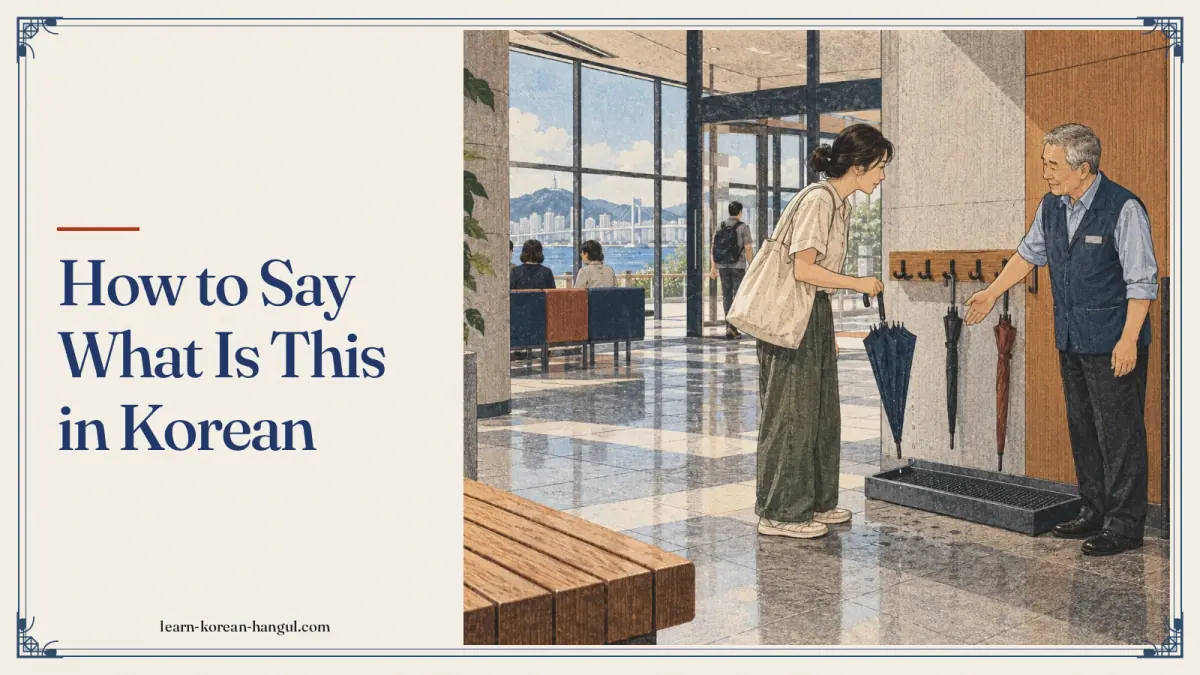
이게 뭐예요?
이게 뭐예요?
What you'll learn
- Say 이게 뭐예요? aloud with the stress on 뭐.
- Use 이, 그 and 저 to ask about things near you, near the listener and far away.
- Choose between 이게 뭐예요?, 이거 뭐예요? and 이거 뭐야? for a seller, a teacher and a friend.
- Spell 뭐예요 correctly, and ask 누구예요? about people.
Before you start: you need to read Hangul; romanization is shown as an aid and can be hidden. Time: about 10 minutes. Audio plays only when you press a button.
How Do You Say What Is This in Korean?
The standard way to ask "what is this?" is 이게 뭐예요? (ige mwoyeyo). It joins 이게 (this thing) with 뭐예요 (what is it). Four forms cover the question for things near you, things far away and different listeners.
| Form | Romanization | Meaning | Register | Say it to |
|---|---|---|---|---|
| 이게 뭐예요? | ige mwoyeyo | what is this? | Polite (해요체) | Sellers, teachers, strangers |
| 이거 뭐예요? | igeo mwoyeyo | what's this? | Polite (해요체), spoken | Staff, classmates |
| 이거 뭐야? | igeo mwoya | what is this? | Casual (반말) | Close friends, younger people |
| 저게 뭐예요? | jeoge mwoyeyo | what is that over there? | Polite (해요체) | Anyone, for far objects |
The table lists the forms. The next section shows each one in a sentence.
What Are the Polite and Casual Ways to Say What Is This?
Korean changes the ending of a sentence to match the listener's age, status and closeness. These endings are called speech levels, and the guide to Korean speech levels explains them in full. Here, the word 뭐예요 carries the polite ending, and the word 뭐야 carries the casual one.
Polite: 이게 뭐예요? (ige mwoyeyo)
Polite · 해요체이게 뭐예요? is the complete polite question. 이게 is the contraction of 이것이 (this thing + subject particle), and 뭐예요 is 뭐 (what) plus 예요 (it is). Point at the object, and the sentence is clear. It works with sellers, teachers, hosts and strangers.
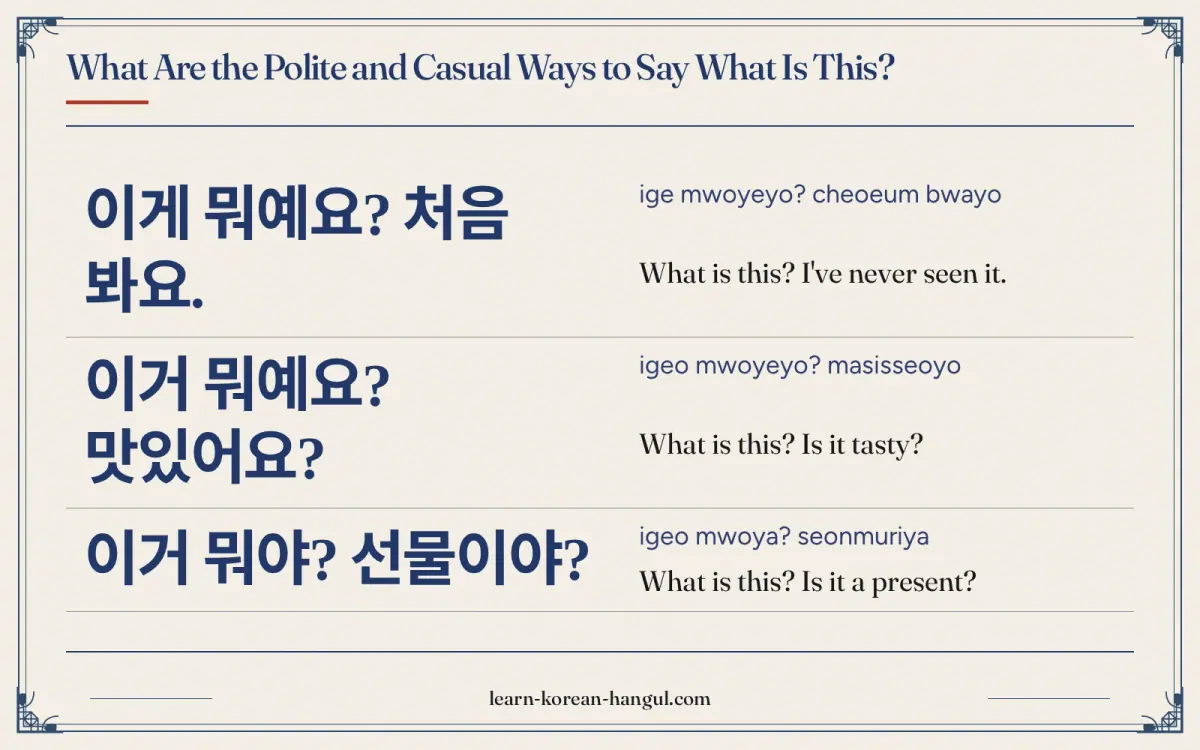
이게 뭐예요? 처음 봐요.
ige mwoyeyo? cheoeum bwayo
What is this? I've never seen it.
Polite: 이거 뭐예요? (igeo mwoyeyo)
Polite · 해요체이거 is the plain word for "this thing," with no particle. Koreans drop the particle all the time in speech, so 이거 뭐예요? is just as common as 이게 뭐예요?. The meaning is the same, and the tone is a little lighter.
이거 뭐예요? 맛있어요?
igeo mwoyeyo? masisseoyo
What is this? Is it tasty?
Casual: 이거 뭐야? (igeo mwoya)
Casual · 반말이거 뭐야? replaces 뭐예요 with 뭐야, the casual ending. It is 반말 (casual speech) for close friends, siblings and younger people. It sounds natural at a party, and it sounds rude at a shop counter.
이거 뭐야? 선물이야?
igeo mwoya? seonmuriya
What is this? Is it a present?
Polite: 저게 뭐예요? (jeoge mwoyeyo)
Polite · 해요체저게 is 저것이: "that thing over there," far from both speaker and listener. Korean has a three-way system for pointing: 이 (near me), 그 (near you, or already mentioned) and 저 (far from both). Use 그게 뭐예요? for something close to the listener.
저게 뭐예요? 저기 높은 건물이요.
jeoge mwoyeyo? jeogi nopeun geonmuriyo
What is that? That tall building over there.
Four forms and four sentences are enough to ask. How they sound comes next.
How Do You Pronounce 이게 뭐예요?
이게 뭐예요? is pronounced [이게 뭐예요], in five syllables across two words. The stress falls on 뭐.
- 이 (i): "ee."
- 게 (ge): "geh," with a light g.
- 뭐 (mwo): a quick w glide, then "o" as in "law."
- 예 (ye): "yeh."
- 요 (yo): "yoh." As in most question-word questions, let the end fall, or rise and then fall. A sharp final rise is for yes/no questions.
Sound Changes to Listen For
This phrase has no required sound change, but three details trip up learners.
- 예요 may sound like 에요. The standard pronunciation is [뭐예요], and [뭐에요] is a common everyday variant. The written form is still 뭐예요, and 뭐에요 is a common spelling error.
- The ㄱ in 게. Between two vowels, ㄱ is voiced, like a light English "g," so 이게 sounds like "ee-geh" with a gentle g.
- Liaison in answers. The reply 선물이야 is pronounced [선무리야], because the ㄹ of 물 moves onto the vowel 이. The page on liaison (resyllabification) explains the rule.
With the sounds set, the next question is who you can ask.
When Should You Use 이게 뭐예요?, and When Should You Not?
Use 이게 뭐예요? with almost everyone and point at the object. Use 이거 뭐야? only with friends.
Situations Where It Fits
- A market stall. 이게 뭐예요? asks for the name of an unfamiliar fruit or snack.
- A restaurant table. Side dishes (반찬) arrive without being ordered, and 이게 뭐예요? asks what each one is.
- A classroom. A teacher holds up a card and asks 이게 뭐예요? to check vocabulary.
- A gift or a parcel. 이거 뭐야? with a friend is playful.
Situations to Avoid
- 이거 뭐야? with a seller or teacher. The casual ending is too familiar.
- Asking about a person. For people use 누구예요? (nuguyeyo), meaning "who is it?"
- Asking what a word means. For meaning, ask 이게 무슨 뜻이에요?, covered on the page about what does it mean in Korean.
These rules are easier to feel in real exchanges, so here are four.
What Does What Is This Sound Like in a Real Conversation?
A "what is this" exchange is short. The asker points, and the answerer names the thing, often with 이에요 or 예요.
At a Market
Customer
이게 뭐예요?
ige mwoyeyo
What is this?
Seller
한라봉이에요. 제주도 귤이에요.
hallabongieyo. jejudo gyurieyo
It's hallabong. It's a citrus fruit from Jeju.
What to notice: the seller names the item and adds one fact. 이에요 follows 한라봉 because the word ends in a consonant.
At a Restaurant
Guest
이거 뭐예요? 매워요?
igeo mwoyeyo? maewoyo
What is this? Is it spicy?
Server
떡볶이예요. 조금 매워요.
tteokbokkiyeyo. jogeum maewoyo
It's tteokbokki. It's a little spicy.
What to notice: 예요 follows 떡볶이 because the word ends in a vowel, and 떡볶이예요 is pronounced [떡뽀끼예요].
Between Friends
Mina
이거 뭐야? 선물이야?
igeo mwoya? seonmuriya
What is this? Is it a present?
Jun
응, 열어 봐.
eung, yeoreo bwa
Yes, open it.
What to notice: both friends use casual forms, and 열어 봐 (open it and see) is a casual command.
In Class
Teacher
이거 한국어로 뭐예요?
igeo hangugeoro mwoyeyo
What is this in Korean?
Student
우산이에요.
usanieyo
It's an umbrella.
What to notice: 한국어로 (in Korean) is pronounced [한구거로], because the ㄱ links to the next vowel. The next section explains why pointing matters so much.
What Should You Know about the Culture behind What Is This?
Pointing and asking is normal in Korean markets, restaurants and classrooms. Sellers expect questions about unfamiliar items, and many offer a taste. The grammar of distance also guides the conversation: the three words 이, 그 and 저 tell the listener where to look.
- 이 is near the speaker. Hold up the item and say 이게 뭐예요?.
- 그 is near the listener, or already mentioned. Use 그게 뭐예요? for the thing in your friend's hand.
- 저 is far from both. Use 저게 뭐예요? for a building across the street.
- Asking is welcome. Sellers and servers usually enjoy explaining local food.
An expert tip: Korean keeps the three-way system when it talks about things in a story. 그 is also the word for "that thing we just mentioned," so 그게 뭐예요? can mean "what is that you were just talking about?" This page covers asking about visible objects. Asking for a word's meaning and for prices lives in the related phrases below.
What Mistakes Do Learners Make with What Is This in Korean?
Most mistakes with this phrase come from register, spelling and word choice.
| Mistake | Why it is a problem | Fix |
|---|---|---|
| Saying 이거 뭐야? to a seller | The casual ending sounds rude | Say 이게 뭐예요? |
| Writing 뭐에요 | The correct spelling is 예요 after a vowel | Write 뭐예요 |
| Asking 이게 뭐예요? about a person | 뭐 is for things | Ask 누구예요? |
| Using 이 when the object is far | 이 means near the speaker | Use 저 for far objects |
| Using 이게 뭐예요? for "what does it mean?" | It asks for the name, not the meaning | Ask 무슨 뜻이에요? |
Learners often think 이게 and 이것은 are interchangeable. They are not: 이게 is the spoken contraction of 이것이 and focuses on the thing as the subject, while 이것은 introduces it as a topic. 이것은 belongs to formal speech and writing; its spoken form is 이건.
How Do You Say What's This, What Is That or What Is It in Korean?
All three use 뭐예요; only the pointing word changes, from 이 to 그 or 저. The short answers below cover the other ways people search for this phrase.
- What's this in Korean: 이거 뭐예요? is the spoken short form.
- What is that in Korean: use 그게 뭐예요? for something near the listener, and 저게 뭐예요? for something far away.
- What is it in Korean: 그게 뭐예요? works when the listener holds the object or you mean something just mentioned.
- What is this called in Korean: 이거 한국어로 뭐예요?, as in the class dialogue above. The page on how do you say in Korean covers this pattern.
Knowing the forms is one thing; saying them on cue is another, so practise now.
Practice: Say It Aloud
Play the slow clip of 이게 뭐예요?, repeat it three times, then point at an object near you and ask it aloud. Then choose a form for each situation. Answers follow.
- A seller holds an unfamiliar fruit.
- A close friend hands you a small box.
- You see a tall tower across the river.
- Why is 뭐에요 a spelling mistake?
Answers
- 이게 뭐예요?
- 이거 뭐야?
- 저게 뭐예요?
- After the vowel in 뭐, the copula is written 예요, so 뭐예요 is correct.
The phrase flashcards drill all four lines with audio.
Related Phrases to Learn Next
Asking what something is sits with the rest of the classroom and shopping questions.
- Korean classroom phrases: the collection that lists every phrase in this cluster.
- What does it mean in Korean: the natural next question.
- How much is it in Korean: the phrase you will often use in the same conversation.
- This one please in Korean: the other side of the exchange, choosing the item.
What this page does not cover: asking about people, places and full word meanings. Pick 이게 뭐예요? when in doubt, and you can ask what is this in Korean to almost anyone.
Frequently Asked Questions
How do you say what is this in Korean?
Say 이게 뭐예요? (ige mwoyeyo) while pointing at the object. 이게 means "this thing" and 뭐예요 means "what is it." In relaxed speech people also say 이거 뭐예요?. For something far away, say 저게 뭐예요?. With a close friend, say 이거 뭐야?.
How do you pronounce 이게 뭐예요?
Say [이게 뭐예요]: "ee-geh mwo-yeh-yo." Stress the 뭐, which sounds like "mwo." The standard pronunciation is [뭐예요], and [뭐에요] is a common everyday variant. In writing, always use 뭐예요, because 뭐에요 is a common spelling error. Let the end fall, or rise and then fall.
What is the difference between 이게 뭐예요? and 이거 뭐예요?
Both mean "what is this?" 이게 is the contraction of 이것이 and marks "this thing" as the subject. 이거 is the spoken form of 이것 (this thing) with the particle dropped, as often happens in speech. The meaning is the same, and both are polite with 뭐예요. 이게 sounds slightly more complete.
Is 이게 뭐예요? formal or casual?
It is polite but not formal. 뭐예요 uses the 해요체 ending, the everyday polite style for shops, restaurants and classes. The casual form is 이거 뭐야?, and the formal form is 이것은 무엇입니까?. Use the polite one with teachers, sellers and strangers, since it is correct in almost every situation.
Can I use 이게 뭐예요? with friends, elders and strangers?
Yes with strangers, sellers, teachers and elders, where it is the standard choice. With close friends, 이거 뭐야? is natural. For an elder you can keep 이게 뭐예요? and add 저기요 or 선생님 first. Never use the casual 이거 뭐야? with a shopkeeper, because it sounds rude.
What is the most common mistake with what is this in Korean?
The most common mistake is the casual 이거 뭐야? with sellers or teachers. Use 뭐예요 instead. The second is spelling: the correct form is 뭐예요, not 뭐에요. A third is asking about people. For a person, ask 누구예요? (who is it?), because 뭐 is for things.