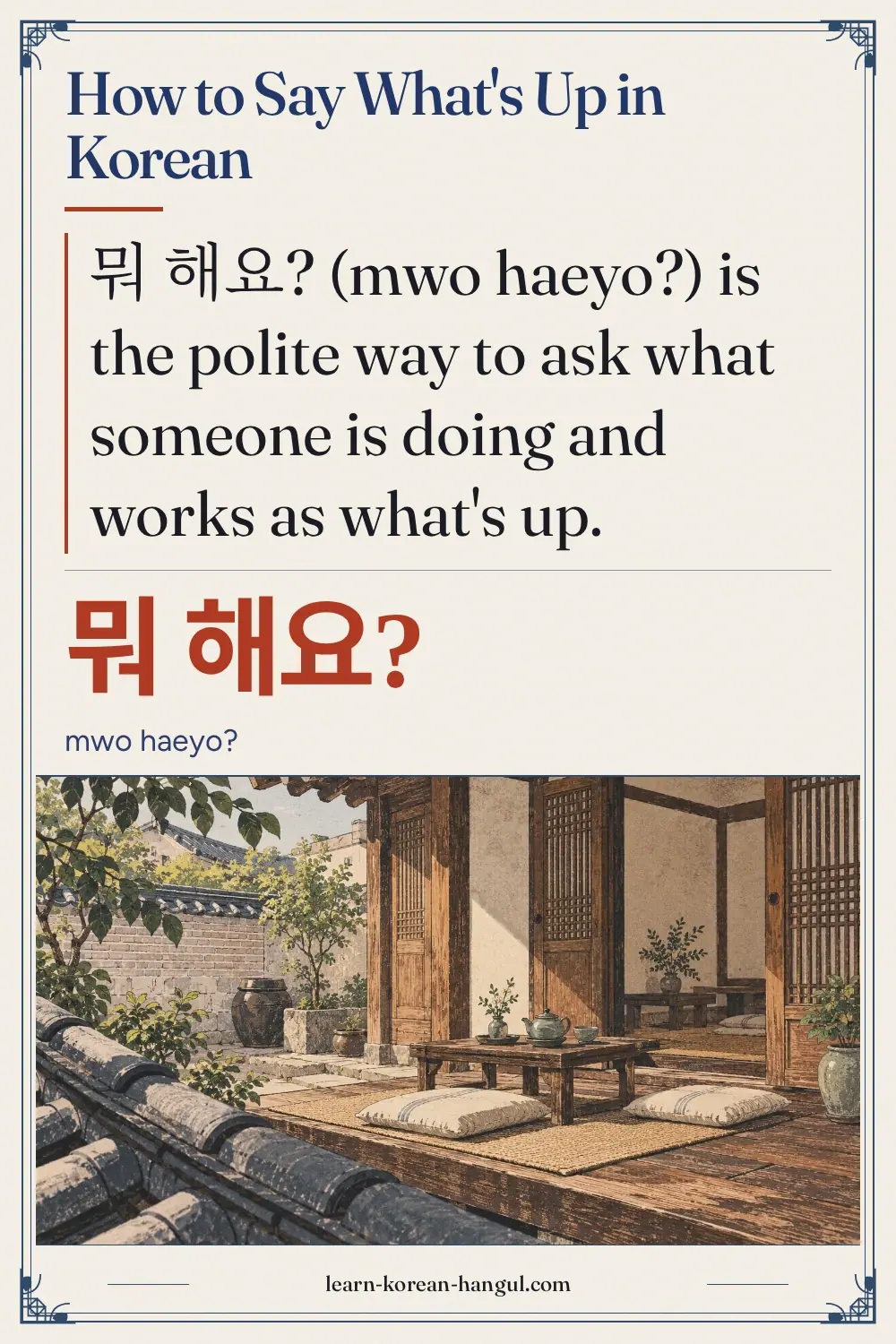
뭐 해요?
뭐 해요?
What you'll learn
- Say 뭐 해요? aloud, with the rounded start of 뭐, the prominence on 뭐 and a falling or rise-fall end.
- Choose between 뭐 해요?, 뭐 해?, 어떻게 지내요? and 잘 지내? for a colleague, a friend and someone you have not seen in a while.
- Answer 뭐 해? with what you are doing, not with fine.
- Use 무슨 일이에요? when you want to ask what is going on.
Before you start: you need to read Hangul; romanization is shown as an aid and can be hidden. Time: about 9 minutes. Audio plays only when you press a button.
How Do You Say What's up in Korean?
Korean has no single word for what's up, so Koreans ask about the present instead. The closest everyday match is 뭐 해요?, which asks what the other person is doing right now. Four forms cover most check-ins.
| Form | Romanization | Register | Say it to |
|---|---|---|---|
| 뭐 해요? | mwo haeyo | Polite (해요체) | Colleagues, acquaintances, friends you speak politely to |
| 뭐 해? | mwo hae | Casual (반말) | Close friends, siblings, partners, younger people |
| 어떻게 지내요? | eotteoke jinaeyo | Polite (해요체) | Someone you have not seen for a while |
| 잘 지내? | jal jinae | Casual (반말) | Close friends you have not seen for a while |
The table lists the choices. The next section shows each one in a sentence.
What Are the Formal, Polite and Casual Ways to Say What's Up?
Korean changes the sentence ending to match the listener's age, status and closeness. These endings are called speech levels, and the guide to Korean speech levels explains them in full. The question keeps its meaning while the ending changes.
Polite: 뭐 해요? (mwo haeyo)
Polite · 해요체뭐 해요? uses 뭐 (what) and 하다 (to do) in the polite style (해요체). It is the standard question between adults who know each other a little. For a boss or an elder, add the honorific and say 뭐 하세요? (mwo haseyo).
지금 뭐 해요? 시간 있어요?
jigeum mwo haeyo? sigan isseoyo
What are you doing now? Do you have time?
Casual: 뭐 해? (mwo hae)
Casual · 반말뭐 해? drops the polite -요. It is 반말 (casual speech) for close friends, siblings, partners and younger people. It is the form that fits "sup", "wassup" and "what's going on" among friends, usually asked in a text or call.
뭐 해? 같이 밥 먹을래?
mwo hae? gachi bap meogeullae
What's up? Want to eat together?
Polite: 어떻게 지내요? (eotteoke jinaeyo)
Polite · 해요체어떻게 지내요? asks how someone has been, not what they are doing right now. Koreans use it with people they have not met in weeks or months. A short answer is 잘 지내요 (I'm doing well).
오랜만이에요. 어떻게 지내요?
oraenmanieyo. eotteoke jinaeyo
Long time no see. How have you been?
Casual: 잘 지내? (jal jinae)
Casual · 반말잘 지내? is the casual check-in for friends you have not seen for a while. It literally asks "Are you living well?" Replies are usually 응, 잘 지내 or 그냥 그래 (so-so).
요즘 잘 지내? 보고 싶었어.
yojeum jal jinae? bogo sipeosseo
How have you been lately? I missed you.
Four questions cover almost every check-in. Saying the main one cleanly comes next.
How Do You Pronounce 뭐 해요?
뭐 해요? is pronounced [뭐 해요], mwo haeyo, in three syllables. The sound to watch is 뭐, which begins with a rounded "mw" and ends with the vowel "uh".
- 뭐 (mwo): round the lips for "m-w", then relax into "uh".
- 해 (hae): a light breathy h and the vowel "eh".
- 요 (yo): "yoh"; raise your voice slightly at the end, because it is a question.
Sound Changes to Listen For
Three points matter for these questions; the first is a rule of the National Institute of Korean Language Standard Pronunciation (표준 발음법).
- Aspiration in 어떻게. ㅎ and ㄱ merge into ㅋ, so 어떻게 is [어떠케]. See aspiration.
- Question pitch. 뭐 해요? and 어떻게 지내요? contain a question word, so the end usually falls or rises and then falls. A sharp final rise can make 뭐 해요? sound like "Are you doing something?". Yes/no questions are the ones that end with a rise.
- Romanization reflects the aspiration. Revised Romanization writes eotteoke with a k, so it already shows the ㅎ + ㄱ → ㅋ merger. It does not show intonation, so listen to the clips for the question pitch.
With the sound set, the next question is when to use each one.
When Should You Use 뭐 해요?, and When Should You Not?
Use 뭐 해요? with people you know at least a little, and 뭐 해? only with close friends. Use 어떻게 지내요? for longer gaps.
Situations Where It Fits
- A text to a friend. 뭐 해? opens the chat and often leads to an invitation.
- A phone call to a colleague. 지금 뭐 해요? is polite and natural before asking for a favour.
- Meeting an old classmate. 오랜만이에요. 어떻게 지내요? is the standard opener.
- A friend who has been silent. 잘 지내? shows you care.
Situations to Avoid
- An elder or a boss. 뭐 해? is too casual; use 뭐 하세요? or a different greeting.
- A first meeting. Asking a stranger 뭐 해요? can sound nosy; use hello in Korean instead.
- A job question. In some contexts, 요즘 뭐 해요? can be taken as a question about work or studies, but usually it means right now. Ask 무슨 일 하세요? when you mean someone's job.
These choices are easier to feel in real exchanges, so here are three.
What Does What's up Sound Like in a Real Conversation?
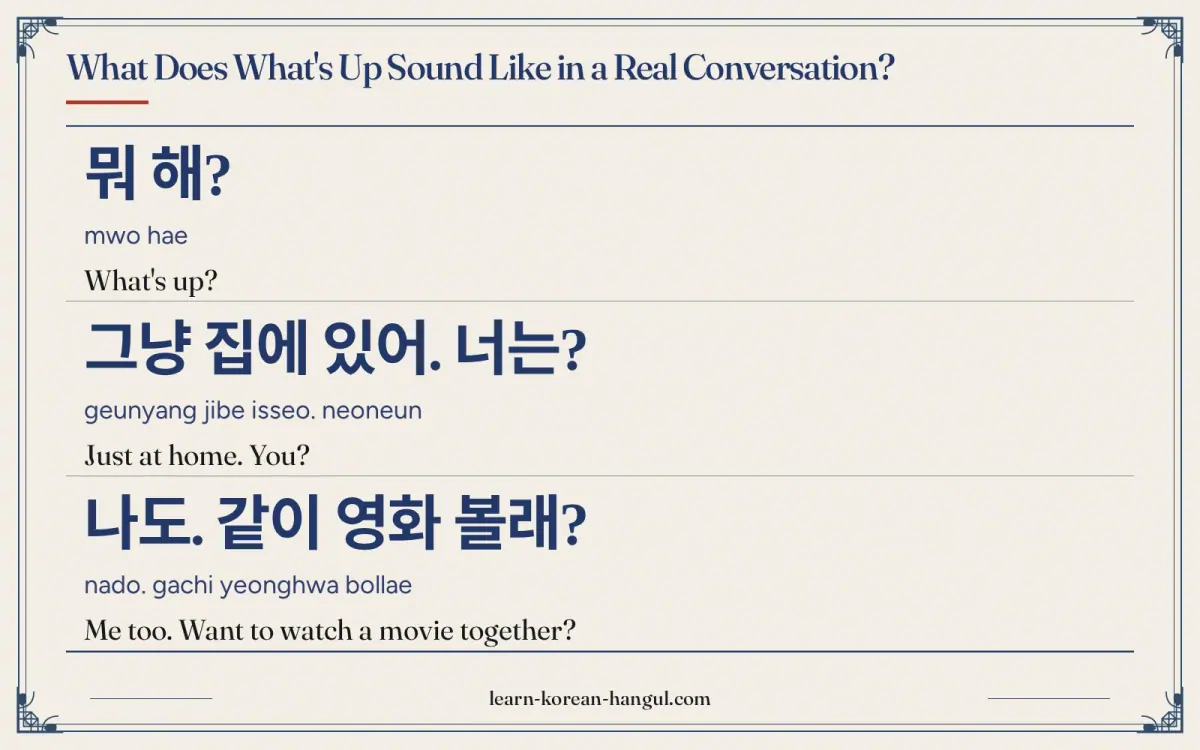
A Korean check-in is short and informal. The answer is usually a plain statement of what the speaker is doing.
Friends Texting
Min
뭐 해?
mwo hae
What's up?
Yuna
그냥 집에 있어. 너는?
geunyang jibe isseo. neoneun
Just at home. You?
Min
나도. 같이 영화 볼래?
nado. gachi yeonghwa bollae
Me too. Want to watch a movie together?
What to notice: Yuna answers with what she is doing, 그냥 집에 있어. The question often leads to a plan.
A Colleague Phones
Jun
지금 뭐 해요?
jigeum mwo haeyo
What are you doing now?
Sora
일하고 있어요. 왜요?
ilhago isseoyo. waeyo
I'm working. Why?
What to notice: the question is polite, and Sora answers with what she is doing and asks why.
Meeting an Old Acquaintance
Daeho
오랜만이에요. 어떻게 지내요?
oraenmanieyo. eotteoke jinaeyo
Long time no see. How have you been?
Sora
잘 지내요. 요즘 좀 바빠요.
jal jinaeyo. yojeum jom bappayo
I'm doing well. I'm a bit busy lately.
What to notice: Sora answers the how-have-you-been question with a short update, which leads to the culture around check-ins.
What Should You Know about the Culture behind What's Up?
Korean check-ins ask about the present rather than greeting with a fixed phrase, so the question depends on the relationship and the gap since you last spoke.
- Ask about the present. Instead of a fixed what's up, Koreans ask what you are doing now.
- Answer with the activity. 집에 있어요 (I'm at home) or 일하고 있어요 (I'm working) is the normal reply.
- Messages are short. In texts, 뭐 해? often starts a conversation or invites a plan.
- Asking what happened. 무슨 일이에요? means what is going on or what is the matter, and fits when someone looks upset.
An expert tip: 뭐 해요? depends on tone. With a rising, friendly voice it works as what's up, while with a flat, sharp voice it can sound like a demand, as in what are you doing there. This page covers casual check-ins. Formal greetings, business small talk and text abbreviations are not covered here.
What Mistakes Do Learners Make with What's up in Korean?
Most mistakes with this phrase come from the answer, the level or the honorific.
| Mistake | Why it is a problem | Fix |
|---|---|---|
| Answering 뭐 해? with 좋아 or fine | The question asks about activity, not mood | Say 집에 있어 or 일하고 있어 |
| Saying 뭐 해? to an elder | Casual ending | Use 뭐 하세요? |
| Saying 뭐 해요? to ask about someone's job | It usually means what are you doing now | Use 무슨 일 하세요? |
| Using 뭐 해요? as a first greeting to a stranger | Sounds nosy | Start with 안녕하세요 |
| Pronouncing 뭐 as [모] | The w glide is missing | Say mwo with rounded lips |
Learners often think they can answer 뭐 해? with a mood like 좋아. The question asks what you are doing right now, so the answer names an activity.
Is It the Same as Sup or What's Going On?
Partly. The short answers below cover the other ways people search for this phrase.
- Whats up in Korean: the same as what's up, so 뭐 해요? or 뭐 해?
- Sup in Korean: 뭐 해? among friends, and 잘 지내? when you have not met in a while.
- Wassup in Korean: 뭐 해? in a text; Korean has no spelling like wassup.
- What's going on in Korean: 무슨 일이에요? (museun irieyo), which asks what happened or what is the matter.
Reading the forms is one thing; producing them on cue is another, so practise now.
Practice: Say It Aloud
Play the slow clip of 뭐 해요?, repeat it three times, then try 뭐 해? and 어떻게 지내요?. Then choose a form for each situation. Answers follow.
- You text a close friend to check in.
- You phone a coworker of your own age.
- You meet an old classmate after two years.
- A friend asks 뭐 해?. How do you answer?
Answers
- 뭐 해?
- 지금 뭐 해요?
- 오랜만이에요. 어떻게 지내요?
- Name an activity, such as 집에 있어 or 일하고 있어.
The phrase flashcards drill all four forms with audio.
Related Phrases to Learn Next
What's up sits with the other check-in and greeting phrases.
- How are you in Korean: 잘 지내세요? and 어떻게 지내세요? for a polite check-in.
- Hello in Korean: 안녕하세요, the standard greeting.
- What are you doing in Korean: more ways to ask about activity.
This guide belongs to the Korean greetings collection. What this page does not cover: slang, texting abbreviations and business small talk. Pick 뭐 해요? when in doubt, and you can say what's up in Korean to almost anyone you know.
Frequently Asked Questions
What is the difference between 뭐 해요? and 뭐 해?
Both ask what you are doing. 뭐 해요? is polite and fits colleagues, acquaintances and friends you speak politely to. 뭐 해? is casual and fits close friends, siblings and younger people. Add the honorific for elders and say 뭐 하세요?.
Is 뭐 해요? formal or casual?
It is polite, in the 해요체 style. It is neither the stiff formal style nor casual speech, so it works with most adults you know a little. It is not a fixed greeting, so use it after hello when you want to know what the person is doing.
Can I use 뭐 해요? with friends, elders and strangers?
Yes with acquaintances and friends you speak politely to. With close friends, use 뭐 해?. With elders, use 뭐 하세요?. With a stranger, start with 안녕하세요 instead, because the question can sound nosy as a first line. Tone matters, so say it lightly and with a smile.
How do you pronounce 뭐 해요?
It is pronounced [뭐 해요], with three syllables. Start 뭐 with rounded lips, like mwo, then say hae and yo. Raise your voice a little at the end to show it is a question. Revised Romanization writes mwo haeyo. Practise the rounded start of 뭐 slowly before you speed up.
What is the most common mistake with what's up in Korean?
The most common mistake is answering 뭐 해? with fine or good. The question asks what you are doing, so say 집에 있어 or 일하고 있어. The second mistake is using the casual 뭐 해? with an elder. Answer with an activity, and the conversation continues naturally.